
How important is IT expertise for a Scrum Master?
Expand the table of contents
Why technical connectivity determines effectiveness
Very few job advertisements require them, and hardly any agile frameworks explicitly explain them: the technical expertise of a Scrum Master. At first glance, this is not surprising. The responsibilities of this role are supposedly elsewhere. As part of the Scrum team, the Scrum Master’s main tasks are to create the right conditions, promote collaboration and increase the effectiveness of agile work.
But how can this be achieved in the face of technical challenges if the technical foundation is lacking to classify causes or understand contexts? How effective can a role be that deliberately limits itself to methodological and social expertise when a large part of daily value creation in software-driven environments is technically oriented and it is precisely there that quality, stability and deliverability are determined?
Where technical expertise makes Scrum Masters effective
The possible applications of technical expertise are as diverse as IT itself. Its benefits are particularly evident in the sprint retrospective. This Scrum event serves to continuously improve teamwork and thus the working environment. Obstacles should be made visible, processes questioned and specifically adapted in order to increase effectiveness and efficiency.
If the Scrum Master has a basic technical understanding, the quality of these discussions changes noticeably. Retrospectives then do not have to be limited to procedural or interpersonal aspects, but can also include technical topics. These include issues of code quality, technical debt, build stability, test coverage, or recurring technical bottlenecks. In this way, not only are symptoms addressed, but systemic causes of problems are also made visible.
Another key area of application for technical expertise is at the interface between development, product management and management. The Scrum Master can classify technical risks, dependencies and limitations and translate them in an understandable way. This improves the quality of decision-making processes, especially when it comes to release planning, prioritisation, cross-system dependencies or weighing up short-term deliverability and long-term maintainability. Technical connectivity creates more realistic expectations, more robust planning and a common understanding of technical conditions.
In addition, a basic technical understanding contributes significantly to psychological safety in technical discussions. If the Scrum Master can classify terms, contexts and questions, the pressure on developers to justify themselves is reduced. The inhibition threshold for openly addressing technical problems is lowered. This creates space for learning, transparency and constructive problem solving. If this connectivity is lacking, there is a risk that the role of the Scrum Master will be reduced to formal moderation of events and that technically-related systemic problems in the team’s working context will remain unrecognised.
These examples illustrate that technical competence is not an optional extra, but a key factor in the effectiveness of the Scrum Master role. At the same time, it is clear that not every Scrum Master has a traditional IT background. What is crucial, therefore, is not comprehensive expert knowledge, but the question of how technical connectivity can be built up in a targeted and context-specific manner.
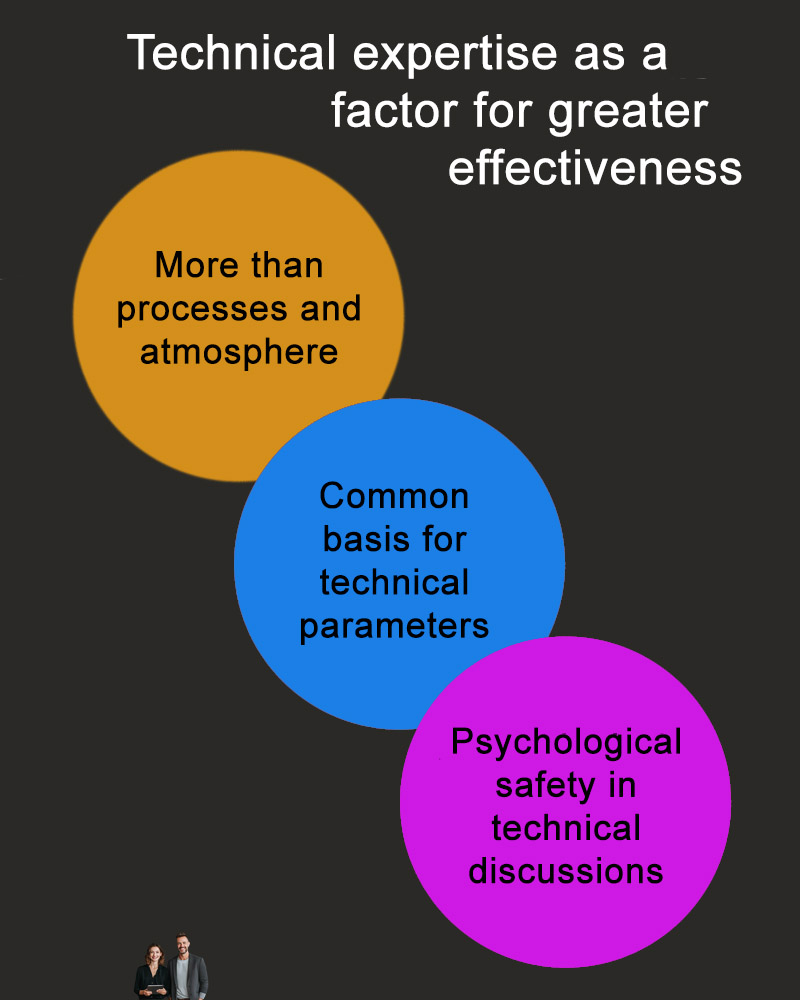
Figure: Technical expertise as a factor for greater effectiveness
Ways to build technical connectivity
In one of the world’s largest professions, there is no shortage of training opportunities. However, it is not so much the choice that matters as how well it fits the respective context. Technical competence building should be geared towards the specific circumstances of a Scrum team and the respective product development.
A team focused on app development requires different fundamentals than an environment with complex backend systems, specific database architectures or highly specialised operational requirements. Structured, interactive learning paths are ideal for gaining a general understanding of areas such as IT management, operating systems, hardware, software and networks.
Platforms such as Coursera [1] provide relevant content, often developed in collaboration with major international technology companies. A combination of videos, practical exercises, scripts and knowledge tests allows basic technical knowledge to be built up at your own pace, even in a mobile format.
Another option is to complete manufacturer-neutral certifications from the international industry association CompTIA. [2] These certificates are particularly useful as an introduction to technical topics and are explicitly aimed at people without in-depth IT backgrounds. These include:
- CompTIA Tech+ as an entry-level certification for basic IT concepts in the areas of software, networks, security and digital working methods
- CompTIA A+ with a focus on hardware, operating systems, endpoint management, troubleshooting, and basic security and networking concepts
- CompTIA Network+ for teaching practical networking fundamentals, network infrastructure, protocols, and troubleshooting
- CompTIA Security+ as a basic certification for key IT security concepts such as threat models, cryptography, and identity management
- CompTIA Cloud+ with a focus on architecture, operation, cost management and governance of cloud infrastructures
There are also numerous low-threshold offerings for building basic programming skills. Free e-learning formats from the Python Institute [3] or the JavaScript Institute [4] teach basic programming logic, software development and initial testing concepts. In addition, freely available learning resources in the form of video formats, podcasts or structured learning paths can be found on GitHub for almost every programming language.
The Python Institute also offers a multi-level, vendor-neutral certification structure that supports the systematic development of programming and testing expertise. These include introductory certifications for teaching basic syntax, data types and control structures, as well as advanced certificates focusing on object-oriented programming, modular code organisation and test-driven development approaches.
Generative AI, such as ChatGPT or Perplexity, can also be used as a complementary sparring partner. These are suitable for classifying technical concepts, reflecting on architectural decisions or for feedback loops on initial coding attempts. In this way, technical connectivity can be built up step by step without having to switch to an operational developer role yourself. This is particularly valuable support for moderating technical discussions, accompanying well-founded decisions and ensuring effectiveness in retrospectives and interface work.
Conclusion
The role of the Scrum Master can become significantly more effective in an agile context if it is supplemented by technical connectivity in the respective product context. A shared understanding of technical interrelationships strengthens team spirit and increases the level of mutual support within the Scrum team.
If, on the other hand, the role is limited exclusively to non-technical support, key potential for team development remains untapped. Technical connectivity enables the Scrum Master to identify systemic causes at an early stage, classify development obstacles in a well-founded manner and anchor improvement measures more sustainably.
Against this background, a basic technical understanding should not be seen as an additional qualification, but as a natural part of a contemporary agile role. In software-driven product development in particular, it makes a decisive contribution to effectively supporting quality, deliverability and customer orientation.
Notes:
Would you like to talk to Niklas Magerl about agile leadership and how teams take responsibility? Then simply contact him on LinkedIn.
[1] Coursera
[2] CompTIA
[3] Python Institute
[4] JavaScript Institute
Would you like to discuss IT expertise for Scrum Masters as a multiplier or opinion leader? Then share this post in your networks.
Niklas Magerl has published more posts on the t2informatik Blog, including:

Scrum Master between effect and ineffectiveness

Self-organised teams, yet everyone still asks the boss

Agile transformations rarely fail by chance

Niklas Magerl
Niklas Magerl is a business psychologist, university lecturer and experienced Scrum Master with a strong focus on agility and customer-oriented process design. In his role as Scrum Master, he ensures that technical developments are optimally aligned with the needs of internal customers in order to deliver software solutions with real added value. At the same time, he is a lecturer at the FOM University of Applied Sciences for Economics and Management, where he teaches students in the fields of project management, psychology and qualitative research methods.
On the t2informatik blog, we share knowledge and experience with people in organisations. And it is for precisely these people that we have been developing and modernising software since 2012. Pragmatically. ✔️ Personal. ✔️ Professional. ✔️ Get to know t2informatik as your development partner.