
When collaboration becomes more than the sum of its parts
Expand the table of contents
Three terms we tend to confuse: collaboration, cooperation and co-creation
Why safety is a prerequisite, yet cannot stand on its own
Participation as implementation: the step many teams overlook
How can effective collaboration be developed?
What’s really needed: the prerequisites for generative interactivity
In short
Psychological safety is just the beginning, genuine participation makes all the difference
A team that feels safe is still a long way from working together in a generative way. At first glance, this observation may seem uncomfortable, as psychological safety has been regarded for several years now as the key to learning, innovative teams. And rightly so. But safety is a prerequisite, not an outcome. It opens the door; it is up to the team itself to walk through it.
In an earlier post, I described how productivity and humanity are not opposites, but are mutually dependent. This post takes it a step further and asks: what actually happens after safety has been established? How does a team in which everyone feels at ease become a team whose results are greater than the sum of the individual contributions?
The short answer is: through participation. The longer answer begins with a set of data that surprised even me.
Safety is half the battle: what a seven-year dataset reveals
A team that I had the privilege of supporting over several years using the Team Climate Inventory (TCI) [1] has completed three surveys: in 2018, 2020 and 2025. The TCI is the German-language version of the Team Climate Inventory [2] and measures four dimensions of the team climate for innovation:
- Vision,
- task orientation,
- support for innovation and
- participatory safety.
The last dimension combines four aspects: influence on decisions, information exchange, maintaining contact and interpersonal safety.
At the level of the overall score, everything appeared unremarkable. Participatory safety was in the above-average range in 2018 (Stanine 6), rose slightly in 2020 (Stanine 7) and returned to its baseline level in 2025 (Stanine 6). A trend that suggests stability: business as usual, no need for action.
This calm is deceptive. For if one breaks down the overall score into its four components, they point in completely different directions. In 2020, the sharing of information had fallen sharply (from stanine 6 to 4), whilst interpersonal safety rose to a peak (stanine 9).
The timing of the survey – ten weeks after the first lockdown – suggests one interpretation: people were making more phone calls and holding more video conferences than ever before, but casual information exchange, overhearing and picking up on things in passing had ceased. Social cohesion remained, but the flow of information dried up. By 2025, the situation had reversed: the flow of information had fully recovered and showed the highest consistency score in the entire series, whilst safety had now fallen from the top to mid-table (Stanine 5). The overall score, which was back at Stanine 6, offset this opposing trend to produce an apparent stalemate.
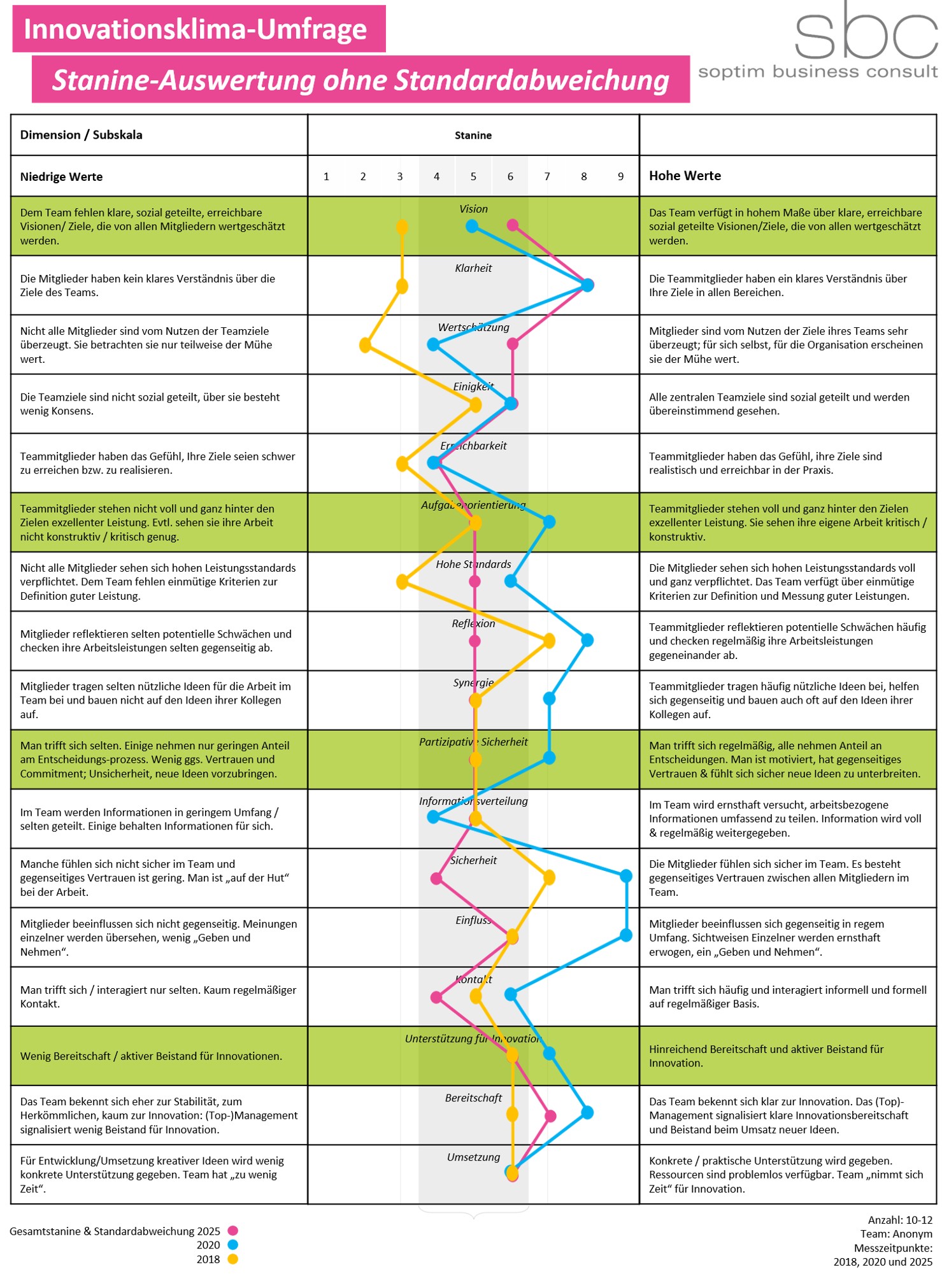
Figure 1: Analysis of the TCI across three measurement points (2018, 2020 and 2025) within the same team (N = 10 to 12)
Two methodological points are crucial here, as they show just how easily one can be misled:
1. A mean value alone tells us nothing about whether a team perceives the same thing. There is a specific measure for this: the interrater agreement coefficient rwg. [3] It answers the question: Do we all see the same team, or are we averaging across people who are situated in completely different realities?
Only when the value reaches around 0.70 can one meaningfully speak of a shared perception. [4] In the ‘Security’ subscale, this value fell to 0.71 in 2025, making it the only value in the entire series to brush against the critical threshold.
In other words: by 2025, there was no longer a shared view on the question ‘Do I belong here?’ Two out of nine respondents rated a sense of belonging and contact very low, whilst having full access to information and normal influence. They were well-informed and were allowed to have a say. Yet they did not feel they belonged. On average, these two individuals were invisible.
2. The four aspects of participatory safety operate independently of one another. What Michael West [5] had theoretically conceived as a psychological construct behaved, within this team over seven years, like several separate systems.
This is not a peculiarity of this one team. Even the validation studies on the TKI repeatedly showed that maintaining contact branches off as an independent fifth factor, particularly in complex activities. [6] [2] The neat categorisation of the theory stands up to empirical testing only to a limited extent.
The actual finding is therefore not that ‘the team is stable’, but rather that security, information, influence and contact are distinct areas that must be considered individually. And security is merely one of the four.
Three terms we tend to confuse: collaboration, cooperation and co-creation
Before we go any further, it is worth clarifying these terms. We often use the same word for very different things, and this lack of clarity costs us dearly in practice.
Collaboration, in the broadest sense, means: several people carrying out tasks within the same context. This can already work well if everyone does their bit and the parts fit together in the end. The focus is on the division of labour; the result is the sum of the contributions. A relay race is a good analogy: clear hand-overs, defined sections, everyone runs their own leg.
Cooperation goes one step further. Here, those involved actively coordinate with one another, share information and align their actions with common goals. The result is coordination rather than mere addition. The outcome improves because friction is reduced and interfaces are deliberately designed. But at its core, it remains an optimisation of the known: people do the right things more effectively together.
Co-creation or generative interactivity is something qualitatively different. Here, something emerges during the process that did not previously exist in any single person’s mind. It is not the improved implementation of an existing idea, but an idea that only emerges through collaboration. The term ‘generative’ stems from Otto Scharmer’s work on dialogue and listening: at the deepest level of conversation, it is no longer a matter of asserting one’s own position or even simply understanding what the other person means, but of jointly perceiving what is seeking to emerge. The result is synergistic: the whole suddenly amounts to more than the sum of its parts. [7]
This distinction is not an academic quibble. It explains why so many teams remain stuck at a solid level of cooperation and never make the leap to co-creation. They keep optimising what is already known, without ever venturing into the space where something truly new emerges. And the reason for this is rarely a lack of competence. It is a lack of participation.
Why safety is a prerequisite, yet cannot stand on its own
Amy Edmondson coined the term ‘psychological safety’ and has provided extensive evidence for it: teams learn when their members feel they can take interpersonal risks without being penalised for doing so. [8] Anyone who asks a question, admits a mistake or voices an unfinished idea risks looking foolish. Only when this risk seems low do people say what they think. The link between psychological safety and learning is one of the most consistently supported findings in organisational psychology. [9]
This is the necessary condition. But it is not a sufficient one. A team can feel completely safe and still produce nothing new. For safety only answers the first of two questions. Edmondson asks: “Can I speak up here?” West goes further and asks: “Can I speak up here, and will it make a difference?” The second question focuses on participation. Anyone who feels safe but finds that their contributions fizzle out without consequence will eventually fall silent – not out of fear, but out of resignation.
This is precisely where the danger of a narrow understanding of psychological safety lies. If it becomes an end in itself, a pleasant, low-conflict atmosphere emerges in which everyone feels at ease and no one asks critical questions any more. West has identified an important counterbalance to this: task orientation – that is, the willingness to critically scrutinise one’s own work and to apply high standards. If this counterbalance is lacking, safety tips over into complacency. In the worst case, this gives rise to what Irving Janis described as groupthink: conformity becomes more important than quality. [10]
This, too, was observable in the dataset described at the outset. By 2025, not only had safety declined, but task orientation had also fallen in parallel (from Stanine 7 to 5), most markedly in the reflective aspects: questioning one’s own foundations and building on the ideas of others. The team had lost its critical-reflective routine. Not because it had become too concerned with maintaining harmony, as social desirability remained constant and unremarkable across all three surveys, but because a routine that nobody actively maintains withers away over time.
Participation as implementation: the step many teams overlook
If security is the prerequisite, then participation is the implementation. And participation is more than simply being allowed a say. According to West’s model, it consists of several elements that must work together:
- genuine influence over decisions,
- a functioning exchange of information and
- regular contact.
Only when these elements come together do people invest in the outcomes of joint decisions and contribute their ideas.
Interestingly, this very insight has long been well documented in productivity research, albeit under a different name. Participatory productivity management (PPM), as defined by Robert Pritchard, rests on the pillars of goal-setting, feedback and participation. The meta-analysis of 83 field studies shows a mean effect size of 1.16 standard deviations. [11] That is a remarkably large effect. And the mechanism behind it is no secret: people who are involved in setting goals, measuring criteria and making improvements take ownership of them, rather than simply putting up with them.
The crux of the matter is that participation is not the same as information. The data set illustrates this very clearly. In 2025, the two people on the periphery of the team were extremely well informed. They were kept fully up to date. But being informed is a one-way street, whilst participation is a cycle. Information flows towards me. Participation means that something also flows back from me and that this feedback has an effect. It was precisely this feedback that was missing. And without it, even the best supply of information is of little use.
Participation is therefore the step that separates cooperation from co-creation. In cooperation, I coordinate with others and do my bit. In co-creation, I help shape the task, the criteria and the shared understanding of what is good. Peter Kruse has described this transition as an increase in network density: “If the network density in a system is increased, the number of feedback effects automatically increases as well.” [12] And it is these feedback loops that give rise to synergistic outcomes. It is not the people who become wiser, but the network between them.
How can effective collaboration be developed?
The obvious question now is: Is this even possible? Can high-quality collaboration be developed, or is it a matter of luck, dependent on having the right people at the right time?
The good news is: it can be shaped. Not at the flick of a switch, nor through a weekend seminar, but through routines that are consciously established and maintained. Some have proven their worth:
- Regular, structured feedback is the most effective single lever. This is the key finding from PPM research: the major leap in productivity occurs the moment teams begin to review and discuss their own key performance indicators. [11] Feedback is not a soft, peripheral element, but the driving force.
- Joint goal-setting, as systematised by Objectives and Key Results (OKR), ensures that participation has a clear direction. Influence without a shared goal leads to friction; a shared goal without influence leads to working to rule. Only when both are combined does it work.
- Structured team reflection – that is, regularly pausing to examine and question one’s own working methods – keeps the focus on tasks alive. Here, however, the order is crucial, and this is the point at which many team-building initiatives fail: reflection initially creates uncertainty before it brings clarity. Anyone who immediately begins with critical self-examination in a team with fragile cohesion will lose precisely those people who are already on the fringes. First security, then reflection. This sequence is non-negotiable.
- Finally, consciously shaping interactions may sound trivial, but it is not. The 2020 findings from the dataset show that more frequent contact by no means automatically leads to a better flow of information. Video conferences are no substitute for word of mouth. Those working remotely or in a hybrid setup must actively organise information, as the casual channels of communication are no longer available. This is about structure, not atmosphere.
What all these routines have in common is that they can be practised, but they cannot be established once and for all. A team that fails to maintain its reflection routine will lose it again, as the decline in task orientation in the data set shows. Good collaboration is not a state to be achieved, but a practice to be sustained.
What’s really needed: the prerequisites for generative interactivity
Let’s summarise the prerequisites that must be met for collaboration to become generative interactivity. Four conditions seem essential to me, and they build on one another:
- The first is safety as a foundation. Without the feeling that they can take interpersonal risks, nobody will say what they really think. Safety is the entry ticket – nothing more, but without it you cannot enter the space.
- The second is genuine participation, i.e. not just being kept informed, but having a real influence. The difference lies in the feedback: does my contribution count; does it make a difference? Where this experience is lacking, people fall silent even in safe teams.
- The third is a counterbalance to harmony: the critical examination of one’s own work. Safety without a task-oriented focus becomes complacent and, in the worst case, leads to groupthink. A productive team holds both together: the warmth that enables contributions, and the rigour that improves them.
- The fourth is responsiveness, the willingness to allow oneself to be changed by the shared process. This is the most demanding condition and the one that is hardest to achieve. It means that I do not merely contribute my pre-formed opinion, but allow something to emerge from the exchange that I did not have before. Kruse has described organisational intelligence as a form of self-organisation that arises through disruption, stimulation and resonance. [12] Gitta Peyn uses the term ‘pogo capability’ to describe a related capacity of systems: to remain robust and capable of engagement, even when criticism sets the shared vision in motion. [13] This is precisely what is meant: a state in which the team collectively generates something new because they stimulate one another, rather than merely coordinating their efforts.
These four conditions also explain why generative collaboration is so rare and so valuable. It is not a characteristic that one simply ticks off a list, but the result of an interplay that must succeed in several areas simultaneously. And it is fragile: as the dataset shows, a single survey can paint a completely different picture from the previous one, because the underlying factors fluctuate independently of one another. Anyone who looks only at the overall figure will not notice this until it is too late.
In short
A summary of the key points of this article:
- Psychological safety is a necessary prerequisite for effective collaboration, but it is not sufficient on its own. It merely answers the question ‘Can I speak up?’, but not the question ‘Will it make a difference?’.
- The overall assessment is misleading. Anyone who judges the team atmosphere solely on the basis of aggregated average values overlooks the conflicting trends among the individual factors. A look at the degree of agreement within the team (rwg) reveals whether there is any shared perception at all.
- Collaboration, cooperation and co-creation are three different things. The leap to co-creation – to generative collaboration – can only be achieved through genuine participation, not through mere coordination.
- Participation is more than just information. It requires effective influence, a functioning exchange of information and regular contact, all of which must work together. Merely being informed, without receiving feedback, is not enough.
- Good collaboration can be developed through training, but cannot be achieved overnight. Feedback routines, shared goal-setting, structured reflection and a conscious approach to interactions are effective, but must be nurtured. The order is crucial: first psychological safety, then reflection.
- Generative collaboration requires four conditions: security as a foundation, genuine participation, a counterbalance to harmony, and the ability to resonate and pogo capability. It is only through their interplay that the whole becomes greater than the sum of its parts.
Feeling safe is good, but it is only the beginning. The real benefit lies one step further: in participation. And this step is worthwhile – not as a feel-good exercise, but because it enables results that would otherwise not be achieved. How do you experience this in your teams: how can you tell when coordination turns into genuine co-creation?
Notes (partly in German):
Sascha Ruelicke would be delighted to discuss your experiences regarding psychological safety and participation with you. Simply send him a message at LinkedIn.
[1] Brodbeck, F. C., Anderson, N., & West, M. A. (2000). Das Teamklima-Inventar: Handanweisung und Validierung der deutschsprachigen Version. Heidelberg: Hogrefe.
[2] Anderson, N. R. & West, M. A. (1994). The Team Climate Inventory. Manual and user’s guide. Windsor: ASE Press. sowie Anderson, N. R. & West, M. A. (1998). Measuring climate for work group innovation: Development and validation of the team climate inventory. Journal of Organizational Behavior, 19(3), 235–258.
[3] James, L. R., Demaree, R. G. & Wolf, G. (1984). Estimating within-group interrater reliability with and without response bias. Journal of Applied Psychology, 69(1), 85–98.
[4] George, J. M. (1990). Personality, affect, and behavior in groups. Journal of Applied Psychology, 75(2), 107–116.
[5] West, M. A. (1990). The social psychology of innovation in groups. In M. A. West & J. L. Farr (Hrsg.), Innovation and creativity at work: Psychological and organizational strategies (309–333). Chichester: Wiley
[6] Kivimäki, M., Kuk, G., Elovainio, M., Thomson, L., Kalliomäki-Levanto, T. & Heikkilä, A. (1997). The Team Climate Inventory (TCI) – four or five factors? Testing the structure of TCI in samples of low and high complexity jobs. Journal of Occupational and Organizational Psychology, 70(4), 375–389.
[7] Scharmer, C. O. (2009). Theory U. Leading from the future as it emerges. San Francisco: Berrett-Koehler.
[8] Edmondson, A. (1999). Psychological safety and learning behavior in work teams. Administrative Science Quarterly, 44(2), 350–383.
[9] Frazier, M. L., Fainshmidt, S., Klinger, R. L., Pezeshkan, A. & Vracheva, V. (2017). Psychological safety: A meta-analytic review and extension. Personnel Psychology, 70(1), 113–165.
[10] Janis, I. L. (1982). Groupthink: Psychological studies of policy decisions and fiascoes (2. Aufl.). Boston: Houghton Mifflin.
[11] Pritchard, R. D., Harrell, M. M., DiazGranados, D. & Guzman, M. J. (2008). The productivity measurement and enhancement system: A meta-analysis. Journal of Applied Psychology, 93(3), 540–567.
[12] Kruse, P. (2020). next practice. Erfolgreiches Management von Instabilität. Veränderung durch Vernetzung (9. Aufl.). Offenbach: GABAL. 7
[13] Peyn, G. (2024). Pogofähigkeit. Formwelt Media
Would you like to support Sascha Ruelicke and discuss genuine participation? Then please share this post on social media or within your organisation.
Sascha Ruelicke has published more articles on the t2informatik Blog, including:

Knowledge management in transition: concepts for the future
From a culture of error to a culture of support

Self-efficacy and collective efficacy in the team

Sascha Ruelicke
Sascha Ruelicke is the managing director of sbc soptim business consult GmbH (Essen), a management consultancy specialising in municipal utilities, network operators and local infrastructure.
Before joining sbc as a consultant in 2009, he spent just under seven years as a research assistant at the A.U.G.E. Institute at the Niederrhein University of Applied Sciences, working in applied research – with a focus on team and organisational development in small and medium-sized enterprises.
His current consulting specialisms include regulatory transformation, smart meter roll-out, gas network transformation and open-source governance for regulated organisations. He teaches communication and the fundamentals of psychology at the Rheinische Hochschule in Cologne and is a member of the board of GWPs e.V., where he facilitates the exchange of practical experience within the energy sector. Methodologically, he works at the interface of systemic organisational development, complexity management and evidence-based consultancy.
On the t2informatik Blog, we share knowledge and experience with people in organisations. We have been developing and modernising software for them since 2012. Pragmatically. ✔️ Personal. ✔️ Professional. ✔️ Get to know t2informatik as your development partner.