
What is Estuarine Mapping?
Table of Contents: Definition – Metaphor – Key terms – Energy/Time Map – Intervention – Questions from the field – Notes
Estuarine Mapping: Visualising working environments as a landscape of change
In many organisations, it quickly becomes clear that something needs to change: processes are too slow, decisions take too long, dependencies hold work back, or old habits stand in the way of new requirements. The more difficult question is where to start. After all, not everything that causes problems can be changed directly, and not everything that appears easy to change has a lasting effect.
Traditional change plans often assume that an organisation can be guided, step by step, towards a desired end state. In complex working environments, however, many factors are at play simultaneously: people, rules, routines, technologies, power dynamics and expectations. These change at different rates and are influenced with varying degrees of ease.
This is precisely where Estuarine Mapping comes in. The method originates from the work of Dave Snowden, who developed the Cynefin Framework – one of the best-known models for classifying complex situations.[1] Estuarine Mapping maps the elements of a working environment according to how quickly and with how much energy they can be changed. This creates a shared understanding of what is stable, what is flexible, and where direct intervention, observation or small-scale experiments are appropriate.
Estuarine Mapping does not, therefore, replace a change plan. The method highlights which conditions, interdependencies and options for action actually exist in the current situation, rather than rushing to devise solutions.
The metaphor of the estuary
The name of the method comes from geography: ‘estuary’ refers to the transitional zone where a river meets the sea. Freshwater and salt water mix; tides push water in and out again; sandbanks shift, whilst solid banks and rocks shape the landscape. Anyone navigating such an area cannot rely on a single, permanent map. They must recognise what is shifting, what remains stable, and when a passage opens up that may disappear again shortly afterwards. [2]
Snowden applied this image to organisations. A working environment, too, consists of elements of varying stability. Some are like rocks: deeply entrenched structures, legal requirements or fundamental cultural patterns that can hardly be shifted, or only with great effort. Others behave like sandbanks: team routines, individual agreements or informal rules that can be shifted relatively easily, but which can also slip back into place.
Still others resemble tides: moments when a window of opportunity opens – perhaps because a new budget has been approved or a manager has changed – and which closes again after a short time. And there are currents: forces that cannot be directly controlled, but which one can work with if one knows their direction, such as market trends or customer expectations.
This metaphor is more than just a figure of speech. It makes it clear why change in complex environments is not a one-off act, but an ongoing process of reading the landscape. What appears stable today may shift tomorrow. What seems insurmountable today may, over time, shift after all. Estuarine mapping provides the tool to visualise this landscape at a specific point in time. The aim is not to survey it definitively, but to identify where one can begin at this very moment.
To actually map this landscape, a few fixed terms are required. They are the tools used to name and categorise the elements of a working environment.
Key terms in Estuarine Mapping
Before mapping a working environment, you need a common language to define what actually ends up on the map. The key umbrella term for this is actant. Actants are everything that has an effect within a system: people, rules, budgets, habits, technologies, meeting formats, processes or expectations.
The term is deliberately broad. It is intended to prevent the analysis from focusing solely on people and overlooking other influential factors. After all, even a rule, a tool or a routine can shape behaviour, open up possibilities or hinder change.
Within the category of actants, Estuarine Mapping distinguishes between three types: constraints, constructors and actors.
Constraints
Constraints are factors that shape behaviour and possibilities. They do not merely restrict; they can also enable, guide, connect or stabilise.
A compliance requirement, for example, restricts certain actions but at the same time provides guidance and protection. An architectural standard may limit the freedom of individual teams, but it can facilitate collaboration and maintainability.
Constructors
Constructors are elements that repeatedly bring about a specific type of change. They alter things that come into contact with them or pass through them.
Typical examples include recruitment processes, onboarding programmes, review routines or deployment pipelines. They exert their influence not only through direct use, but sometimes also through proximity or mere presence: people behave differently because a particular process, role or instance exists.
Actors
Actors are individuals, roles, groups or organisations within the system that take action. They can act with intent, intelligence, motivation and goals.
In Estuarine Mapping, however, actors are not automatically the focus. They are one of three types of actants. This shifts the perspective: it is not just people who act within the system, but people who act within a network of rules, routines, technologies, expectations and structures.
Why is the distinction not always clear-cut?
In practice, these types often cannot be neatly separated from one another. A manager, as a person, is an Actor, but through their repeated behaviour they can also act like a Constructor. A rule can impose a constraint, but at the same time enable a process that regularly produces certain results.
This lack of clarity is not a flaw in the method. It helps us to look more closely: What is actually at work here? How does it work? And can it be changed, stabilised, circumvented or simply observed?
The Energy/Time Map: What can be changed, and how?
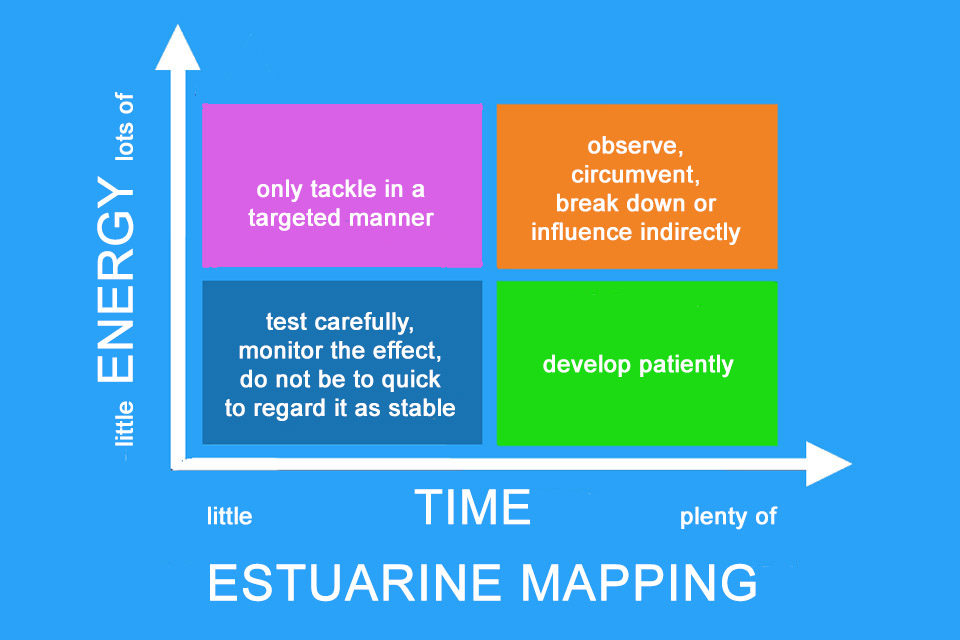
At the heart of Estuarine Mapping is a map with two axes: time and energy. It shows how quickly an actant can be changed and how much effort is required to do so.
Time refers to how quickly or slowly something can change. A meeting format, for example, might be adapted within a few days. By contrast, an established architectural structure, a decision-making process or a cultural pattern often only changes over a period of months or years.
Energy refers to the effort required to bring about a change. This may involve time, money, attention, political support, management capacity, technical knowledge or coordination between many stakeholders.
These two axes form a map of changeability:
| Area | Meaning | Typical consequence |
| little energy, little time | can be changed quickly and easily, but can just as quickly be reversed | test carefully, monitor the effect, do not be too quick to regard it as stable |
| lots of energy, little time | can be changed quickly, but it takes some effort | only tackle in a targeted manner |
| little energy, plenty of time | is changing slowly, but without much effort | develop patiently |
| lots energy, plenty of time | is sluggish, stable or deeply rooted | observe, circumvent, break down or influence indirectly |
At first glance, the ‘low energy, low time’ area seems particularly attractive. However, it is also volatile: what can be changed easily can just as easily revert to its previous state. Rapid interventions should therefore be monitored and not interpreted as permanent changes too soon.
An example from a software team illustrates this more clearly. A meeting format often falls into the ‘low energy, low time’ category because a team can change it quickly. A deployment pipeline requires more energy, but can usually be improved in a targeted manner. Legacy architectural issues often fall into the ‘high energy, high time’ category because they have built up over years and cannot be resolved by a single decision. Regulatory requirements often cannot be changed directly at all, but can be monitored, interpreted or taken into account through appropriate processes.
The key point is this: the map does not judge what is important or unimportant. It shows what kind of change is realistic. Some actants are suitable for direct intervention, others for small experiments, whilst others are better suited to observation, workarounds or long-term efforts.
This makes it clear where a team can act immediately, where it should focus its energy, and where it is better not to fight against established structures but to work with them.
From mapping to intervention
Estuarine Mapping does not begin with a solution, but with a shared question. A team or organisation selects a specific situation that needs to be better understood: Why are decisions not moving forward? Why has a transformation stalled? What factors influence our product development? Or: Where can we focus our efforts effectively, without fighting the wrong battles?
It is important to frame the question narrowly enough. A question that is too broad, such as ‘How do we improve our corporate culture?’ or ‘How do we change the mobility of an entire city?’, rarely leads to tangible actants. Questions such as ‘How do we escalate decisions within this team?’ or ‘What influences the use of a particular bus route in a specific neighbourhood?’ are more specific.
In the next step, the group identifies all the actants at play in this situation. These include not only people, but also rules, routines, technologies, budgets, dependencies, expectations, processes, habits and informal practices. It is important to gather a broad range of actants and not to evaluate them too soon.
The actants are then placed on the energy/time map. For each element, the group assesses: How quickly can it be changed? And how much energy would that require? This is not about precise measurement, but about a shared assessment. It is often the differences in perception that are particularly valuable.
A key moment arises when the group cannot agree. Disagreement is not a mistake in Estuarine Mapping, but a signal. It often indicates that a term is too broad. ‘Culture’, for example, is difficult to categorise. Things become more concrete when you ask: How are decisions made? How are mistakes dealt with? Which behaviours are rewarded? This gives rise to more precise actants that you can actually work with.
The group then examines the patterns on the map. Where are there many elements that are easily changeable but volatile? Which actants are stable and can hardly be directly influenced? Where does change require a lot of energy? Which elements might not be changeable, but can be observed, circumvented or influenced indirectly?
This analysis does not result in grand master plans, but rather in the next sensible steps. These might be small experiments, targeted interventions, observation tasks or decisions not to change certain things for the time being. The value of the method lies not in hastily devising solutions, but in interpreting the landscape of change in such a way that better interventions become possible.
Questions from the field
Here are some practical questions and answers:
When is Estuarine Mapping useful, and when is it not?
Estuarine Mapping is useful when many factors are at play simultaneously and it is unclear where to even begin making changes. The method is particularly helpful when people assess the same situation differently, interdependencies are difficult to identify, or traditional change plans seem too rigid.
Estuarine Mapping is less helpful when a problem is clear, stable and rule-based. Where cause and effect are obvious, a checklist, a standard process or a simple decision is often sufficient. The method is particularly worthwhile where the scope for change is unclear.
Is Estuarine Mapping a prioritisation matrix?
No. Estuarine Mapping does not indicate what is important or unimportant. The method shows how quickly and with how much energy actants can be changed. An element may be very important and yet be almost impossible to change directly. Conversely, something may be easy to change but have only a minor effect.
Does ‘easily customisable’ automatically mean it’s worth it?
No. Anything that can be changed quickly and with little effort can just as easily be reversed. These elements are considered volatile: attractive at first glance, but not necessarily stable or effective. The card indicates the potential for change, not the likelihood of success.
What is the difference between Estuarine Mapping and Cynefin?
Cynefin helps us understand what kind of situation we are dealing with: clear, complicated, complex, chaotic or confusing. Estuarine Mapping helps us identify what changes are possible within a specific situation.
Key point: Cynefin helps us understand the nature of the situation. Estuarine Mapping helps us highlight the scope for change within that situation.
What do you do if the team can’t agree?
Disagreement is not a hindrance, but is often the most valuable part of the method. It shows that there are different experiences, perspectives or assumptions in play. Often, an actant is described too broadly and needs to be broken down. ‘Culture’ then gives rise to specific questions such as: How do we make decisions? How do we deal with mistakes? Which behaviours are rewarded?
Who should take part in an Estuarine Mapping project?
It makes sense to have a group that understands the situation from different perspectives – the more homogeneous the group, the more likely it is that important actors will be overlooked or that the picture will be too one-sided. People with differing perspectives are particularly valuable, because it is often only through their assessments that we realise where an actor has been defined too broadly.
What are the results of Estuarine Mapping?
The result is not a ready-made plan for change, but a shared map of the current landscape of change. It shows which actants are stable, which are volatile, which require a great deal of energy, and where small-scale experiments, observation or indirect influence might be useful.
How often should you update the map?
The map is a snapshot. It should be updated whenever relevant circumstances change: new leadership, a new strategy, a new budget, technical changes, market shifts or significant changes within the team. In dynamic environments, the map is a working tool rather than a one-off document.
What is a good next step after mapping?
A good next step is small enough to be safely tried out, and specific enough to learn from. This could be an experiment, an observation, an adjustment to a process, or a conscious decision not to change a stable element for the time being.
Impulse to discuss:
If a map shows that something can hardly be changed directly – at what point is that an honest assessment of the situation, and at what point is it an excuse for not changing anything?
Notes:
If you like the article or would like to discuss it, please feel free to share it in your network. And if you have any comments, please do not hesitate to send us a message.
[1] David John Snowden (born 1954) is a Welsh management consultant and researcher in the fields of knowledge management and complexity science. During his time at IBM, he led a team that developed the Cynefin framework, for which he remains best known to this day. In 2004, he left IBM and, a year later, founded Cognitive Edge Pte Ltd, a consultancy based in Singapore which now operates under the name The Cynefin Company. Estuarine Mapping is one of the frameworks he has since developed as part of this work.
[2] Numerous example maps on the internet illustrate this metaphor in actual mapping. As a result, the map looks visually like a sea current map; for practical work, a simple quadrant map is recommended, at least as an alternative.
Here you can find further information on the Estuarine Framework.
Here is an article on how complex organisations can learn from natural ecosystems.
Here is a video about the history of the development of the framework.
And here you can find more information from our Smartpedia section:

What is Amara’s Law?
What is Groupthink?
How does the MoSCoW Method work?
‘Smartpedia’ is our glossary for people in organisations involved in software development, project management and product management. It is for precisely these people and their organisations that we have been developing and modernising software since 2012. Pragmatic. ✔️ Personal. ✔️ Professional. ✔️
Get to know t2informatik from Berlin as your development partner.