
What is DOBO?
DOBO – When uncertainty becomes creativity
Many discussions about AI begin with a concern: Which tasks will be automated? Which skills will become less important? What role will remain for humans?
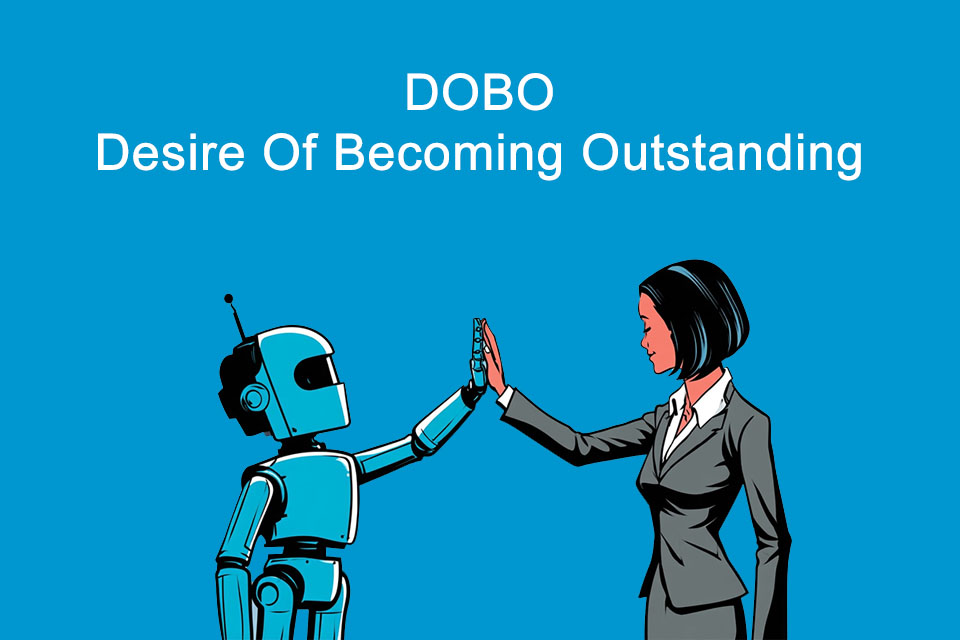
DOBO turns this perspective on its head. “Desire Of Becoming Outstanding” describes the desire not merely to weather technological change, but to consciously harness it for one’s own development. Rather than asking solely whether AI will change one’s job or restrict one’s scope for action, the focus shifts to a different question: How can I combine my skills with the possibilities offered by AI in such a way that I can make my work better, more effective or more meaningful?
DOBO is not yet an established academic term with a clearly defined field of research. Rather, the term is used as a more recent, discursive counter-concept to FOBO (Fear Of Becoming Obsolete) and FOLA (Fear Of Losing Agency). It encapsulates the idea of viewing technological change not merely as a threat or a loss of control, but as an opportunity to actively develop one’s own role.
The term should not, however, be understood primarily as a counter-argument to FOBO and FOLA. The concern about losing professional significance, or the fear of having less influence, does not simply disappear. Rather, DOBO describes a possible additional mindset: the desire to actively make the most of a changing world of work. [1]
What does ‘outstanding’ mean?
The term ‘outstanding’ is often equated with ‘exceptional’, ‘extraordinary’ or ‘particularly good’. In the context of DOBO, however, this should not turn into a competition to be better than everyone else.
A different interpretation is more interesting: it is not necessarily the person who masters as many AI tools as possible or automates a great deal who stands out. Rather, the decisive factor may be applying one’s own strengths where they make a real difference.
These may include specialist knowledge, experience, creativity, social skills, sound judgement or a willingness to take responsibility. AI can support such skills, enhance them or free up time for them.
In this sense, ‘outstanding’ does not mean standing out from other people. It means using one’s own combination of human skills and technological support particularly effectively.
DOBO does not mean: more AI at any cost
Anyone who interprets ‘Desire Of Becoming Outstanding’ solely as a desire to use as much AI as possible is missing the point. AI can prepare texts, structure information, analyse data or take on routine tasks. In doing so, it can free up time and broaden one’s perspective. Nevertheless, not every task is automatically a good candidate for automation. DOBO therefore begins with a conscious distinction: in the future world of work, many tasks will likely consist of a mix of automated and human elements. People will focus more on interpreting, contextualising, making decisions and taking responsibility, whilst AI handles parts of the preparation or execution. [2]
- Where does AI actually help me?
- Where does it improve my work?
- Where do I need my own experience?
- And where do I want to make conscious decisions or take the lead myself?
What role do my own strengths play?
DOBO focuses not only on new skills, but also on those we already possess. Anyone who has worked in a profession for a long time brings with them experience that cannot be reduced to individual bodies of knowledge. Those who work with people develop a feel for situations, relationships and nuances. Those who bear responsibility learn to make decisions even when information is incomplete or contradictory.
AI does not necessarily diminish the value of such skills. In many roles, they may even become more important, as technical systems take on an increasing number of preparatory or standardisable tasks. The crucial question is therefore not just: What can AI do?
It is also: What am I particularly good at, and how can AI help me make better use of precisely this strength?
DOBO requires new skills
However, simply knowing one’s own strengths is not enough. Technological changes are shifting tasks and requirements. That is why DOBO also involves a willingness to learn. This is less about trying out every new tool and more about the ability to develop the skills that are suited to one’s own role and to the actual changes taking place in the workplace. These may include, for example: Companies are increasingly focusing precisely on this shift in job profiles and future skills. Upskilling and identifying new skills requirements are therefore becoming key components of work design. [3]
- AI literacy: understanding what a system is capable of and where its limitations lie.
- Critical thinking: examining, contextualising and questioning results.
- Judgement: linking information with experience and context.
- Communication and social skills: being effective where relationships and trust play a role.
- Adaptability: trying out new tools and refining one’s own approach to using them.
From FOBO and FOLA to DOBO
FOBO, FOLA and DOBO can be understood as three different perspectives on the same change: these terms do not describe a fixed developmental path that every person must follow. No one automatically shifts from fear to enthusiasm or from uncertainty to personal excellence. However, ‘Desire Of Becoming Outstanding’ can open up a new perspective as soon as an abstract threat becomes a concrete question of agency: Which tasks would I like to carry out differently using AI, and how would I like to utilise the opportunities this creates?
- FOBO asks: Will I still be needed in the future?
- FOLA asks: Can I continue to shape my own path and make my own decisions?
- DOBO asks: How can I use this change to increase my own impact?
What can DOBO foster?
Such a shift in perspective rarely arises from motivation alone. People need the opportunity to familiarise themselves with new technologies, gain their own experiences and find out which applications are actually useful to them. The following are particularly helpful in this regard: DOBO does not, therefore, arise from a single big leap. Rather, it develops from many small decisions about how people and technology can work together effectively.
- Curiosity: trying out new possibilities first, without immediately passing final judgement.
- Clarity about one’s own strengths: knowing which skills actually create value in one’s own day-to-day work.
- Realistic learning goals: not trying to learn everything, but developing relevant skills.
- Experimentation: using AI in manageable situations and evaluating the results.
- Reflection: regularly checking whether the use of AI actually leads to better results or greater freedom.
- Personal responsibility: consciously deciding which tasks to delegate and which to take on yourself.
What are the limitations of DOBO?
The term can easily be misunderstood. If ‘outstanding’ becomes a permanent performance expectation, a positive development concept can give rise to new pressures. People might get the impression that they have to constantly learn, become more productive or keep up with the latest AI tools. In this way, DOBO would actually reinforce the very insecurity that it is intended to offer a different perspective on.
Not everyone needs to become an AI power user. Not every task needs to be optimised. And not every gain in productivity automatically leads to better work. A properly understood DOBO is therefore not focused on constant self-optimisation. It is focused on conscious development: Which skills do I want to strengthen? Which tasks do I want to approach differently? And what does ‘good work’ actually mean to me?
Impulse to discuss
How can an organisation manage to establish more efficient processes whilst at the same time creating opportunities for people to use their skills more effectively?
Notes (partly in German):
If you like the article or would like to discuss it, please feel free to share it in your network. And if you have any comments, please do not hesitate to send us a message.
[1] Onlinemarketing.de: Der FOBO-Trend 2026: Wie KI die Angst vor beruflicher Überflüssigkeit verstärkt
[2] McKinsey Global Institute: Agents, robots, and us: Skill partnerships in the age of AI
[3] PwC: Gemein die Zukunft der Arbeit gestalten
Here you will find an interesting article on the question: Why AI makes many people feel uneasy.
What does t2informatik do?

And here you will find additional information from our Smartpedia section:
How does Failing Forward work?
What is Human-on-the-loop?