
What is FOLA?
FOLA – When support turns into external control
Artificial intelligence can prepare decisions, sort through options, make recommendations and take over entire work processes. This can ease the burden. However, it can also create a new sense of uncertainty: how much do I actually still decide for myself?
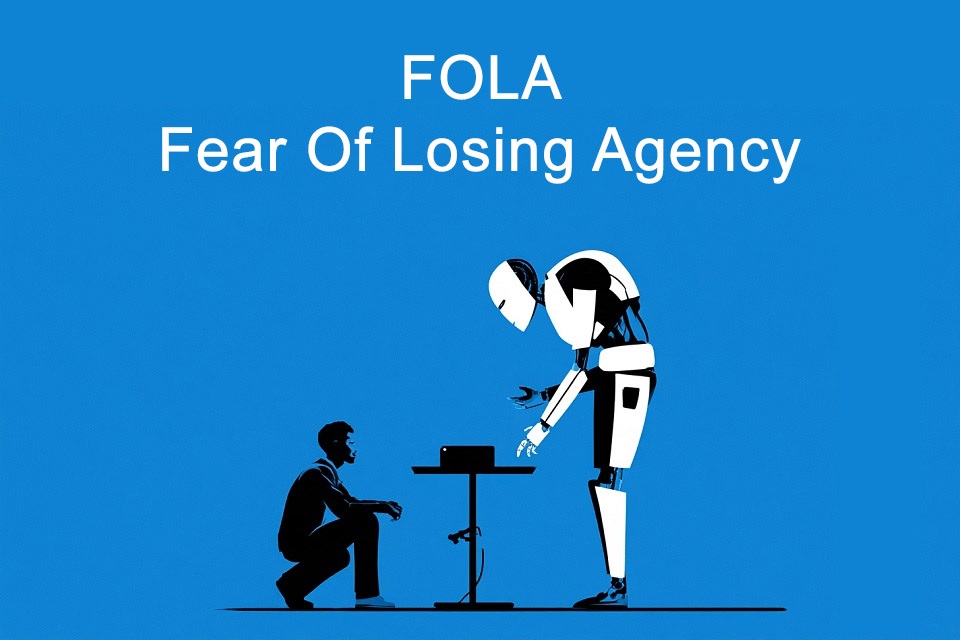
FOLA, the ‘Fear Of Losing Agency’, describes precisely this concern. It refers to the fear that human influence is gradually diminishing, whilst AI systems are increasingly determining which possibilities become visible, which recommendations seem obvious, and which next steps are chosen.
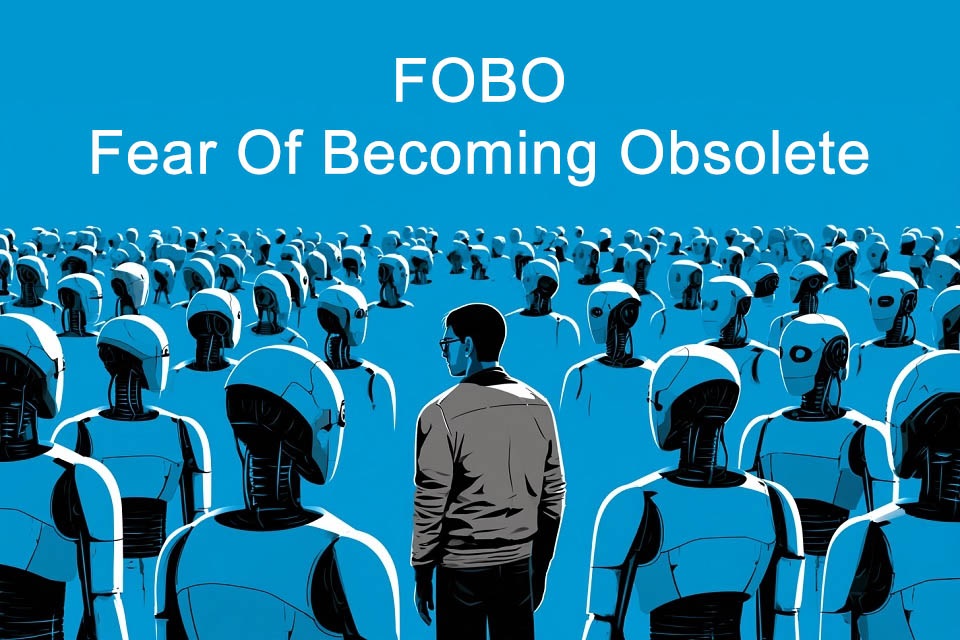
Yet nobody has to officially lose their decision-making powers. Even the way in which systems pre-sort information or suggest solutions can influence just how free a decision actually still is. In German-speaking AI discourse, FOLA is therefore increasingly described as the counterpart to FOBO. Whilst FOBO concerns the fear of losing professional significance, FOLA focuses on a different question: do humans actually remain the architects of their own lives, or are they increasingly becoming mere recipients of technical suggestions? [1]
What does ‘agency’ mean?
The term ‘agency’ refers to the ability to act effectively of one’s own accord. This includes pursuing one’s own goals, making decisions, weighing up alternatives and influencing the outcome. Agency is therefore not merely demonstrated by a person being allowed to click ‘Yes’ or ‘No’ at the end. It is also crucial whether they understand what is being decided, what alternatives exist and what consequences are associated with them.
This is precisely why agency is so important when dealing with AI. A person may formally make the final decision yet still have very little scope for action if a system has already completely predetermined the options or presents a recommendation so dominantly that other possibilities are hardly even considered.
How does AI alter one’s scope for action?
AI can expand agency. It can make information available that was previously difficult to access. It can highlight new possibilities, reveal connections or provide additional perspectives when making complex decisions. In this way, it can even empower people to act more effectively.
However, the same mechanism can also work in the opposite direction. Anyone who relies permanently on a system’s suggestions may, at some point, begin to develop fewer alternatives of their own. Those who regularly delegate decisions to AI may lose the habit of weighing things up for themselves. Support can then gradually turn into dependence.
It is therefore particularly interesting to ask not only what AI can do, but also what people still do, decide and question for themselves as support increases. Research into collaboration between humans and generative AI deals precisely with this tension between support and the conscious reclaiming of human agency. [2]
Where can agency be lost?
A loss of agency need not be dramatic. It often starts on a small scale. The problem does not lie in the delegation itself. The division of labour has always been a feature of organisations. It becomes critical when delegation is scarcely done consciously any more, or when people can no longer understand what influence a system has had on their decision.
- A suggestion is accepted because it sounds plausible.
- An alternative is no longer considered because the system has already provided a recommendation.
- A decision is justified on the grounds that the AI suggested it.
- Or a task is delegated so regularly that one’s own ability to carry it out oneself gradually fades into the background.
FOLA therefore turns its attention to something very commonplace: how much of one’s own judgement remains in an AI-supported decision?
Control and agency are not the same thing
Control is an important component of agency, but it is not identical to it. Control means, for example, being able to stop a process or reject a recommendation. Agency goes further. It also involves setting one’s own goals, developing alternatives and making decisions based on one’s own convictions. A ‘stop’ button alone does not, therefore, make a process self-determined.
If a person barely understands how a recommendation is arrived at, what alternatives might be possible, or what consequences a decision might have, their actual scope for action remains limited. Autonomy therefore does not arise solely from technical means of control. It also requires understanding, the capacity for judgement, and the freedom to make a different decision.
What role does autonomy play?
Autonomy describes the ability to align one’s own actions with self-chosen goals and values. Agency more strongly describes the ability to actually translate these into actions. The two are closely linked.
AI can support autonomy if it opens up additional options for action or provides information that enables people to make better decisions. It can restrict autonomy if technical systems increasingly dictate how tasks are to be carried out, which options are even visible, or which recommendation appears to be the supposedly best solution.
Here, too, the following applies: the use of AI does not automatically mean less autonomy. What is crucial is how tasks, responsibilities and scope for decision-making are structured. [3]
What can foster FOLA?
FOLA can arise in particular where people gain the impression that, whilst they continue to bear responsibility, they have ever less influence over the decision-making process. Various factors can contribute to this: FOLA therefore does not arise solely from the capabilities of AI. It also depends on how people and organisations use these systems.
- Non-transparent systems: If it is not possible to understand how a recommendation is generated, it becomes more difficult to scrutinise it critically.
- High levels of automation: The more steps that are carried out automatically, the fewer opportunities there may be to intervene oneself.
- Time pressure: Under high time pressure, there is a strong temptation simply to accept a plausible recommendation.
- Habituation: What was initially delegated consciously can, over time, become taken for granted.
- Unclear accountability: If no one knows exactly who is actually responsible for a decision, the lines between technical support and human responsibility become blurred.
Having less say in decisions can certainly make sense
More agency is not automatically better in every situation. People delegate all the time. They follow sat-nav systems, use automated calculations, rely on specialist software or hand tasks over to other people. This makes sense because no one can – or should – do everything themselves.
The interesting question is therefore not: How do I prevent any form of delegation? Rather, it is: Which decisions do I want to consciously hand over, and for which do I want to retain my own judgement? This is precisely where the difference lies between being relieved of a burden and being controlled by an external force.
Those who delegate consciously and can always understand what has been delegated occupy a different position to those who merely follow a system’s recommendations.
How can agency be maintained when dealing with AI?
Dealing confidently with AI does not mean questioning every recommendation as a matter of principle or carrying out every step of the process yourself. A conscious division of tasks is more helpful. This brings a simple question to the fore: does AI help you make better decisions, or is it increasingly making decisions for you?
Clarify decision-making scope: Which decisions can AI prepare, and which do you wish to make yourself?
Start by forming your own assessment: Particularly when it comes to important issues, it can be helpful to know your own position before an AI recommendation is made.
Ask for alternatives: A single suggestion can quickly seem like the only option. Having several options restores your scope for decision-making.
Review key outcomes: The greater the consequences of a decision, the more important it is to carry out a deliberate human review.
Maintain relevant skills: Anyone who delegates every task entirely may, over time, lose the ability to assess outcomes meaningfully.
Allow for dissent: People must be able to amend, reject or choose a different course of action.
Research into the design of AI-supported work is increasingly focusing on precisely this balance between technical support, human judgement and the preservation of key skills. [4]
FOLA as a question of work design
The extent to which people retain agency when dealing with AI is not determined solely on an individual basis. Organisations design processes, select systems and define responsibilities. In doing so, they play a key role in determining how much influence employees actually retain.
An organisation can introduce AI in such a way that people receive better information and can therefore make decisions with greater confidence. However, it can also design processes in such a way that employees mainly confirm suggestions whose origins they can scarcely understand. That is why, whenever automation is introduced, it is worth asking more than just about efficiency. FOLA thus highlights a question that is easily overlooked when introducing AI: it is not only the quality of technical outcomes that matters. Equally crucial is the role people will play in the future in bringing these outcomes about.
- Who is authorised to override decisions?
- When is human review envisaged?
- Which skills should be deliberately retained?
- And who ultimately bears responsibility?
FOLA thus highlights an issue that is easily overlooked when AI is introduced: it is not only the quality of technical results that matters. Equally crucial is the role that people will play in the future in bringing about those results.
Impulse to discuss
For which decisions would you like AI to provide deliberate support, and for which is it important to you to shape the path to the outcome yourself?
Notes (partly in German):
If you like the article or would like to discuss it, please feel free to share it in your network. And if you have any comments, please do not hesitate to send us a message.
[1] Prof. Dr. Yasmin Weiß: “Fear of Losing Agency” (FOLA): Was wir über die aktuelle Debatte über KI-Kontrollverlust wissen müssen
[2] Human agency and deliberate reassertion in the age of generative AI: Evidence from online labor platforms
[3] Artificial intelligence and autonomy at work: empirical insights from Germany
[4] Human Agency and Skill in AI-Supported Work: Countering Cognitive Offloading
Here you will find an interesting article on the future of human autonomy.
What does t2informatik do?

And here you will find additional information from our Smartpedia section:
What is Fobo?
What is Human-in-the-loop?