
Which strengths really count in the age of AI
Part 2 of the series ‘AI scares me’: Why human strengths are becoming more important
In the first part of this series, we looked at what you might be feeling when it comes to AI: uncertainty, reluctance, feeling overwhelmed or fear. We gave these feelings names – FOBO and FOLA – and saw that they are understandable. Perhaps you’ve even found your own personal starting point on a bridge that can lead you, step by step, from where you stand today to a different place.
Now we’re going to do something different: we’re not looking at the technology; we’re looking at you.
This article is not an introduction to new tools, nor is it a plea to deploy as much AI as possible as quickly as possible. It is an invitation to rediscover yourself and to focus on what you already bring to the table. As AI becomes increasingly powerful, a crucial question arises: which skills are becoming more important precisely because technology can take on so much?
The answer lies, amongst other things, in your experience, your social skills and your ability to take responsibility even in unclear situations. It is precisely these human strengths that are at the heart of this article.
Why machines can’t do everything
AI is impressive. There’s hardly any denying that. It can read and summarise vast amounts of text in seconds. It can recognise patterns in data that a human could hardly possibly detect at that speed. It can compose texts, generate images, write code and complete complex tasks in minutes that would take humans considerably longer.
This can seem threatening. And it’s understandable that some people might feel a sense of unease when hearing this list of capabilities. But this is where the other side of the story begins.
AI does not know what it feels like to have a bad day. It does not experience what it means to sit opposite someone who is currently disappointed, unsettled or sad. It does not perceive a tense atmosphere within a team in the same way as a human who knows the people involved, understands their background and notices that something is currently left unsaid in the room.
It can process information, recognise patterns and make suggestions. However, it cannot take responsibility when something goes wrong. It has no values of its own against which to weigh up a difficult decision. And it does not experience the consequences of a decision.
Imagine a long-standing colleague returning to the office after a difficult meeting with a client. His face says more than his words. Perhaps you can tell from the tone of his voice that this isn’t the time to present a solution straight away. Perhaps you realise that, for now, some quiet time, a conversation or simply a bit of space is needed.
This intuition doesn’t arise from a single piece of information. It arises from experience, relationships, context and attentiveness. This is precisely where human strengths come into play, strengths that become particularly valuable when combined with AI. We’ll now take a closer look at three of them.
Your three irreplaceable strengths
There are three areas in which people bring something to the table that AI simply cannot replace. These three areas are not just a consolation prize. They are at the heart of what makes you valuable in a world of work shaped by AI.
1. Your experiential knowledge and intuition
You have spent years learning your trade. You have experienced situations that have shaped you. You have made mistakes and learnt from them. You have celebrated successes and understood why something worked. All of this has become embedded within you as a special form of knowledge that goes far beyond retrievable facts. You probably cannot even fully explain much of it. You simply know when something feels right and when it doesn’t.
This experience gives rise to intuition.
Sometimes you sense that something isn’t quite right even before you can say why. Perhaps you notice a connection to a previous situation. Perhaps you remember a colleague whose knowledge might be important now. Perhaps your gut feeling tells you that a decision looks good on paper but won’t work in practice.
AI can analyse data, link information and reveal possible connections. It can even help you to question your own judgement. But it hasn’t had your experiences.
I remember an experienced IT colleague from a consultancy project at a bank. There was a critical fault in a client’s core system. The monitoring tools didn’t reveal a clear cause. At first glance, all the key figures looked normal. Nevertheless, after a few minutes, he said: ‘I’ve seen this before. It’s to do with the last update.’ He couldn’t back it up at that moment. He had simply experienced a very similar situation before. And he was right.
That is intuition in action. Experience creates connections that are not always immediately visible or explainable.
2. Your social skills in real human situations
People are complicated. They don’t always say what they mean. They react to tone of voice, body language and context. Sometimes they need someone who is simply there, without immediately offering a solution. And they trust not only arguments, but also people. Your ability to build relationships, gain trust and act appropriately in emotional situations is one of the most valuable skills in the workplace.
AI can provide possible explanations. It can formulate perspectives or make suggestions for a difficult conversation. However, it cannot experience for itself how a situation in a room changes or how a particular remark is received by the other person.
In an AI workshop with an internal sales team, one member of staff recounted a telephone call with an angry customer. The customer was complaining about a delayed delivery. From a purely factual point of view, a standard response would probably have sufficed. However, the employee could tell from the tone of voice that there was more to the complaint than met the eye. The customer had been feeling neglected and undervalued for some time. She broached the subject carefully, rather than simply explaining the delayed delivery. In the end, the customer thanked her for the conversation.
It is precisely situations like these that show just how important human perception and social experience remain. It is not just about what is said. It is also about what happens between the words.
3. Your ability to make responsible decisions in unclear situations
Life is rarely black and white. Often there is no perfect answer, only different options with different risks. In such situations, you need someone who can weigh up the options, make a decision and then stand by it.
AI can help you structure your options. It can outline the pros and cons, provide additional perspectives and highlight potential risks. It is very good at helping you prepare for a decision. However, it does not take responsibility. Only you can do that.
A manager from one of my coaching sessions was preparing for an important team meeting in which an unpopular prioritisation had to be communicated. With the help of AI, she had neatly organised various options and arguments. Nevertheless, in the end she had to decide for herself how she wanted to present this to her team. She made a conscious decision to communicate openly and honestly, even though this was more uncomfortable in the short term.
This is precisely where the difference lies between a well-prepared decision and a responsible decision. AI can help you with the preparation. The attitude with which you make and stand by a decision remains yours.
Experiential knowledge, social skills and responsible decision-making do not operate independently of one another. They are intertwined, and it is precisely in this interplay that your true strength lies.
Achieving DOBO with your strengths
You may well remember FOBO and FOLA from the first article. FOBO describes the fear of becoming redundant at work. FOLA stands for the worry of losing control and the freedom to shape your work.
This is precisely where your three strengths come into play. Your practical knowledge, your social skills and your ability to take on responsibility show that your role will not simply disappear in the age of AI. On the contrary: the more tasks technology takes over, the more important the question becomes of who interprets results, shapes relationships and ultimately bears responsibility.
This realisation can give rise to a different feeling: DOBO, ‘Desire Of Becoming Outstanding’.
This isn’t about being better than everyone else or chasing after every new development. It’s about consciously shaping your own role in interaction with AI. Once you know your strengths, your perspective on AI will also change. Then the question is no longer simply which tasks a system could take over. You can also ask yourself: where does AI help me make better use of my own abilities?
Perhaps it takes on preparatory work, thereby freeing up more time for you to have an important conversation. Perhaps it organises information so that you can contribute your experience in a more targeted way. Perhaps it shows you additional perspectives before you make a decision. DOBO begins where the fear of being replaced or controlled by others gives way to the desire to become more effective yourself. And that is precisely why there is no need for a technological arms race; what is needed is clarity about what AI is good at and what you yourself contribute.
The next step is therefore obvious: do not view AI as a competitor, but as an assistant.
AI as a silent assistant, not a competitor
Imagine a highly capable, extremely patient and tireless assistant. They summarise long texts, process data and draft initial versions of documents. They research, organise and structure information. They help you to consider different perspectives, examine arguments and ensure you don’t overlook anything important.
But there’s one thing it won’t take off your hands: responsibility.
It won’t decide for you how to speak to a client who’s feeling uncertain. It doesn’t automatically know which experience from your day-to-day work is relevant right now. And it can’t judge which decision aligns with your values, your team or your specific situation. For me, this is precisely where AI’s most meaningful role lies: as a silent assistant working in the background.
An assistant that prepares, organises and speeds things up, so that you have more time for what requires your human strengths.
Let’s take a simple example. You’re preparing for an important meeting with a client. In the past, you might have spent two hours gathering information, reviewing documents and structuring the key points. With the support of AI, this part may now take only a fraction of the time. The time you save is yours.
You can prepare for the meeting in greater depth. You can consider which questions are truly important. You can focus on your counterpart, listen more closely and better pick up on what’s happening between the lines.
AI doesn’t take away what you’re good at. At best, it creates more space for you to do it.
The ‘Values Square’ also helps here to keep the balance in mind. Goal-orientation and efficiency are important, but can veer towards coldness or merely going through the motions. Empathy and humanity are just as important, but without goal-orientation they can lead to arbitrariness or unnecessary waste of time. Both sides go hand in hand.
A sensible use of AI therefore does not mean automating as much as possible. It means making a conscious decision about what the technology should take over and where your experience, your judgement and your relationships with other people make the difference. It is precisely this decision that lies at the heart of a confident approach to AI.
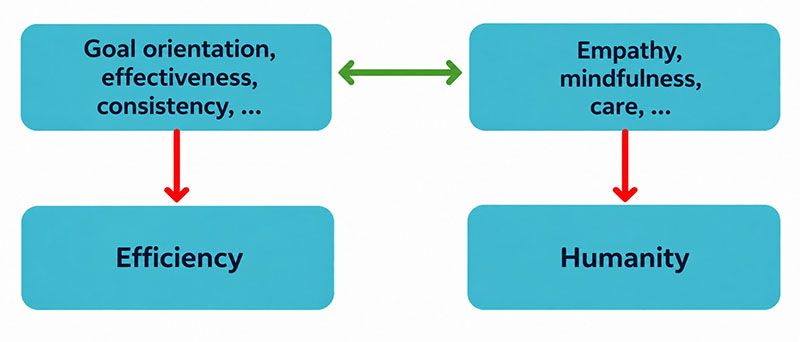
Figure: Value square on goal orientation and empathy
Using AI effectively does not, therefore, mean automating as much as possible. It means making a conscious decision about what tasks the technology should take on and where your experience, your judgement and your relationships with other people make the difference. It is precisely this decision that lies at the heart of using AI with confidence.
Your personal strengths overview
Now it’s all about you again.
Take ten minutes and write down three things you’re particularly good at in your work. Not what’s in your job description, but the things your colleagues or clients come to you for. The things that come easily to you, even though others find them difficult. The things you might secretly take a little pride in.
If you find it hard to write, you can also use the dictation function on your smartphone here. Perhaps a walk will help. Or you could ask a colleague you trust: ‘What three strengths do you see in me?’
Then look at each of these points individually and ask yourself a simple question: ‘Could a machine do this just as well?’
Perhaps your first answer is ‘yes’. Perhaps ‘no’. Perhaps you’ll hesitate. It is precisely this hesitation that is interesting.
Ask yourself further: what does this strength really consist of? Experience? Confidence? An understanding of human nature? Intuition? The ability to recognise connections? Or the courage to make a difficult decision and stand by it?
It is often only upon closer inspection that it becomes clear a strength consists of several layers. AI may be able to support some of these. It can provide information, prepare or structure something, but the real value of your strength may lie elsewhere entirely. This is precisely where self-confidence can grow. Not from claiming that AI can’t do anything, but from clarity about what you yourself are particularly good at and where technology can usefully complement you.
In the age of AI, you are not valuable simply because machines have limitations. You are valuable because you can combine experience, relationships, judgement and responsibility.
When a whole team becomes stronger
So far, we have mainly focused on the individual. On experience, interpersonal skills and the ability to take on responsibility. These strengths become even more powerful when a whole team consciously brings them to bear.
Imagine a team working together on an important decision. AI can play a valuable role here. It processes data, summarises different viewpoints and presents possible options along with their respective pros and cons. This saves time that would otherwise be spent painstakingly gathering information.
Perhaps the team even consults the AI together. And that’s when the real teamwork begins.
An experienced member, drawing on years of practical experience, recognises a risk that isn’t apparent in the data. Another person senses that a particular solution might meet with resistance amongst the workforce because they are well acquainted with the mood within the company. A third person ultimately takes responsibility for the decision and stands by it with their name. It is precisely in this interplay that the real added value is created.
AI structures, prepares and broadens the perspective. The team assesses, discusses, weighs up the options and decides. A team that works in this way is not replaced by AI; rather, AI takes the pressure off them and, in the best-case scenario, makes them more capable of taking action.
Technology can support the preparatory work. Experience, humanity and responsibility remain with the team. And that is precisely what makes the difference.
Notes:
The third and final part of the series ‘AI Scares Me’ addresses the question of how you can remain in control when dealing with AI. It focuses on three habits that will help you to scrutinise results, set conscious boundaries and retain control over the use of AI.
Dierk Soellner supports specialists and managers in tackling current challenges through professional coaching and offers useful training courses on AI.
[1] What does ‘Outstanding’ mean in the context of DOBO?
Would you like to support Dierk Soellner and discuss human strengths when working with AI? Then share this post on social media or within your organisation.
Dierk Söllner has published more posts on the t2informatik Blog, including:
Why AI causes uncertainty for many people
AI and responsibility

Working learning gap – good intentions are not enough

Dierk Soellner
Dierk Soellner’s vision is: ‘Empowering people and teams – with empathy and expertise’. As a certified business coach (dvct e.V.), he supports teams, specialists and managers in tackling current challenges through professional coaching. Combined with his many years of extensive specialist expertise in IT methodology frameworks, this makes him a competent and empathetic guide in the fields of personnel, team and organisational development. He also holds a teaching post on ‘Modern approaches to designing high-performing IT organisations’ at the NORDAKADEMIE in Hamburg and has published the specialist book IT-Service Management mit FitSM.
His clients range from DAX corporations to medium-sized companies to smaller IT service providers. He likes to tweet and regularly publishes expert articles in print and online media. Together with other experts, he founded the Value Stream initiative.
On the t2informatik Blog, we share knowledge and experience with people in organisations. We have been developing and modernising software for them since 2012. Pragmatically. ✔️ Personal. ✔️ Professional. ✔️ Get to know t2informatik as your development partner.