
What often goes wrong after a promotion
Expand the table of contents
Pitfall 1: The new manager remains the best specialist in the team
Pitfall 2: The new manager continues to measure themselves against old standards
Pitfall 3: Colleagues become staff members, but nobody talks about it
Pitfall 4: The new manager says ‘yes’ to everything from above
A simple framework for the first three months
What you don’t have to do yourself
Conclusion: The promotion is your decision, and so is the start
What management teams can do to ensure new managers don’t fall into four typical traps
Not at all.
That’s one of the most common answers when I ask young managers how they were prepared for their first leadership role. The other common answer is: ‘With a workshop. Two days, intensive.’
Afterwards, these people are put in charge of a team. They conduct pay reviews, mediate conflicts and may even have to hand out their first dismissal. And everyone expects them to be able to do this because they were the best in their field.
I see this all the time in my work: the title is given, but the guidance never follows.
This article is for you if you run a business and are placing young people in leadership roles. It describes four pitfalls that new managers almost always fall into, and what you, as a member of senior management, can do in practical terms to ensure they don’t get stuck there for months on end. Most of it doesn’t require any extra budget, just a few hours of your time in the right places.
Why good intentions aren’t enough
I used to be one of those young managers myself. My boss at the time was one of the good ones; I owe him a great deal. And yet, during a project that was just getting underway, he said: “We don’t need any help with that – you can take it on, can’t you? Right?”
I said “Yes!”. Of course.
He believed I was capable. For him, that was trust. For me, it was yet another task on a pile that was already too high – and I would never have said it was too high. I wanted to prove that the promotion was the right decision.
This is precisely where the problem lies, and it lies on both sides: senior management place a great deal of trust in their new managers and deliberately give them leeway. New managers rarely ask for support because they want to show that they can manage on their own. Both sides wait for the other to say something. If senior management waits until a young manager asks for help of their own accord, they usually wait too long.
Pitfall 1: The new manager remains the best specialist in the team
Most promotions follow the same pattern: the specialist tasks remain, and leadership is added. Nobody says what tasks are no longer required. So everything stays the same.
In day-to-day practice, it looks like this: at half past five, the new manager is still poring over the slides for the budget meeting – which a team member has prepared – and makes three corrections herself. It’s quicker than sending them back and explaining. The first time, that’s fine. By the fifth time, the team has learnt that, in the end, everything goes via the manager’s desk anyway. This makes them the slowest link in the whole process.
What you can do: When promoting someone, clarify two things: what’s being added and what’s being taken away? Work together to draw up a short list of technical tasks that should no longer be the responsibility of the new manager within three months. Also set out who will take over these tasks in future. This list is the most important permission you can give a new manager: permission to stop doing something themselves.
Pitfall 2: The new manager continues to measure themselves against old standards
As a specialist, every day yielded a tangible result. A quote was sent out, a mistake rectified, a target met. In a leadership role, success is seen with a time lag and through the team’s performance. For many new managers, a day full of meetings feels like a day on which they have achieved nothing.
The result: young managers retreat back to their specialist tasks because that is where they can at least see what they have achieved. And they quietly ask themselves whether they are leading well, without getting an answer.
What you can do: Tell your new manager specifically what you look for in good leadership within your organisation. Three or four points are enough. For example: the team solves problems without the manager having to intervene. Holiday requests are processed without the need for a phone call. Staff gradually take on more responsibility. In your discussions, ask specifically about these points, in addition to the figures. Because what you regularly address becomes the benchmark.
Pitfall 3: Colleagues become staff members, but nobody talks about it
Anyone promoted from within their own team experiences a change in role that is often not discussed. The change becomes apparent in small ways: a conversation in the kitchen falls silent when the new manager joins in. An invitation to lunch fails to materialise. And because nobody addresses these changes, many young managers wonder whether they have done something wrong.
The common reaction to this is to be particularly relaxed and approachable, so that no one thinks the new position has changed them. Uncomfortable decisions are put off, and conflicts are phrased so vaguely that eventually no one recognises them as conflicts anymore.
What you can do: Make the change in role official. Introduce the new manager to the team yourself in their new role and state clearly what they are now responsible for. After that, do not make any more decisions without consulting them. If staff continue to come to you directly with issues falling within their area of responsibility and you make the decisions, the new role will quickly be undermined. A simple sentence helps: “Please sort this out with her.”
Pitfall 4: The new manager says ‘yes’ to everything from above
New managers want to prove that appointing them was the right decision. So they accept every request – from above, from colleagues and from outside the organisation. It’s quicker to say ‘yes’ than to explain why ‘no’ is the answer, and it feels like a sign of commitment.
Yet a request from you carries more weight than one from the team. What you mean as a question is often taken as an order by a new manager. “Could you have a quick look at this?” means to them: do it today, no matter what else is left undone.
What you can do: Make saying ‘no’ possible by asking for it yourself. When you delegate a new task, ask a follow-up question: ‘What will you have to put on hold to do this?’ And respond positively when your manager negotiates priorities with you. Anyone who sees that a well-reasoned ‘no’ is well received by you will also be able to stand by it within their own team.
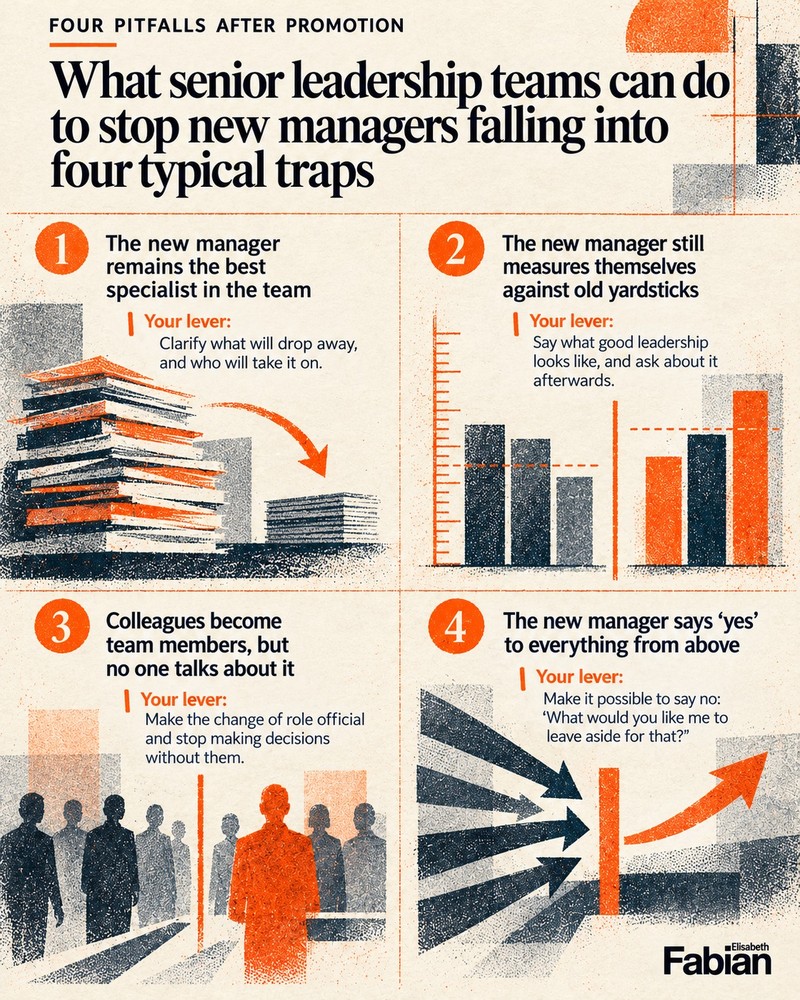
Figure: What company management can do to ensure new managers do not fall into four typical pitfalls
A simple framework for the first three months
None of these pitfalls can be avoided with a single conversation. What helps is a framework to guide the first few months:
- Before the promotion: a discussion about expectations. What’s new, what’s no longer required, and how do we recognise good leadership?
- In the first week: you officially announce the change of role to the team.
- In the first three months: 30 minutes every two weeks, dedicated solely to leadership issues. Three questions are enough: What meeting is coming up? Which task have you completed yourself that someone from the team could have taken on? Where do you need support?
- Before the first difficult meeting: prepare together instead of saying ‘You’ll manage that’.
- After three months: an honest assessment of where things stand. What’s working, what isn’t, and what else is needed?
This isn’t a grand scheme. It’s just a few appointments in the diary that prevent a young manager from facing problems alone for a whole year – problems that could have been resolved in a few short conversations.
What you don’t have to do yourself
However, there is one thing you, as management, should bear in mind: you cannot and do not have to be the right point of contact for every leadership issue. Young managers in particular often find it difficult to show uncertainty or admit their own mistakes to the person who promoted them. After all, they want to prove that your decision was the right one.
This is where external support can be useful. It offers young managers a space in which they can openly address difficult situations, question decisions and reflect on their own leadership behaviour.
What matters here is not so much the format as the duration. A workshop prior to promotion can cover the basics. However, the real questions often only arise in day-to-day management: during the first conflict, the first time they have to say ‘no’ to a superior, or the first time a team member carries out a task differently than expected.
Support spanning several weeks can therefore be more effective than two intensive days of training. As senior management, you remain responsible for this process, but you do not have to personally oversee every challenge.
Conclusion: The promotion is your decision, and so is the start
A promotion is a decision you make. To a large extent, you play a key role in determining how the first few months afterwards unfold. The four pitfalls are neither inevitable nor a sign of a lack of suitability. They are simply what happens when someone takes on a new job whilst still holding onto their old one, without anyone saying so out loud.
Many companies allow two weeks for onboarding new software. For a new manager, a congratulatory email is often enough. That’s exactly where you can start. And perhaps it begins with a simple question to your newest manager, even this week: “What’s proving difficult at the moment?”
Notes:
Are you interested in having a chat with Elisabeth Fabian? Then simply get in touch with her via LinkedIn or visit her excellent website.
Would you like to support Elisabeth Fabian and discuss a sensible approach to funding? Then please share this post on social media or within your organisation.
Elisabeth Fabian has published another post on the t2informatik Blog:

How to measure corporate culture …

Elisabeth Fabian
Elisabeth Fabian supports young leaders during their first years in management. She headed up the Enterprise Solutions division at Hays, was branch manager in Graz and a member of the Austrian Management Board. In these roles, she built up teams and a consultancy division from the ground up.
Through Leadership OS, she works one-to-one for twelve weeks with managers who tend to take on too much themselves: focusing on clear communication, shared responsibility and a day-to-day management routine that leaves room for what really matters. Together with Matthias Fabian, she runs Elisabeth Fabian GmbH in Graz and writes the fortnightly newsletter ‘Mitten im Führungsalltag’.
On the t2informatik Blog, we share knowledge and experience with people in organisations. We have been developing and modernising software for them since 2012. Pragmatically. ✔️ Personal. ✔️ Professional. ✔️ Get to know t2informatik as your development partner.