
What conflicts reveal
We usually look for the answer in the trigger. Who said what? Who made which decision? Who is responsible? But as understandable as these questions are, they fall short. They remain on the surface. They explain the cause, but not the actual dynamics.
Conflict does not arise by chance. It arises when something is at stake. When a value is affected. When a need remains unfulfilled. When a person feels that something important is threatened. This can be recognition, security, influence, justice, or belonging. The greater the friction, the greater the perceived significance, as a rule.
That is why asking “why” rarely gets us very far. It provides reasons, sometimes even justifications. But it does not explain what people are actually fighting for. And it is precisely this “what” that remains surprisingly unclear in many disputes. Instead, those involved get caught up in details, arguments, and counterarguments.
If it didn’t matter, there would be no conflict
>Practice shows that those involved in disputes are not always concerned with objective reasons. Often there is only one motive: to win. The human ego is driven by feelings such as power, control, greed, pride, and the desire to be right. In such cases, people argue for the sake of arguing, without a clear goal or any real prospect of a solution.
Winning then becomes an end in itself. The dispute no longer serves to clarify the issue, but to confirm one’s own position. The conflict becomes a stage on which it is decided who will prevail.
I remember a mediation between two team leaders in a medium-sized company. Superficially, it was about the distribution of resources: Who gets which budget? Who is allowed to assign which employees? Both presented well-founded arguments, referring to figures, projects, and targets. It seemed like a classic distribution issue.
But the longer we talked, the more the tone shifted. Statements such as “You always get everything approved” or “We are constantly cutting costs, while you are allowed to grow” were no longer just casual remarks. They were expressions of a deeper feeling.
It wasn’t about numbers. It was about perception. About influence. About recognition within the company.
One felt systematically disadvantaged, the other constantly questioned. Both felt they had to prove themselves all the time. Both were convinced that they had to perform better than the other in order to be heard. The budget was only the visible object of conflict. In fact, both were defending their importance within the system.
As this connection slowly became apparent, the atmosphere in the room changed. The arguments became less heated, the statements more personal. Instead of “You’re taking resources away from us,” it suddenly became, “I feel like my work counts for less.”
That was the turning point. It wasn’t the numbers that had changed, but the understanding of each other.
Conflicts reveal what we are fighting for
In my work as a business mediator, I repeatedly find that the parties involved in a dispute often do not know what specific goal they are pursuing with the conflict. They know why they are arguing, but not what for. They can describe in detail what is bothering them, but not what should be different in the end. Yet this question is crucial. What for? Those who do not pursue a goal argue just for the sake of arguing.
That is why I recommend pausing briefly during a conflict and answering the following questions honestly:
- What is the purpose of this conflict?
- What specifically is to be achieved?
- Is there a common goal that unites both sides?
- What might a possible solution look like?
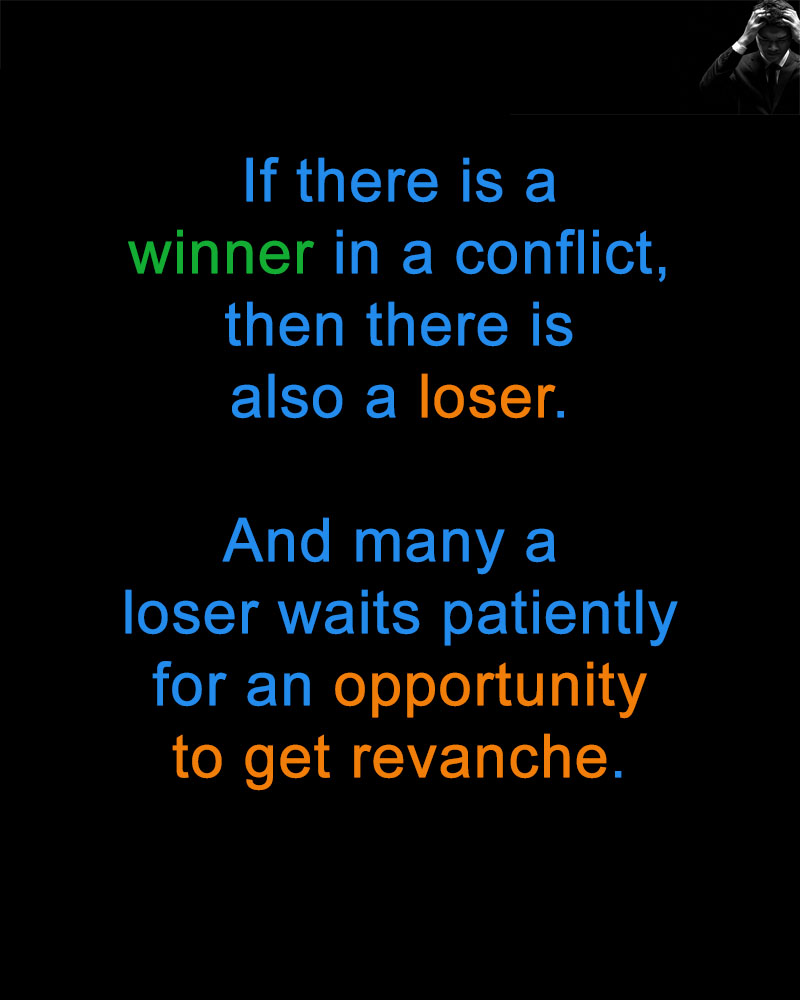
If the simple and honest answer is, “I want to win,” then my practical experience tells me that it’s not worth arguing about. Where there is a winner, there is always a loser. And many a loser waits patiently for an opportunity for revenge. An apparent victory can be costly in the long run.
Conflicts as an indication of importance
Emotions play a central role in conflicts. Anger, frustration, or hurt feelings are often experienced as disruptive. But first and foremost, they are indicators. They signal that something has been touched that is not arbitrary.
However, many people react reflexively. They argue louder, become harsher, and gather evidence to prove that they are right. The other person does the same. This creates a spiral of defense and attack. Both paddle with force, but in opposite directions. Positions harden, fronts become clearer, and mutual understanding diminishes.
What gets lost in the process is the question of one’s own responsibility. Not in the sense of guilt, but in the sense of self-clarification. Why does this affect me so much? What exactly feels threatened? Is it about respect, influence, security, belonging?
Those who take this step realize: I am not just reacting to behavior. I am reacting because something is important to me.
And the same applies to the other side. Behind every accusation there is a concern. Behind every harshness there is often a worry.
Conflicts are therefore less a battle between right and wrong than a collision of different meanings. Two perspectives, two value systems, two needs collide. As long as the struggle is only about positions, this level remains invisible.
Making the common ground visible
The decisive moment in the mediation between the two team leaders was not the agreement on figures. It was the realization that both shared the same basic concern: to be taken seriously and to be effective.
When this common ground became visible, cooperation emerged. The participants stopped seeing each other as opponents and began to look at the structural framework together. They no longer asked: Who gets more? Instead, they asked: How can we both be successful under fair conditions?
This changed the dynamic. Energy was no longer directed toward fighting each other, but toward shaping the situation.
Conflict resolution therefore does not mean smoothing over differences or creating harmony. It means recognizing what lies behind the positions. And acknowledging that both sides have good reasons to defend what is important to them.
Conclusion
Conflicts do not arise because people are difficult. They arise because something important is being touched upon.
Those who search exclusively for the “why” remain caught in a cycle of arguments and counterarguments. However, those who have the courage to ask “what for” enter a different realm. There, it is about values, needs, and recognition.
The subject of the dispute may be interchangeable. The underlying concerns are not.
Genuine clarification becomes possible when both sides understand what they want to protect and when they discover that opposing positions often conceal a common human need. That is precisely where understanding begins.
Notes:
People like and appreciate it very much when you take an interest in them and listen to them. If your counterpart is not yet listening to you, Stephanie Huber will be happy to listen to you. She will help you gain a different perspective. Often, this is enough for you to be able to generate clarification yourself. You can reach her at https://www.konsensation.de/ or info@konsensation.de.
Stephanie Huber has published more articles on the t2informatik Blog, including:

Avoid unnecessary conflicts

Tolerance and the diversity of opinions

Respectful interaction

Stephanie Huber
Stephanie Huber is founder and managing director of konSENSation GmbH. She works enthusiastically as a mediator with a focus on business mediation and conflict management and helps companies and executives to improve the working atmosphere.
In the t2informatik Blog, we publish articles for people in organisations. For these people, we develop and modernise software. Pragmatic. ✔️ Personal. ✔️ Professional. ✔️ Click here to find out more.