
How to remain confident when using AI
Expand the table of contents
We’ve been on a little journey together. In the first article, we put a name to your feelings about AI: uncertainty, reluctance, feeling overwhelmed or fear. We’ve established that these feelings are understandable and that you’re not alone in experiencing them. Perhaps you’ve even found your own starting point on a bridge that can guide you, step by step, in a new direction.
In the second article, we shifted our focus from the technology to you. We looked at three human strengths that no machine can take away from you: your experiential knowledge, your social skills and your ability to make responsible decisions even in unclear situations.
Now comes the third and decisive step. It’s about how you can actively take control of AI and ensure that it stays in your hands.
What confidence really means
Many people think that you need to know a great deal about technology to be confident in dealing with AI. This is a misconception that creates unnecessary pressure. Perhaps this impression arises partly because many people focus on the technology itself and are keen to share their knowledge of it.
However, being in control when dealing with AI is not primarily about technical knowledge. It is, above all, a question of attitude.
Being in control means that youThe difference between a person who is driven by AI and a person who consciously controls AI therefore does not lie solely in knowledge. It lies in the way the results are handled.
- know when to use AI and when not to.
- can assess when it helps you and when it does not.
- Check results rather than accepting them blindly.
- Challenge them if something does not seem plausible.
- Ask for clarification when things are unclear and do not believe everything simply because it is convincingly worded.
- The final decision remains with you.
Those who allow themselves to be driven by AI ask: ‘What does the system say?’ and may follow the answer without questioning it further. Those who use AI confidently ask additional questions: ‘Does this match my experience?’, ‘Does this apply to my specific situation?’ and ‘Which parts of this do I actually want to adopt?’
You don’t need any special technical expertise to ask these questions. Above all, you need the willingness to make conscious decisions and to stay in control.
Three habits of confident people when dealing with AI
Confidence isn’t born of a single defining moment. It develops through small, recurring habits. You can incorporate three of these directly into your everyday life.
1. Check before you trust
AI systems produce results at great speed and often with a surprising degree of certainty in their tone. It is precisely this that tempts us to simply accept their answers.
Confident people do not do this. They read what the system suggests and then ask themselves a simple question: Does this fit with what I know and have experienced?
Incidentally, this behaviour is neither new nor limited to AI. We all know people who come across as very convincing, even though their statements are wrong or at least questionable. People who mask their uncertainty with self-assurance and sound very convincing in the process.
Whether it’s a human or AI: don’t rely solely on the certainty with which something is phrased. Rely also on your experience, your judgement and your intuition.
When I’m developing new training materials, I often use AI to get the ball rolling. For example, I ask it to suggest a structure or possible examples for a new topic. However, I never adopt these suggestions without checking them first. I read through them with the knowledge gained from many years of practical experience in mind. Does this example really suit my participants? Does the statement align with what I’ve experienced myself in workshops? And how can I use the result in a way that fits with my own style of explaining things?
I often change the wording or add my own experiences, which an AI couldn’t provide in that way. It is precisely this scrutiny that ultimately makes the difference between generic training materials and truly good ones.
2. Set deliberate boundaries
AI shouldn’t take on every task. Decide for yourself which areas of your work are important to you and which you deliberately wish to keep in your own hands. These might include face-to-face conversations with clients, the final drafting of an important text, or decisions that touch on your values.
Such boundaries are not a sign of being behind the times. Rather, they show that you know what is important to you in your work. And, of course, these boundaries are allowed to change. You can experiment, gain experience and adjust your decisions later on.
For example, I have set a very clear boundary for myself: I do not write emails to my contacts using AI. My interactions with my clients are based on trust and my personal touch. That is precisely what I do not want to relinquish, even if AI could technically handle this task without any difficulty.
This decision sometimes takes me a little longer. However, it also ensures that the people I’m communicating with actually recognise me and do not receive an interchangeable, formulaic response. For me, this is precisely a conscious expression of autonomy.
3. Reflect regularly
Set aside a quarter of an hour once a week and ask yourself three questions: This reflection keeps you on your toes. It helps you avoid slipping unnoticed into a passive role and enables you to continually readjust your own approach to AI.
- Where has AI really helped me this week?
- Where has it disrupted me or steered me in the wrong direction?
- Where have I given it too much leeway or let others put me under pressure?
Incidentally, my personal reflection time doesn’t take place at my desk, but whilst walking the dog. On Fridays, I set aside time for this, if it suits. Not every week, but often enough to go over the past few days in my mind. Sometimes I also speak my thoughts directly into my smartphone’s voice-to-text feature. That’s often when the most honest insights emerge: far away from the screen, with the dog’s leads in my hand and with a little more distance from my everyday working life.
Achieving DOBO with confidence
Do you remember DOBO from previous posts? [1] This refers to the desire to be particularly effective in the age of AI. Three habits help you do just that:
1. When you scrutinise results rather than accepting them blindly, you take your own expertise seriously. You compare suggestions with your experience, question statements and decide for yourself what is right for your situation. This confidence in your own judgement is a key foundation for DOBO.
2. By setting clear boundaries, you actively shape your work rather than letting yourself be carried along. You decide for yourself what you will use AI for and what you won’t. This clarity reveals what you stand for and which tasks you consciously wish to keep in your own hands.
3. And when you reflect regularly, you develop your approach to AI step by step. You learn from both positive and negative experiences and continually adapt your decisions.
For me, this is precisely the essence of DOBO. It is not about avoiding AI or following it blindly. It is about becoming more confident, clearer and more effective with every experience. In this way, something new can gradually emerge from FOBO and FOLA. [2] [3] Not through a giant leap, but through small habits that help you shape your own approach to AI.
From being externally driven to being in control on the bridge
Do you remember the bridge model from the first post? It was all about breaking down major changes into small, achievable steps. One particularly important bridge leads from being externally driven to being in control.
Imagine you work in a company that is introducing new AI-supported processes. Suddenly, a lot of things are running automatically. Decisions are prepared by systems, workflows are changing, and your own role may feel smaller than before. You get the feeling that things are happening to you, rather than you shaping them yourself.
This is exactly where the first step comes in: understanding.
You don’t need to understand every technical detail. What matters is that you can grasp what the system actually does in your day-to-day work. Where does it intervene? Which tasks does it take on? Which decisions does it prepare? And what remains in your hands?
This understanding provides clarity. The unknown loses some of its power as soon as you are better able to assess exactly what is happening.
In my experience, it helps to make this step tangible. Write down where AI is already involved in your work, what has changed as a result, and which tasks remain your responsibility. Often, simply having this overview makes it clearer just how much scope you actually have to shape things.
The second step is active control.
You begin to consciously use AI for tasks that you wish to delegate to it. At the same time, you retain those activities that are important to you or that require your experience, judgement and responsibility. This is how your role changes. You are no longer merely reacting to a system, but are increasingly deciding for yourself how you wish to use it.
If you already work with agile methods, two concepts may sound familiar to you:
The first is self-organisation. Teams decide for themselves how best to tackle their tasks. A similar approach also helps when dealing with AI: you consciously consider where you want AI to provide support and where you wish to retain responsibility yourself.
The second concept is the iterative approach. You don’t have to find the perfect way of working with AI on your first attempt. Try something small, observe what works, and then adjust your approach accordingly.
Confidence doesn’t develop overnight. It grows with every experience.
The value square also helps to put this development into perspective. Too much control can tip over into mistrust. Then you scrutinise every result so thoroughly that the potential benefits of AI are lost. Too much trust, on the other hand, can end in naivety. Then you accept suggestions without checking them and, without realising it, hand over responsibility.
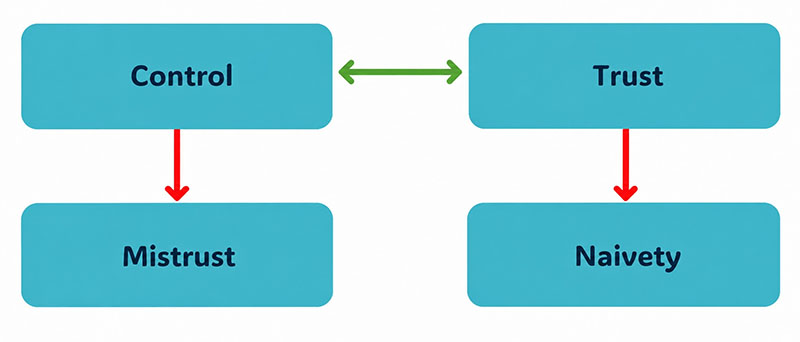
Figure: Value square on control and trust
Sovereignty lies between these two extremes.
Sometimes a situation calls for more control, at other times, you can allow more scope for a particular outcome. The key is that this balance does not arise by chance, but is consciously shaped by you.
Your confident approach begins today
Now it’s back to your own practice.
Think of a specific situation from your day-to-day work. A task that regularly takes up your time without really challenging you or giving you any pleasure. Perhaps it involves summarising longer texts, preparing documents or researching information.
Incidentally, if you find yourself putting off certain tasks time and again, that’s a good indication that they might be suitable for this exercise.
Write down one such task.
Then ask yourself: Which of your personal strengths actually plays hardly any role in this activity? Does it require a lot of experience? Social skills? A sense of responsibility? Intuition?
You might realise that this very task could be well supported by an AI tool or even partially taken over by one. And then comes the question I find even more intriguing: what would you do with the time you’ve gained?
- What conversation could you have?
- What decision could you prepare more carefully?
- Where could you give a colleague more attention?
- Or what task could you finally tackle that you’d otherwise barely have time for in your day-to-day life?
As with the exercises in the two previous posts, you can use the dictation function on your smartphone here too. Or you could discuss your thoughts with a colleague you trust.
For me, this is precisely what constitutes a confident approach to AI. You decide where it serves you. You decide what remains your responsibility. And you decide what to do with the freedom you’ve gained.
When an entire team becomes more confident
A few weeks ago, in a small IT department, I witnessed the impact that collective reflection on the use of AI can have. The team had already been using AI in their day-to-day work for some time, including Microsoft Copilot. During a regular quarterly retrospective, I took up the three reflection questions from the previous chapter and worked through them with the team.
When asked where AI had really helped over the past few weeks, several team members independently mentioned the faster processing of error analyses. The team leader had already noticed this, but sharing this perspective made the benefits even more tangible for everyone.
I was able to report from other companies that, in some cases, the time required for an in-depth error analysis based on a log file had been reduced from several days to around 30 minutes.
Things got more interesting with the second question: where had AI caused problems or steered things in the wrong direction?
It became clear that one colleague had, on several occasions, adopted suggestions too quickly. In dealings with customers, this had led to misunderstandings. The team was already familiar with such experiences from other situations and quickly turned to the topic of ‘AI sloppiness’. [4]
The third question finally shifted the focus away from the technology and towards collaboration: where had the team given the AI too much leeway, or allowed time pressure to lead them into rushing to solutions?
This discussion resulted in a simple agreement: in future, AI-generated texts for clients will always be proofread by a second person. This rule did not come from outside the team. It arose from the team’s own experiences and from their joint reflection on where AI provides support and where additional attention is required.
For me, this is precisely where the strength of such retrospectives lies. They bring individual experiences to light, foster shared learning and help a team to develop its own rules for working with AI.
The journey continues
We have taken three steps in this series: This brings this short series to a close. Your own journey in dealing with AI, of course, does not end here.
- In the first article, you identified your feelings about AI and saw that uncertainty, reluctance or fear can be understandable reactions.
- The second article focused on your human strengths: experience, social skills and the ability to take responsibility even in unclear situations.
- And in this third post, we’ve looked at how you can use AI consciously, review results, set your own boundaries and retain control over how you interact with AI.
The technology will continue to evolve. New tools will emerge, whilst others will disappear. New possibilities will arise, and new questions are likely to follow. Nevertheless, your starting point remains the same: you yourself, with your experiences, your strengths and your ability to make responsible decisions.
Sovereignty therefore does not mean having found a definitive way of dealing with AI at some point. It is constantly being redefined. Through trial and error, questioning, learning and the conscious decision as to what you leave to the technology and what should remain in your hands.
Notes:
Dierk Soellner supports individuals and teams on this journey through workshops, training sessions and one-to-one discussions. If you’d rather not go it alone, simply get in touch with him via his website or on LinkedIn.
[1] What skills does DOBO foster?
[2] What factors can contribute to FOBO?
[3] What can promote FOLA?
[4] Characteristics and causes of AI slop or workslop
Would you like to support Dierk Soellner and discuss how to work confidently with AI? Then share this post on social media or within your organisation.
Dierk Soellner has published more posts on the t2informatik Blog, including:

Why AI causes uncertainty for many people

Which strengths really count in the age of AI

Solution seeks problem

Dierk Soellner
Dierk Soellner’s vision is: ‘Empowering people and teams – with empathy and expertise’. As a certified business coach (dvct e.V.), he supports teams, specialists and managers in tackling current challenges through professional coaching. Combined with his many years of extensive specialist expertise in IT methodology frameworks, this makes him a competent and empathetic guide in the fields of personnel, team and organisational development. He also holds a teaching post on ‘Modern approaches to designing high-performing IT organisations’ at the NORDAKADEMIE in Hamburg and has published the specialist book IT-Service Management mit FitSM.
His clients range from DAX corporations to medium-sized companies to smaller IT service providers. He likes to tweet and regularly publishes expert articles in print and online media. Together with other experts, he founded the Value Stream initiative.
On the t2informatik Blog, we share knowledge and experience with people in organisations. We have been developing and modernising software for them since 2012. Pragmatically. ✔️ Personal. ✔️ Professional. ✔️ Get to know t2informatik as your development partner.