
From self-management to obsession with optimisation
Expand the table of contents
Eat-that Frog: The most unpleasant task first
The Pomodoro Technique: Working in short intervals of focus
The Ivy Lee method: Six taks for the next day
The Not-to-do list: Consciously foregoing tasks
When self-management becomes an obsession with optiimisation
Why the logic of self-optimisation is so easy to buy into
Conclusion
What can methods such as Eat That Frog, Ivy Lee and Pomodoro achieve, and where are their limitations?
Self-management is a big promise. With the right method, so the widespread hope goes, working days can be structured, tasks completed more consistently and distractions better controlled. Names such as Eat That Frog, Ivy Lee and Pomodoro crop up time and again in this context. The ideas behind them are often astonishingly simple: set priorities, work in a focused manner and complete unpleasant tasks first.
Many of these methods actually work. They help you get started on tasks, reduce decision-making stress and bring structure to an often hectic working day.
However, a whole logic of optimisation has long since developed around productivity. The day is divided into blocks of time, tasks are sorted according to their impact, and even breaks sometimes follow a method. The implicit message is that with the right technique, you can continuously improve your own behaviour.
It’s worth taking a closer look here. What is intended as a helpful tool can quickly become a new form of self-control. When every minute is planned, every habit optimised and every deviation perceived as inefficient, the path from self-management to obsession with optimisation is relatively short.
So let’s take a look at some well-known methods of time and self-management. What do they actually achieve, where do they help in everyday life and where are their limits?
The 5 Second Rule: Just get started
The 5 Second Rule was developed by author Mel Robbins and addresses one of the most common problems in everyday working life: procrastination. The idea is simple: as soon as you feel the urge to start a task, count down from five in your head and start the task at zero.
The approach uses a well-known psychological mechanism: there is often a brief moment of hesitation between the thought of doing something and the actual action. During this phase, the brain quickly finds reasons why a task can wait. Seconds turn into minutes, and minutes sometimes turn into days.
Consciously counting down interrupts this process. The focus shifts from thinking to acting. Especially with small or unpleasant tasks, this can help to overcome the initial hurdle. Provided, of course, that you don’t use the five seconds to quickly open an email.
At the same time, this method also has its limitations: not every task fails because we think about it for too long. Sometimes we lack time, energy or clear priorities. In such cases, even a countdown won’t help. It is not a universal recipe for productivity, but rather a little mental trick that helps you get started at certain moments. That is where its real value lies. It becomes problematic when such a tool creates the expectation that every form of hesitation must be overcome.
Eat-that-Frog: The most unpleasant task first
The Eat-that-Frog method was developed by author Brian Tracy and is also based on a simple idea: complete the most important or unpleasant task of the day as early as possible. The ‘frog’ symbolises the task that you would most like to put off. The metaphor plays with the idea of having to eat a frog first thing in the morning. Once that’s done, the rest of the day can hardly get any worse.
The idea behind it is understandable: difficult, complex or unpleasant tasks create inner resistance. Many people tend to do smaller or more pleasant tasks first. [1] This feels productive, but rarely solves the actual challenges of the day.
The method therefore recommends consciously starting the day with this one important but unpleasant task. Eating the ‘frog’ first thing in the morning quickly creates clarity and reduces the mental pressure associated with unfinished tasks.
In practice, this approach can be very effective. Especially for strategically important or particularly unpleasant tasks, the method helps to implement priorities more consistently. But there is a limitation here too: not every working day can be structured so clearly that the most important task can simply be completed in the morning. Meetings, consultations or external requirements often set their own priorities.
There is another point to consider: if every day begins with the most unpleasant part of the work, this can have a negative impact on motivation in the long term. Who enjoys going to work when they know that the most difficult part of the day awaits them every morning?
The Pomodoro Technique: Working in short intervals of focus
The Pomodoro Technique was developed in the 1980s by Francesco Cirillo. Its name comes from a simple kitchen timer in the shape of a tomato that Cirillo used during his studies. ‘Pomodoro’ is the Italian word for tomato.
The basic idea is easy to explain: work is divided into short, clearly defined 25-minute intervals. During this time, you work on one task with full concentration and avoid any distractions as much as possible. This is followed by a short break. After several of these intervals, you take a longer break. [2]
The approach makes use of a simple effect: clear time slots help many people to concentrate better. The task seems more manageable because it initially only requires attention for a limited period of time. At the same time, regular breaks ensure that concentration remains stable over a longer period of time.
Unsurprisingly, there are practical limitations here too: not every activity can be easily broken down into 25-minute blocks. Discussions, spontaneous consultations or phone calls rarely follow a fixed time schedule. In addition, particularly demanding tasks sometimes involve so-called flow states, in which work is particularly focused and productive. Interrupting such a phase just because a timer rings can be counterproductive.
The Ivy Lee method: Six tasks for the next day
The Ivy Lee method dates back to an anecdote from the early 20th century. Management consultant Ivy Lee is said to have advised executives to prioritise their work consistently. According to this method, at the end of each working day, you should write down and prioritise the six most important tasks for the next day.
The following day, you start with the first task and work through the list step by step. Only when one task is completed do you move on to the next. Unfinished tasks are carried over to the next day and reprioritised.
The strength of the method lies in its clarity. Limiting yourself to six tasks forces you to consciously choose what is really important. At the same time, the prepared list reduces the amount of decision-making required the next morning. Instead of first thinking about where to start, you begin directly with the most important task.
For many people, this approach creates structure and focus. The method helps to make priorities visible and prevents the day from becoming fragmented by a multitude of small tasks. However, working days rarely run as predictably as a fixed list suggests. New requirements, spontaneous consultations or unexpected problems can quickly change carefully planned priorities.
The Not-to-do list: Consciously foregoing tasks
Most self-management methods deal with one central question: what should we do? The Not-to-do list asks the opposite question: what should we consciously refrain from doing? Instead of constantly organising, prioritising or completing new tasks more efficiently, activities are identified that should be consciously avoided. These can be certain habits, unnecessary meetings, constantly checking emails or tasks that contribute little to the actual goal.
The approach is based on a simple insight: a working day is finite and most people have too much to do rather than too little.
A Not-to-do list provides clarity here. It highlights which activities should deliberately not be part of your daily work routine. This change of perspective can be a relief, especially in complex working environments. Productivity is then achieved not only through better organisation, but also through conscious omission.
But even omission can become another optimisation strategy: anyone who starts to systematically analyse and eliminate every habit quickly falls back into the same logic of permanent improvement.
When self-management becomes an obsession with optimisation
The methods mentioned above clearly follow a similar logic: they attempt to reduce the complexity of everyday working life by means of simple rules. The working day is structured, priorities are set and distractions are deliberately limited. Used correctly, such rules can actually make everyday life easier.
However, problems arise when individual tools are turned into a permanent system of self-control. Then it is no longer just work that is organised, but also one’s own behaviour that is constantly observed and improved. Every task is optimised, every habit analysed, every work step made as efficient as possible.
A similar mechanism is known from organisations: micromanagement. Managers try to control work through increasingly detailed rules and controls. Exactly this logic can also arise in self-management.
Helpful tools quickly turn into a form of self-micromanagement.
The working day becomes a sequence of methods. Tasks are selected according to rules, time is broken down into intervals, and decisions follow fixed routines. This may work in the short term. In the long run, however, a new pressure easily arises: the demand to organise every day as perfectly as possible.
This reveals a paradoxical side to many self-management approaches. They are supposed to help people deal with work better. At the same time, they can lead to people starting to control themselves more and more. Self-management then quickly turns into self-optimisation. And the desire to constantly improve often gives rise to a new demand: to become even more efficient, structured and productive.
The step from self-management to obsession with optimisation is then often smaller than it initially seems.
Why the logic of self-optimisation is so easy to buy into
The idea of organising yourself better seems reasonable at first. Setting priorities, working in a more focused way or reducing distractions can actually improve your everyday working life. Many self-management methods build on precisely this experience.
At the same time, it is striking how quickly individual techniques can develop into a more comprehensive logic. The working day is planned, habits are analysed, routines are adjusted. Step by step, the impression arises that one’s own behaviour can also be continuously improved.
Several factors contribute to the persuasiveness of this logic:
- One reason lies in the increasing pressure to perform in many organisations. Work is becoming more complex, tasks are becoming more diverse, and expectations regarding speed and efficiency are continuously rising. Many people respond to this by searching for methods that promise them more structure. In this environment, self-management appears to be a pragmatic answer to a structural problem.
- Added to this is a culture of comparison. On social networks, podcasts and in self-help books, people talk about their routines, morning rituals and productivity systems. The message is usually unspoken, but clear: if you want to work more successfully, you should consistently optimise your behaviour.
- The market for productivity guides also reinforces this logic. Many methods promise simple solutions to complex challenges. Small changes are supposed to have a big impact. That sounds plausible.
- Finally, another factor plays a role: self-optimisation conveys a feeling of control. Those who apply methods at least have the impression that they can actively do something. In a working world that is often characterised by uncertainty and high dynamics, this has a calming effect.
This is precisely why the line between helpful structure and constant pressure to optimise is often difficult to recognise. What starts as a tool can easily develop into a permanent demand.
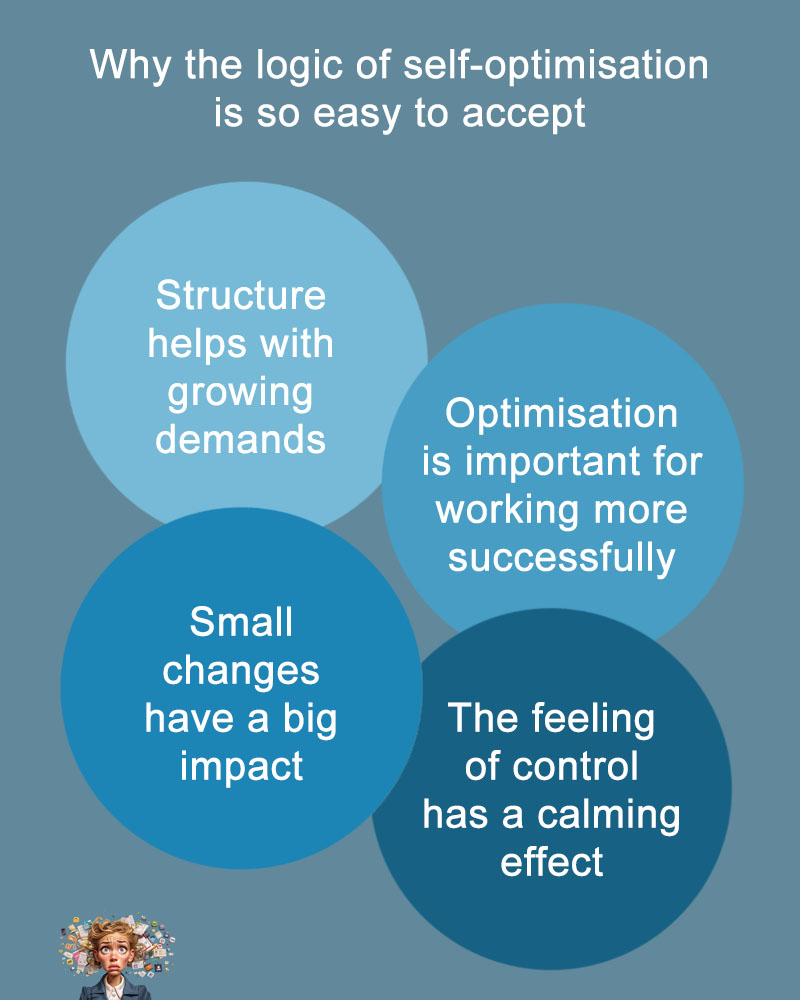
Figure: Why the logic of self-optimisation is so easy to accept
Conclusion
Self-management methods have their uses. Many work so well precisely because they use simple principles: start instead of procrastinating, do the important things first and reduce distractions.
At the same time, each method also has its own challenges:
- The 5 Second Rule can help you get started. Sometimes it takes ten seconds or a minute.
- Pomodoro works with clear time intervals. In practice, you might continue working for thirty minutes because a good idea has just come to mind.
- The Ivy Lee method recommends six tasks for the next day. Perhaps five would be more suitable for a particular day.
Such deviations are an indication that work is rarely as predictable as many models suggest.
Methods can provide guidance, but they cannot replace your own judgement. They are tools for work, not the yardstick by which it should be measured.
Self-management therefore does not mean adhering to methods as consistently as possible. It means using methods consciously and knowing their limitations.
Notes (partly in German):
[1] This phenomenon is called precrastination. Tasks are preferably completed quickly. That sounds good at first. Every to-do item that is ticked off releases endorphins, but pre-crastination quickly becomes a trap that we use to sabotage ourselves when we work through the easy and quick tasks first. Ticking things off just feels good. Too good, sometimes. The list as a whole gets shorter, which feels good. But all the rest, especially the more complex and, of course, the unpleasant tasks, remain undone. And they remain undone, and remain undone, and remain undone.
[2] The 60-Minutes method takes a similar approach with a fixed time interval, where you reserve 60 minutes each day to work on a specific task.
Would you like to discuss self-management versus optimisation mania as a multiplier or opinion leader? Then share this post in your networks.
Michael Schenkel has published more posts on the t2informatik Blog, including:

Form on the day in everyday working life

6 templates for better collaboration

Our world of beliefs

Michael Schenkel
Head of Marketing, t2informatik GmbH
Michael Schenkel has a heart for marketing - so it is fitting that he is responsible for marketing at t2informatik. He likes to blog, likes a change of perspective and tries to offer useful information - e.g. here in the blog - at a time when there is a lot of talk about people's decreasing attention span. If you feel like it, arrange to meet him for a coffee and a piece of cake; he will certainly look forward to it!
In the t2informatik Blog, we publish articles for people in organisations. For these people, we develop and modernise software. Pragmatic. ✔️ Personal. ✔️ Professional. ✔️ Click here to find out more.