
From colleague to manager
Expand the table of contents
The leap to the top of the team: yesterday a colleague, today the boss
Leadership is not a side job: act operationally and think strategically
Finding your role: clarifying expectations and practising leadership
Delegation as a lever for motivation and accountability
Successful leadership: Trust, develop, and empower
The transition to a management role: leading with clarity and gaining acceptance
There are around two million managers in Germany. Nevertheless, the German economy is short of around 28,000 more managers and supervisors. A survey by the German Economic Institute shows that only one in seven can imagine taking on such a role. [1] For many, the workload is too high, whilst the additional income seems too low. As a result, manager positions often remain unfilled.
The leap to the top of the team: yesterday a colleague, today the boss
Leadership can be a very fulfilling job. Especially when you find your feet in the role, take on responsibility and work with people who are all pulling together towards a common goal. As I write these lines, I realise myself just how idealistic that sounds. Because in the day-to-day life of a manager, the reality is often quite different.
Leadership often means preventing fires, putting out fires and taking away the lighters from those who play with fire. In coaching and training sessions, many managers speak less of a normal office routine and more of constant crisis management.
Nevertheless, people continue to take this step time and again. Some even move directly from being a colleague to the role of manager, often within the same team. One day a colleague, the next the boss. It is precisely this transition that brings questions and challenges for everyone involved.
An important first step is therefore to truly understand the new role. This does not just mean the multitude of new appointments and tasks. Above all, what matters is what it means to bear responsibility for people and results as a manager.
Many new managers mean well. They want to lead fairly, provide support and do better than previous bad bosses. Yet it soon becomes clear just how demanding managing staff is in day-to-day life.
If you want to be a successful manager, you need more than just good intentions. Communication, clarity, decision-making and providing direction are part of the daily routine. Sometimes it’s a sick note in the morning, sometimes a customer issue, sometimes meetings with senior management. The demands are constantly changing.
The transition from being part of a team to taking on a leadership role is therefore more than just a new title. It is a genuine change of role for which you should consciously prepare yourself.
Leadership is not a side job: act operationally and think strategically
It is not enough simply to claim to possess the typical traits of a leader. Anyone who wants to be a successful manager must practise and hone their communication skills, clarity and decision-making, and adapt them to their own daily routine. This takes time, patience and experience. No one is born a master.
At the same time, be aware that leadership is not a part-time job that you can only do half-heartedly. Particularly in the technical sector, I often see managers who remain heavily involved in day-to-day operational business. If you try to do everything yourself and lead effectively at the same time, it usually doesn’t work out.
This brings to mind a personal experience I still often reflect on. During our introductory meeting, a manager said to me: “Don’t worry. Everything will stay exactly as it is.” Naive as I was back then, I believed him. A few weeks later, nothing was the same as before. New ways of working, new approaches, a new style of communication – and, at times, silence.
It wasn’t the newness itself that was the problem. What was particularly difficult was the lack of clarity about where it was all heading. That is precisely why employees need guidance. A manager should not only initiate changes, but also explain why they are necessary and what the underlying goal is.
When you move from being a colleague to a manager, you naturally want to make a difference. Perhaps certain processes have been bothering you for a long time and you’d like to finally improve them. Perhaps you consciously decide to first restore calm and safeguard what already exists. Both approaches can be valid.
What is more important is that you know what your role truly demands. Take the time to gain this clarity. Do not focus solely on immediate problems or visible weaknesses. Good managers also keep strategic issues in mind.
Are all key positions in the team filled? Are there any impending staff shortages, for example due to retirements? What role does your department play within the company? What developments – such as AI, skills shortages or rising costs – will affect your team in the short, medium or long term?
Anyone who wants to lead must therefore be able to do two things: manage day-to-day operations whilst thinking about tomorrow.
Finding your role: clarifying expectations and practising leadership
Before you can truly fulfil your new leadership role, you need to answer one key question for yourself: where do you want to lead your team?
You won’t be able to answer this question sitting alone at your desk. Talk to your line manager about what is expected of you and your responsibilities. Involve your team as well. What challenges do your team members see? Where do the opportunities lie? Which strengths should be utilised even more in future? And ask yourself: What do I actually want to achieve here?
Once you have clear answers to these questions, many leadership tools will become much easier to apply. Performance reviews, delegation, feedback and choosing the right leadership style will then take on a clear direction.
This clarification also helps with an issue that concerns many new managers: proximity and distance. Especially when you move from being a colleague to a manager, you often experience uncertainty here. It is not uncommon for relationships to change, sometimes even friendships.
I recall a manager I coached who didn’t know how to handle the invitations to her wedding. She was only friends with part of the team in her private life and wanted to celebrate only with those people. Another client managed his own brother-in-law and found that the relationship became increasingly strained, even in everyday family life.
These are special cases, but they clearly show that the transition to a leadership role is not only professionally but often emotionally demanding.
Many newcomers then ask themselves how much distance a manager must maintain. In my view, this is often a false debate. What matters is not the distance, but the quality of leadership. Instead, ask yourself: When were you yourself well led? What made a good manager for you?
A good manager focuses on people. They value their employees’ knowledge and skills, listen, take opinions seriously, give feedback, build trust and delegate responsibility. At the same time, they keep an eye on results. They set expectations, demand quality, support the team, offer praise and motivate them to perform well.
Feel free to ask your employees directly: “What do you need from me to do a good job?” Clarify together what good work means in day-to-day practice. This way, you avoid misunderstandings and develop your own role as a manager step by step.
As this role becomes clearer, the question of closeness and distance also loses its significance. What matters most then is how you put leadership into practice in your daily work.
Delegation as a lever for motivation and accountability
Generally speaking, I recommend that you empower your staff. People want to feel that their work is meaningful and that they are part of a well-functioning team. If you succeed in doing this as a manager, you will foster motivation and a genuine sense of belonging.
However, this won’t work if you, as a manager, take yourself too seriously. If every decision has to go through you, every email has to be copied to you, or tasks can only be done exactly as you would do them yourself, this slows your team down.
New managers in particular, who were previously part of the team, often struggle with delegation. Typical thoughts include: “If I do it myself, at least I know it will be done properly.” Or: “My team are already stretched thin; I’d rather do it myself.”
Yet this leaves a lot of potential untapped. Delegating tasks does not simply mean passing on tedious work. It means sharing responsibility and, ideally, achieving success together. This is precisely what boosts motivation and loyalty.
Many employees now view work merely as a duty. This is often because they are rarely given interesting or independent tasks. A good manager can address this specifically.
The following, for example, have a motivating effect:
- varied tasks, such as through new topics or changing responsibilities,
- a complete process rather than small individual steps,
- the feeling of making an important contribution,
- autonomy and the freedom to make their own decisions, as well as
- direct feedback on their own work. [2] [3]
Make a conscious effort to look for tasks that include such features, and assign them appropriately to your employees. Naturally, new tasks should be challenging, but not overwhelming.
You will find that some employees are just waiting for someone to finally trust them with something. This is precisely where an important task for every manager lies.
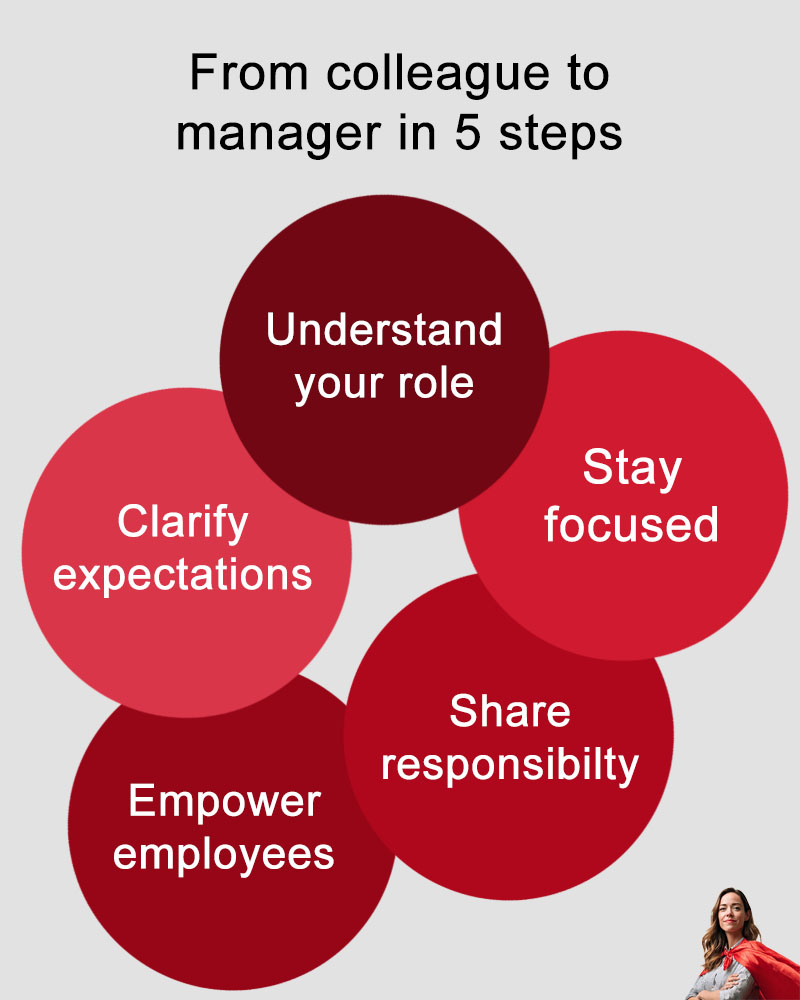
Figure: From colleague to manager in 5 steps
Successful leadership: Trust, develop, and empower
Many employees are reluctant to take on a leadership role: too much pressure, too little financial incentive. Perhaps you recognise these thoughts too. At the same time, leadership can be very fulfilling when the role, expectations and collaboration are clearly defined.
In practice, however, many managers experience their role less as one of creative freedom and more as constant facilitation, conflict resolution and crisis management. Leadership involves a variety of communication situations; it requires practice and conscious self-management, and is not a side job that you can simply handle alongside your day-to-day duties.
Anyone who wants to be a successful manager should therefore not just fix immediate problems. It is also important to look ahead: How is the team developing? What staffing needs are emerging? What role does the department play within the company? And what external influences, such as AI or market changes, need to be taken into account?
The key question here is: Where do you want to lead your team?
You can strike a good balance between closeness and distance by keeping both the people and the task in mind. Listening, showing appreciation, giving feedback and placing trust are just as much a part of this as clear expectations, improvements, motivation and recognition.
Delegation is a particularly important lever. Those who delegate responsibility in a targeted manner are not only sharing tasks, but also purpose, development and success. Employees become stronger, take on more responsibility and grow through new tasks.
This is precisely what good leadership is all about: a good manager does not do everything themselves, but empowers others to succeed.
Notes (partly in German):
Do you want to improve collaboration within your team or your skills as a manager? Then visit Michael Zocholl’s website and arrange a meeting. It’s definitely worth it!
[1] Institut der deutschen Wirtschaft: KOFA Kompakt 1/2026 – Führungsetage leer? Was Beschäftigte wirklich zur Führung motiviert
[2] Bakker, A. B. & Demerouti, E. (2007). The job demands-resources model: State of the art. Journal of Managerial Psychology, 22(3), 309-328
[3] Christian, M. S., Garza, A. S. & Slaughter, J. E. (2011). Work engagement: A quantitative review and test of its relations with task and contextual performance. Personnel Psychology, 64(1), 89-136
Would you like to discuss the transition from colleague to manager as an influencer or thought leader? Then please share this post on your social media channels.
Michael Zocholl has published more posts on the t2informatik Blog, including:

Feedback as an active leadership tool

Conflicts in employee appraisals

The art of performance appraisal

Michael Zocholl
Michael Zocholl is a business psychologist who supports managers and teams in strengthening communication, cooperation and trust in the long term – through workshops, coaching and training. In his podcast Zuhören, Fragen, Führen (Listen, Ask, Lead), he addresses the challenges and opportunities surrounding employee appraisals once a week. Conclusion
On the t2informatik Blog, we share knowledge and experience with people in organisations. We have been developing and modernising software for them since 2012. Pragmatically. ✔️ Personal. ✔️ Professional. ✔️ Get to know t2informatik as your development partner.