
Cyber security as a foundation for a career in IT
How attacking and defending help make technical concepts easier to understand
Prompt Injection, Azure DevOps, Red Teaming, penetration testing or Motherboard: the world of IT is full of technical terms, technologies and concepts. This can quickly feel overwhelming, especially for those new to the field. Many terms are not immediately intuitive, whilst at the same time, areas of work, methods and technologies are constantly evolving at a rapid pace.
Cyber security can therefore be a particularly exciting starting point. Although the field may seem abstract at first glance, it is based on clearly understandable relationships. This is because cyber security links many fundamental IT disciplines together – from networks and software to infrastructure and processes. Those who enter this field often not only build up specialist knowledge but also develop a broad technical understanding of how modern IT systems interact.
Why cyber security can be a good starting point for a career in IT
In IT, you cannot protect what you do not understand. Effective cyber security therefore necessarily requires a fundamental understanding of key IT components, processes and technical interrelationships. Anyone wishing to identify security vulnerabilities, understand attacks or secure systems must understand how networks, operating systems, applications, user rights and data flows work and interact with one another.
This is precisely what gives rise to a learning approach in which technical understanding is directly linked to practical application. Unlike a purely theoretical introduction, IT concepts are not taught in isolation, but are made comprehensible through real-world security challenges. Learners thus automatically engage with the fundamental building blocks of modern IT systems and develop an understanding of how different technologies interact.
Cyber security therefore offers a particularly broad gateway to IT, as almost all technical areas are potentially relevant to security.
Building on this broad technical foundation, various roles and concepts have emerged within cyber security, each offering different perspectives on attack, defence and security optimisation. Of particular relevance here are the approaches of Blue, Red and Purple Teaming – terms from the field of cyber security that describe different roles in the protection, analysis and testing of IT systems.
Blue, red and purple teaming as concepts in cyber security
Blue teaming focuses on defending IT systems through prevention, monitoring and incident response. Incident response refers to the structured response to security incidents – from identifying and analysing an attack through to containing it and restoring affected systems. For beginners, Blue Teaming offers a practical introduction to fundamental IT topics such as networks, user rights, operating systems, firewalls, log files and system monitoring. This enables users to learn, for example, how to detect suspicious activity, analyse data traffic and secure systems in day-to-day business operations.
Red Teaming describes the simulation of real cyberattacks to specifically uncover vulnerabilities in systems, processes and security mechanisms. This involves adopting the perspective of potential attackers. The aim is to reveal security gaps under realistic conditions and to test both the technical and organisational resilience of a company. For beginners, this provides a practical understanding of how websites, networks, applications or user accounts function technically and where typical vulnerabilities can arise. At the same time, users are introduced to the basic tools and methods also used in penetration testing and IT security analysis.
Purple Teaming combines insights from Red and Blue Teaming to specifically align attack simulation and defence. The focus is on collaboration, knowledge sharing and the joint improvement of a company’s security posture. Security mechanisms can thus be optimised step by step, and response capabilities continuously developed using realistic attack scenarios. For beginners, Purple Teaming makes it particularly clear how closely technical systems, security processes and teamwork are interlinked in modern IT environments. This provides a holistic view of how attacks are detected, communicated and managed organisationally.
The following figure illustrates the differences between the various teaming roles:
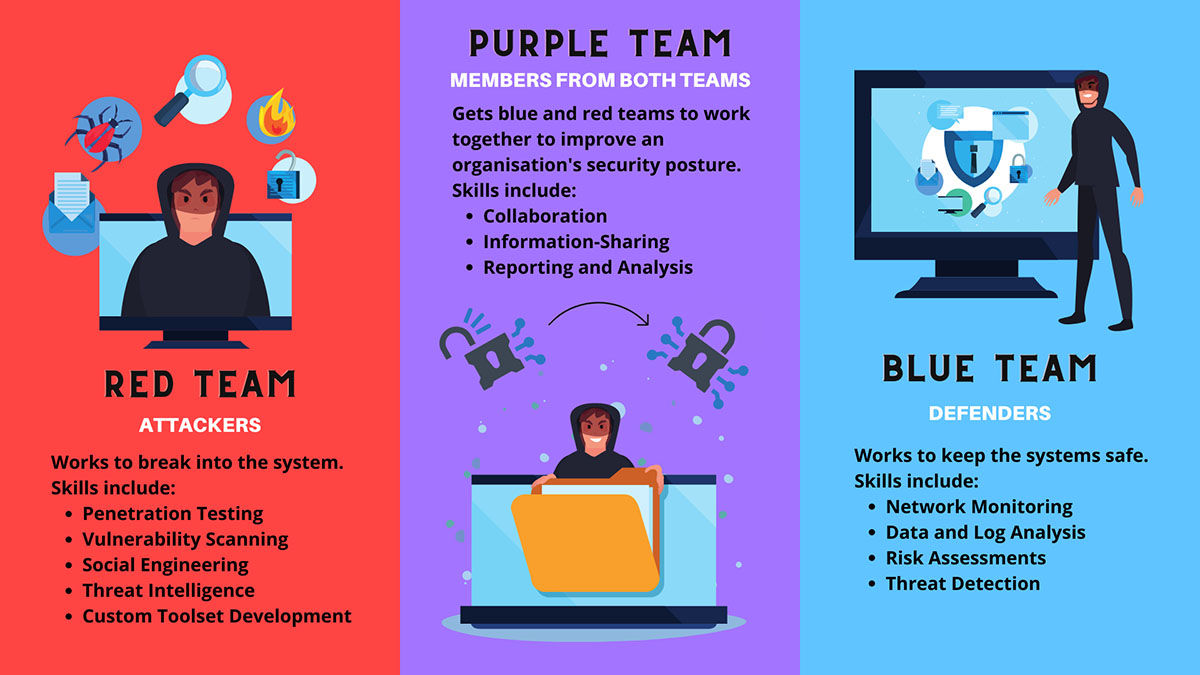
Figure: Teaming roles in cyber security (Manocha, 2022). [1]
Building expertise in cyber security
Developing cyber security skills today requires far more than just theoretical knowledge. Threat landscapes, technologies and attack methods are constantly evolving, particularly due to the increasing use of artificial intelligence. In practice, it therefore quickly becomes apparent that a purely theoretical approach is insufficient. Learning platforms such as AttackIQ, TryHackMe and Hack The Box address precisely this issue and offer structured environments for the practical development of cyber security skills.
AttackIQ is a platform founded in 2013 for simulating cyber attacks and continuously validating security measures. Companies and learners can use it to automatically replicate real-world attack techniques based on the MITRE ATT&CK framework in order to test the effectiveness of their security controls. The focus is on Breach and Attack Simulation (BAS), Purple Teaming and the continuous improvement of cyber resilience. [1]
TryHackMe is a browser-based learning platform for cyber security and ethical hacking. It offers over 900 interactive labs, learning paths and capture-the-flag exercises for different levels of experience, from beginners to advanced users. The focus is on practical ‘learning by doing’ within a gamified learning environment. [2]
Hack The Box takes a similar approach and enables the development and consolidation of cyber security skills through practical hands-on labs. The platform offers realistic attack scenarios for penetration testing, vulnerability analysis and red and blue teaming concepts, also within a gamified environment. [3]
What these platforms have in common is their strongly practice-oriented approach. Instead of teaching security concepts purely in theory, they rely on interactive learning environments, simulation-based exercises and real-world attack scenarios, through which technical interrelationships can be experienced first-hand. The focus is on the ‘learning by doing’ principle: learners should not only understand security concepts, but actively apply them. At the same time, the platforms foster analytical thinking, problem-solving skills and a holistic understanding of modern IT and security architectures.
For individuals, these learning environments offer the opportunity to gradually build up knowledge in areas such as network security, operating systems, Linux, Windows, cloud security, penetration testing, threat detection, incident response, vulnerability analysis and security monitoring. Furthermore, users learn to work with realistic tools, attack techniques and security processes that are closely aligned with the requirements of modern businesses. Particularly valuable is the combination of offensive perspectives such as red teaming and defensive approaches such as blue teaming, which provides a comprehensive view of cyber security.
These platforms are particularly well-suited for those new to cyber security, as they provide low-threshold access to a complex subject area. Rather than starting with abstract theory, learning content is directly translated into interactive scenarios where typical security issues can be simulated realistically. This creates a direct link between concept and application, which makes understanding easier, particularly for beginners.
Another advantage lies in the structured learning curve. Platforms such as AttackIQ, TryHackMe and Hack The Box guide users step-by-step from basic concepts through to more complex attack and defence scenarios. Learners can thus progress at their own pace without being overwhelmed by the complexity of the field as a whole. Mistakes are part of the learning process and take place within a secure, controlled environment.
At the same time, these platforms foster a holistic understanding of cyber security by combining offensive and defensive perspectives. Beginners learn not only how attacks work, but also how security mechanisms are structured and how organisations respond in the event of an incident. The combination of practical relevance, progression and a shift in perspective makes these learning platforms a particularly suitable foundation for further specialisation or a career entry into cyber security.
Conclusion
Cyber security is particularly well suited as a gateway into IT, as it brings together a wide range of technical disciplines and thereby fosters a broad fundamental understanding. Concepts such as Blue, Red and Purple Teaming not only highlight technical interrelationships, but also underscore the importance of analytical skills, communication and continuous improvement within modern IT environments.
Practical learning platforms such as AttackIQ, TryHackMe and Hack The Box enable beginners to experience these interrelationships interactively and realistically, rather than learning them purely in theory. This creates a learning approach in which technical understanding is directly linked to practical application.
It is precisely this combination of fundamental technical knowledge, practical application and a holistic perspective that makes cyber security a valuable starting point for a sustainable career in IT.
Notes:
Would you like to discuss the development of IT skills and cyber security with Niklas Magerl? Then simply get in touch with him on LinkedIn.
[1] Manocha, H. (2022): Red, Blue, and Purple Teaming: A collaborative approach to Security Assurance
[2] AttackIQ
[3] TryHackMe
[4] Hack The Box
Are you an influencer or thought leader looking to discuss cyber security and concepts such as blue, red and purple teaming? If so, please share this post on your social media channels.
Niklas Magerl has published more posts on the t2informatik Blog, including:

Self-organised teams, yet everyone still asks the boss

Agile transformations rarely fail by chance

How important is IT expertise for a Scrum Master?

Niklas Magerl
Niklas Magerl is a business psychologist, university lecturer and experienced Scrum Master with a strong focus on agility and customer-oriented process design. In his role as Scrum Master, he ensures that technical developments are optimally aligned with the needs of internal customers in order to deliver software solutions with real added value. At the same time, he is a lecturer at the FOM University of Applied Sciences for Economics and Management, where he teaches students in the fields of project management, psychology and qualitative research methods.
On the t2informatik blog, we share knowledge and experience with people in organisations. And it is for precisely these people that we have been developing and modernising software since 2012. Pragmatically. ✔️ Personal. ✔️ Professional. ✔️ Get to know t2informatik as your development partner.