
Feedback as an active leadership tool
‘Change is not necessary here. After all, the business runs like a well-oiled machine.’
This sentence was uttered recently in a workshop. It was the start of a lengthy discussion about why, from one participant’s point of view, there was no need for action.
When I asked him how he had come to this conclusion, he replied without hesitation: ‘My employees always tell me that everything is fine.’
At first glance, this feedback sounds reassuring. It signals stability, satisfaction and effective collaboration. And yet this statement is deceptive. It does not describe a reliable state of affairs, but rather an assumption about what employees say or do not say.
‘Everything is fine’ can mean many things. Perhaps the team is indeed satisfied. But it could just as easily mean that criticism has long since fallen silent. That feedback is not given because it has been experienced as ineffective or is considered risky. Silence is rarely neutrality. Silence is almost always a message.
This is exactly where leadership begins. Not where you trust that someone will say something, but where you actively ask for feedback. Feedback is not a passive event that happens by chance. It is an active leadership tool.
Managers cannot avoid giving feedback. Those who do not ask, listen or follow up are also sending signals. Often unconsciously, but with effect.
In the following, I will show why actively seeking feedback is indispensable for managers. Why it helps to make dynamics visible at an early stage. And why it is worthwhile to consciously invite even uncomfortable feedback.
Getting feedback is tedious, but it pays off
My motto in coaching is simple: don’t fix what isn’t broken. In everyday working life, however, it’s sometimes like having a cold. It comes on for three days, stays for three days and goes away for three days. So just because there’s no fever or chills yet, it doesn’t mean that a team is in top shape.
In my view, exploring the status quo in a team is an essential task for managers. Outwardly, everything may seem objective and calm, but internally, things can be boiling over. One moment it’s about competition, recognition or resources, the next moment information is deliberately withheld or filtered. This often indirectly sabotages decisions. If projects then come to a standstill without it being clear why, it is often already too late. So the crucial question is: why do I, as a manager, often only notice so late that something is going wrong?
Be honest: how often do you actively ask your employees for feedback? And we’re not talking about the general mood, but specifically about satisfaction with decisions, information or the way people work together. Since I’m being generous, you can also count when the classic closing line comes at the end of a performance review: ‘So, what other feedback do you have for me?’
Employees notice very clearly whether a manager is genuinely interested in their opinion. That’s why it’s not enough to ask for feedback once a year. If you really want to make use of feedback, you should do so on the other 364 days of the year as well. Reflect on collaboration or current projects regularly in team meetings. Work with point ratings and then engage in conversation. Hold open discussions. And, if necessary, follow up with one-on-one conversations, especially with employees who are more introverted and less vocal in group settings.
Using feedback as a one-off event, on the other hand, creates mistrust. Questions quickly arise such as: Why does my manager now want to know what I think about our collaboration? Is this a trap? Did they perhaps hear me expressing criticism in the coffee kitchen and now want to confront me?
In this context, I like to talk about a credit of trust that employees grant their managers. This credit grows when managers act with integrity, appreciation, objectivity and goal orientation. And the greater this credit of trust, the more likely it is that honest feedback will be received that can actually be worked with.
You can only make good decisions when you have a comprehensive picture
Believing that everything is always sunshine and roses in a team borders on denial of reality. I often wonder where such attitudes come from.
The freedom motive is one of the four basic motives according to Julius Kuhl and his PSI theory. [1] It describes the need for self-determination and autonomy, i.e. the desire to free oneself from external and internal constraints. A particular manifestation of this motive is rigid self-protection. This is exactly what I hear when managers tell me that they don’t need feedback because everything is fine.
At such moments, I remind myself how some managers come to be in their role. Either they are the best specialist or they are simply installed. Neither of these says much about how well someone can lead.
Many managers simply do not have the time in their everyday lives to reflect on themselves and their leadership behaviour and to honestly assess whether they are actually doing a decent job. Any criticism is then quickly interpreted as praise. In addition, many managers continue to be the best specialists and become deeply immersed in operational business. Delegating responsibility often does not even occur to them.
I recently overheard a discussion in which it was said that employees must first be sent on a training course so that they can ‘do tasks the way I would do them’. But delegating is not about having tasks performed in a parrot-like or superior-like manner. If you want an exact copy, it’s best to do the task yourself. Employees need responsibility, leeway and, of course, competence. However, it says a lot about a manager’s mindset if delegating is merely understood as passing on tedious tasks.
The situation is similar with feedback. Your employees are well trained, many even academically trained. Many have been working for you or the company for years. So they have already been through a lot. However, when it comes to their perspective on your leadership behaviour, this expertise suddenly seems less relevant. Or does it perhaps even become dangerous at this moment?
In my view, this is a core problem of emotional intelligence. Many managers are insufficiently aware of what actually hurts them when it comes to feedback. Is it the uncomfortable feeling of having made mistakes? Is it the unease of having their own self-worth questioned?
Actively involve your employees in shaping teamwork and invite them to improve processes and collaboration in line with corporate guidelines. Not everyone will accept this invitation. Some will even try to use their influence primarily to their own advantage.
The key point, however, is that this behaviour already exists. Employees already exert influence, shape processes, prioritise issues and make decisions. The question is not whether this happens, but how visibly, openly and constructively it happens. Active involvement creates transparency. Without it, shaping and influence remain informal and escape the manager’s perception.
Feedback contributes to satisfaction
What if your employees give you appreciative, constructive and positive feedback about what a good manager you are? Far too often, the focus on problems and shortcomings obscures the fact that leadership is indeed successful. Don’t deprive yourself of this opportunity.
I am also convinced that your employees are well aware that your demands are not always easy to meet. Managers often find themselves in a sandwich position and have to withstand pressure from different directions. When you engage in dialogue with your employees and give each other feedback, a deeper understanding of one another develops. This in turn adds to your credit of trust.
This trust gives rise to loyalty, also known as cohesion. Cohesion describes all the forces that contribute to people wanting to remain part of a group. It forms the basis not only for team spirit, but also for genuine cooperation. [2]
In the context of leadership, it is always about empowering people in their roles. We are talking about empowerment. Empowerment refers to self-empowerment or enabling and means the process of supporting people in recognising and utilising their own strengths and resources. [3] The aim is to promote self-determination, overcome powerlessness and actively shape one’s own working environment instead of feeling patronised. This applies both at the individual level, for example in terms of ego strength, and at the collective level as group strength.
Why is this important? I have already mentioned the freedom motive from PSI theory. A much healthier coping strategy is self-acceptance and the integration of even unpleasant feedback into one’s own self-image. Bad feedback is just as much a part of life as good feedback. Having the courage to face the truth is also a commitment to one’s own strengths. Feedback is therefore a conscious decision to gain new insights about oneself and one’s own leadership behaviour. It should also be mentioned again at this point that you do not have to buy feedback.
Therefore, actively ask for feedback. Request it regularly and specifically from your employees. And very importantly, once you have asked the question, listen. Try to understand what your employees are actually trying to tell you.
- What is the message behind the message?
- What motivators are becoming apparent?
- How does what I hear make me feel?
Ask questions if anything is unclear. However, do not fall into the trap of justifying or explaining why you think the feedback is incorrect.
Conclusion
Feedback is not a nice add-on to good leadership, but a central leadership tool. Managers cannot avoid giving feedback. Silence, not asking questions or evasiveness also send messages. Those who assume that everything is fine because no criticism is being voiced run the risk of overlooking warning signs and only noticing developments once they have already escalated. Regular and honest feedback provides guidance, reveals dynamics and enables informed decisions to be made before problems become apparent.
At the same time, feedback is not a one-way street. It thrives on trust, relationships and attitude. Managers who actively seek feedback, listen and reflect are consciously investing in their credit of trust. They show that they value their employees’ perspectives, even when they are uncomfortable. This is precisely the core of empowerment. Employees are not just executors, but are involved, taken seriously and empowered to take responsibility.
Feedback thus contributes not only to performance, but also to satisfaction and loyalty within the team. It strengthens cohesion, promotes mutual understanding and supports personal growth. The courage to tell the truth, self-acceptance and the willingness to confront one’s own blind spots are essential leadership qualities. Those who see feedback as an opportunity to learn not only lead more effectively, but also more humanely.
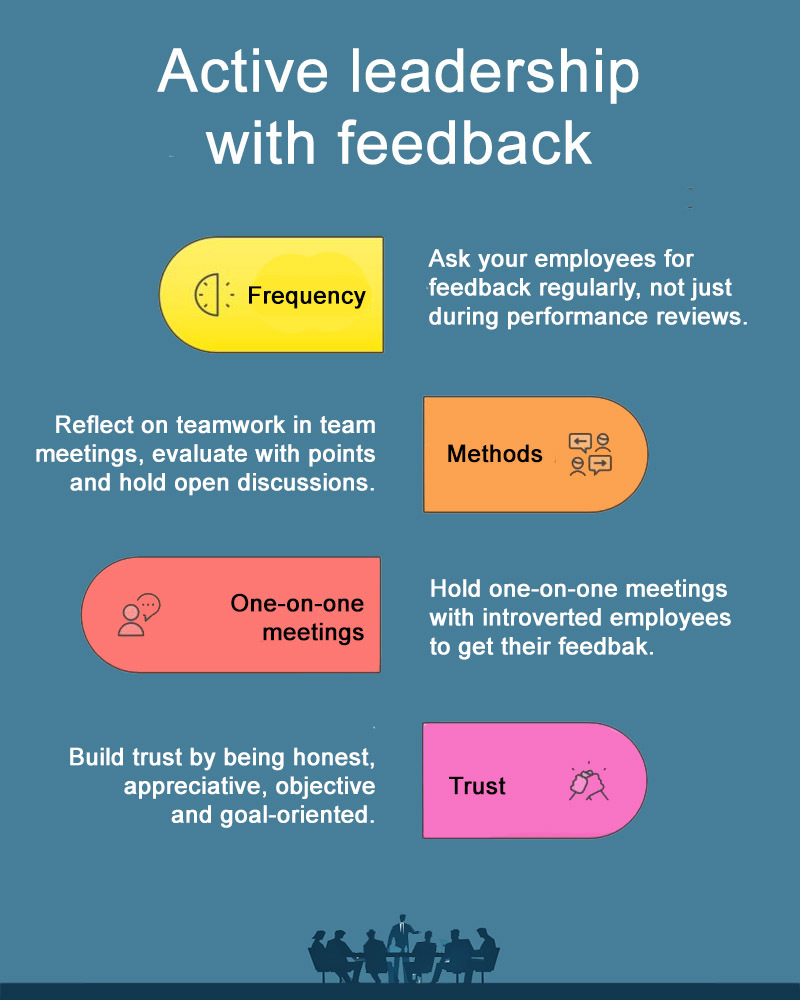
Figure: Active leadership with feedback
Notes (mainly in German):
Would you like to improve teamwork within your team or your communication skills as a manager? Then visit the website of Michael Zocholl and arrange a meeting. It will definitely be worth your while!
[1] Fink, Lotta; Berghammer, Anja (2025) : Bewusste und unbewusste Motive in der Führung und ihre Wirkung auf Erwartungen an Mitarbeitende: Eine qualitative Untersuchung auf Basis der PSI-Theorie, IU Discussion Papers – Human Resources, No. 9 (November 2025), IU Internationale Hochschule Erfurt
[2] Dorsch Lexikon der Psychologie: Gruppenkohäsion
[3] Bundesministerium für wirtschaftliche Zusammenarbeit und Entwicklung: Empowerment
Here you will find an interesting article on the statement: All feedback is toxic.
Would you like to discuss feedback as an active management tool in your capacity as a multiplier or opinion leader? Then share this post in your networks.
Michael Zocholl has published more posts on the t2informatik Blog, including:

Conflicts in employee appraisals

The art of performance appraisal

3 myths that ruin your employee appraisal

Michael Zocholl
Michael Zocholl is a business psychologist who supports managers and teams in strengthening communication, cooperation and trust in the long term – through workshops, coaching and training. In his podcast Zuhören, Fragen, Führen (Listen, Ask, Lead), he addresses the challenges and opportunities surrounding employee appraisals once a week. Conclusion
On the t2informatik blog, we share knowledge and experience with people in organisations. And it is for precisely these people that we have been developing and modernising software since 2012. Pragmatically. ✔️ Personal. ✔️ Professional. ✔️ Get to know t2informatik as your development partner.