
What is the human-on-the-loop?
Table of Contents: Definition – Distinction – How it works – Examples – Advantages and limitations – Prerequisites – Questions from the field – Notes
Smartpedia: Human-on-the-loop refers to a concept in which humans monitor autonomous or AI-supported systems and can intervene in a targeted manner when necessary.
Human-on-the-loop as a concept of human oversight
Autonomous and AI-supported systems can accelerate processes, analyse large volumes of data, and prepare or execute decisions at high speed. However, the more independently such systems operate, the more pressing the question becomes of how human control can be maintained without manually approving every single step.
Human-on-the-loop, or HOTL for short, addresses this issue. Humans are not permanently involved in every decision, but instead take on a supervisory role. The system operates largely autonomously, whilst humans monitor ongoing operations, assess anomalies and intervene where necessary.
This distinguishes human-on-the-loop from fully manual control. The aim is not to replace automation, but to design autonomous systems in such a way that human oversight, opportunities for intervention and accountability remain possible.
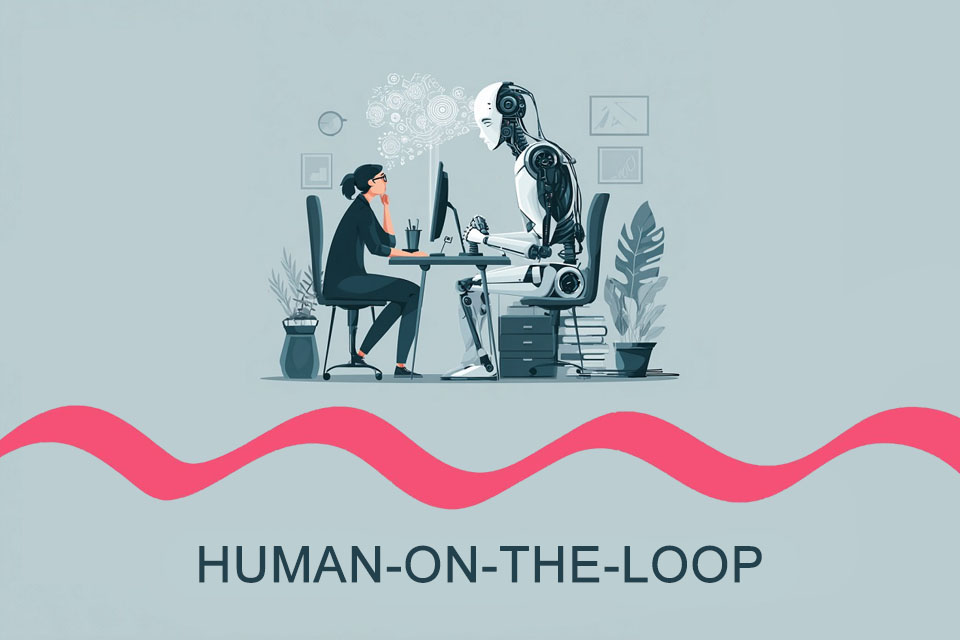
Human-on-the-loop therefore refers to a concept of human-machine collaboration in which humans monitor automated or AI-supported systems without scrutinising every single decision in advance. They intervene when errors, risks, borderline cases or unexpected developments arise, thereby ensuring that autonomous processes remain controllable and accountable.
Distinction between human-in-the-loop and human-out-of-the-loop
Not every AI system involves humans in the same way. The key factor is whether humans are actively involved in individual decisions, monitor the system, or no longer intervene in the ongoing process at all.
Human-in-the-loop – also abbreviated to HITL – describes the active involvement of humans in the decision-making process. The AI generates suggestions, assessments or results, which are then reviewed, corrected, confirmed or approved by humans. Humans are thus an integral part of the process.
Human-on-the-loop describes a supervisory role for humans. The system operates largely autonomously, whilst humans monitor operations and can intervene in the event of anomalies or risks. Humans do not review every single decision, but remain involved as a monitoring and intervention authority.
Human-out-of-the-loop – HOOTL for short – refers to systems that operate without direct human involvement. Decisions or actions are made or carried out automatically, without humans intervening in the ongoing process.
The levels differ primarily in how closely humans are involved in the actual decision-making process. In human-in-the-loop, they play an active role, in human-on-the-loop, they monitor the process, and in human-out-of-the-loop, there is no direct human control.
How does human-on-the-loop work?
Human-on-the-loop operates through defined forms of monitoring and intervention. Humans support the operation of a system not by constantly approving individual decisions, but through monitoring, alerts, escalation rules and opportunities for intervention. [1]
A typical component is monitoring systems. These display relevant key figures, system statuses, error rates, utilisation levels or anomalies. This enables people to determine whether a system is operating within expected parameters or whether deviations are occurring.
Alerts and threshold values are also important. If certain risks, uncertainties or limit values are exceeded, the system can automatically trigger an alert. Supervisors can then assess whether intervention is necessary.
In addition, there are escalation processes. Not every anomaly needs to lead immediately to a system shutdown. Often, there are graduated responses, such as a more detailed investigation, referral to specialist staff, an adjustment of parameters, or a temporary interruption of the automated process.
It is crucial that human supervision is not merely a formality. People must understand the information, have sufficient time to react, and actually be able to stop the system, override it, or correct decisions.
Human-on-the-loop is therefore a control model for systems that operate largely autonomously but are not intended to be run entirely without human oversight.
Examples of human-on-the-loop
Human-on-the-loop is primarily used in situations where systems make numerous decisions, react in real time or control processes largely autonomously, but human supervision is still required.
In aviation, autopilots handle numerous routine tasks. Pilots do not control every single operation manually, but they monitor the system, assess the situation and intervene in the event of deviations, malfunctions or critical situations.
In industry, automated systems can control production processes autonomously. People monitor key performance indicators, machine statuses and error messages. In the event of malfunctions or quality deviations, they can intervene, adjust processes or shut down systems.
In IT security, systems automatically detect suspicious activity, block attacks or prioritise alerts. Security teams monitor the situation, review critical events and decide whether further action is required.
In financial trading, algorithms can execute transactions automatically. People monitor limits, market movements, risk parameters and unusual patterns in order to intervene in the event of adverse developments or extreme market conditions.
On digital platforms, automated systems can detect, classify or remove content. Humans monitor complaints, borderline cases, systematic errors or conspicuous developments and can adjust rules or decisions.
These examples show that ‘human-in-the-loop’ is particularly relevant where direct individual checks would be too slow or too costly, but human oversight must be maintained for reasons of security, fairness, quality or accountability.
Advantages and limitations of human-on-the-loop
Human-on-the-loop combines the efficiency of autonomous systems with the option of human oversight.
Advantages of human-on-the-loop:
- The concept enables faster and more scalable processes, as not every single decision needs to be reviewed or approved by humans. This is particularly relevant when dealing with large volumes of data, real-time applications or high-frequency decision-making.
- At the same time, the option for human intervention remains. People can assess unusual developments, assess risks, override decisions or interrupt automated processes.
- HOTL can help to map out organisational responsibility. If it is clearly defined who monitors a system, when intervention is required and what options for action exist, autonomous processes can be better controlled.
- The concept is particularly suitable for use cases where full manual checking is impractical, but fully autonomous operation would be too risky. It thus creates an intermediate form between active individual checking and full automation.
However, Human on the Loop also presents challenges, as human supervision must be effectively organised under real-world conditions.
Limitations of human-on-the-loop:
- Humans can only intervene effectively if they detect deviations in good time. In the case of very fast, complex or opaque systems, human reaction may come too late.
- There is a risk of ‘superficial monitoring’. If humans are officially monitoring but do not understand the system logic, do not receive sufficient information or have no real ability to intervene, supervision remains ineffective.
- Too many warning messages can lead to alarm fatigue. If systems constantly generate alerts or false alarms, attention levels drop and important signals may be overlooked.
- Automation bias is also a risk. People may tend to place too much trust in automated decisions, even when doubts would be warranted.
- Unclear responsibilities complicate practical implementation. If it is not specified who monitors, who is authorised to intervene and who is responsible for decisions, HOTL cannot fulfil its control function.
Human-on-the-loop is therefore not automatically an effective form of human control. The approach only delivers its benefits if supervision, information, response times and intervention options are designed realistically.
Prerequisites for effective human oversight
For human-on-the-loop systems to be more than just a formal concept of control, people must actually be able to understand and influence autonomous systems. Mere observation is not enough if it does not lead to the possibility of taking action.
Clear responsibilities are a key prerequisite. It must be established who monitors a system, who makes decisions in the event of anomalies, and who is responsible for interventions. Without clear responsibilities, uncertainty or a diffusion of responsibility can easily arise.
Equally important is comprehensible information. Supervisors need not only raw data or technical alerts, but clear indications of what is happening, why it is happening, and what risks are involved.
Realistic response times are also crucial. If a system acts faster than humans can assess and evaluate a situation, human supervision is only of limited effectiveness. Options for intervention must therefore be commensurate with the speed and criticality of the system.
In addition, suitable tools and escalation procedures are required. People must be able to review warnings, document decisions, interrupt processes, make adjustments or involve specialist managers.
Finally, training and experience are required. Anyone monitoring a system must be familiar with its functioning, limitations, risks and typical error patterns. Only then can human-on-the-loop contribute to the controllable, traceable and accountable operation of autonomous systems.
Questions from the field
Here are some practical questions and answers:
Is human-on-the-loop less safe than human-in-the-loop?
Not necessarily. Human-in-the-loop offers closer control because humans check or approve individual outcomes. However, human-on-the-loop may be more appropriate when systems have to make many decisions in a short space of time and a full individual check is not practical. The key factor is whether risks are identified and humans can intervene in good time.
When is human-on-the-loop a better option than human-in-the-loop?
Human-on-the-loop is suitable when automated systems operate reliably enough that it is not necessary to review every decision individually, but human oversight is still required. This applies particularly to large volumes of data, real-time processes or recurring decisions with defined risk thresholds.
Who bears responsibility in a human-on-the-loop system?
Responsibility remains with the people and organisations that are required to operate, monitor and control the system. AI systems can automate processes or execute decisions, but do not assume any legal, technical or ethical responsibility. A human-on-the-loop system is therefore a mechanism for implementing oversight, audit requirements and responsibilities at an organisational level.
The more autonomously AI systems operate, the more important human oversight becomes. At the same time, the question arises as to whether humans can still effectively monitor complex, fast-moving and data-intensive systems. Is HOTL genuine control, or merely a comforting notion, when autonomous systems act faster than humans can understand and intervene?
Notes (partly in German):
If you like the article or would like to discuss it, please feel free to share it in your network. And if you have any comments, please do not hesitate to send us a message.
[1] What Is Human-on-the-Loop (HTOL) and Other Glossary Terms
And here you will find additional information from our t2informatik Blog:

Promoting AI skills in your company

Human-in-the-loop: Responsibility or illusion of control

How effective are AI-supported code reviews really?
‘Smartpedia’ is our glossary for people in organisations involved in software development, project management and product management. It is for precisely these people and their organisations that we have been developing and modernising software since 2012. Pragmatic. ✔️ Personal. ✔️ Professional. ✔️
Get to know t2informatik from Berlin as your development partner.