
What is FORDEC?
Table of Contents: Definition – How it works – Example: software development – Distinctions – Advantages and disadvantages – Challenges – Practical questions – Notes
FORDEC – A framework for structured decision-making
An alarm sounds, several messages come in almost simultaneously, and for a moment it is unclear within the team who should take the first step. Anyone who has ever had to make an important decision under acute time pressure is probably familiar with situations like this. FORDEC was developed precisely for such situations.
FORDEC stands for six consecutive steps: Facts, Options, Risks & Benefits, Decision, Execution and Check. The acronym also encapsulates the core concept of the model, namely an analysis phase followed by an action phase. The aim is to structure complex decisions in a transparent manner, whilst complementing experience and intuition with a systematic decision-making process.
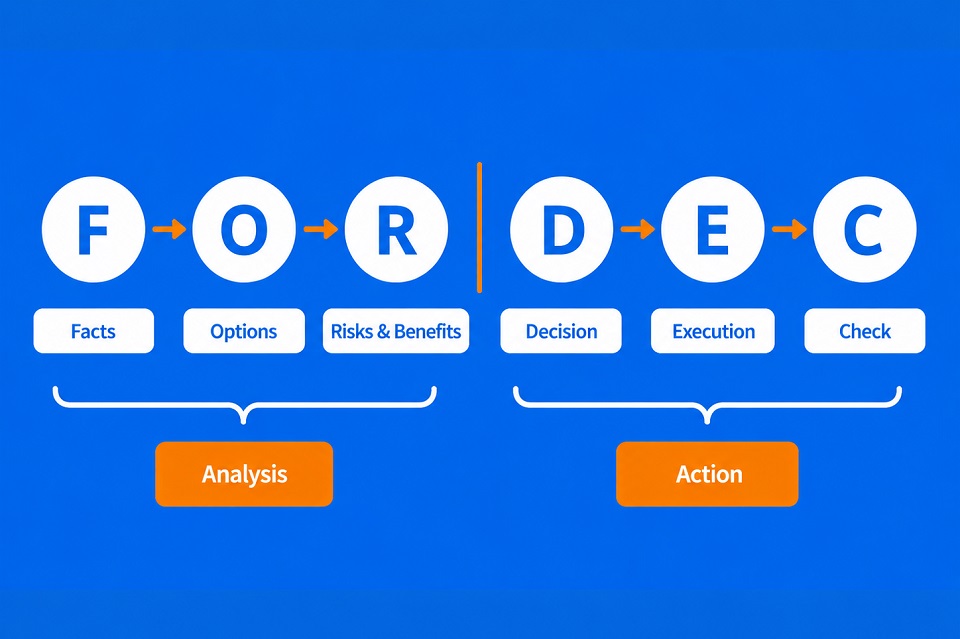
The alternative spelling ‘FOR-DEC’, with a hyphen, serves a substantive purpose: the hyphen marks the transition from the three analysis steps to the three action steps – a brief pause before the actual decision is made.
FORDEC was developed in the early 1990s by a joint working group on Crew Resource Management comprising Lufthansa and the German Aerospace Centre (DLR). [1] The psychologist Hans-Jürgen Hörmann first presented the model to a wider specialist audience in 1994. [2] The aim was to provide cockpit crews with a common language and structure for decision-making in exceptional situations, such as technical faults or sudden changes in weather conditions.
Just how necessary this was is illustrated by the case of Air Transat Flight 236: in 2001, the cockpit crew initially interpreted indications of a fuel leak over an extended period as a sensor fault – a textbook example of how strongly one’s own expectations can distort the perception of ‘facts’. [3] One of the objectives in developing FORDEC was precisely to highlight such misjudgements at an early stage.
Simulator studies now show a significant improvement in the quality of decision-making when the model is applied. And FORDEC is no longer confined to its original scope of application: wherever people have to make factually correct decisions under time pressure with incomplete information – for example, in project management or during critical IT failures – the model can be applied in a similar manner.
- A six-stage decision-making model developed in the early 1990s by Lufthansa and DLR for the aviation industry
- Separates the analysis phase (Facts, Options, Risks & Benefits) from the action phase (Decision, Execution, Check)
- Reduces the influence of cognitive biases on decisions
- Now also in demand outside the cockpit, for example in projects, IT operations and crisis management
- The approach does not automatically produce the right decision; it ensures that people make their perceptions, alternatives and justifications visible to one another. [4]
- Mnemonic: FOR DECisions. The name says it all and recalls the model’s core function: to produce a well-founded decision, not an endless discussion.
How does FORDEC work?
FORDEC is followed in a linear sequence, with each of the six steps linked to a key question:
- Facts: What is the situation? What is the problem?
- Options: What courses of action are available?
- Risks & Benefits: What are the risks and benefits of each option?
- Decision: What is our decision?
- Execution: Who does what?
- Check: Is the situation improving? Is another cycle necessary?
Facts
First, all those involved gather the available information to form a shared understanding of the situation. In this step, no solutions are discussed yet; instead, the focus is solely on examining the current situation from various perspectives and defining the objective to be achieved by the decision.
Options
Based on this shared understanding of the situation, possible solutions are gathered without evaluating them, for example through brainstorming. How much time is invested in this step depends heavily on how time-critical the situation currently is. In urgent cases, a quick decision followed by monitoring is often more sensible than spending too long searching for options.
Risks & Benefits
Each option is assessed for opportunities and risks, ideally with an evaluation of probability and impact. In groups, it is worth considering the so-called ‘risky-shift’ phenomenon: groups tend to make riskier decisions than individual members would on their own.
Decision
Following the intensive discussions of the first three steps, there is a deliberate, brief pause before the decision is made; it is precisely this moment that is symbolised by the hyphen in ‘FOR-DEC’. In hierarchical structures, the decision should be justified in order to secure the commitment of all those involved.
Execution
The decision taken is implemented. Responsibilities are clarified, necessary measures are taken and, where necessary, the decision is also communicated externally.
Check
Finally, a check is carried out to see whether the decision and its implementation have actually led to the desired outcome. This step is often neglected in ad hoc decisions, but it is essential. If it becomes apparent that the approach taken so far has not been effective, the FORDEC process is repeated in the light of the new insights.
This creates a repeatable cycle of analysing, deciding and reviewing, which works even when time is short and the situation is unclear.
Example: FORDEC in software development
A medium-sized software company rolls out an update for a central application programming interface (API) on Thursday. By Friday lunchtime, several customers report significantly longer response times under heavy load.
Facts: The team compiles what is known. Only users with high data volumes are affected; the old API version is running stably; a rollback is technically possible but must be carried out manually and would interrupt ongoing test features. With support ending in the afternoon, there is little time left for further feedback.
Options: Three options are on the table: a full rollback to the old version, continued operation with additional monitoring, or a short-term workaround via an intermediate caching layer that absorbs the load.
Risks & Benefits: A rollback would be a safe option, but it would prevent any further fault analysis and would be almost impossible to reverse over the weekend. The workaround could be implemented quickly, but it is untested. Continuing operations with monitoring would provide important diagnostic data, but would prolong the risk for affected users.
Decision: The team opts for the workaround with accompanying monitoring, agreeing to reassess the situation by 5 pm if conditions do not improve.
Execution: One team member implements the caching layer, a second informs the affected customers, and a third monitors the system metrics in real time.
Check: At 5.00 pm, it becomes clear that response times have stabilised and critical metrics are unaffected. The team decides to leave the workaround running over the weekend and to continue the actual fault analysis on Monday.
Ultimately, it becomes clear that FORDEC proves its worth even in a hectic day-to-day situation and ensures a clear, transparent structure.
Distinction from related decision-making models
Various models take a similar approach to FORDEC: dividing the decision-making process into clearly defined phases. Two of the best-known are DODAR and DECIDE, which, like FORDEC, were originally developed for the aviation industry.
How does FORDEC differ from DODAR? DODAR stands for Diagnosis, Options, Decide, Assign and Review. With five steps instead of six, DODAR is slightly more streamlined than FORDEC. The key difference is that DODAR implicitly incorporates risk assessment into the ‘Decide’ step, whilst FORDEC dedicates a separate, explicit step to it under ‘Risks & Benefits’.
How does FORDEC differ from DECIDE? DECIDE stands for Detect, Estimate, Choose, Identify, Do and Evaluate, and was coined by the US Federal Aviation Administration (FAA). The structure is similar to FORDEC, although DECIDE spreads the evaluation of options across the ‘Estimate’ and ‘Choose’ steps, rather than bundling them into a separate ‘Risks & Benefits’ step as FORDEC does.
Common to all three models is the fundamental idea of dividing decision-making into clearly defined phases in order to assess facts, options and risks systematically rather than intuitively. Which model prevails within one’s own team is ultimately less important than the fact that a common structure is used at all.
Advantages and disadvantages of FORDEC
Like any structured process, FORDEC has its advantages as well as its weaknesses.
Advantages:
- Several options are deliberately generated and compared, rather than relying on the first idea that comes to mind.
- The influence of cognitive biases (heuristics) on the decision is reduced.
- The decision-making process becomes transparent to all those involved, which is particularly important for team decisions.
Disadvantages:
- In truly time-critical situations, a full run-through can itself cause a delay if discussions drag on for too long.
- If differences in hierarchy and opinion within the team are not consciously managed, a team decision can quickly turn into the sole decision of a dominant individual.
Whether the advantages outweigh the disadvantages depends primarily on whether there is enough time for at least a brief round and whether all those involved are genuinely committed to the process. If either of these conditions is not met, it is worth taking an honest look at whether FORDEC is the right tool for the job at that particular moment.
Challenges during implementation
Anyone wishing to introduce FORDEC within their own team will encounter a number of typical stumbling blocks:
Setting a timeframe: Without explicit facilitation, discussions about individual steps can get out of hand. A fixed timeframe, known as a timebox, prevents FORDEC itself from becoming a time-waster.
Be aware of power imbalances: In teams with a pronounced hierarchy or dominant opinion leaders, there is a risk that other team members will unconsciously go along with the majority rather than contributing their own assessments. Facilitators should therefore make a conscious effort to seek out the views of those lower down the hierarchy or who are more reserved first. [5]
Do not delegate responsibility: FORDEC relies on all participants going through every step together. If individual steps are split up or preliminary decisions are delegated, the quality of decision-making – which the model is actually designed to ensure – declines.
By keeping these three points in mind, FORDEC can be successfully established even in teams with no prior experience.
Questions from the field
Here are some practical questions and answers:
Why is FORDEC important?
Our brains are trained to make practical decisions very quickly. In familiar, straightforward situations, this is an advantage. In complex or novel situations, however, the same mechanism falls back on learnt patterns and mental models that simply no longer apply. Important information is then overlooked or given the wrong weighting.
This is precisely where FORDEC comes in. By separating the pure analysis of the situation from the actual action, the model prevents solutions from being discussed before all the facts are even fully on the table. This effect can be observed in a wide variety of teams, from production to software development.
For teams, this means one thing above all: decisions become more transparent and depend less on the gut feelings of individuals. Anyone who can explain, in retrospect, which facts and options led to a decision builds trust within the team and can learn from wrong decisions in a more targeted way.
When is FORDEC appropriate?
- The decision has a significant impact on the project, team or business.
- There is no immediately obvious, correct solution.
- Several people are involved in the decision or affected by it.
- There is at least a brief moment to weigh up the options in a structured manner, even if it is only a few minutes.
- The decision should be traceable or documented retrospectively.
If there is not even time for this – for example, in the event of imminent danger – trained routine procedures or even more streamlined processes are often the better choice.
Can FORDEC also be used on its own?
Yes, FORDEC can also be used by an individual.
The structure helps you to make decisions systematically rather than purely intuitively, particularly when you have to weigh up a lot of information against one another under time pressure. However, the model’s true strength is only realised when used as a team: when several people gather facts and evaluate options independently of one another, blind spots and one-sided assessments tend to become apparent more readily than is possible for a single person.
Anyone using FORDEC on their own therefore benefits from the structure, but not from this core advantage, and should, where possible, have important decisions double-checked by another person afterwards.
How long does a FORDEC cycle take?
That depends very much on how time-sensitive and how complex the decision in question is. In urgent situations, such as a technical fault during ongoing operations, a cycle may take just a few minutes and is often carried out verbally and very briefly. For more complex decisions, such as strategic prioritisation within a project, the same process can take one or more hours, particularly if risks and options are discussed in detail within the team.
The actual duration therefore varies from case to case; the key factor is that the team or individual consciously takes the time appropriate to the situation at hand.
What happens if the team cannot reach a consensus?
If, during the risks-and-benefits phase, it becomes apparent that opinions within the team differ significantly, it helps to address the disagreement openly rather than glossing over it. In many teams, the final decision rests with a designated person, such as a project manager, who weighs up the arguments gathered during the process and makes a decision for which they also take responsibility. The key thing here is that all relevant objections have actually been heard before the decision is made. Complete agreement is not a prerequisite for this.
Does FORDEC need to be documented?
Documentation is not strictly necessary; FORDEC generally works just as well as a purely mental or verbal process. However, for decisions that need to be traceable retrospectively – such as those relating to safety or with significant financial implications – it is advisable to produce a brief written summary for each step. This can be as simple as a few bullet points in a database or a shared document. Above all, it is important that the key facts, options and the reasoning behind the decision are recorded.
Impulse to discuss
FORDEC is excellent at distinguishing between three poor options. However, it does not necessarily generate a fourth, better option. Experts, in particular, sometimes find themselves in the situation where two or three typical solutions spring to mind very quickly, effectively bringing the search for options to an end. So does the creative aspect of decision-making lie, at least in part, outside the model?
Notes:
If you like this article or would like to discuss it, feel free to share it on your social media.
[1] Soll, H. et al.: Decision-Making Tools for Aeronautical Teams: FOR-DEC and Beyond, Aviation Psychology and Applied Human Factors, 2016, 6 (2), 101–112.
[2] Hoermann, H. J.: FOR-DEC, A Prescriptive Model for Aeronautical Decision Making, 21st WEAAP Conference, Dublin, 1994.
[3] Wikipedia: Air Transat Flight 236
[4] In this sense, FORDEC is a communication framework for joint decision-making.
[5] What is the HIPPO effect?
You can find more information here on the t2informatik Blog:

Decision-making ability – the success factor of teams
The best way to a decision
Decision-making techniques for self-organised project teams
‘Smartpedia’ is our glossary for people in organisations involved in software development, project management and product management. It is for precisely these people and their organisations that we have been developing and modernising software since 2012. Pragmatic. ✔️ Personal. ✔️ Professional. ✔️
Get to know t2informatik from Berlin as your development partner.