
What is the Blue Ocean Strategy?
Table of Contents: Definition – Applications – Red and blue oceans – Examples – Prerequisites – Procedure – Differentiation – Advantages and disadvantages – Questions – NotesSmartpedia: With the Blue Ocean Strategy, companies open up new markets without direct competition by increasing customer value and reducing costs.
Blue Ocean Strategy: Setting sail with foresight
For the third time in a row, the sales department reports shrinking margins. Competitors have cut their prices, the company has followed suit, and the same proposals are back on the table at the strategy meeting: yet another discount campaign, a bigger advertising push. Everyone senses that this is leading nowhere, but nobody knows which direction to take instead.
This is precisely the kind of situation the Blue Ocean Strategy is designed for. It is a strategy development method that a company uses to look for market spaces in which there is initially little or no competition. The image behind it: existing, fiercely contested markets are ‘red oceans’, in which many providers fight over limited demand. ‘Blue oceans’ are market spaces that nobody has occupied yet and in which new demand arises.

The concept was developed by W. Chan Kim and Renée Mauborgne, two professors of strategy at the INSEAD business school in Fontainebleau. It is based on a study, spanning more than ten years, of over 150 strategic moves from more than 30 industries and around 100 years of business history. They first presented the basic idea in the Harvard Business Review in 2004. The book ‘Blue Ocean Strategy’ followed in 2005; the German edition is titled ‘Der Blaue Ozean als Strategie’. [1] In 2017, ‘Blue Ocean Shift’ was published, a book that describes the path there as a process.
The central term is value innovation. Traditional strategy theory assumes that a company has to make a choice: either it offers more value at higher cost, or it offers less at lower cost. Kim and Mauborgne argue that the two can be combined [2]. Those who consistently leave out what customers hardly value save costs. Those who invest the savings in things that customers really want or have never been offered before increase value. In short: for the new offering, the competition simply becomes irrelevant.
Key points at a glance
- The Blue Ocean Strategy helps companies to create a market of their own instead of competing with many providers for the same customers.
- It was developed by W. Chan Kim and Renée Mauborgne, professors at the INSEAD business school, and published as a book in 2005.
- At the heart of the method is value innovation: an offering becomes significantly more valuable for customers and, at the same time, cheaper for the company to produce.
- Key tools are the strategy canvas, the ERRC grid with the levers Eliminate, Reduce, Raise and Create, and the search for noncustomers.
- A blue ocean does not stay free for ever; over time, imitators turn it red.
Areas of application for the Blue Ocean Strategy
The method is aimed at companies and business units that are stuck in a saturated market or face a realignment. Typical occasions fall into three groups:
- New markets and offerings: A company is looking for an alternative to the price war and wants to win a customer group that the market has so far overlooked. The result is a new product, a new service or a new combination of the two.
- Realigning existing products: An offering has grown over the years, is expensive and hardly differs from those of competitors any more. The method helps to streamline it in a targeted way and to upgrade it elsewhere.
- Sales channels and cost structure: A new sales channel can also open up a blue ocean, for example when a product suddenly becomes available where the target group would not previously have expected it.
The end result is a strategy for an offering that clearly stands out from the market, appeals to new customers and improves the company’s competitive position. Ideally, the company becomes the only sensible provider for its new target group.
Red and blue oceans compared
How can you tell which ocean you are sailing in? Kim and Mauborgne contrast the two mindsets in several pairs of opposites. [2] The following table summarises them and adds two characteristics that are easy to observe in practice:
| Characteristic | Red ocean | Blue ocean |
|---|---|---|
| Market space | Existing markets with fixed boundaries | New, self-created market spaces |
| Competition | Many providers with similar offerings | Few or no direct competitors |
| Competitive goal | Beat the competition | Make the competition irrelevant |
| Demand | Existing demand is shared out | New demand is created, often among noncustomers |
| Cost and value | More value costs more, lower costs mean less value | More value at lower cost at the same time |
| Strategic orientation | Differentiation or cost leadership | Differentiation and low cost at the same time |
The right-hand column does not describe a permanent state. Sooner or later, every blue ocean attracts imitators and then turns red. The method therefore belongs in a company’s regular strategy calendar.
Five examples of blue oceans
The following cases show how different a blue ocean can look. Each example stands for a different contrast from the table.
Nespresso: creating a new market
Nestlé launched Nespresso in Japan, Italy and Switzerland in 1986, thereby founding the portioned coffee segment. [3] This created a market space that had not existed before: bar-quality espresso at the touch of a button, at home, without any expertise. At the same time, the case shows how a blue ocean turns red: once key patents had expired, compatible capsules from many (cheaper) providers came onto the market.
SumUp: winning noncustomers
Card terminals had been around for a long time, but they were not worthwhile for taxi drivers, snack bars or tradespeople. The devices were expensive, and there were monthly fees and long contract terms on top. SumUp, a Berlin company founded in 2012, offered a small card reader for smartphones with no fixed costs at all. [4] Above all, it won businesses that had not accepted cards at all until then. No provider had seriously courted these customers before.
Motel One: differentiation and low cost at the same time
The first Motel One opened in Offenbach in 2000. The rooms are around 16 square metres in size; there is no telephone, wardrobe or minibar, and no conference rooms or gym either. The lobby, breakfast room and work area are combined in a single space. Instead, the company invests in design, good beds, high-quality towels and central city locations. [5] In this way, a hotel needs about half the floor space of a classic four-star hotel and can still score points with its look and feel.
Canva: making the competition irrelevant
Professional graphics programs were powerful, but hardly usable for laypeople. Canva launched in 2013 with the aim of enabling everyone to design. [6] Templates and simple drag-and-drop operation replaced specialist knowledge. As a result, Canva hardly competed for professional designers. Its target group was teachers, clubs, small businesses and marketing teams that had not used any design software before.
Duolingo: creating new demand
Language courses cost money, take place at fixed times and require a course venue within reach. Duolingo launched in 2012 as a free offering and thus reached many people who would never have taken a course for reasons of time, location or cost. [7] Playful elements that motivate people to practise every day were added later. Nobody had served the demand that arose in this way before.
The five cases have one thing in common: all the providers changed the rules of the game in their market. They deliberately did without familiar features and instead created an offering that reaches customer groups the market had previously overlooked.
Key point: A blue ocean emerges when a company leaves out what customers hardly miss and instead creates what nobody has offered them before.
Prerequisites and resources
At its core, the Blue Ocean Strategy is a simple tool. It becomes ‘difficult’ because it requires questioning the familiar thought patterns of one’s own industry. Anyone who has been fighting the same competitors for the same customers for years often only sees their own market through those competitors’ eyes. It is therefore worth bringing together the right information and people right at the start. The following are helpful:
- Market data and a competitor analysis: Who are the competitors, what do they advertise with, and what strategy are they pursuing?
- an overview of the company’s own products, services, markets and sales channels
- value creation metrics, such as contribution margins per product or costs per customer
- expertise from sales, service, development and controlling, supplemented by outside perspectives
- assessments of how products and markets will develop, broken down into today, in one year and in three years
The outside perspective is at least as important as the data. External facilitation can help to break up the tunnel vision of the expert team because it does not share the industry’s assumptions. Equally important is a management team that visibly supports the process. In terms of tools, flipcharts, whiteboards and sticky notes are sufficient. If the team works remotely, digital whiteboards are a good choice. A complete data set is not a prerequisite for getting started; many gaps only become apparent during the joint work.
The Blue Ocean Strategy in six steps
Kim and Mauborgne describe their tools in several books and variants. In practice, a six-step procedure that links the most important tools has proven its worth:
- Clarify the goal and the starting point
- Draw the industry’s strategy canvas
- Look for noncustomers and unfamiliar perspectives
- Fill in the ERRC grid
- Classify ideas and examine them critically
- Implement and overcome the four hurdles
The steps build on one another, but rarely run in a straight line. New insights often lead back to an earlier step. To illustrate this, one example accompanies all the steps: a medium-sized provider of time-tracking software that has been on the market for 20 years and whose customers come mainly from industry and public administration. Six competitors offer almost the same thing, and every new version brings more features.
1. Clarify the goal and the starting point
The starting point is an honest review of the current situation. What exactly is to be achieved? How will success be measured later, and are there metrics for this? And is the company acting of its own free will or already under pressure? This last question is more important than it may sound, because those who are under pressure are quicker to reach for the first solution that comes along.
The Business Model Canvas by Alexander Osterwalder and Yves Pigneur is well suited to describing the current business model [8]. It maps a business model in nine fields on a single page, from the value proposition through customer segments and channels to costs and revenues. The team ideally fills it in together. This way, gaps become apparent early on, and everyone involved agrees on the same terms along the way.
In the example, it quickly becomes clear: the value proposition of the time-tracking software is ‘fits into any system landscape’, and the largest cost blocks are interface maintenance and on-site training.
2. Draw the industry’s strategy canvas
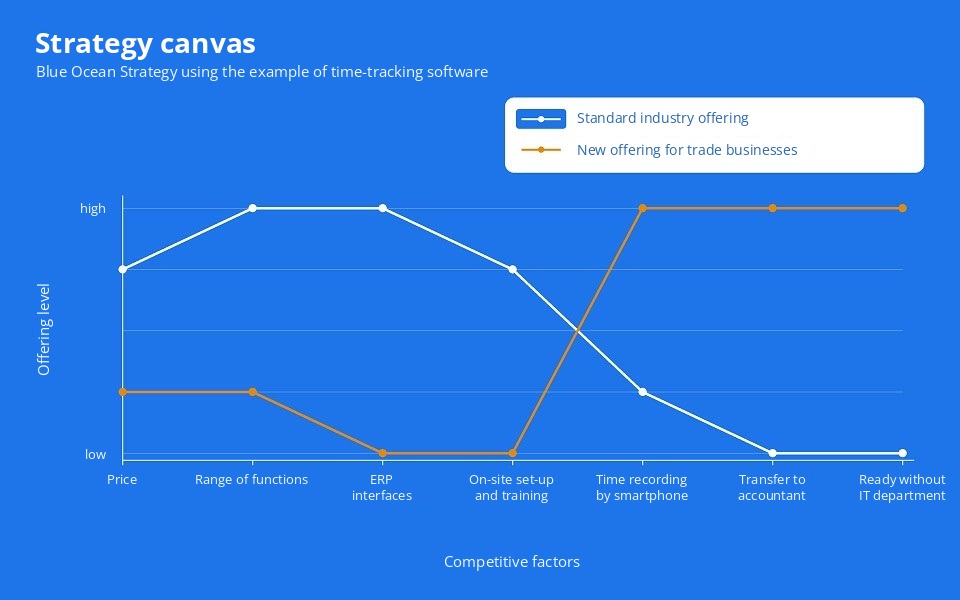
The method’s most important analytical tool is the strategy canvas. On a single page, it shows what the providers in an industry compete on and how much customers receive of each [9]. The horizontal axis shows the competitive factors, usually starting with price. The vertical axis shows the offering level, for example on a scale from 1 to 5. Connecting a provider’s values produces its value curve.
The strategy canvas is most revealing when the value curves of several providers are placed side by side. If they run almost parallel, this is a clear sign of a red ocean: everyone is doing the same thing, just a little more or a little less. In the example, the team enters seven factors. The industry’s value curve is at the very top for range of functions and ERP interfaces, and at the very bottom for mobile time recording and support for small businesses. The company’s own curve hardly differs from it.
An important point when selecting the factors: they should be worded the way customers talk about them. ‘Time recording by smartphone on the building site’ is such a factor, whereas an internal module name such as ‘Mobile 3.2’ means nothing to customers. More than eight to ten factors make the chart confusing.
3. Look for noncustomers and unfamiliar perspectives
Those who want to create new demand rarely find it among their own customers. Kim and Mauborgne therefore recommend looking specifically at noncustomers and distinguish between three tiers [10]:
- First tier: People or businesses that only use the industry’s offering out of necessity and will jump ship as soon as something better comes along.
- Second tier: People or businesses that know the offering, have examined it and consciously rejected it, for example because it is too expensive or too complicated.
- Third tier: Groups that nobody in the industry has so far regarded as potential customers because their needs seemingly belong to a different industry.
The largest group is usually the third, while the easiest to reach is often the second. In the example, the team comes across trade businesses with 5 to 30 employees. Many of them have looked at time-tracking software before and rejected it because neither the set-up nor the price suited their size. Instead, the fitters fill in paper timesheets, which are typed up in the office at the end of the month.
In addition to looking at noncustomers, other industries can help. In their book ‘Not Invented Here’ (2015), Ramon Vullings and Marc Heleven describe how companies discover solutions from other industries, combine them with their own strategy and turn them into something new. A practical way to start: the team compiles a list of unusual, new products and services from completely different fields and researches how they work. A typical pattern can be expected here. An outside idea is exciting at first, but the first attempt to transfer it raises doubts and apparent contradictions. Only when the team modifies the idea, even in far-fetched directions, and then works it up methodically does it become clear what really fits. Those who give up at this low point often throw away the best approaches.
Other industries are not the only source of new perspectives. It is often enough to mentally transfer one’s own offering into a different situation or to look at it consistently through the customers’ eyes. Three changes of perspective have proven useful for this:
- Ask professionals from other fields: How would an emergency control centre solve the problem, and how would an outfitter for polar expeditions? The further removed the industry, the more likely familiar assumptions are to break down.
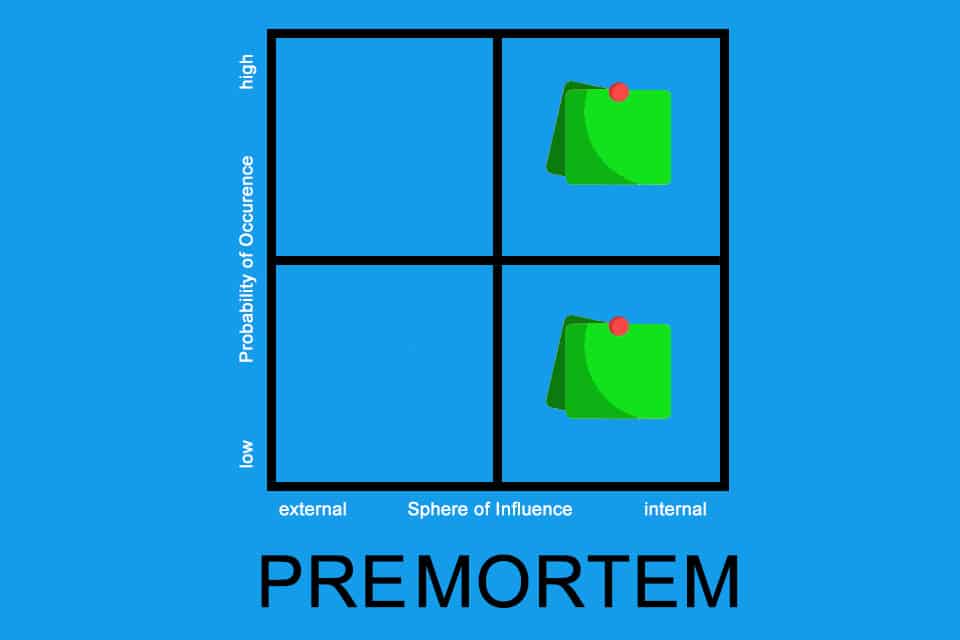
- Look back from the future: In a so-called premortem, the team moves a few years ahead and imagines that the company has failed. What reasons come together? The answers often show where today’s path leads into a dead end.
- Adopt the customer’s perspective: The Kano model makes it possible to distinguish which features customers merely expect and which delight them. Detailed personas, i.e. exemplary profiles of typical users, help to keep the situation of noncustomers firmly in view.
These tools are intended as suggestions. Their common purpose is to broaden the view before deciding in the next step what should change about the offering.
4. Fill in the ERRC grid
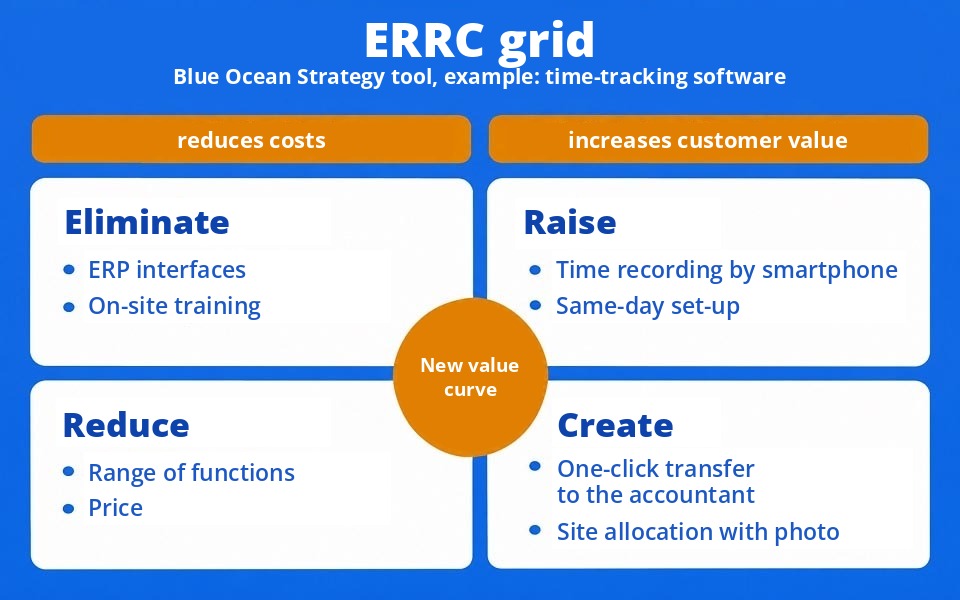
At the heart of the method, the team asks four questions about each factor of the strategy canvas. Kim and Mauborgne call this the four actions framework; the associated worksheet is the ERRC grid [1]. The four letters stand for Eliminate, Reduce, Raise and Create. The first two levers lower costs, the last two increase customer value. Only when all four are filled in does genuine value innovation emerge.
Eliminate: Which factors that the industry takes for granted can the company leave out entirely? This is the most radical lever and saves the most. It often concerns features that were once important but whose benefit has become outdated, such as the hardware keyboard on smartphones or the CD drive in laptops. Good questions here: What costs a lot and delivers little from the customer’s point of view? What is no longer up to date? What would we use the freed-up resources for?
Reduce: Which factors can be reduced well below the industry standard? Many offerings are overloaded, and too many features tend to overwhelm customers rather than help them. Here it is worth looking at oversized services that customers no longer want to pay for, and at costs that are not matched by any noticeable benefit. A Pareto analysis often shows that a few features account for most of the usage.
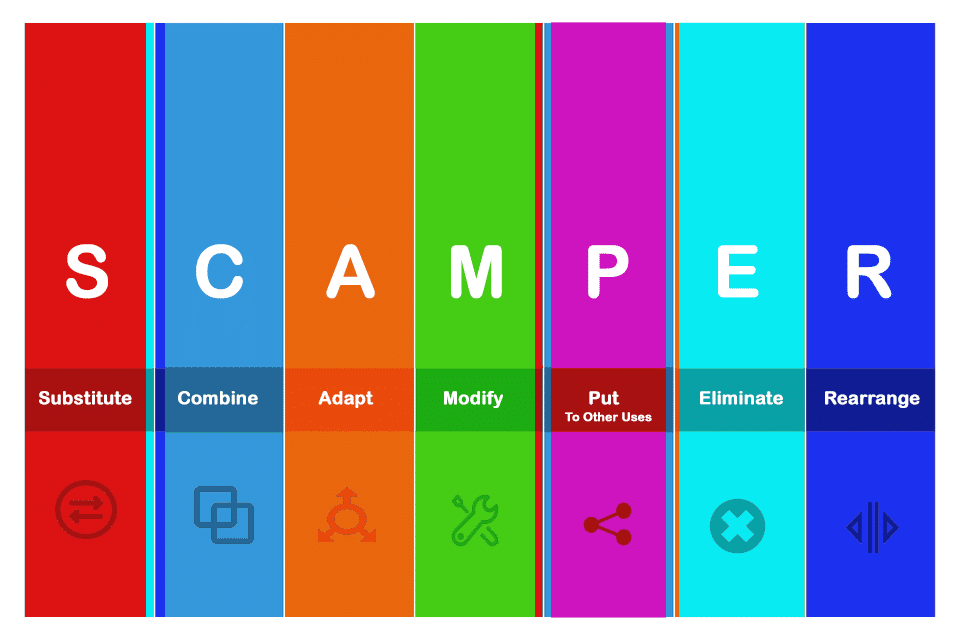
Raise: Which factors should be raised well above the industry standard? The question is what current and future customers are happy to spend money on and what would turn customers into fans. A helpful prompt is the question of the level at which a company engages with its customers: does it merely deliver a product, does it add services, does it offer a solution, does it create an experience or even a lasting relationship? The higher the level, the closer the relationship. Creativity methods such as SCAMPER, which modify existing features through targeted questions, are well suited to generating ideas.
Create: Which factors has the industry never offered? This question is the most demanding because it asks about something that nobody is aware of yet. This is where the results from step 3 come in: what noncustomers are missing and what other industries are already doing is the best raw material.
In the example, the team fills in the ERRC grid as follows:
- The ERP interfaces and on-site training are eliminated entirely for the new offering.
- The range of functions and the price are reduced significantly; there is no shift planning and no extensive reporting.
- Time recording by smartphone is raised, as is the set-up, which can now be completed on the same day without an IT department.
- Newly created are the one-click transfer of monthly hours to the accountant and the allocation of working time to a building site, including a photo.
And so the ERRC grid serves its purpose: reducing costs and increasing customer value.
5. Classify ideas and examine them critically
After the first steps, there is usually a wealth of ideas on the table. To organise them, Kim and Mauborgne developed the Pioneer-Migrator-Settler Map. It sorts a company’s offerings into three groups:
- Pioneers are value innovations. They clearly stand out from the market and have the greatest growth potential.
- Migrators are value improvements. They offer more than the competition but do not change the rules of the game.
- Settlers are imitations. They correspond to what everyone offers and lie entirely in the red ocean.
When the team enters the current and the planned portfolio side by side, it becomes clear where tomorrow’s money is supposed to come from. A company whose revenue consists almost entirely of settlers has a problem for the future, even if the figures are still right today. The map is therefore also a good basis for discussions with senior management. In the example, the existing industrial licence and a copied workforce planning module end up among the settlers. A cloud version of the existing product and a revised app are among the migrators. The new offering for trade businesses is the only pioneer.
Before the decision is made, a second, sober review is worthwhile. In the euphoria of a workshop, the most convincing idea is often the one that promises the quickest success. A similar pattern is familiar from the hype cycle of new technologies: inflated expectations are followed by disillusionment. The favourite should therefore be run through the previous steps once again. Does its value curve really differ from that of the industry? Does it actually win noncustomers, or does it merely attract competitors’ existing customers? Can it be offered at a price the target group can afford and at costs that pay off?
Kim and Mauborgne name three characteristics of a sound value curve: it is focused, i.e. it concentrates on a few factors. It diverges significantly from the industry’s curve. And it can be summed up in a compelling tagline. In the example, this could be: ‘Time tracking for trade businesses, ready to go on the same day.’ If one of the three characteristics is missing, the idea is usually not yet mature.
6. Implement and overcome the four hurdles
Once the strategy is in place, project management takes over with its tried-and-tested means: defining the scope, breaking it down into work packages, allocating resources and budgets, and agreeing schedules. Particularly with a new offering, it is advisable to start with a Minimum Viable Product. This means a first, deliberately lean version that already delivers real benefit and provides quick feedback from the market.
A Blue Ocean Strategy breaks more sharply with established practice than a normal further development. Resistance is correspondingly high. Kim and Mauborgne describe four typical organisational hurdles [11]. The table shows how to recognise them and what helps:
| Hurdle | How to recognise it | What helps |
|---|---|---|
| Cognitive hurdle | Those involved see no reason for change because the status quo still works | Make the problems tangible, for example through conversations with dissatisfied customers and noncustomers |
| Resource hurdle | There seems to be no budget for anything new | Shift funds from settler offerings and start with a lean first version |
| Motivational hurdle | Key people do not get on board or lose momentum after the kick-off | Involve influential people early on and make progress visible |
| Political hurdle | Managers fear for their influence, budget or status and actively put on the brakes | Strengthen supporters, negotiate concerns openly and plan change management in a targeted way |
In the example, the political hurdle quickly becomes apparent: the sales team is paid on the basis of large industrial deals, and small trade businesses are not worth their while. As long as the remuneration model remains in place, the new offering will be lost in day-to-day business. Knowing the hurdles is therefore no substitute for change management. Established models such as John P. Kotter’s eight-step process, which supports change from creating a sense of urgency to anchoring it in the culture, have proven their worth.
How does the Blue Ocean Strategy differ from related approaches?
The Blue Ocean Strategy is often compared with three other concepts. The differences help in deciding which approach suits one’s own situation.
Porter’s competitive strategies: In 1980, Michael E. Porter described the well-known generic competitive strategies: cost leadership, differentiation and focus on a niche. According to Porter, a company has to choose one direction; otherwise it risks the situation he calls ‘stuck in the middle’. This is exactly where Kim and Mauborgne come in. Their value innovation combines differentiation and low cost. Porter takes the industry as a given, whereas the Blue Ocean Strategy aims to shift its boundaries.
Disruptive innovation: With disruptive innovation, Clayton M. Christensen describes offerings that are initially simpler and cheaper than established ones, start in a neglected niche and then displace the existing market leaders. Both approaches focus on customers that the market overlooks. However, disruptive innovation aims to replace existing providers, often by means of a new technology. A blue ocean can also emerge without new technology and without displacement, as Motel One shows.
Niche strategy: A niche is a small segment of an existing market that a provider serves better than the large competitors. The Blue Ocean Strategy, on the other hand, looks for commonalities among many noncustomers in order to open up as large a new market as possible. A niche can be the entry point into a blue ocean, but is usually conceived on a smaller scale.
What this means for companies: Those who want to serve an existing market better are well advised to use the classic competitive strategies. Those who feel that the market itself is the problem will find the right tools in the Blue Ocean Strategy.
Advantages and disadvantages
The Blue Ocean Strategy has a strong appeal because it promises a way out of the price war. Its advantages are real, but they only materialise if the method is applied consistently:
- Less price pressure: Those who create an offering that cannot be directly compared do not have to measure themselves against the cheapest competitor. This protects the margin, at least until imitators appear.
- Growth from new demand: The method directs attention to noncustomers. This group is usually larger than the contested customer base, as the SumUp and Duolingo examples show.
- Cost and value in a single view: The ERRC grid forces people to talk about leaving things out as well. This counteracts the typical feature creep in which products become more expensive and more complicated with every version.
- A common language: The strategy canvas and the ERRC grid make strategy visible on a single page. Afterwards, management, sales and development are talking about the same picture.
- High customer loyalty: Offerings that delight customers and are tailored to their situation are switched less often than interchangeable products.
These advantages are offset by risks that relate above all to implementation and to the robustness of the method itself:
- Limited shelf life: Successful blue oceans attract imitators. Without regular renewal, the competition returns, as the Nespresso case shows.
- Retrospective evidence: Many success stories were interpreted as blue ocean moves after the event. Failed attempts hardly appear in the case collections, which slightly overstates the chances of success.
- Considerable need for change: The method requires new thought patterns and often a cultural change. Not every organisation has the necessary agility. In the worst case, experienced employees who do not identify with the new direction leave.
- Difficult in a crisis: When the pressure to act is greatest, there is often no calm in which to try out new things. Too much pressure also narrows the view to obvious solutions.
- Creativity cannot be forced: The ‘Create’ step depends on ideas that cannot be planned. The method creates good conditions, but it offers no guarantee.
All in all, the Blue Ocean Strategy is a framework for thinking that makes opportunities visible that remain hidden in day-to-day business. It replaces neither market research nor a sound business case, but it gives both a clear direction.
Questions from the field
Here you will find some questions and answers from practice:
What tips help when applying the Blue Ocean Strategy?
Whether the Blue Ocean Strategy produces more than colourful workshop results depends above all on how openly the team is allowed to work and how seriously management takes the results. The following lessons from experience help:
- Talk to noncustomers instead of speculating about them: Just five to ten conversations with businesses that have rejected the company’s offering often provide more insights than a market study.
- Deliberately invite other industries: The attitude ‘What wasn’t invented here doesn’t suit us’ is one of the biggest brakes on innovation. A guest from a completely different industry at the workshop often has more impact than any method.
- Work in loops: The six steps are not a conveyor belt. Those who deliberately return to earlier steps with new insights improve the result significantly.
- Bring in experienced facilitation: External facilitation ensures that unfamiliar paths are examined alongside the familiar ones and keeps the discussion free of hierarchies.
- Involve people gradually: The method is unfamiliar to many. Those who first let a small core team work and then bring in further colleagues step by step gain time for training and avoid overburdening people.
- Agree on ground rules for generating ideas: Particularly with the ERRC grid, it helps to set and enforce the rules of brainstorming, for example that ideas are collected first and evaluated later. Otherwise, the most unusual suggestions die in the first minute.
If you can only take one tip to heart, start with the conversations with noncustomers. They provide the material for all further steps and are also the most effective means of overcoming the cognitive hurdle.
What should you do if loyal existing customers value precisely the features that the ERRC grid wants to remove?
This is the most common conflict during implementation, and it can usually be resolved without alienating existing customers. A blue ocean does not have to replace the existing offering. It often emerges as a separate offering, under its own name or as a separate product line, while the existing business continues. The Pioneer-Migrator-Settler Map helps to plan both side by side in a deliberate way. Things only become risky when the new offering is so cheap that existing customers switch in large numbers. It is therefore worth clearly separating the target groups and openly factoring this switching into the business case.
How can you tell that a supposed blue ocean idea is just a red offering with a new coat of paint?
The most reliable signal comes from the strategy canvas. If the new value curve runs parallel to the industry’s and is only slightly higher for one or two factors, it is an improvement within the red ocean. A second warning sign is an empty ‘Eliminate’ field in the ERRC grid: those who only add and leave nothing out generally increase costs as well. Another warning signal: if, on closer inspection, the hoped-for new customers turn out to be competitors’ customers, existing demand is merely being redistributed.
How long does a blue ocean stay blue?
That depends on how easily the offering can be copied. Patents, a network that is difficult to replicate or a strong brand delay imitators. A study of Dutch retailing between 1982 and 2000 found evidence that new market spaces do indeed emerge. At the same time, it showed that competition eroded the pioneers’ profits only slowly, over around two decades [12]. Nobody should rely on this, however. It makes sense to compare one’s own value curve with that of the market regularly and to develop new pioneers while the existing offering is still making money.
Is it worth the effort for a medium-sized company without a strategy department?
Yes, if the framework is right. The method does not have to turn the entire company upside down; it can be limited to one product line or one business unit. For a first run, a few workshop days with a core team from management, sales and product management are often sufficient, plus a handful of conversations with noncustomers. What matters is the willingness to question cherished assumptions about one’s own industry. The size of the company plays hardly any role in this.
Impulse to discuss:
Should a company be allowed to deliberately strip down a proven product and make it worse for existing customers in order to win a new customer group?
Notes:
If you like this post or would like to discuss it, please feel free to share it within your network.
[1] W. Chan Kim, Renée Mauborgne: Der Blaue Ozean als Strategie. Wie man neue Märkte schafft, wo es keine Konkurrenz gibt. 2nd, updated and expanded edition, Carl Hanser Verlag, Munich 2016 (in German). The original English edition ‘Blue Ocean Strategy’ was published by Harvard Business School Press, Boston, in 2005.
[2] W. Chan Kim, Renée Mauborgne: Red Ocean Strategy vs Blue Ocean Strategy. INSEAD Blue Ocean Strategy Institute, accessed on 10 November 2026.
[3] Nestlé USA: Nespresso: How One Man’s Passion Created a Coffee Icon, Nestlé Malaysia: Nestlé Nespresso Coffee.
[4] Alexander Hüsing: „SumUp Pay wird schneller als Bargeld sein“ – Stefan Jeschonnek von SumUp. deutsche-startups.de, 23 April 2013 (in German).
[5] Elena Freisinger: „Grandhotel für wenig Geld“ erzielt Spitzenwerte bei zentralen Branchen-KPIs. Haufe, 9 February 2017 (in German).
[6] Canva: Canva Celebrates 10 Years of Empowering the World to Design. Press release, Business Wire, 28 August 2023.
[7] Oh Young Koo: How Duolingo Gamified Language Learning to Revolutionize Online Education. INSEAD Blue Ocean Strategy Institute, 9 December 2024.
[8] Alexander Osterwalder, Yves Pigneur: Business Model Generation. A Handbook for Visionaries, Game Changers, and Challengers. John Wiley & Sons, Hoboken 2010.
[9] W. Chan Kim, Renée Mauborgne: Strategy Canvas. INSEAD Blue Ocean Strategy Institute, accessed on 10 November 2026.
[10] W. Chan Kim, Renée Mauborgne, Mi Ji: How to Create Your Blue Ocean Through Noncustomer Analysis. INSEAD Blue Ocean Strategy Institute, accessed on 10 November 2026.
[11] W. Chan Kim, Renée Mauborgne: Four Hurdles to Strategy Execution in Your Organization. INSEAD Blue Ocean Strategy Institute, accessed on 10 November 2026.
[12] Andrew Burke, André van Stel, Roy Thurik: Testing the Validity of Blue Ocean Strategy versus Competitive Strategy: An Analysis of the Retail Industry. International Review of Entrepreneurship, 14(2), 2016, pp. 123–146.
Here you will find two interesting articles: Staff cuts do not constitute restructuring and Generational change: turning point in family business.
And here you’ll find more information from our Smartpedia section:
What is a Premortem?
What is SCAMPER?

What is the Hype Cycle?
‘Smartpedia’ is our glossary for people in organisations involved in software development, project management and product management. It is for precisely these people and their organisations that we have been developing and modernising software since 2012. Pragmatic. ✔️ Personal. ✔️ Professional. ✔️
Get to know t2informatik from Berlin as your development partner.