
What is Bisociation?
Table of Contents: Definition – Applications – Prerequisites – Procedure – Example – Differentiation – Advantages and Disadvantages – Questions – Notes
Smartpedia: Bisociation is a creativity technique that deliberately links a task with an entirely unrelated field in order to arrive at unexpected solutions.
Bisociation: Creative detours
The group has been sitting in front of the whiteboard for an hour. Everyone already knows the suggestions written up there from last year, and none of them made much of a difference back then. Everyone senses that their thoughts are going round in circles.
Bisociation is made for moments like these. It is a creativity technique that deliberately links a task with something that seems to have nothing to do with it, such as a photo of a landscape or a circus tent. Thinking about this unrelated image takes you off the beaten track. The impressions that emerge are then transferred to the actual task. This produces approaches that would hardly have come to mind by thinking about the problem directly.
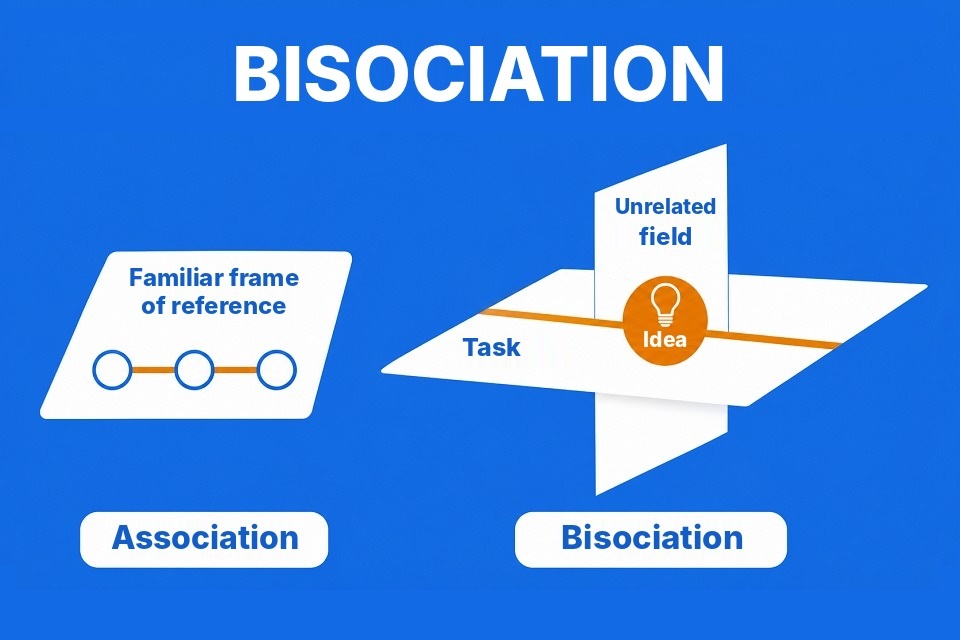
The name points to the difference from association. With an association, thoughts are strung together within a familiar frame of reference: holiday, beach, sun cream. With a bisociation, two independent frames of reference meet, and the idea emerges where they touch.
The term was coined by the Hungarian-British writer Arthur Koestler (1905–1983). In his book ‘The Act of Creation’, published in 1964, he describes humour, scientific discovery and art as the result of such connections. [1] Koestler called these levels of thought ‘matrices’. One of his examples is Johannes Gutenberg, who used the principle of the wine press for printing. The German edition was published in 1966 under the title ‘Der göttliche Funke’ (The Divine Spark). [2] A methodical approach was later developed from Koestler’s theory, allowing bisociation to be used specifically for generating ideas.
Key points at a glance
- Bisociation is a creativity technique that deliberately links a task with an unrelated field; the term was coined by Arthur Koestler in 1964.
- It is suitable when the obvious solutions are known but not sufficient, for example for product ideas, problem-solving or concepts.
- The process comprises five steps: defining the task, choosing an unrelated image, collecting impressions, forming analogies and deriving measures.
- Experienced facilitation, well-chosen images and sufficient time are crucial to success.
- The method requires hardly any materials and no prior knowledge, but takes longer than brainstorming, and its results need to be evaluated afterwards.
What is bisociation suitable for?
In principle, bisociation is worthwhile wherever the obvious solutions are known and are not sufficient. The method requires little preparation and works best in small groups. Larger groups split into subgroups, each working with its own images and bringing their results together at the end. A single person can also use the technique, even spontaneously at their desk.
Fields of application range from technology to communication; typical occasions can be divided into three groups:
- Developing products and services further: new features for an app, a service offering that stands out from the competition, or the question of why newly introduced software is hardly used in everyday work.
- Solving problems: technical hurdles as well as organisational issues for which well-known standard solutions have already been tried.
- Developing messages and concepts: ideas for advertising and marketing, concepts of all kinds, and presentations and speeches that are meant to stick in the memory.
A bisociation produces two results: the first is a collection of analogies between the task and the unrelated stimulus. The second, which is more important for decision-makers, is a list of concrete measures that the team has classified as feasible. This list forms the basis for the next step, such as an evaluation or a project mandate.
Prerequisites and tools
Participants do not need any prior knowledge of the method. Attitude is more important: they must be willing to voice unusual thoughts and question their own habits. The environment is just as important. If management or product management reject new approaches from the outset, even good results will fizzle out. In terms of information, a clear description of the task and the expertise of those involved are sufficient, because experience from one’s own field counts at the latest when the ideas are transferred into practice. Facilitation should be taken on by someone who has already guided groups through creative processes; training in facilitation is helpful.
When it comes to materials, the main thing is that the group can work undisturbed and record its thoughts so that everyone can see them. Most of this is available in companies anyway:
- a sufficiently large room that looks more like a living room than a meeting room, with daylight, comfortable chairs and drinks, or alternatively a place outdoors
- a selection of images that have nothing to do with the task, for example from magazines, catalogues, brochures or posters
- at least two pinboards or a large wall surface, depending on the size of the group
- facilitation cards with pins or sticky notes, and pens that remain legible from a few metres away
For technical tasks, motifs from nature are suitable, for example, whereas for service topics, places and situations from a completely different world work better. If you collect the images a few days in advance, you can review them at your leisure and condense them into a small, varied collection.
The bisociation process step by step
There is no rigid rule for the process. The only thing that matters is that two fundamentally different fields meet. A preparation phase followed by five steps has proven effective:
Preparation: The facilitator sets up the room and provides a selection of images that are as far removed from the task as possible. Pinboards, cards and pens are close at hand so that the process does not stall later on.
Step 1: Define the task together
The group formulates an initial question, as specific as possible. A question such as ‘How can we get better?’ invites platitudes, whereas a question with a clear target group and a clear goal steers the later analogies. The question is written legibly on a poster that remains visible throughout the session. This allows the group to check at any point in the later phases whether their thoughts still fit the task.
Step 2: Choose an unrelated image
The participants jointly choose an image from the prepared collection. The greater the distance from the task, the better. A motif that seems absurd at first glance often yields more than one that immediately suggests a connection. The facilitator should not hold back here; the selection itself is already part of loosening up.
Step 3: Collect impressions of the image
Now it is all about the image; the task is set aside for a moment. The participants describe what they see, what it reminds them of and how it makes them feel. Each thought goes on a separate card. Either the facilitator takes notes, or everyone writes down their own ideas and then pins them to the pinboard. Nothing is evaluated in this step.
Step 4: Form analogies to the task
Now the group builds the bridge back. For each card collected, the participants consider what it could mean for the task. Guiding questions make this easier. One is: ‘What principle lies behind this impression?’ Another: ‘What would have to change for things to feel the same way for us?’ This step is the most demanding, as the connections are usually not obvious. The facilitator helps by asking questions and keeps the analogies visible on a separate pinboard. Methods such as brainstorming or mind mapping support collecting and organising.
Step 5: Transfer the results into practice
In the final step, the group examines which analogies can actually be implemented. Ideas may be modified, combined and made more concrete. First, the group sorts out what cannot be realised. These cards are put in brackets. Unlike crossed-out cards, they remain legible and can be picked up again later if circumstances change. For the remaining analogies, the group describes what implementation would look like in concrete terms: who does what, and what changes for customers? If a suggestion remains vague, the facilitator keeps asking until a tangible picture emerges.
Example: online bookings for a bicycle workshop
A bicycle retailer with its own workshop introduced an online booking system for services and repairs at the start of the season. After a few months, it becomes clear that only about one in five appointments is booked online. All other customers phone, and the mechanics keep interrupting their work to answer the phone. The owner invites the team to a bisociation session. Five other people take part: the workshop manager, two mechanics, a salesperson and the project manager from the software service provider that looks after the booking system.
The task is: ‘How can we get our customers to prefer booking workshop appointments online rather than phoning?’ From the stack of images, the group chooses a photo of a station concourse with a large departures board.
The group collects its impressions of the station concourse and then transfers them to the workshop. The table shows six of the impressions, the analogies derived from them and the assessment in the final step.
| Impression of the image | Analogy to the workshop | Possible measure | Status |
|---|---|---|---|
| Departures board | Everyone can see at a glance what happens next. With us, nobody knows when an appointment is available. | Show available workshop slots live on the website and on a screen in the shop | implement |
| Regular timetable | Trains always leave at the same minute past the hour. Our customers don’t know when they can drop off and collect their bike. | Fixed time slots for drop-off and collection in the booking system | implement |
| Delay announcement | Many calls are enquiries as to whether the bike is ready yet. | Automatic status message by email or text message from the booking system | implement |
| Ticket machine | Anyone who finds the machine complicated queues at the counter. | Reduce booking to three clicks, QR code on the receipt and at the workshop counter | implement |
| Saver fare | Booking early is rewarded. | Free chain care for online bookings, initially as a trial for one season | implement |
| Lockers | Collection at the station is possible around the clock. | Collection lockers with an access code from the booking confirmation | bracketed |
The group considers five of the six analogies feasible. The collection lockers are put in brackets because they are currently too expensive, but they remain on the pinboard as an idea for later. It is striking that two measures do not concern the booking itself at all: fixed time slots and status messages remove reasons to pick up the phone in the first place. The project manager from the software service provider takes away the three points that relate to the booking system and estimates the effort. After three months, the owner wants to check whether the proportion of online bookings has increased.
How does bisociation differ from other creativity techniques?
Bisociation is one of the methods that work with analogies. Many other creativity techniques can be combined with it or used as an alternative. The Ideation Whitepaper provides a good overview of methods for generating ideas. The following table classifies the most important neighbouring methods.
| Method | Brief explanation | Relationship to bisociation |
|---|---|---|
| Brainstorming | A group spontaneously collects ideas; criticism is initially taboo. | Complement, especially when collecting impressions and analogies |
| Mind Mapping | Thoughts are noted as a branching map around a central term. | Complement, organises impressions and analogies clearly |
| Synectics | The task is deliberately made strange in several steps and then brought back. | Similar principle, but considerably more complex and facilitation-intensive |
| Walt Disney Method | An idea is viewed in turn from the perspective of the dreamer, the realist and the critic. | Complement for reviewing the measures from step 5 |
| Six Thinking Hats | Six coloured ‘hats’ represent perspectives such as facts, feelings, risks and opportunities. | Complement for the structured evaluation of new ideas |
| Idea Tower | Many ideas are gradually condensed and ranked. | Complement when there are a great many measures at the end |
| Circular Questions | Questions from systemic consulting shed light on a situation from the perspective of other stakeholders. | Complement for loosening entrenched views even before the session |
| Morphological Box | A task is broken down into attributes whose characteristics are combined systematically. | Complement for deriving variants from a measure |
| Design Thinking | Multi-stage, user-centred innovation process with prototypes and tests. | Alternative for large projects; bisociation can form an idea generation phase within it |
The overview shows a division of labour: bisociation is strong at opening up new directions. For evaluating, organising and elaborating the results, teams are better off using one of the complementary methods, such as the Walt Disney Method.
Advantages and disadvantages of bisociation
Whether the effort is worthwhile depends on the task. When making a decision, it helps to compare the most important strengths and weaknesses. The advantages include:
- High chance of the unusual: Because the stimulus comes from outside, ideas emerge that are rarely obvious within one’s own industry.
- Widely applicable: The method suits technical, organisational and communication tasks alike.
- Low barrier to entry: Hardly any materials or prior knowledge are needed; a room, images and facilitation cards are enough.
- Energises collaboration: Participants experience that their spontaneous ideas count, which increases their willingness to take part in further creative sessions.
However, these advantages only unfold if the group and the facilitator engage with the unfamiliar approach. This also marks the limits of the method:
- Greater time requirement: Compared with classic brainstorming, bisociation takes noticeably more time, because the detour via the unrelated image and the formation of analogies require additional steps.
- Unsuitable when requirements are fixed: Where standards, contracts or processes prescribe a particular solution, there is little room for unconventional ideas.
- Dependence on facilitation and choice of image: An unsuitable image or an unsure facilitator quickly leads to thin results.
- Results need a second review: The measures collected are initially just ideas. Their effort and benefit still have to be assessed afterwards.
All in all, bisociation is particularly suitable when the usual solutions have been exhausted and there is time for a genuine change of perspective. For quick routine decisions, there are more efficient tools.
Questions from practice
Here you will find some questions and answers from practice:
What tips help when carrying out a bisociation?
Whether a bisociation succeeds depends heavily on the atmosphere and the materials. Most participants are reluctant to voice their thoughts because they initially sound nonsensical. Yet these are exactly the thoughts the method needs. The following lessons from experience help:
- Use an experienced facilitator: They encourage reticent participants, intercept evaluations in steps 3 and 4 and consistently steer towards concrete measures at the end.
- Choose images carefully: The image should be interesting, evoke feelings and be as far removed from the task in content as possible. A motif with lots of detail offers more points of connection than a plain surface.
- Adapt the image size to the group: In large groups, the image belongs on the wall as a poster. Alternatively, each person receives their own smaller copy so that nobody in the back row has to guess.
- Allow enough time: Breaking out of familiar thought patterns does not happen in fifteen minutes. If you squeeze the session in between two appointments, you will usually only get the obvious answers.
- Start with a warm-up exercise: A short warm-up round, such as free associations on a completely different image, lowers inhibitions, provided it suits the group.
- Allow humour: Laughter about a crazy idea shows that the group is loosening up and daring more. The facilitator should therefore let it run.
If you can only follow one tip, invest in facilitation. A good image is of little help if nobody guides the group confidently through the difficult phase of forming analogies.
What variants of bisociation are there?
The basic idea can be adapted to group size, time budget and the type of stimulus. Some variants only change the organisation, others replace the image with a completely different trigger. Four variants are particularly common:
- Working alone: One person chooses an image, notes their impressions and transfers them to the task. This is quick and requires no preparation, but it lacks the variety of perspectives that arises in a group.
- Large groups: Several subgroups work in parallel with different images and then present their results to one another. This produces considerably more analogies in the same amount of time.
- Semantic intuition: Instead of images, this technique works with words. The group combines terms from different lists to create new coinages and only then considers what idea might lie behind the new term.
- Bionics: Here, nature serves as the unrelated field. The group asks how plants or animals solve a comparable problem and transfers the principle to technology or organisation.
Beyond that, it doesn’t always have to be images: objects, short films or randomly selected terms are also suitable as stimuli. In every variant, the decisive factor remains the large distance between stimulus and task.
What if no analogy seems feasible at the end?
This does happen, especially in a group’s first bisociation. Often the task is the reason: if it is formulated too broadly or too generally, the analogies don’t really fit anywhere. In that case, it is worth narrowing the question and doing a second round with a new image. It also helps to take another look at the bracketed cards, because some ideas were discarded out of habit and can be realised after all with minor changes. Even a seemingly fruitless round has value, because it shows which assumptions the group considers immovable.
Does bisociation also work in an online meeting?
Yes, with a few adjustments. The image is shown large on the shared screen, and a digital whiteboard replaces the cards. Because calling out spontaneously is harder online, it makes sense to have participants first note their impressions of the image silently for a few minutes and only then discuss them together. Forming analogies in step 4 takes more time online and requires more active facilitation. Smaller groups in separate breakout rooms of the video tool, which then present their results in plenary, have proven effective.
Can AI take over bisociation?
Partly. AI tools provide unrelated images or terms at the touch of a button and suggest possible analogies for each impression. This can get a stalled session going again or serve as a sparring partner for an individual. However, the real strength of the method lies in step 5: whether an analogy works in one’s own organisation is judged by people who know their customers, processes and systems. AI suggestions are therefore an additional source of inspiration; selection and elaboration remain the team’s job.
Notes:
If you like this post or would like to discuss it, please feel free to share it within your network.
[1] Arthur Koestler: The Act of Creation. Hutchinson, London 1964. In it, Koestler develops his theory of bisociation using examples from humour, science and art, including Johannes Gutenberg’s invention of the printing press.
[2] Arthur Koestler: Der göttliche Funke. Der schöpferische Akt in Kunst und Wissenschaft. Scherz, Bern, Munich, Vienna 1966. German edition of ‘The Act of Creation’.
Here you will find two interesting articles on creativity at the touch of a button and the journey from fear to excitement for the future.
And here you’ll find more information from our Smartpedia section:

What is the Walt Disney Method?
How does the Headstand Technique work?
What tips help with brainstorming?
‘Smartpedia’ is our glossary for people in organisations involved in software development, project management and product management. It is for precisely these people and their organisations that we have been developing and modernising software since 2012. Pragmatic. ✔️ Personal. ✔️ Professional. ✔️
Get to know t2informatik from Berlin as your development partner.