
Creativity at the touch of a button?
Expand the table of contents
Creativity isn’t just about the end result
When creativity arises from new combinations
Generating ideas is not the same as evaluating them
Bullshit isn’t an AI problem, but AI accelerates it
Why humans remain the ‘quality gate’
Conclusion: Creativity requires more than just new ideas
Ever since the capabilities of artificial intelligence have reached new heights thanks to a technological quantum leap, questions that previously tended to occupy philosophers have suddenly arisen in the world of work too:
- What is creativity?
- And why do we still need people when developing creative products?
Creativity means: new and potentially useful
Creativity, as a characteristic of an idea, a product or, more generally, a piece of work, can be defined in simple terms as follows: creative = new + potentially useful.
However, it is not at all easy to judge whether an idea is creative or not. This is because both novelty and usefulness are less clear-cut than they appear at first glance.
First, let’s consider novelty: here, we must take two perspectives into account, namely that of the inventor and that of everyone else. If a student, in his small hall of residence room, conceives and programmes an app that already exists, this activity is still creative if he was unaware of the existing examples. His activity was creative in the sense that he devised something new that was unknown to him. His brain has therefore, in the original sense of the Latin verb ‘creare’, created something new. Whether a similar app already exists elsewhere or not is, at first, a matter of chance.
I would argue that anything in which the inventor has been creatively active should be described as creative. It is therefore a question of intellectual achievement. Not the result of market research which later determines whether the supposedly new idea is entirely novel. The adjective ‘innovative’ applies stricter standards here. For something to be considered innovative, it must be genuinely novel compared to existing products – that is, from everyone’s perspective. Ignorance does not protect against the fact that the creative product, unfortunately, cannot be regarded as innovative.
Usefulness is also a difficult criterion to pin down. Something is useful if it brings a benefit to someone. If a persuasive inventor manages to sell hot air at a profit, this at least brings him the benefit of a high margin. For the buyer, it is not useful when measured against objective criteria. But perhaps he feels better having a jar of hot air at home? Even when a nursery-aged child gives their aunt a crude scribble, which she proudly hangs on the wall, an emotional benefit becomes apparent.
Only the target audience can judge whether something is useful. However, the benefit of a product often only becomes apparent during use. Think of kitchen appliances that looked so ingenious and practical in the shop that you simply had to take them home. After five years of slumber in the kitchen cupboard, the appliance is then ‘kissed awake’, used for the first time and subsequently discarded as useless in the electronic waste bin.
That is why I have placed ‘potentially’ before ‘useful’ in the definition. To determine the usefulness of a technical device, we must first build and use it.
Creativity isn’t just about the end result
However, this definition is of limited use as long as it remains abstract. It only becomes practically relevant when I have several ideas in front of me and have to decide which of them to pursue.
As an inventor, I want to decide – even during the selection process – which of my new ideas, created using a creativity method, are creative, i.e. which might be useful. I have to judge this using ‘human judgement’. After all, I have a great many ideas and am selecting those that are worth pursuing further.
In doing so, I prioritise usefulness over novelty. When in doubt, I can generate more profit with a useful but not entirely new idea than with a brilliant, innovative idea that offers my customers little benefit.
So far, the focus has mainly been on creative ideas and products. But the activity that generates a creative idea can also be described as creative – in contrast to a routine task. On closer inspection, creative activities usually involve an element of non-determinism. Different people start with the same task and achieve different results. The same applies to the same person at different times.
However, non-determinism is not automatically creative; it could also arise from errors in reasoning. Generally speaking, tasks that can be described by rules and possibly automated by a deterministic computer programme are not considered creative. Solving a maths problem, for example.
Scope for creativity arises from work steps whose outcome is not predetermined by a rule. However, this does not necessarily lead to a creative result, because one can simply use a tried-and-tested standard solution, which by definition is not novel and therefore not creative. Creativity is made possible by freedom of choice, but it is not forced. Only where there is no standard solution is a creative solution required; otherwise, the problem remains unsolved.
A person who is capable of developing creative ideas is regarded as creative. However, this is not a binary trait. Everyone comes up with something creative from time to time, and everyone has moments when nothing suitable springs to mind. When it comes to creativity, people fall along a continuous spectrum. Some people almost never come up with a creative idea, whilst others almost always come up with a useful one. Most fall somewhere in between.
Whether this is an innate difference or whether a child’s bubbling imagination has been curtailed to varying degrees by upbringing, I do not know. In any case, I would not assume that there are creative and uncreative people, but rather that one has creative ideas in certain situations and not in others.
Creativity techniques guide people step by step to make the most of their creativity. [1]
When creativity arises from new combinations
Most innovations are not radically new inventions that spring from nothing. Even if a technological advance comes as a surprise to the layman, it usually does not come as a surprise to experts. Every novel product arises from the incremental development of what already exists and from the combination of several ideas or technologies, which, taken individually, are often not all that innovative.
Many inventions had long been floating about as ideas and were put into practice as soon as all the necessary technological conditions were in place. This rather incremental improvement stems, on the one hand, from technical necessity, because numerous practical problems must be solved in order to develop an innovative, stable product.
On the other hand, the human brain generally finds it difficult to generate something truly new. It always draws on what is already familiar. On closer inspection, ideas that appear novel often turn out to be a combination of existing elements. Just as the most creative dreams frequently blend personal experiences, elements from a film and various other sensory impressions. Familiar elements are transferred from one context to another. In hindsight, it is often not radically new at all.
Against this backdrop, the criticism levelled at generative AI – that it is not truly creative because it merely recombines elements already present in the training data – becomes interesting. Well, but that’s not much different from what our human brains do either. The only drawback is that we have less extensive training data at our disposal than AI. The more, the better. The more training data there is, the more possible combinations there are.
Generative AI can recombine elements and thereby generate ideas. That is precisely what it was programmed to do. However, the AI itself cannot judge just how novel and useful these ideas actually are.
Generating ideas is not the same as evaluating them
A fundamental principle of creativity methods is usually to alternate between creative and analytical activities.
During the creative phase, you generate as many ideas as possible without any censorship; these may well be unrealistic or far-fetched. It is only during the analytical phase that you evaluate them: What is truly new? How useful is each of these ideas?
It is precisely at this point that the division of tasks between humans and AI becomes interesting. I would entrust the creative activities in particular to generative AI. It generates new ideas in a matter of seconds and in large quantities. Whilst it can also write texts that sound like meaningful evaluations, these cannot be genuine evaluations.
AI has no understanding of the world whatsoever. It manages data, but cannot convert it into genuine knowledge. It can only write texts that imitate knowledge. That is why generating ideas is not the same as evaluating them.
Bullshit isn’t an AI problem, but AI accelerates it
I recently learnt a ‘scientific’ definition of the term ‘bullshit’ from a lecture by Professor Daniel M. Berry: bullshit is something – for example, a text – that is independent of what actually exists in reality. [2]
This does not necessarily mean that the bullshit is wrong. It is simply independent of reality. One of my students once had an AI write a text explaining why it is healthier to sleep on concrete than on a mattress. The argument sounded very convincing. Nevertheless, it is, of course, bullshit.
For our discussion of creativity, this means: not all AI-generated ideas are creative. Some are, instead, just bullshit.
However, bullshit has always existed: incompetent ramblings, falsified measurement results, alternative facts. So people produce bullshit even without AI support.
This ties in with a quote I jotted down from Pascal Mercier’s *Night Train to Lisbon*: ‘What people say isn’t text. They’re just talking.’ [3]
With AI, of course, it’s even better: ‘A fool with a tool is a faster fool.’ In future, people will be able to produce even more bullshit than before with less effort. So bullshit isn’t purely an AI problem. But AI can generate it faster, more cheaply and in greater quantities.
Why humans remain the ‘quality gate’
This results in a sensible division of tasks: the AI generates as many ideas as possible by recombining words. Humans check which of these are actually new, useful and feasible. Humans act as the ‘quality gate’ and only let the good ideas through.
As humans find it easier to evaluate ideas than to generate new ones, whilst AI finds it easier to generate combinations than to evaluate them, this makes for a good team. Everyone does what they do best. Humans can select from a vast array of potentially creative ideas.
However, there is a limit to this division of labour. AI systems can identify really good ideas and filter out the bad ones. But they can also make two types of error: generating uncreative ideas – false positives – and overlooking good ideas – false negatives. [4] If you don’t want to overlook any good ideas, you have to let the AI generate as many as possible and then review them all. The fewer false negatives, the more false positives. And the more false positives, the more work for humans.
At some point, it is no longer worth it. Namely, when the effort involved in reviewing the ideas exceeds the effort required for a results-oriented creativity workshop with skilled people.
In my experience, however, the risk of this is low if you take a structured approach when working with AI – for example, moving from the broad to the detailed, or following a tried-and-tested creativity method. Then you can filter out ideas at every single stage and continue working only with the good approaches.
Conclusion: Creativity requires more than just new ideas
Creativity is not only evident in the end result. It also lies in the process that leads to an idea, and in a person’s ability to produce something new and potentially useful in a given situation.
Generative AI can support this process because it rapidly generates many new combinations. This is precisely where its strength lies. At the same time, however, this also reveals its limitation: not every new combination is creative. Some ideas are useful, some are useless, and some are just nice-sounding nonsense.
That is why creativity arises from collaboration, not simply from the AI’s output. What happens next is crucial: humans evaluate, test, filter out the unsuitable and develop the ideas further. Only then can one idea emerge from the many possibilities that is truly new, useful and feasible.
Notes (partly in German):
The extent to which human and AI creativity actually differ has not yet been conclusively researched. Among other things, it remains unclear whether AI ideas are more creative, novel or useful than human ideas, and whether they adhere better to specified parameters.
Dr Andrea Herrmann is currently investigating this question in an experiment. After her students had solved a task, she had a generative AI tackle the same task. The analysis is still ongoing, but an initial finding is already emerging: the AI generated more ideas in a shorter time than the human participants.
[1] What methods help with ideation?
[2] Daniel M. Berry: Why Large Language Models Appear to be Intelligent and Creative: Because They Generate Bullshit!
[3] Pascal Mercier: Nachtzug nach Lissabon, Page 166
[4] What is a false positive?
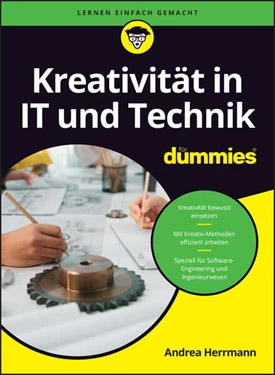
Dr Andrea Herrmann describes how generative AI can help to develop and refine ideas for new technical products in her new German-language book „Kreativität in IT und Technik für Dummies“.
Are you an opinion leader or influencer who would like to discuss creativity and artificial intelligence? If so, please share this post on your social media channels.
Dr Andrea Herrmann has published more articles on t2informatik, including:

Software engineering in the AI era

7 IT use cases with ChatGPT

Machine ethics – a question of development

Dr Andrea Herrmann
Dr Andrea Herrmann has been a freelance trainer and consultant for software engineering since 2012. She has more than 28 years of professional experience in practice and research.
Dr Herrmann was most recently a deputy professor at Dortmund University of Applied Sciences and Arts, she has published more than 100 specialist publications and regularly gives conference presentations. She is an official supporter of the IREB Board and co-author of the IREB syllabus and handbook for the CPRE Advanced Level Certification in Requirements Management.
On the t2informatik Blog, we share knowledge and experience with people in organisations. We have been developing and modernising software for them since 2012. Pragmatically. ✔️ Personal. ✔️ Professional. ✔️ Get to know t2informatik as your development partner.