
What is the Analytic Hierarchy Process (AHP)?
Table of Contents: Definition – Applications – Prerequisites – Procedure – Pitfalls – Differentiation – Advantages and disadvantages – Questions – Notes
The Analytic Hierarchy Process at a glance
Five people sit around a table with several quotes in front of them, and each of them has a different favourite. They all have good arguments, but each of them weighs those arguments differently. After two hours, the group is tired, and in the end whoever holds out the longest gets their way.
The Analytic Hierarchy Process (AHP), also known as the ‘Saaty method’, helps to make decisions based on several criteria. Instead of weighing all criteria against each other at the same time, they are compared in pairs. Is criterion X more important than criterion Y for our goal, and if so, by how much? From many such individual judgements, the AHP calculates how much each criterion contributes to the decision. These weights can then be used to evaluate the options and put them in a well-founded order of priority.
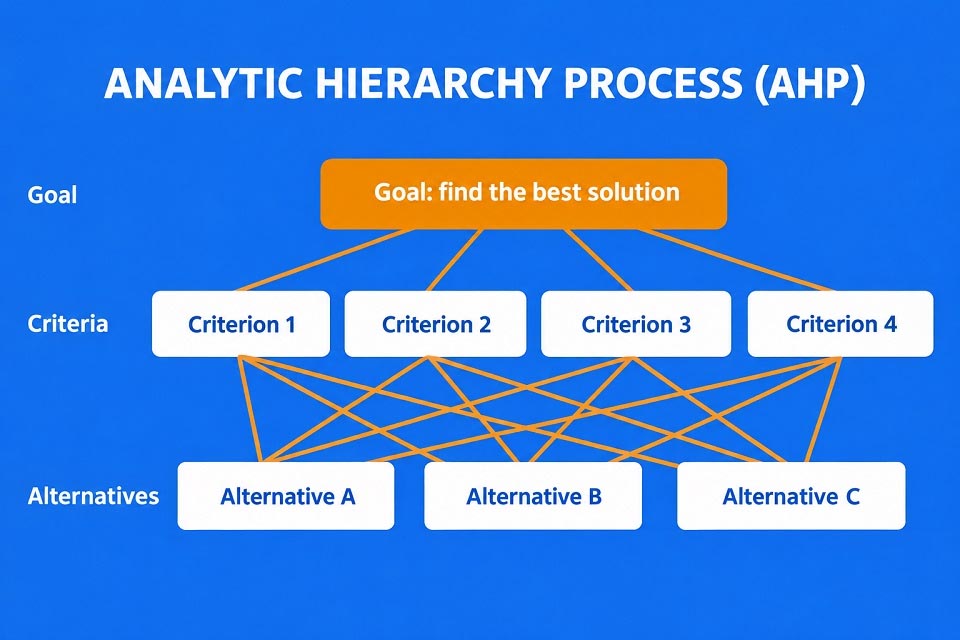
The method owes its name to its basic structure. Each decision is represented as a hierarchy with three levels: the goal at the top, the criteria in the middle (with sub-criteria if required) and, at the bottom, the alternatives to choose from.
The AHP was developed by the mathematician Thomas L. Saaty in the 1970s while he was teaching at the Wharton School of the University of Pennsylvania. It was prompted by complex decision problems he had previously dealt with at the US Arms Control and Disarmament Agency (ACDA) [1][2]. The method originates from operations research, i.e. mathematical decision support. Saaty’s seminal work on the AHP was published in 1980 [3].
- The Analytic Hierarchy Process (AHP) is a method that helps a team make difficult decisions in a structured way. This applies in particular when several criteria matter that conflict with one another, for example when selecting software.
- The method was developed by the mathematician Thomas L. Saaty in the 1970s. Its core idea: instead of weighting all criteria at once, the team only ever compares two of them and records how much more important one is than the other. These individual judgements are used to calculate weights in per cent.
- A built-in check shows whether the judgements contradict each other. An example of a contradiction: A is more important than B, B is more important than C, but C is more important than A.
- Criteria that a solution must meet in any case, such as legal requirements, are not weighted but checked in advance. The team often considers costs separately, too, so that they do not overshadow everything else.
- The AHP is particularly worthwhile for important decisions with five to seven criteria, as the effort increases significantly with each additional criterion. The calculated ranking structures the discussion, but in the end it is the team that makes the decision.
What is the Analytic Hierarchy Process used for?
The AHP is worthwhile wherever several conflicting criteria matter and a decision has to be justified later on. Typical areas of application fall into four groups:
- Selecting providers and solutions: software, suppliers, service providers, locations or concepts. Here, the AHP provides a justification that also stands up to scrutiny by management, procurement or auditors.
- Prioritisation in projects: requirements, measures, risks or entire project portfolios. The method makes it visible why one undertaking takes precedence over another, thereby complementing classic prioritisation techniques.
- Strategic course-setting: for example, the question of whether a legacy system should be modernised, replaced or redeveloped. Especially when business departments and IT pursue different goals, the AHP creates a common basis.
- Personnel decisions: role profiles, applications or development measures can be assessed against transparently weighted criteria.
The outcome of an AHP is a list of clearly defined criteria, their weights in per cent and a documented decision logic including the scale and consistency value. If the weights are applied to specific options, a ranking is added.
An individual can use the AHP to sort out their own priorities. However, its real strength shows in a team: it brings different perspectives into a common, verifiable form and thus leads to a result that everyone can support.
The effort depends above all on the number of criteria, as each one has to be compared with every other one. The number of comparisons is n × (n − 1) / 2:
| Number of criteria | Pairwise comparisons |
|---|---|
| 3 | 3 |
| 4 | 6 |
| 5 | 10 |
| 7 | 21 |
| 10 | 45 |
In short: with every additional criterion, the effort grows faster than the list. The calculation itself is straightforward and can be done with a spreadsheet. More care is needed in the preparation, i.e. clearly defined terms, and in the facilitation.
Prerequisites and tools
Before a team starts with the comparisons, a few conditions should be met. If they are missing, the AHP will still produce a result, but it will be of little use.
- A clear goal: Everyone involved knows which decision is to be made and how it will be measured.
- Willingness to take a stand: The decision-makers must be prepared to state their preferences openly and translate them into numbers. Anyone pursuing a hidden agenda will resist this transparency.
- Distinct criteria: Each criterion describes a separate aspect and can be compared with the others. If two criteria overlap, the same aspect is counted twice.
- Clarify must-have criteria in advance: Legal requirements, standards, security or data protection requirements do not belong in the weighting. They are non-negotiable and are checked beforehand as exclusion criteria. Any option that does not meet them is ruled out.
- Handle costs deliberately: Price easily overshadows all other criteria. It is often wiser to evaluate the benefits first and then consider the costs separately alongside them.
- Comparable information: If specific options are to be evaluated, the information on them must come from comparable sources or be gathered on the same assumptions, for example from demo sessions with the same test cases.
The AHP does not require any special qualifications. For team decisions, it helps to have an experienced facilitator who does not take sides, especially when there are conflicting objectives. In addition, an agreed rating scale and a rule on how disputed comparisons are documented are needed.
As for tools, pen, paper and a calculator are sufficient for small questions. A spreadsheet that handles totals, normalisation, weights and charts is less prone to error. With significantly more than ten criteria or regular use, a tested template or specialised AHP software that also calculates consistency automatically is worthwhile.
The procedure for the Analytic Hierarchy Process
In the narrower sense, the AHP comprises six steps and ends with verified criteria weights. A seventh step shows how these weights are used in practice to select an option. Why take the detour via the weights? Anyone who compares options directly usually ends up arguing about the result, because everyone weights the criteria differently in their head. If the team first agrees on what matters and how much, this agreement is reflected in every evaluation later on.
A municipal music school with three locations and around 1,800 pupils serves as a running example. Until now, it has managed enrolments, tuition contracts and fees with a home-made database dating from 2009. Three providers of administration software have been shortlisted. Around the table are the head of the school, the head of administration and two teachers; the meeting is facilitated by a colleague from the local cultural affairs office.
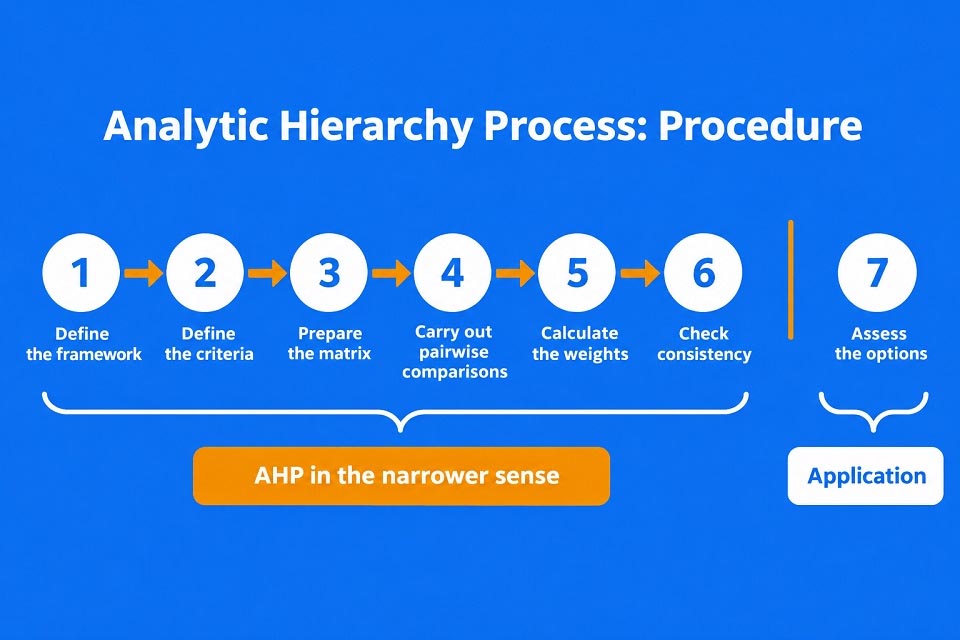
1. Define the decision framework
The team records in one sentence each what is being decided and what goal the decision is intended to achieve. It lists the options and explicitly writes down what is not part of the decision. A simple in-out list, i.e. two columns for ‘in scope’ and ‘out of scope’, is sufficient for this. It prevents new options or side issues from cropping up in the middle of the evaluation. Equally important is a sentence on the ground rules, such as: ‘We decide on the basis of criteria that we weight together beforehand.’ This gives hidden interests less room for manoeuvre. The framework also includes a brief explanation of why the effort is worthwhile and a formally appointed facilitator.
In the example, the goal is as follows: the music school selects the administration software that best supports its day-to-day work at all three locations. Providers A, B and C are the options, and no others. Changing the accounting software and relaunching the website are not up for discussion. Data protection compliance with data storage in the EU and the collection of fees by SEPA direct debit are must-have criteria. All three providers meet them. The team only puts the costs next to the result at the very end.
2. Collect and sharpen criteria
First, the team collects all the criteria it can think of. Then it condenses them: combining similar ones and deleting duplicates and vague ones until each criterion describes a separate aspect. Two rules help here. Criteria describe verifiable characteristics: ‘parent portal with online registration’ can be checked, whereas ‘satisfied parents’ is merely a hoped-for effect. And all criteria are at the same level of detail: ‘good availability’ and ‘hotline until 8 pm’ are difficult to compare with each other. Each criterion is given a name and a short definition of one or two sentences, which remains visible to everyone. Finally, there is a test: can each criterion be weighed well against every other one? If the group hesitates, the list is condensed further.
In the example, the group agrees on four criteria:
- Usability: Administrative staff, teachers and parents can use the software without lengthy training.
- Process coverage: Individual, group and ensemble rates, sibling discounts, instrument hire and room planning across three locations work without workarounds.
- Data migration: Pupil, contract and payment data can be transferred from the old database.
- Support: The provider can be reached and responds reliably to questions and faults.
3. Prepare the pairwise comparison matrix
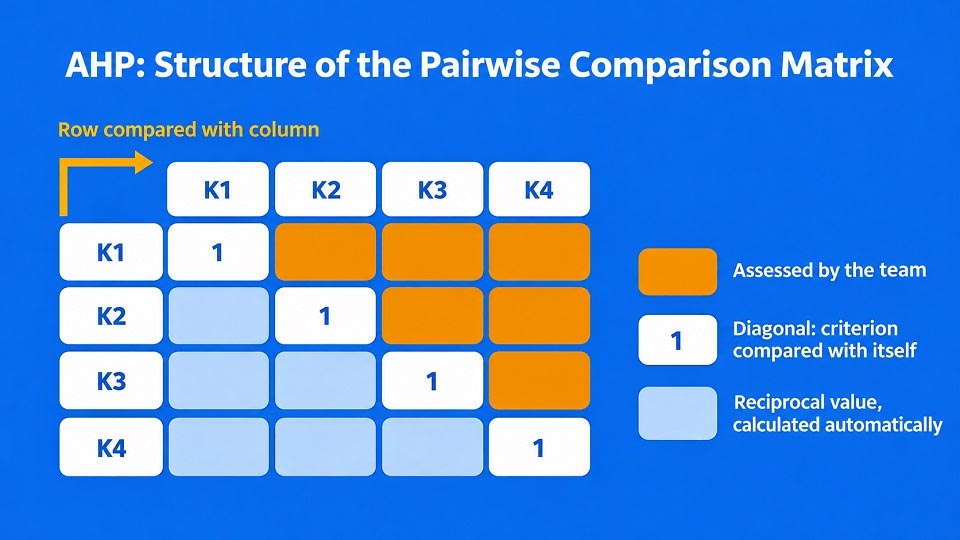
The criteria are carried over unchanged from step 2 into a square table, once as rows and once as columns. This means that each criterion can be compared with every other one. On the diagonal, a criterion meets itself, so there is always a 1 there. The team rates each pair only once, usually in the half above and to the right of the diagonal. The other half is derived from it. A clear reading direction is important, usually ‘row compared with column’, and it should be marked visibly, for example with an arrow. Anyone reading the other way round must take this into account when calculating the totals in step 5. Before starting, the facilitator walks through one pairing as an example without rating it. That way, everyone knows where to enter the values.
4. Compare the criteria in pairs
For the comparisons, the AHP uses Saaty’s scale [4]. It translates verbal judgements into numbers:
| Value | Meaning | Reciprocal value if reversed |
|---|---|---|
| 1 | both criteria equally important | 1 |
| 3 | moderately more important | 1/3 |
| 5 | strongly more important | 1/5 |
| 7 | very strongly more important | 1/7 |
| 9 | extremely more important | 1/9 |
| 2, 4, 6, 8 | intermediate values when the judgement lies between two levels | 1/2, 1/4, 1/6, 1/8 |
The scale therefore has nine levels from 1 to 9, plus the reciprocal values for the opposite direction. Many teams manage with the odd values and only resort to 2, 4, 6 or 8 for genuine intermediate judgements.
The facilitator names each pairing clearly. The question is always the same: ‘Measured against our goal, which of the two criteria matters more, and by how much?’ In workshops, it has proven useful for the team to answer in words (‘strongly more important’) and for the facilitator to translate the judgement into the numerical value. Some teams also use colours or symbols for the levels; the translation into numbers remains the same. Immediately after each entry, the reciprocal value goes into the mirrored cell: if row 1, column 2 contains a 3, row 2, column 1 contains 1/3. If there is any uncertainty about a term, a quick look at the short definitions from step 2 helps, and then the evaluation continues.
If the team cannot agree, a 1 is only correct if it actually considers the criteria to be equally important. Otherwise, the pairing remains marked and open. An alternative: everyone gives their judgement individually, and the individual values are combined using the geometric mean, which is common practice in the AHP for group judgements.
In the example, the only lengthy discussion concerns usability versus process coverage. The teachers consider usability to be more important, while the head of administration shows on screen how many hours each month-end closing with sibling discounts and hire fees currently costs him. The group agrees: process coverage is moderately more important. The completed matrix looks like this:
| Row compared with column | Usability | Process coverage | Data migration | Support |
|---|---|---|---|---|
| Usability | 1 | 1/3 | 3 | 5 |
| Process coverage | 3 | 1 | 5 | 7 |
| Data migration | 1/3 | 1/5 | 1 | 3 |
| Support | 1/5 | 1/7 | 1/3 | 1 |
| Total | 4.53 | 1.68 | 9.33 | 16.00 |
The team assigned the values above and to the right of the diagonal; the reciprocal values are below and to the left of it. The column totals in the last row are the first calculation for step 5.
5. Calculate the weights
Only now does the calculation begin. If the team works with a prepared template, the totals and result columns can remain hidden up to this point so that nobody is influenced by interim results during the comparisons. Then the calculation is disclosed:
- Calculate the total for each column.
- Divide each value by its column total. Each column then adds up to 1.
- Calculate the average of each criterion’s row. This is its weight.
For the music school, this results in the following normalised matrix:
| Criterion | Usability | Process coverage | Data migration | Support | Weight |
|---|---|---|---|---|---|
| Usability | 0.22 | 0.20 | 0.32 | 0.31 | 26% |
| Process coverage | 0.66 | 0.60 | 0.54 | 0.44 | 56% |
| Data migration | 0.07 | 0.12 | 0.11 | 0.19 | 12% |
| Support | 0.04 | 0.09 | 0.04 | 0.06 | 6% |
| Total | 1.00 | 1.00 | 1.00 | 1.00 | 100% |
Due to rounding, individual columns may add up to 0.99 or 1.01 at two decimal places; this is not an error. More than two decimal places provide no additional insight anyway, as the team’s judgements are not that precise. A side note for IT professionals: Saaty himself calculates the weights as the so-called eigenvector of the matrix [4]. The calculation shown here is a common approximation that delivers almost the same values when the judgements are consistent. In the example, the two methods differ by no more than one percentage point.
The result clearly shows the music school’s priorities: more than half of the weight is on process coverage, and just over a quarter on usability.
6. Check the result and consistency
Before the weights are used further, the team checks two things separately. The formal check asks: is the matrix complete, are the correct reciprocal values in place everywhere, and are the totals, rounding and formula references correct? The content check reads the weights in plain language: does the picture match what was said during the comparisons? Marked, disputed pairings from step 4 are discussed first.
The AHP comes with its own measuring instrument for this: the consistency ratio (CR). It shows how free of contradictions the judgements are overall. A contradiction would exist, for example, if A were strongly more important than B and B strongly more important than C, but C more important than A. Saaty recommends accepting weights with a consistency ratio of 0.1 or less and otherwise revising the judgements [4]. AHP software and many spreadsheet templates calculate the value automatically.
If the check reveals anomalies, the entire matrix is not re-evaluated. Instead, the team specifically reviews the pairings concerned, the definitions of the criteria and possible transcription errors. Finally, a note is made as to whether the weights were approved unchanged or refined in individual places.
In the example, the consistency ratio is 0.04, i.e. well within the acceptable range. Nevertheless, the group is surprised: support from the provider only accounts for 6 per cent. Reviewing the three pairings concerned shows that the judgements were meant that way. The music school has a contract with a local IT service provider, which is the first point of contact for faults anyway. The software vendor only steps in in exceptional cases. The team approves the weights.
7. Evaluate the options using the weights
Strictly speaking, this step is no longer part of the core AHP. It shows how the verified weights lead to a decision. The usual tool is a weighted scoring matrix:
- Enter the options in the rows and the criteria with their weights in the columns.
- Define a points scale and describe each level, for example 1 = barely met, 3 = met with limitations, 5 = fully met.
- Evaluate each option per criterion without letting the overall impression influence the score.
- Multiply the points by the weight and add up the partial values for each option.
- Sort the options by total score.
The music school awards the points after demo sessions in which all three providers had to work through the same five everyday cases, including a month-end closing with sibling discounts:
| Provider | Usability (0.26) | Process coverage (0.56) | Data migration (0.12) | Support (0.06) | Unweighted points | Total score | Rank |
|---|---|---|---|---|---|---|---|
| Provider A | 5 | 3 | 4 | 3 | 15 | 3.64 | 3 |
| Provider B | 3 | 5 | 2 | 4 | 14 | 4.06 | 1 |
| Provider C | 4 | 4 | 3 | 5 | 16 | 3.94 | 2 |
Calculation for provider B: 3 × 0.26 + 5 × 0.56 + 2 × 0.12 + 4 × 0.06 = 0.78 + 2.80 + 0.24 + 0.24 = 4.06.
The table shows the effect of the weighting. Unweighted, provider C would be in the lead and provider B in last place. Because process coverage counts so heavily for the music school, the order is almost reversed. Now the costs come into play, which the team had deliberately left out: provider B costs €8,400 a year, provider C €6,000. With a difference of only 0.12 points, that is an argument that counts. The group decides to have B and C tested with real data for two weeks and to ask B for a revised offer. The ranking has structured the decision, but it is the team that makes it.
The full AHP according to Saaty takes a different route at this point: the team also compares the alternatives in pairs, for each criterion, and does without a points scale. With four criteria and three providers, that means twelve additional comparisons. The result can be checked for consistency in the same way and is particularly useful when options are difficult to express in points. For many selection decisions, the scoring matrix is sufficient; it is quicker and easier to explain.
Key point: First agree together on what matters and how much, then evaluate the options. The Analytic Hierarchy Process separates these two questions and makes both of them verifiable.
Typical pitfalls of the Analytic Hierarchy Process
Most problems with the AHP arise during preparation and facilitation; the calculation itself is rarely the cause. These mistakes are particularly common in workshops:
- Even before the framework is in place, someone sometimes says something like ‘It’s obvious which one we should choose.’ The facilitator should postpone such premature judgements in a friendly but firm manner.
- Terms such as ‘flexible’ or ‘future-proof’ initially give the impression that everyone means the same thing. Without a shared definition, however, they often lead to discussions later on.
- An overly long list of criteria may seem thorough, but it leads to more comparisons and increases the risk of vague assessments.
- If criteria are spontaneously merged or reworded when they are transferred to the matrix, their original definitions may no longer match the subsequent assessments.
- In step 4, only the criteria are compared with each other. Anyone who already has a particular provider in mind risks a distorted weighting.
- The difference between ‘strongly more important’ and ‘very strongly more important’ seems small, but it can noticeably change the calculated weights.
- If the reciprocal values are not entered into the comparison matrix immediately, avoidable errors occur that are difficult to trace later on.
- Caution is also required when calculating with a spreadsheet. A single shifted cell reference can distort the result unnoticed, which is why spot checks are advisable.
- Especially when the differences are small, the calculated ranking should not automatically determine the decision. It provides a basis for the final discussion but does not replace it.
Investing time in steps 1 and 2 reduces the effort required for the subsequent comparisons and for reviewing the results.
How does the AHP differ from related methods?
There is a whole family of methods for decisions involving several criteria. The AHP differs from them mainly in how the weights are arrived at and how easily they can be verified.
- Utility analysis: Here, the team sets the weights directly, for example ‘usability 30%’. This is quicker but difficult to justify when there are many criteria. The AHP derives the weights from pairwise comparisons. The two methods can be combined: the evaluation in step 7 is essentially a utility analysis using AHP weights.
- Simple pairwise comparison: Here, too, each criterion is compared with every other one, but only with the question of which is more important. How great the difference is does not matter. The AHP also records the intensity and checks the judgements for consistency.
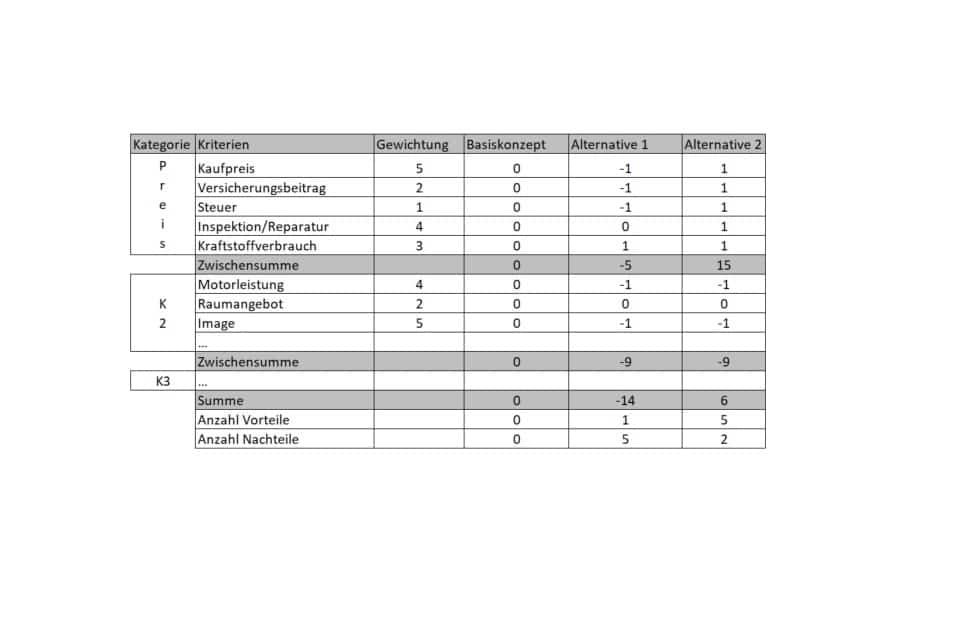
- Decision matrix and Pugh matrix: The decision matrix sets options and criteria against each other in a table. The Pugh matrix evaluates options in comparison to a reference solution as ‘better’, ‘same’ or ‘worse’. Both are suitable for a quick preselection; the weighting there is simpler or missing altogether.
- Decision tree: The decision tree maps decisions that are made one after the other and depend on uncertain events, often with probabilities. The AHP, on the other hand, weighs up criteria for a single decision.
Some methods complement the AHP well. Dot voting, in which each person distributes a limited number of sticky dots, can be used to narrow down a long list of criteria to the most important candidates beforehand. The in-out list from step 1 helps to define the framework. And once the decision has been made, an elevator pitch summarises it in a few sentences for management.
The AHP is thus the more thorough member of the family: more effort, but in return a weighting that can be justified and verified.
Advantages and disadvantages of the AHP
The AHP requires preparation and discipline, but in return it delivers decisions with a comprehensible justification. You should be aware of these strengths and weaknesses before using it.
The advantages include:
- The weightings and evaluations make it clear why a particular option was preferred. This is a considerable advantage, especially for investment decisions or public procurement.
- Conflicting objectives are addressed and evaluated openly. For example, the team has to decide whether ease of use is more important than process coverage. As a result, unspoken personal preferences lose influence.
- Measurable criteria such as response times can be considered together with qualitative assessments such as usability. The prerequisite is that each criterion is clearly defined and the alternatives can be evaluated accordingly.
- The consistency ratio shows how free of contradictions the pairwise comparisons are overall. If the value is conspicuous, the team can review its evaluations once again.
These strengths come at a price. The AHP requires time and a team that is willing to engage with the method. If either is missing, the weaknesses and disadvantages quickly become apparent:
- The calculated weights and evaluations are not automatically objective. Unclear criteria or careless comparisons can lead to results that are mathematically precise but questionable in substance.
- As the number of criteria increases, the number of comparisons required rises considerably. This lengthens the sessions, while declining concentration can impair the quality of the evaluations.
- If a further alternative is added to the full AHP or an existing one is removed, the ranking of the remaining alternatives may change. Valerie Belton and Tony Gear described this effect as early as 1983 [5].
- Overlapping or very different types of criteria make the comparisons more difficult. This can lead to lengthy discussions, which at the same time reduce the meaningfulness of the calculated weightings.
The Analytic Hierarchy Process is particularly suitable for important or controversial decisions with a manageable number of criteria. For quick everyday decisions, however, the effort is usually too great.
Questions from the field
Here you will find some questions and answers from practice:
What tips help with AHP workshops?
In addition to a well-structured process, a few lessons learned help the AHP to work well in a team:
- Ideally, five criteria are used, and if possible there should be no more than seven. Five criteria require ten pairwise comparisons, seven as many as 21. As the number of comparisons increases, concentration may decline.
- If the list of criteria cannot be shortened sufficiently, a few main criteria with two or three sub-criteria each can be formed. These are compared separately within their respective level so that the individual comparison matrices remain manageable.
- A flip chart or shared document with short definitions of all criteria helps to avoid misunderstandings and reduces recurring discussions about terms.
- Sufficient breaks should be planned for longer sessions, as evaluations can become less precise or more contradictory as concentration declines. A comparison that has already been evaluated can be asked again after the break to check the consistency of the judgements.
- The facilitator should ask questions, reflect statements back and summarise results, but not take part in the evaluations. Taking sides can undermine the participants’ trust and the acceptance of the result.
- The rating scale used, the comparison matrices, disputed evaluations and the reasons for the final decision should be recorded in brief minutes. This makes it possible to trace how the result was reached at a later date.
Other than that, practice makes perfect.
What should you do if a fourth provider suddenly appears during the evaluation?
First clarify whether it goes beyond the framework from step 1 or whether it was simply overlooked. If it is included, the criteria weights remain valid, as they do not depend on the options. Only the evaluation in step 7 needs to be repeated. However, anyone who also compares the alternatives in pairs, as in the full AHP, must expect the order of the existing options to shift and should go through the comparisons for all criteria again.
Doesn’t the AHP simply convert gut feeling into numbers?
Partly, and that is intentional. The pairwise comparisons remain subjective judgements. The difference is that each judgement is stated individually, recorded and checked for contradictions. A vague ‘I have a good feeling about provider B’ thus becomes a statement that can be discussed: which criterion leads to this feeling, and how much does it count? Anyone who disagrees with the result has to point to a specific pairing.
How many people should take part in the comparisons?
Four to eight people covering the most important perspectives, such as management, business departments and IT, have proven effective. In significantly larger groups, the comparisons drag on and quieter voices are lost. In such cases, it is better for everyone to evaluate individually and for the individual judgements to be combined. The discussion then focuses on the pairings where opinions differ widely.
Impulse to discuss:
How can you tell with the AHP whether the weighting of the criteria is the result of an open discussion or merely a retrospective justification for a decision that was already favoured?
Notes:
If you like this post or would like to discuss it, please feel free to share it within your network.
[1] INFORMS: Thomas L. Saaty, Biographical Profile. History of O.R. Excellence, INFORMS, Catonsville (Maryland).
[2] Thomas L. Saaty: A Scaling Method for Priorities in Hierarchical Structures. Journal of Mathematical Psychology 15 (1977), Issue 3, pp. 234–281.
[3] Thomas L. Saaty: The Analytic Hierarchy Process: Planning, Priority Setting, Resource Allocation. McGraw-Hill, New York 1980.
[4] Thomas L. Saaty: How to make a decision: The analytic hierarchy process. European Journal of Operational Research 48 (1990), Issue 1, pp. 9–26.
[5] Valerie Belton, Tony Gear: On a short-coming of Saaty’s method of analytic hierarchies. Omega 11 (1983), Issue 3, pp. 228–230.
Here you will find an interesting series of articles on decision-making techniques for self-organised project teams.
And here you’ll find more information from our Smartpedia section:
What is a Pugh Matrix?

What is Dot Voting?

What is an Elevator Pitch?
‘Smartpedia’ is our glossary for people in organisations involved in software development, project management and product management. It is for precisely these people and their organisations that we have been developing and modernising software since 2012. Pragmatic. ✔️ Personal. ✔️ Professional. ✔️
Get to know t2informatik from Berlin as your development partner.