
Why workplace health needs long-term activation
Expand the table of contents
Health also influences statt retention
Long-term engagement requires initiatives suitable for everyday life
The same provision does not mean equal access
From a ‘supply-based’ to a ‘usage-based’ approach in workplace health management
What might long-term engagement look like in practice?
From a health initiative to sustainable implementation in day-to-day working life
For many companies and organisations, high levels of sick leave have long been more than just an HR metric. They place a strain on teams, complicate staff planning and incur significant costs. At the same time, some of the health-related pressures remain hidden: employees sometimes carry on working even though they are unwell.
The question of how to reduce sick leave therefore falls short. What is more important is: How can companies create conditions in which employees can remain healthy and productive in the long term?
Alongside working conditions and leadership, this brings into focus an often underestimated challenge of workplace health management. Health initiatives must reach employees, be integrated into their day-to-day working lives and remain relevant over the long term.
Sick leave figures only reveal part of the problem
The Federal Institute for Occupational Safety and Health (BAuA) estimates the average number of days of incapacity for work in 2024 at 20.8 days per employee. In total, there were around 881.5 million days of incapacity for work. The resulting estimated loss of production amounted to 134 billion euros, whilst the loss in gross value added stood at 227 billion euros. [1]
Absenteeism is therefore also a significant economic factor. At the same time, it only partially reflects the health-related burdens within companies.
Anyone who stays at home due to illness is included in the absence statistics. However, employees may also continue to work despite being unwell, either on-site or whilst working from home. This phenomenon is known as presenteeism. The BAuA points out that presenteeism has not yet been systematically recorded and can result in both health consequences for employees and costs for companies. [2]
This is relevant for companies because attendance says little about how resilient or productive employees actually are. Health in the workplace therefore begins long before an employee reports sick.
Health also influences staff retention
Employees are acutely aware of how their organisation deals with stress. Are heavy workloads questioned? Can staff raise concerns about being overwhelmed? Are stressful processes changed?
Such working conditions influence health and, at the same time, shape how employees perceive their employer. Anyone wishing to retain qualified staff in the long term should therefore consider health and staff retention as a single issue. However, workplace health management (BGM) can only go so far in compensating for organisational shortcomings. A back care course does not solve staff shortages, nor does resilience training resolve unclear lines of responsibility. Effective workplace health management requires health-promoting working conditions and initiatives that employees can actually make use of in their day-to-day work.
Long-term engagement requires initiatives suitable for everyday life
Many organisations do not lack health initiatives. Health days, sports classes, webinars, counselling programmes and digital health solutions are standard practice in many places. The real challenge lies in uptake. Are employees being reached, do they start taking part in an initiative, and do they remain active over a longer period?
A scoping review of workplace health promotion programmes examined 58 scientific publications. Only 37 of these reported participation rates at all. Of these 37 studies, 20 showed an average participation rate of less than 50 per cent. The authors also emphasise that target groups, interventions and measurement timepoints vary greatly, and direct comparisons are therefore only possible to a limited extent. [3]
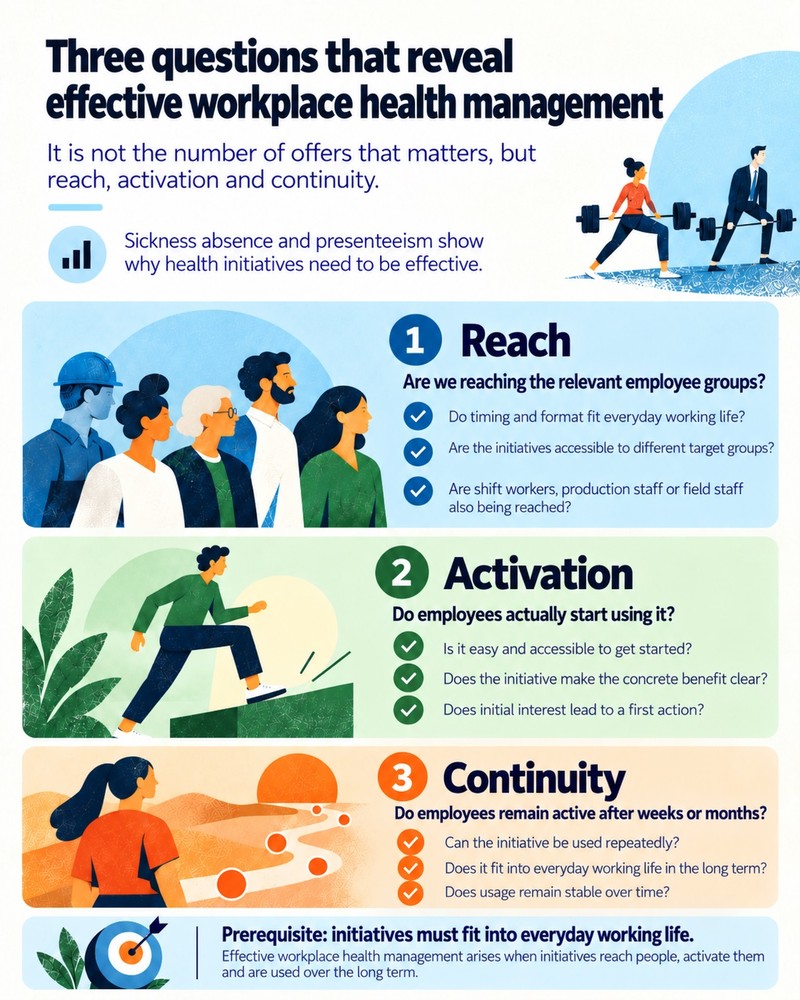
When evaluating workplace health management programmes, it is therefore worth distinguishing between three levels:
- reach,
- engagement and
- continuity.
How many employees are reached? How many actually start using the programme? And how many remain active after several weeks or months?
This is precisely where low-threshold formats become increasingly important. Short exercise sessions, micro-learning modules, mental prompts or small challenges are often easier to integrate into a busy working day than additional lengthy sessions. Different formats can cater to different needs. Short digital sessions facilitate flexible use, whilst more comprehensive programmes provide scope for in-depth topics. It is crucial that the format, target group and reality of the workplace are well-aligned.
The same provision does not mean equal access
Whether employees can make use of a health provision depends heavily on how well it fits in with their day-to-day working lives. The 2025 Prevention Report by the GKV Spitzenverband and the Federal Medical Service shows that 65 per cent of the documented workplace health promotion measures in the 2024 reporting year were aimed equally at all employees. 35 per cent were aimed at specific target groups. [4]
A standardised programme offers employees very different opportunities for participation:
- A care worker on shift work has a different daily routine to a colleague in administration.
- An employee in production has different periods of free time to someone working from home.
- Field staff, managers, apprentices and manual workers differ in the pressures they face, as well as in when, where and how health programmes fit into their daily lives.
A webinar at 2 pm may work well for an office-based role but be practically impossible to attend during a production shift. The key question is therefore: “How do we create access that works in everyday life and encourages repeated use?”
From a ‘supply-based’ to a ‘usage-based’ approach in workplace health management
This perspective also changes how success is measured in workplace health management. The number of measures in place says little about how successful workplace health management actually is. Even registrations or one-off participation only show a snapshot. The analysis becomes more meaningful when companies track how usage develops over a longer period of time.
- Which employee groups are being reached?
- How does activity change after four weeks, three months or half a year?
- Which formats are used on a long-term basis? Where is interest waning?
Workplace health management should therefore shift more strongly from a programme-based approach to a usage-based approach.
Success is thus increasingly measured by how effectively health programmes reach their target groups and how firmly they can be embedded in everyday working life.
What might long-term engagement look like in practice?
GoEcoFit demonstrates how such an approach can be implemented. The digital workplace health management platform combines short health-related content and micro-learning modules with exercise, mental well-being activities, gamification and team challenges. The aim is to integrate prevention into everyday working life in an accessible way: suitable for everyday use, continuous and flexible.
Engagement rates in previous roll-outs spanning several months have ranged between 65 and 85 per cent. The key question here is whether employees remain active over a longer period. Whilst these figures are not directly comparable with participation rates from scientific studies – as definitions, target groups and measurement periods vary – they do highlight why workplace health management programmes should focus not only on reach but, above all, on how usage develops over time.
This leaves companies with a key question: do your employees make long-term use of the health programmes?
Notes (partly in German):
If you’d like to see how GoEcoFit works in practice, book a free GoEcoFit demo.
[1] Bundesanstalt für Arbeitsschutz und Arbeitsmedizin: Volkswirtschaftliche Kosten durch Arbeitsunfaehigkeit
[2] Bundesanstalt für Arbeitsschutz und Arbeitsmedizin: Praesentismus – Arbeiten trotz Krankheit
[3] National Library of Medicine: Is It Time to Re-Shift the Research Agenda? A Scoping Review of Participation Rates in Workplace Health Promotion Programs
[4] GKV: Praeventionsbericht 2025
Would you like to support Sebastian Ströhl and discuss workplace health management and the long-term engagement of employees? Then please share this post on social media or within your organisation.
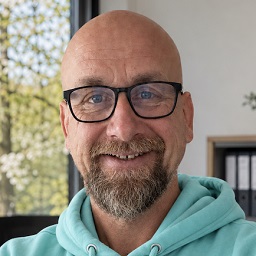
Sebastian Ströhl
Sebastian Stroehl is the Managing Director of GoEcoFit GmbH. For more than 20 years, he has been developing and scaling up companies and business areas in technology-driven markets. At GoEcoFit, he focuses in particular on the question of how workplace health promotion not only reaches employees but also engages them in the long term. His focus is on prevention, behavioural change and the measurable impact of workplace health management in companies and organisations.
On the t2informatik Blog, we share knowledge and experience with people in organisations. We have been developing and modernising software for them since 2012. Pragmatically. ✔️ Personal. ✔️ Professional. ✔️ Get to know t2informatik as your development partner.