
Why team problems are often relationship patterns
A systemic practical perspective from management and consultancy
Organisations invest considerable resources in processes, structures and methods to make collaboration more efficient. Responsibilities are clarified, communication rules defined and workflows optimised. Yet one phenomenon remains surprisingly persistent: conflicts do not disappear.
This finding is neither a coincidence nor a sign of inadequate implementation. It points to a fundamental assumption that is prevalent in many organisations yet falls short: the notion that better structures automatically lead to better collaboration.
From a systemic perspective, a different picture emerges. Many problems described in day-to-day work as technical challenges are, in reality, an expression of stable relationship patterns within a social system.
This is particularly evident in complex fields of work, such as the hospitality industry. Yet the dynamics observable there are not a special case. They are equally found in industrial companies, start-ups, educational institutions or medium-sized businesses.
In my work as a non-medical practitioner for psychotherapy in Nuremberg with a systemic background, I regularly encounter the same patterns outside traditional organisational structures as well, for example in leadership contexts, group practices or owner-managed companies.
Collaboration arises from interactions
Take a hotel, for example. On paper, it appears clearly organised: departments, responsibilities, duty rosters. This formal structure gives the impression of clarity and controllability.
In reality, however, the picture is far more complex. It is not just structures at work, but several systems operating simultaneously and influencing one another:
- staff and guests,
- teams within individual departments,
- the entire company as an organisational system,
- each staff member as an independent psychological system,
- people in multiple roles simultaneously, such as colleague, manager or trainer,
- external systems such as vocational schools or cooperation partners,
- personal networks and competitors, and
- economic and social conditions.
This simultaneity of different systems has an important consequence: hardly any event remains in isolation. A difficult situation with a guest affects the mood within the team. Internal uncertainty impacts service quality. Economic pressure alters leadership behaviour. Personal stresses faced by individual staff members shape team dynamics.
This highlights a key systemic insight: problems rarely arise from individual people, but rather from interactions.
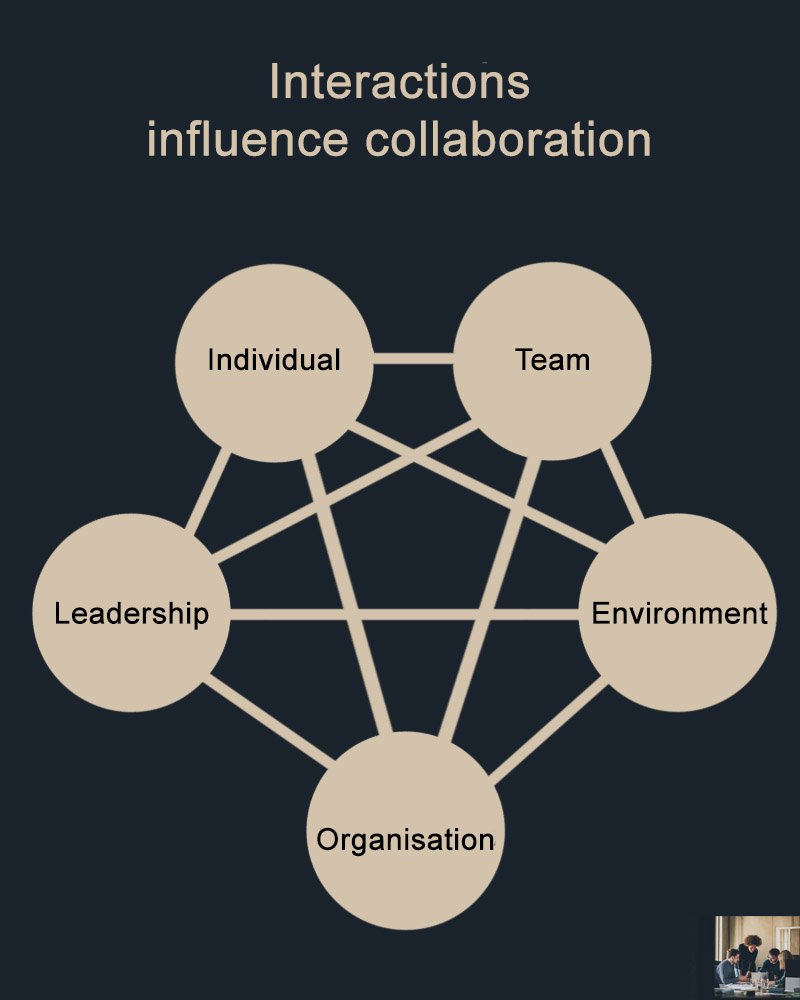
Figure: Interactions influence collaboration
However, particularly within social systems, this expectation can only be met to a limited extent. The search for a single cause falls short because it overlooks the complexity of the interrelationships. Organisational reality emerges in a circular manner. People react to one another and, in doing so, often unintentionally reinforce existing patterns.
Systemic work therefore does not rely on definitive diagnoses, but on hypotheses. The first step is to work together to define a problem, rather than intervening prematurely.
Insight often only emerges through small, targeted changes. Typical starting points might include:
- What happens when responsibilities are shifted slightly?
- What effect does a change in the leadership’s communication style have?
- How does a team react to greater transparency?
Such interventions open up new perspectives. They make differences tangible and enable patterns to become visible. Organisations learn less through instruction than through experience. Measures under employment law may be necessary in individual cases. However, they often address only visible behaviour. The underlying dynamics remain in place. The problem does not disappear, but reappears elsewhere.
Not because people are interchangeable, but because the system favours and stabilises certain reactions. Anyone wishing to understand and change organisations must therefore focus less on searching for clear-cut causes and more on the interactions through which problems arise and persist in the first place.
What team conflicts are often about: relationship patterns
If collaboration arises from interactions, the same applies to conflicts. What often becomes apparent are stable relationship patterns that shape how the team works together.
Conflicts are usually described in factual terms: insufficient coordination, inefficient processes, misunderstandings. This is rarely wrong, but often incomplete. Because teams are social systems. People bring their past relationship experiences into their collaboration and react based on these patterns.
Typical questions that play a role here include, for example:
- How do I deal with criticism?
- How do I ensure a sense of belonging?
- When do I feel secure?
- How do I react to uncertainty or authority?
These patterns usually operate unconsciously and often influence interaction more strongly than any process description.
From these individual influences, typical dynamics emerge within the team that stabilise over time:
- Individuals consistently take on too much responsibility.
- Others withdraw when tensions arise
- Criticism is taken more personally than intended.
- Conflicts are handled indirectly
Such patterns rarely develop intentionally. They arise from the interplay of individual reactions and are reinforced by repeated interaction.
On the surface, the team discusses processes. At its core, however, it negotiates trust, security and a sense of belonging.
Against this backdrop, conflicts appear less as disruptions and more as indicators. They reveal which relationship patterns are at work within the team and where expectations, insecurities or unspoken rules collide.
Those who seek to resolve conflicts solely at the factual level therefore often fall short. Lasting change only occurs once the underlying relationship patterns are also recognised.
How to stabilise and change organisational dynamics
In practice, organisations often respond to tensions by introducing new methods. Feedback models, meeting structures, guidelines or agile frameworks are designed to improve collaboration and create clarity. Such tools are useful and can provide direction.
However, their effectiveness depends on one key prerequisite: psychological safety.
If this is lacking, typical effects emerge in day-to-day life:
- Feedback remains superficial,
- meetings are structured but tense,
- decisions are postponed and
- conflicts are rationalised.
Methods only work where people feel secure enough to speak openly and to show uncertainty. The crucial question thus shifts: no longer what method is missing, but under what conditions collaboration actually succeeds.
To better understand these conditions, it is worth taking a look at a central principle of systemic work: circularity.
Whilst linear thinking asks what triggered a problem, the focus here is on the patterns that perpetuate it. It is not about a starting point, but about cycles in which behaviour reinforces itself.
A typical example:
A manager perceives their team as lacking initiative and takes on greater control. The team responds by taking even less personal responsibility. The manager feels vindicated and reinforces their behaviour further. The crucial question is not who started it, but which pattern is becoming entrenched here.
Such loops are not random. They often serve to provide stability in the short term, but lead to entrenchment in the long term. Change occurs when these cycles are disrupted. Often, even small shifts are enough: greater clarity, different questions or deliberately introduced pauses.
In this context, leadership plays a special role. Managers are part of the system and, at the same time, play an active role in shaping it. Every decision, but also every hesitation or failure to act, influences the dynamics.
In uncertain situations, the urge to control often increases. However, lasting stability arises less through control than through clarity and reliability.
Clarity means, for example:
- making expectations explicit,
- defining roles transparently and
- making decision-making processes comprehensible.
Reliability is demonstrated, amongst other things, by:
- consistent behaviour,
- predictable reactions and
- emotional stability.
Teams are guided less by formulated guidelines than by observed behaviour. Security arises not through announcements, but through repeated experience in everyday life.
Resistance, too, can be viewed in a new light in this context. It is frequently interpreted as a disruption, but from a systemic perspective it is initially a form of information. It can, for example, be an indication of:
- uncertainty,
- a lack of involvement,
- unclear consequences, or
- a sense of belonging under threat.
If resistance is ignored or penalised, the underlying pattern often becomes further entrenched. If, on the other hand, it is understood as a signal and taken seriously, the opportunity for differentiation arises: what is making this change difficult? Where is guidance lacking?
It often becomes apparent that resistance loses intensity as soon as it is named and its function understood.
Change in organisations therefore rarely arises from major interventions, but rather from the conscious alteration of interactions. Minor disruptions to the existing pattern can be enough to trigger new dynamics and break deadlocked cycles.
When leadership becomes personal and systems react emotionally
The more complex organisations become, the more leaders themselves find themselves caught up in emotional dynamics. Decisions made under uncertainty, team conflicts, economic pressure or high external expectations do not merely have a structural impact. They also have a personal impact.
Leadership is not a purely objective process. It is always, in part, about shaping relationships whilst under scrutiny.
In practice, this gives rise to a recurring tension. Leaders try to maintain neutrality, emphasise professionalism and suppress personal involvement. At the same time, teams react sensitively to every nuance in behaviour. Tone of voice, presence, eye contact or the pace of decision-making are closely observed and interpreted.
This creates a paradoxical situation: the more leadership attempts to exclude emotions, the more strongly they implicitly influence the system.
From a systemic perspective, emotions are not a disruption to rational processes. They are an integral part of social systems. They provide clues to tensions, uncertainties or unresolved expectations.
Typical effects manifest themselves in everyday life in various ways:
- A team that consistently avoids conflict appears harmonious but loses its capacity for innovation.
- A team that discusses tensions exclusively in a matter-of-fact manner often develops a tense sobriety.
- A management team that communicates pressure only rationally creates underlying uncertainty.
These patterns do not arise by chance. They are an expression of a lived culture.
Culture does not arise from mission statements or formulated values. It arises through repeated interaction in everyday life. What matters here is not so much what is said, but what actually happens.
Typical questions that reveal culture include, for example:
- How are mistakes dealt with?
- Who is allowed to voice criticism?
- How are conflicts managed?
- Which emotions are accepted?
Every reaction, particularly under pressure, further shapes these patterns. Culture cannot therefore be introduced directly, but only changed indirectly by altering interactions.
For leaders, this means being consciously aware of their own influence on these dynamics. Behaviour is never neutral in this context. It always fulfils a function within the system and reinforces certain expectations.
A real-life example illustrates this:
A manager with a strong sense of responsibility consistently takes on additional tasks to ensure stability. The team learns to rely on this stabilising effect. At the same time, this leads to overwork. If this is later addressed, employees react with irritation because their expectations have already adjusted.
The original behaviour was functional. In the long term, it became system-stabilising and thus difficult to change. This demonstrates once again that behaviour cannot be viewed in isolation. It always interacts with the system in which it takes place.
Change therefore often begins not with new measures, but with increased self-observation. The following questions can be helpful for managers:
- What role do I regularly play within the system?
- What reactions do I unintentionally trigger?
- What dynamics do I stabilise through my behaviour?
These questions are not aimed at self-optimisation, but at self-reflection. They open up the possibility of perceiving one’s own role within the system more consciously.
Particularly in highly performance-oriented organisations, the expectation quickly arises that problems must be solved efficiently. However, social dynamics cannot be resolved like technical glitches. They change through new experiences of working together.
When leadership begins to understand relationship patterns not as individual failure but as an expression of systemic interconnections, a sense of relief emerges. Responsibility remains, but the search for blame recedes into the background.
This shift in perspective often marks a decisive turning point. Not because conflicts disappear, but because they are viewed differently. And this is precisely where sustainable change begins: not by controlling individual behaviours, but by consciously shaping interaction. Systems always react. The crucial question is not whether they react, but to what.
Conclusion: Teams are always working on relationships
Teams never just solve tasks. They are always shaping relationships as well.
Many problems that appear as practical challenges in day-to-day work are actually manifestations of established patterns in how people interact. Processes, methods and structures are important. However, they fall short if the underlying dynamics are ignored.
In this sense, conflicts are not disruptions, but clues. They reveal where expectations, uncertainties and needs intersect. Those who address them solely at a factual level often miss the real crux of the matter.
Leadership therefore involves less about directly changing people. Rather, it is about creating conditions under which new forms of interaction become possible. Where these conditions change, new experiences emerge. And with them, the patterns that shape collaboration also change.
Systemic work therefore does not begin with individual people, but with understanding the relationships within which collaboration arises.
This shift in perspective is a particular strength. It relieves pressure without relinquishing responsibility. And it opens up new avenues for action, particularly where traditional approaches reach their limits.
For sustainable change does not arise through greater control, but through a deeper understanding of the dynamics within which people work together.
Notes:
A systemic perspective can provide new insights, particularly in cases of recurring conflicts, high stress or entrenched patterns. Dennis Meistereck supports managers in stressful or unclear situations, as well as self-employed individuals in complex decision-making and responsibility contexts. The focus is not on finding quick solutions to individual problems, but on understanding the dynamics and relationship patterns in which they arise. You can easily get in touch with Dennis Meistereck via his website.
Would you like to discuss team problems and relationship patterns as an influencer or opinion leader? Then share this post on your social media networks.

Dennis Meistereck
Dennis Meistereck is a systemic consultant and alternative practitioner specialising in psychotherapy based in Nuremberg, with a professional background in the management of international hotel organisations. Having spent many years in senior management roles, he now supports executives, teams and individuals on issues relating to collaboration, communication and sustainable change.
His approach combines practical management experience with a systemic organisational perspective. The focus is on working with interactions, relationship patterns and the conditions for successful collaboration, particularly where purely technical solutions reach their limits.
On the t2informatik Blog, we share knowledge and experience with people in organisations. We have been developing and modernising software for them since 2012. Pragmatically. ✔️ Personal. ✔️ Professional. ✔️ Get to know t2informatik as your development partner.