
Three typical pitfalls as a manager
How managers unintentionally manoeuvre themselves out of the game
Every new manager starts out with lots of fresh energy, big ambitions and a strong desire to really make a difference. This enthusiasm is fundamentally positive and necessary. However, it can quickly backfire if you overlook fundamental systemic relationships at crucial points and thus fall into typical pitfalls. The following section discusses three such pitfalls that can derail you as a manager. At the same time, you will learn how to lead more wisely, calmly and sustainably by taking a systems theory approach.
Pitfall 1: The manager makes everything new
As a new manager, there is a strong impulse to turn everything upside down with full energy and a fresh perspective. However, organisations and teams are complex, living systems. They constantly strive for an inner balance, known as homeostasis. This means that although changes from outside are registered, the system uses a variety of mechanisms to avoid fundamental change and preserve the status quo. This dynamic is similar to the way our bodies maintain a stable core temperature, regardless of how much the environment changes.
If you try to change everything at once, your energy will often meet with resistance. This often leads to rejection, frustration within the team or even paralysis. System theory explains that organisations and teams consist of different units that regulate themselves and protect their boundaries against external influences. Your role as a leader is to understand these self-organising principles and to work respectfully with the internal dynamics rather than ignoring them. Simply put, you are not a repair service that quickly remakes everything, but someone who develops a sensitive understanding of the forces at work within the system.
Practical tip:
At the beginning, consciously take one to two weeks to observe. Use this phase to accurately identify patterns, relationship networks and processes. Note down the three most important levers for change from your point of view and share them with your team. Discuss together why change seems appropriate in this particular area and what a future, improved state might look like. Jointly developed measures lead to more realistic solutions, create acceptance and avoid blind spots.
This approach promotes mutual understanding and awakens personal responsibility within the team. Instead of directing from above, actively involve your employees and shift leadership from control mechanisms to learning-oriented cooperation.
Pitfall 2: The manager as a mate
Modern managers rely on closeness, openness and a friendly relationship with their team to build trust. This is contemporary and promotes cohesion. At the same time, the systemic perspective shows that trust in social structures such as organisations arises primarily through predictability and reliability. If you position yourself too strongly as a buddy, this role becomes mixed up with your formal role as a manager. The team then does not always know how you will react, for example, to mistakes, conflicts or stress.
This uncertainty can be paralysing and reduce performance because teams need a stable foundation for their behaviour. The systemic perspective makes it clear that leadership is not just a role or function, but consists of reciprocal relationships and communication processes. The roles of managers and employees are coded differently. The expectations on both sides differ and must be transparent for cooperation to work.
Practical tip:
Be open about what upsets you, how you react in conflicts and where your boundaries lie. Communicate clearly what your expectations are, how you evaluate mistakes and when you intervene. Predictability and clear communication create more security and trust than a supposedly harmonious buddy role. By making it clear from the outset what behaviour is acceptable in your team and when you will intervene, you minimise uncertainty and create a safe space for performance and development.
This leadership style, based on trust rather than friendship, supports stable structures while promoting the openness necessary for innovation.
Pitfall 3: Flying blind without control
For many, the word “controlling” has negative connotations because it is often associated with control and mistrust. As a result, metrics and evaluation criteria, if used at all, are seen as a necessary evil and are rarely used effectively in a management context. From a systems theory perspective, however, controlling is an indispensable feedback mechanism for keeping your team on track.
Only when you know which parameters influence your employees’ behaviour, which actual goals are being pursued and whether you are on the right track can you manage effectively. Often, predefined metrics are not meaningful or do not fit the team context. The challenge then is to identify suitable metrics.
Feedback loops create feedback in the system, which allows behaviour and strategies to be continuously reviewed and adjusted. Without such control mechanisms, there is a risk of flying blind. You act on gut instinct without knowing whether the goal will be achieved or which intermediate goals will be lost.
Practical tip:
First, describe in plain language what you want to measure or evaluate and why, for example, the quality of collaboration, the ability to innovate or the team’s contribution to the department’s success. Discuss with your team how these aspects can be operationalised and translated into suitable metrics. In this way, you increase acceptance, reduce fears of control and create a sound basis for management and further development. Use regular meetings such as retrospectives to openly reflect on the results and jointly derive improvements.
This continuous learning process ensures that your team responds flexibly to changes and continually adapts the set goals to reality.
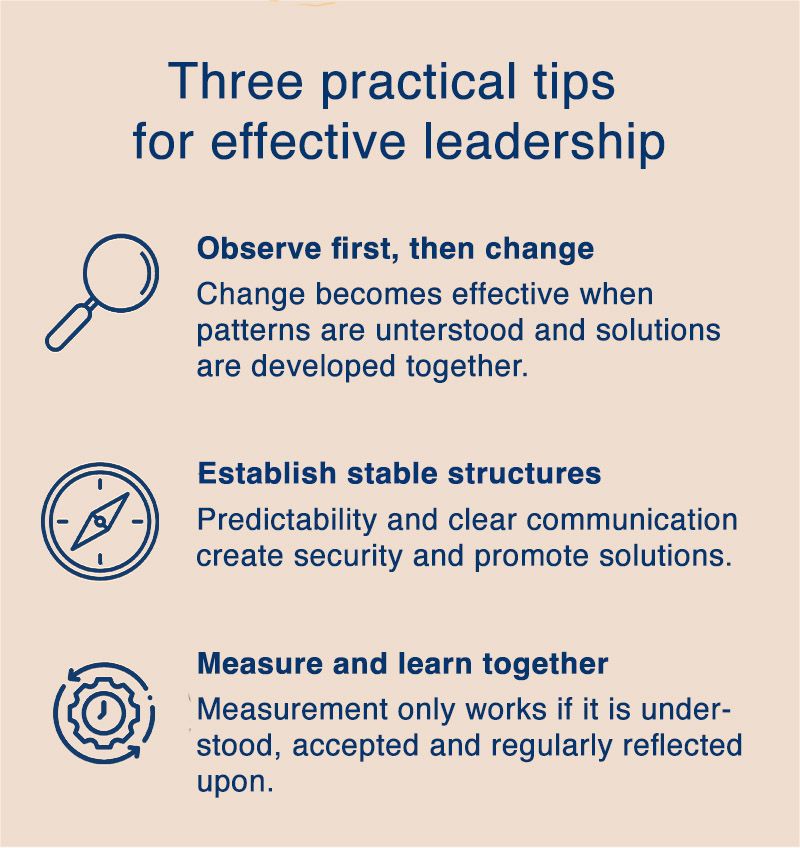
Figure: Three practical tips for effective leadership
Recognising pitfalls and leading effectively in a systemic manner
Leadership always takes place in a complex, dynamic context comprising diverse relationships, communication patterns and processes. Attempts at change must be systematic, reflective and dialogue-based in order to avoid being blocked by the system’s tendency to seek equilibrium. Clear roles and transparent expectations create security and promote a professionally friendly working environment. The use of feedback and control mechanisms is essential for open reflection and continuous development.
It is precisely here that the typical pitfalls for managers arise: hasty intervention, unclear role models and a lack of feedback.
This understanding opens up new perspectives. Leadership is not a one-dimensional hierarchical structure, but a circular process between individual actors, teams and the entire organisation. Interactions should be understood as mutual influences in which all participants take responsibility.
Those who recognise these connections avoid the pitfalls described above not through actionism, but through the conscious shaping of relationships, expectations and control.
Use this knowledge in your everyday leadership to better understand the strengths of your team and your organisation and to influence them in a more targeted manner. In this way, as a leader, you will not only achieve short-term success, but also promote the long-term development of your team.
Notes:
Are you interested in the topic of ‘Leadership in a complex, dynamic context’? Stefanie Hamann looks forward to hearing from you! She is easy to reach via LinkedIn.
Would you like to discuss pitfalls as a leader or opinion leader? Then share this post in your networks.
Here you will find an interesting article about trust destroyers in everyday management.
And here you will find an article worth reading about role clarification in teams.
Stefanie Hamann has published another post on the t2informatik Blog:

Matrix organisation: formalised irresponsibility

Stefanie Hamann
Stefanie Hamann is an expert in smart organisational design and agile methods. With her passion for innovative and effective structures, she helps companies to remain resilient and adaptable. As a consultant, she has successfully supported numerous companies in implementing agile methods such as Scrum, Kanban and SAFe. She also coaches managers to develop their leadership skills and establish an inspiring leadership culture.
In the t2informatik Blog, we publish articles for people in organisations. For these people, we develop and modernise software. Pragmatic. ✔️ Personal. ✔️ Professional. ✔️ Click here to find out more.