
The inner resignation within a team
Expand the table of contents
Anna’s got it sorted: what inner resignation means for her colleagues
The team realises it before the manager does
When effort remains ineffective in the long run
Addressing inner resignation: two conversations instead of one
Five things to do over the next two weeks
Conclusion
Inner resignation is the only team problem that managers are initially pleased about.
Monday, ten o’clock, team meeting. The agenda features the new prioritisation, and everyone in the room knows what’s coming: Jens is going to pick it apart. Jens picks everything apart. For years, he’s been asking the questions nobody else asks, and he does so reliably just when you’d actually like to have finished.
This time, Jens says nothing. He nods, jots something down and glances at his watch. The meeting ends ten minutes earlier than planned. And the manager thinks, quite honestly: at last.
I’ve heard this thought expressed by many managers, and it’s understandable. But here’s the thing: someone who has questioned every decision for years and has been merely nodding for the past few weeks isn’t suddenly on board. They’ve stopped getting involved because they no longer believe it makes any difference. That’s how ‘quitting in your head’ begins.
Because it initially makes things calmer within the team, hardly anyone sees it as a problem. At first, someone else bears the brunt of this ‘mental check-out’: Anna, two desks over. From now on, she’ll be asking the questions that Jens no longer asks and doing the work he leaves undone. For a while, at least.
Why inner resignation goes unnoticed for so long
Inner resignation means that someone is still there and carrying out their duties, but has emotionally distanced themselves from their work and employer. This is often lumped together with ‘quiet quitting’. Quiet quitting usually describes a conscious decision to limit one’s efforts to what is contractually required. Inner resignation goes further than that: the emotional connection to the work and the employer has largely been lost. This is not necessarily evident in working hours, but rather, for example, in a lack of initiative, a reluctance to take on responsibility or increasing withdrawal.
The current Gallup Engagement Index shows just how widespread this is: according to Gallup, 13 per cent of employees in Germany no longer have an emotional connection and are therefore considered to have mentally checked out. A further 77 per cent show only a low level of emotional connection. Only 10 per cent feel a close emotional connection to their employer. Gallup estimates that the loss of productivity resulting from ‘quitting in your head’ will amount to between 119 and 142 billion euros by 2025. [1]
There is a simple reason why ‘quitting in your head’ goes unnoticed for so long: it happens in small steps, and there is a plausible explanation for each individual step. Jens has a lot on his plate at the moment. He’s had a bad week. Perhaps something’s going on in his personal life. It’s only when you compare the last six months side by side that you realise how much has changed: fewer suggestions, less pushback, no longer any interest in how the project is progressing. Jens is still getting his tasks done, of course. But commitment comes long before results.
Anna’s got it sorted: what inner resignation means for her colleagues
Anna’s the one who still has people popping in at four o’clock on Fridays, ‘just for a moment’. This has been happening more often over the past few months. The enquiry from the client that used to go to Jens now ends up with her. The proposal that Jens was actually supposed to review, she ‘quickly takes a look at’. And when nobody else in the meeting asks the awkward question, she simply asks it herself. None of this is on any to-do list. It just happens.
This is also evident in absence figures. Employees with no emotional attachment are absent for an average of 9.7 days a year, whilst those with a strong sense of commitment are absent for 5.7 days. According to Gallup, high levels of sick leave increase stress amongst the remaining team members, who have to cover for the absentees. [2] Added to this are the tasks that do get done, but only to the extent that nobody can complain. Anna takes care of the rest.
Organisational researchers Will Felps, Terence Mitchell and Eliza Byington have described what happens in a group in such situations. [3] Anyone who visibly scales back their efforts initially triggers a feeling among the others that they are being treated unfairly. After that, trust declines. And eventually, the others also take their foot off the gas to protect themselves.
In the canteen, it goes something like this:
‘Are you doing Jens’s evaluation again?’
‘Someone’s got to do it.’
‘And who does yours?’
Anyone who spends months doing a colleague’s work eventually wonders what the point actually is. Anna is then left with two options: she carries on until she can’t take it any more. Or she does what Jens does.
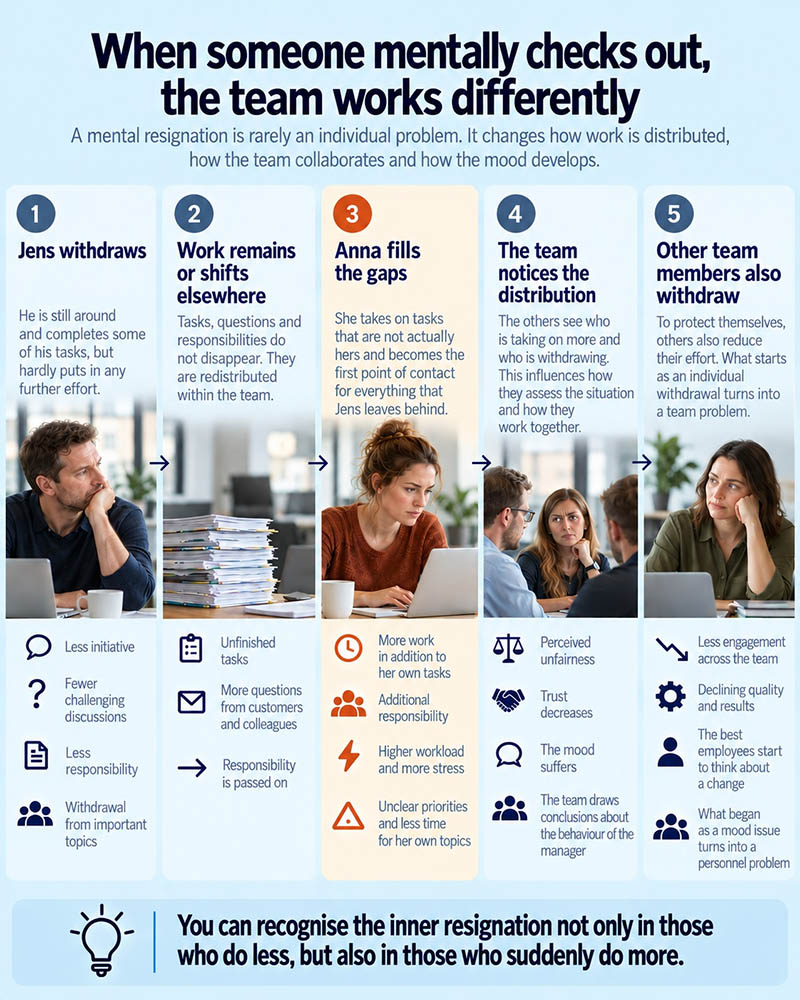
Illustration: When someone mentally checks out, the team works differently
The team realises it before the manager does
The manager sees Jens in meetings and one-to-one discussions. His immediate colleagues see him every day. They notice that, when handing over work, he only documents the bare essentials; that he passes on enquiries rather than answering them; and that he talks about the project as if it belonged to someone else. Colleagues talk about it amongst themselves, even if the manager isn’t aware of it.
And they observe what the manager does. If nothing happens for weeks on end, the team draws its own conclusion: here, nobody notices whether you put in the effort or not. If the manager says nothing, the team still interprets that as a statement in itself.
Incidentally, ‘quitting in your head’ doesn’t just manifest as withdrawal. Some people become sarcastic. A “We’ve already tried that three times” here, a roll of the eyes at the next initiative there. This dampens the mood in the whole room, even amongst those who were actually keen on the topic.
If someone then actually resigns, the problem with morale quickly turns into a staffing issue. Natalia Hoffmann-Demsing has described how this sort of domino effect plays out within a team here on the t2informatik blog, using the example of a skilled worker who leaves after many years and is soon followed by the next colleague. [4]
When effort remains ineffective in the long run
Now comes the uncomfortable bit. Jens wasn’t always like this. He was the one who questioned every idea because the results mattered to him. Exhausting, yes. But he was right with his objections surprisingly often. At some point, he realised that they didn’t change anything. Priorities are shifted without anyone consulting him. He makes a suggestion and never hears a word about it again. In meetings, the manager glances at their watch the moment he speaks up.
Anyone who experiences time and again that their efforts make no difference stops trying. Many describe this feeling as: ‘I’m just working here for the bin.’
Gallup reaches a similar conclusion. The widespread practice of ‘working to rule’ is ‘less a recruitment issue than a leadership problem’. Anyone who does not feel seen, involved, supported or inspired by their own manager will carry out their tasks, but nothing more. [5]
In the CoWeWi principle, I describe leadership in terms of three factors:
- Commitment,
- appreciation and
- effectiveness.
In Jens’s case, we can see how these factors are interlinked. Because he repeatedly finds that his objections and suggestions have no effect, his perceived effectiveness suffers. At the same time, he gets the impression that his commitment is not valued. The result is ultimately reflected in his commitment: he withdraws. Michael Schenkel has vividly described how differently people experience appreciation in his article on the language of appreciation. [6]
This does not mean that the manager is to blame for every instance of ‘quitting in one’s head’. But they are the ones who are best placed to change the situation.
Addressing inner resignation: two conversations instead of one
The first conversation is with Jens. Many managers put it off because they don’t have any concrete evidence. After all, he is doing his job. That is precisely why the conversation should begin with an observation rather than an accusation: “I’ve noticed that you’ve hardly said a word in meetings over the last few weeks. You used to regularly pick apart my plans. To be honest, I miss that.”
After that, open-ended questions help:
- Are you clear about what I expect from you?
- Can you currently contribute here in the areas where you excel?
- What’s stopping you from doing that at the moment?
Perhaps it turns out that something is going on in his personal life. Perhaps a long list of frustrations emerges. Either way, it’s better than continuing to remain silent.
The second conversation is often overlooked. It’s the one with Anna. This is about her workload; Jens isn’t an issue here. What tasks has she taken on in recent months that aren’t actually hers? Which of these would she like to keep, and which should be handed back or redistributed? For many dedicated staff members, it’s a relief in itself that someone has even noticed their extra workload.
And the team? They don’t need to know what Jens said in the conversation. But they do need to see that things are changing: tasks are being redistributed, and extra work isn’t simply left to the most reliable members of the team.
Five things to do over the next two weeks
Internal disengagement cannot be resolved with a single conversation. But managers can quickly identify where shifts have already taken place within the team and where they need to take action.
1. Compare the situation today with that of six months ago. Ask yourself, for each team member, what has changed. Who is contributing less, and who no longer voices dissent?
2. Keep an eye on those who are filling the gaps. Find out who is currently taking on tasks that aren’t officially assigned.
3. Have the conversation before you’re absolutely certain. An observation is reason enough. If you wait for proof, you’ll have the conversation too late.
4. Make extra work visible and redistribute it, even if this is inconvenient in the short term.
5. Ask the questions from the conversation with Jens regularly, in every one-to-one meeting and not just when a crisis arises.
The key isn’t to tick the topic off after two weeks. The key is to notice changes early enough so that a silent Jens doesn’t eventually turn into a silent Anna.
Conclusion
A few months later, another Monday, ten o’clock again. Jens is still nodding. The meeting ends earlier than planned once more. And Anna hasn’t said a word today either.
‘Mental resignation’ won’t remain an isolated case if nobody takes action. It shifts the workload and frustration onto the committed members of the team, and eventually it is precisely those who have been carrying the team who end up leaving. Managers can therefore most reliably recognise the consequences in the people who are filling the gaps. If you only look at Jens, you’ll realise too late that Anna has also stopped speaking up.
Notes (partly in German):
Do you want to strengthen your leadership impact and integrate it effectively into your day-to-day work? Then discuss with Christine Schmitt where you currently stand, what your team needs and how CoWeWi can support you in practical terms. You can arrange a consultation here.
Christine Schmitt has compiled a guide on how to recognise the signs of silent resignation in individual employees at cowewi.com.
[1] [2] [5] Gallup: Engagement Index Germany 2025
[3] Felps, W., Mitchell, T. R. & Byington, E. (2006): How, when, and why bad apples spoil the barrel: Negative group members and dysfunctional groups. Research in Organisational Behaviour, 27, 175–222
[4] Natalia Hoffmann-Demsing: Resignations as a reflection of corporate culture
[6] Michael Schenkel: The language of appreciation
Would you like to support Christine Schmitt and discuss inner resignation? Then share this post on social media or within your organisation.
Christine Schmitt has published another post on the t2informatik Blog:

Human skills in leadership

Christine Schmitt
Christine Schmitt is a leadership expert, keynote speaker and founder of CoWeWi. After more than 15 years as a manager in industry, most recently with responsibility for more than 160 staff, she now helps managers to lead more clearly and work together more effectively. This is based on her tried-and-tested CoWeWi principle, which focuses on commitment, appreciation and effectiveness.
On the t2informatik Blog, we share knowledge and experience with people in organisations. We have been developing and modernising software for them since 2012. Pragmatically. ✔️ Personal. ✔️ Professional. ✔️ Get to know t2informatik as your development partner.