
Staff cuts do not constitute restructuring
Expand the table of contents
Fewer people do not necessarily mean a leander organisation
Those who remain are not simply the ‘lucky ones’
Stabilisation is not enough. What needs to go now?
It is precisely now that offboarding becomes a form of organisational learning
Five tips for managers following staff cuts
Restructuring is only complete once the new organisation is up and running
Conclusion
How companies can return to being a functioning organisation after staff cuts
We read about it in the media every day; it’s practically being drummed into us: companies are cutting jobs on a massive scale. There is talk of hundreds, even thousands, of people being affected.
The focus is usually on the people who have to leave the company, the economic reasons behind the job cuts, and the question of how the redundancy process is organised. Less attention is paid to what happens afterwards. After all, a restructuring process is far from over once the departing staff have worked their last day. A new phase is now beginning for those who remain and for the organisation as a whole.
What does it actually mean for a company when, suddenly, significantly fewer people find themselves facing the same structures, processes and expectations as before? And what is needed to ensure that staff cuts actually result in a functioning new organisation?
Everyone looks after those who are leaving. Who looks after those who stay?
Let’s imagine an automotive supplier with 1,000 employees. After the restructuring, there are 700. For those leaving, there is a redundancy scheme, outplacement advice and transfer companies.
And on the Monday after the redundancies?
The remaining 700 employees rub their eyes in disbelief. Abandoned workstations everywhere. The crumbs from the farewell party are still on the floor. Helga isn’t coming back. Neither are the other 299.
The aim is to give the company the opportunity to adapt to the market, reinvent itself, become more agile and, in the best-case scenario, regain its competitiveness.
This promise must now be delivered. If nothing happens now, the company will have reduced its workforce but failed to adapt its organisation.
Fewer people do not necessarily mean a leaner organisation
An organisation consists not only of headcount and FTEs (full-time equivalents), but also of tasks, roles, interfaces, decision-making pathways, informal structures, processes, routines and rules.
A project purchaser at an automotive supplier has experienced precisely this on several occasions. Although her colleagues in procurement were made redundant, the organisation was not adapted to the fact that she was the only project purchaser left. Following the wave of redundancies, she still attends the same regular meetings, processes the same reports, goes through the same approval loops and works to the same milestones. Nothing has changed, except that she now has to cope with the workload of four people.
Some companies, following restructuring, have the size of a start-up and the bureaucracy of a large corporation.
Those who remain are not simply the ‘lucky ones’
If we were to ask the project buyer, she would tell us that she is glad to have kept her job. But she would also tell us that it is almost impossible to make up for the lost expertise, take on all the tasks and, at the same time, work out:
- How do we carry on from here?
- What is really, really important now?
- Who makes the decisions?
- Which tasks will be dropped?
- How will we work together in future?
Downsizing doesn’t just affect those who have to leave the company, but also those who are allowed to stay. Studies show that staff cuts also take their toll on them, especially when the process is perceived as unfair. Trust and loyalty to the company can decline, whilst at the same time uncertainty grows about how things will proceed and what will be expected in future. This is precisely why it is not enough to simply return to business as usual after job cuts. The people who remain need guidance, clarity and the feeling that they can help shape the new organisation.[1][2]
After all, the remaining staff are asking themselves:
- whether they will be next,
- why a colleague had to leave whilst they did not,
- who is now supposed to do all the work,
- who will make the decisions in future and what tasks might hopefully be eliminated, as well as
- what their own role will look like going forward.
That is why leadership must first and foremost stabilise the remaining team. In practical terms, this means: providing direction, creating a space to discuss uncertainty and ensuring clarity. Leadership explains what the team should focus on and what is explicitly no longer expected of them.
This is precisely what reduces uncertainty and prevents teams from trying to carry on as before, thereby wearing themselves out. However, stabilisation can only be the first step. As soon as sufficient direction is in place again, attention must turn to the organisation itself.
Stabilisation is not enough. What needs to go now?
Stabilisation can only be the first step. As soon as there is sufficient clarity again, attention must turn to the organisation itself.
The question now is: How do we need to reorganise ourselves with those who are still here?
This also changes the role of each individual. Those who remain should not simply be expected to fill the gaps left by what has been cut. They must be allowed to help shape what still makes sense for the future.
It must be permissible to question the status quo. And explicitly so.
Reorganisation therefore does not mean first asking how the remaining tasks are to be distributed. The more important question is which tasks still make sense at all. Teams should work together across departments with their managers to address one central question:
“If we were to set up this company from scratch today with the current team, how would we build it?”
Specifically, following such a drastic staff reduction, teams should be allowed to systematically examine:
- Which tasks truly create value and which are merely a way of keeping people occupied?
- Which meetings do we really need and which can be dispensed with?
- Which reports have we never received feedback on and can therefore do without?
- Which approval loops are outdated, not least because there are far fewer of us now?
- Which roles need to be redefined?
- Which decisions can the team make for itself in future?
- Which expectations no longer fit the size of the company?
- How do we adapt our software to the new processes and decision-making pathways?
This last point, in particular, should not be overlooked. Processes often remain in place simply because the software dictates it. It is therefore essential to factor in and budget for any necessary software updates.
If these questions are asked and answered seriously, we will not simply be managing the old, downsized company. A new organisation will emerge.
It is precisely now that offboarding becomes a form of organisational learning
It is precisely at this point that our perspective on offboarding broadens. It is no longer solely about ensuring an orderly departure for individual employees, but about the learning capacity of the organisation as a whole.
Even though the 300 employees have long since left, the offboarding process is not yet complete. It does not end with the departing colleagues, but focuses on the remaining teams, the managers and the organisation as a whole.
In the case of individual departures, the three building blocks of value-adding offboarding come into play:
- Building block: Exit interview – understanding the resignation
- Building block: Learning meeting – stabilising and safeguarding knowledge
- Building block: Offboarding retrospective – learning and redesigning for the future
When dealing with hundreds of departures, a scaled-up form of value-adding offboarding is required:
- Separation process
- Stabilising the remaining teams
- Organisational reset
- Re-designed organisation
For these steps to actually result in organisational learning, managers play a crucial role. They must ensure that insights are translated into concrete changes in day-to-day working practices.
Five tips for managers following staff cuts
Five starting points to help managers work with their teams to shape the new situation in practical terms.
1. Radically redefine priorities
Following staff cuts, things cannot simply carry on as before. Management must clearly state what is now truly important and what will no longer be done for the time being. Otherwise, this will lead to an additional increase in workload rather than providing direction.
To achieve this, managers must secure the necessary leeway from senior management.
2. Clarify decision-making authority
Who will decide what in future? Which responsibilities lie with the team, and which with the manager?
If this is not clarified, grey areas will arise that encourage decision-making ping-pong rather than providing certainty.
3. Do not treat overload as an individual issue; address it structurally
If a reduced workforce is expected to carry the same workload and is unable to do so, this is usually not an individual time-management problem, but a structural one.
Managers must therefore work with the team to identify which tasks, meetings and reports can be dispensed with and which processes need to be streamlined.
4. Involve those remaining in the reorganisation
Teams usually know very well where the stumbling blocks lie and where the crux of the matter lies. They are aware of duplication of work and the areas where no one feels responsible. Therefore, they should not merely be informed about organisational changes. They should be explicitly tasked with questioning the status quo and proposing alternatives.
These alternatives should then be tested and improved through an iterative process.
5. Do not try to restore ‘normality’ too quickly
If, as in our example, 300 employees leave the company, there can be no return to normality. Teams need time to come to terms with the loss of their colleagues. They need time for clarification, learning and reorganisation. Step by step.
Managers should therefore make a conscious effort to engage with their team on a regular basis and seek to understand what is needed for them to work successfully as a new team.
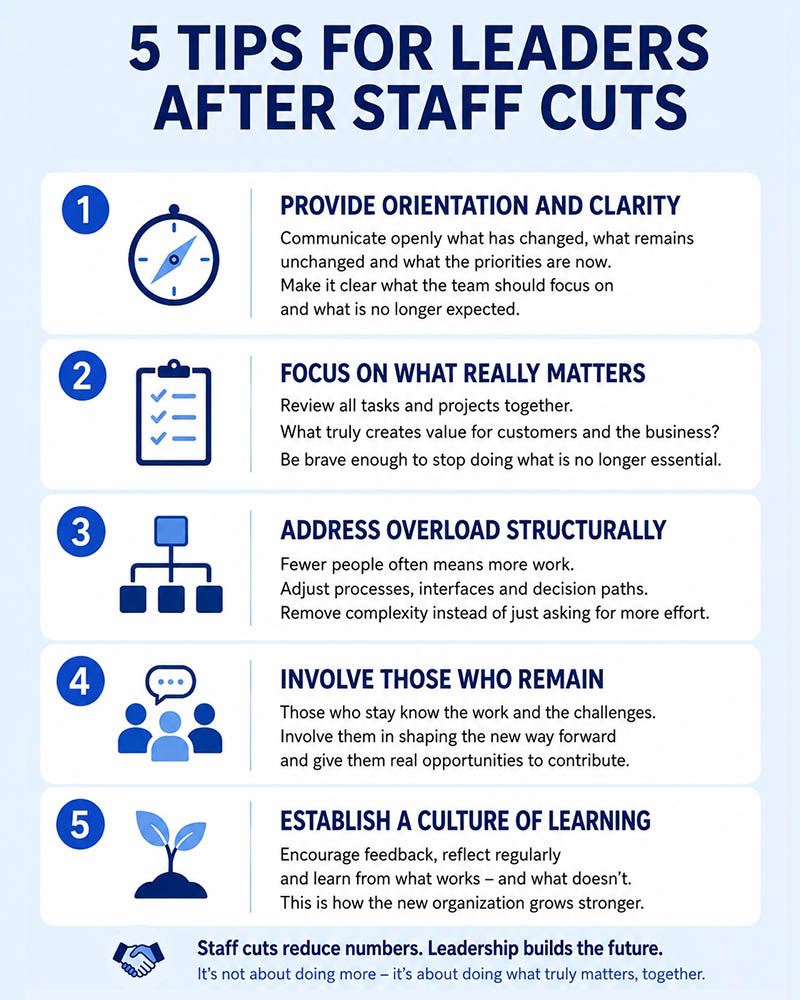
Figure: 5 Tips for leaders after staff cuts
Restructuring is only complete once the new organisation is up and running
The aim of restructuring is to restore a company’s competitiveness. This is precisely the yardstick by which its success must be measured.
However, if, following staff reductions, everything carries on as before with significantly fewer people, it may be that only a cost issue has been resolved. At the same time, a new organisational problem arises.
The crucial question is therefore: Can the new organisation operate successfully again with the people who have remained?
Only when this question can be answered in the affirmative is the restructuring truly complete.
Until then, the focus must be on further simplification, clarifying priorities, reorganising responsibilities and jointly assessing what the organisation actually needs under the changed conditions.
Conclusion
Staff cuts may be necessary. But they do not solve a single organisational problem.
If fewer people are then expected to cope with the same tasks, meetings and coordination loops as before, this does not result in a leaner organisation. Above all, it creates more work for fewer people.
The real task therefore begins after the job cuts. Structures, processes, responsibilities and expectations must be adapted to the new reality. At the same time, the people who remain need guidance and the opportunity to help shape the new organisation.
This is precisely where the opportunity for restructuring lies: the company can not only downsize, but actually reinvent itself.
To achieve this, leadership must create the framework and set an example by challenging the status quo and making new approaches possible.
Notes:
Together with Nicole Richter, Natalia Hoffmann-Demsing is publishing a specialist book entitled ‘Wertschöpfendes Offboarding | Warum der Abschied über die Zukunft eines Unternehmens entscheidet. It will be published by Hauf-Verlag in autumn 2026, and if you wish, you can pre-order it now.
[1] van Dierendonck, D.; Jacobs, G. (2012): Survivors and Victims, a Meta-analytical Review of Fairness and Organizational Commitment after Downsizing. British Journal of Management, Vol. 23, No. 1, p. 96–109.
[2] Grunberg, L.; Anderson-Connolly, R.; Greenberg, E. S. (2000): Surviving Layoffs: The Effects on Organizational Commitment and Job Performance. Work and Occupations, Vol. 27, No. 1, p. 7–31.
Would you like to support Natalia Hoffmann-Demsing and discuss staff cuts and restructuring? If so, please share this post within your network or within your organisation.
Natalia Hoffmann-Demsing has published three more posts on the t2informatik Blog:

Farewell as a leadership task

How does value-adding offboarding work?

Resignations as a reflection of corporate culture

Natalia Hoffmann-Demsing
Natalia Hoffmann-Demsing is an HR mentor, independent business coach and loves people. Her mission is to increase employee satisfaction in companies and reduce staff turnover. She takes a structured, step-by-step approach. She delves deep, identifies pain points and supports companies in finding their own unique path to an enthusiastic workforce.
She has been working for many years with companies in a wide range of industries, including manufacturing, telecommunications and finance. She is a trained systemic business coach, licensed MBTI trainer, trainer (IHK), Agile Coach and author of specialist books (Haufe and ManagerSeminare).
She sees herself as a link between the traditional and agile worlds of work and moves playfully between the two. People are always at the centre of her work, as is the creation of parameters in which people can effectively contribute their strengths and work with intrinsic motivation.