
Product launch with momentum
What does a successful product launch require?
Just a few more tests, then the new product generation will be ready. Finally. After months of adjustments, internal uncertainties and discussions, as well as numerous overtime hours in product management and the development department, the product is ready to go.
The news spreads like wildfire throughout the company. The anticipation is mixed with an uncomfortable feeling: now the product launch has to be perfect. Has the sales department already planned the roadshow and requested customer appointments? How far along is marketing with content for the website? And does support already know how to successfully migrate to the new product generation?
The hectic atmosphere in the company is palpable. The first gaps in the product launch are becoming apparent. Which features were actually implemented in the end and which were not? Is upgrading to the current product generation just as expensive for existing customers as purchasing a new product? Is there already documentation showing how users can import their data into the new product?
These questions show exactly why many product launches stumble. Not because teams are doing a poor job, but because the launch is recognized too late as a separate task. If you only start thinking about the next steps shortly before completion, you will inevitably end up with hecticness instead of impact.
However, it doesn’t have to be that way. All it takes is a change of perspective, knowledge of typical mistakes, and a structured approach. It’s less complicated than it feels in the situation.
The necessary perspective on a product launch
What many product managers underestimate: A successful product launch is not a calendar date. And it is certainly not the moment when a product can be ordered. Anyone who believes that the launch begins with the sending of a press release is just as mistaken as those who consider it complete as soon as the product description is available online.
A product launch is a strategically planned introductory phase in the product life cycle with clear objectives, internal coordination, and external market focus. It is business-critical because the launch opens the door to sales and revenue. How quickly, clearly, and effectively you design this phase influences market penetration, trust, and return on investment.
To ensure that this impact is not left to chance, modern launch processes are divided into three phases:
- First, there is an internal pre-launch phase: teams are prepared, sales and support are trained, messages are coordinated, and internal communication provides guidance.
- This is followed by the external pre-launch phase, in which you build awareness, generate curiosity, and empower customers to classify and evaluate the new product.
- And finally, the post-launch phase, in which you systematically collect feedback, support sales in implementation, and readjust your strategy based on real market signals.
Especially for industrial products that require explanation, a lead time of six to nine months is realistic if you really want to exploit the market potential. In practice, however, this phase is often slowed down: typical patterns cost lead time, blur responsibilities, and ultimately leave the potential for an effective market launch untapped.
The most common mistakes in product launches
Many product launches start with the best of intentions, but that’s not always enough. Especially when certain patterns repeat themselves, slowing down preparation and preventing impact. If you keep these pitfalls in mind, your next launch will most likely go better than the last one.
You start too late
If the starting signal for the product launch is only given once development and approvals are “complete,” then it’s too late. There is simply not enough time to properly empower sales and support, sharpen core messages, create materials, and systematically prepare customers. The result is a launch that appears hectic to the outside world and raises questions internally that should have been answered long ago.
You lack a clear target vision
A launch without a goal is one thing above all else: arbitrary. Should the primary focus be on visibility, pipeline, concrete deals, or upgrades for existing customers? Which target group should be reached when, and what signals are considered success? Without measurable goals, communication becomes actionism, and many individual measures lack a common thread.
Without a budget, it becomes difficult
If the product is ready but there is no dedicated budget for communication, enablement, training, trade shows, or content creation, the launch often remains an internal event. Then improvisation takes over, priorities shift, and measures are canceled before they can even take effect. A launch without a budget is rarely “free”; it is usually paid for invisibly, with lost time and missed opportunities.
There is a lack of commitment within the team
The product launch is not decided by beautiful PowerPoint slides, but by the people who carry it out. If sales, service, or training teams are involved too late, there is often a lack of confidence in the product’s maturity, value proposition, or implementation in customer use. Then the launch is half-heartedly supported, slowed down, or tacitly circumvented, and that is exactly what the market senses.
How does the customer actually see the whole thing?
If you plan marketing only after development, you will quickly fail to communicate what is needed. Customers don’t buy features, they buy benefits, risk protection, and clarity. Without early customer feedback, arguments, objections, and use cases often remain assumptions. This comes back to haunt you at the latest when initial discussions show that the messages are not catching on or important questions cannot be answered.
You lack product-related services
Especially with innovations, the product alone is rarely enough. Customers need to understand it, experience it, and be able to translate it into their context. Demos, explanatory videos, webinars, white papers, test devices, or migration guides are not nice extras, but pre-sales levers. If these building blocks are missing, the hurdle to a purchase decision increases and sales loses momentum.
Product launches rarely fail because of the product, but because of preparation, focus, and enablement. Late launches, unclear goals, lack of budget, lack of commitment, too little customer perspective, and lack of services cost lead time and market impact.
The good news is that these mistakes can be systematically avoided if you view the launch not as a collection of individual measures, but as a plannable process. The next step is therefore to look at the building blocks of a strategic launch plan that brings together goals, stakeholders, budget, content, and services in such a way that activity turns into a real market launch.
What should a strategic launch plan include?
A successful product launch is not a matter of chance, but the result of clear planning. Product managers who take their role seriously think about the launch from the outset and translate it into a process that provides guidance, distributes work, and generates impact. A good launch plan not only answers the question “What are we doing and when?”, but above all “Why are we doing it and how do we measure success?”.
Involve stakeholders early on
A launch can only be successful if the relevant departments work together. Marketing, sales, service, and training teams need to know early on what is coming, what is changing, and what messages will be communicated externally. Above all, they need clarity about roles and responsibilities: Who delivers what content, who approves it, who trains whom, and who will be the contact person for customer questions later on? Internal clarity is a prerequisite for presenting a convincing external image.
Structure the launch phases clearly
You have already learned about the three phases. In the launch plan, they become the timing that everything is aligned with. In the internal pre-launch phase, you ensure alignment, training, and internal communication. In the external pre-launch phase, you build awareness, activate target groups, and empower customers to make decisions. In the post-launch phase, you collect feedback, support sales in implementation, and adjust messages, measures, and priorities. It is crucial that each phase has a clear goal and does not simply “run along” somehow.
Plan product-accompanying pre-sales services
Products that require explanation rarely sell themselves through a product description. Customers need help to understand the benefits, differences, and effort involved. Demo material, white papers, webinars, animations, migration guides, or test installations bring the product to life and lower the barrier to initial discussions. Good pre-sales services not only accelerate the pipeline, they also relieve the burden on sales and support by providing clear answers to recurring questions.
Set up a realistic business plan and budget
Features alone do not guarantee market success. The decisive factor is how you combine sales targets, marketing measures, enablement efforts, and launch costs. What does the market launch cost, and what can it cost to make the business case pay off? A cost breakdown over three to ten years helps you justify investments, set priorities, and put budget discussions on a solid footing.
Use checklists and templates
No two launches are alike, but many tasks are repetitive. A standard procedure saves time and reduces errors: project plan, communication plan, asset list, review dates, approval process, training plan, FAQ structure. Templates give you a framework that you can adapt to suit your product without having to start from scratch every time. This allows you to maintain an overview, even when several areas are working in parallel.
A strategic launch plan therefore provides clarity about the people involved, the goals, the phases, and the materials. It ensures that customers understand the product, internal teams can represent it confidently, and the budget and effort are in line with the expected impact.
Once these building blocks are in place, one question remains: How do you implement them efficiently without having to write, structure, and evaluate everything yourself? This is exactly where AI can help, from market feedback and positioning to content creation and communication.
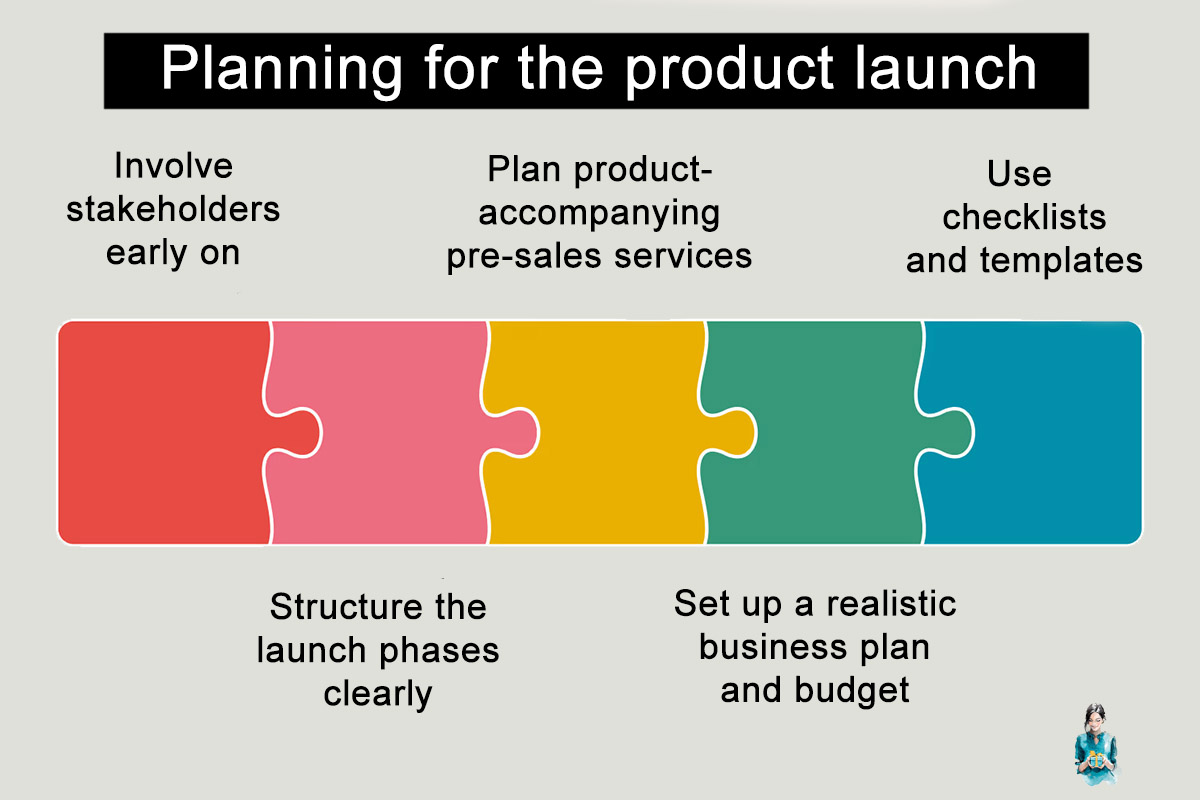
Figure: Planning for the product launch
How AI can help you with product launches
You don’t have to do everything yourself, but you do need to know what matters. AI can really take the pressure off during a launch if you use it in a targeted way and check the results carefully. Used correctly, AI can help throughout the entire launch phase, from early orientation to concrete communication.
Gather market feedback faster
Many companies already have crucial information at their disposal, but it is spread across too many sources. Support tickets, meeting notes, survey results, comments from webinars or trade shows. AI can help bundle, cluster, and prioritize large amounts of such feedback. This allows you to identify recurring questions, objections, and expectations more quickly and tailor your launch messages to real obstacles instead of building on assumptions.
Sharpen your positioning
Good positioning is rarely a spontaneous idea, but rather the result of comparison and consolidation. AI can help you structure competitor information, test lines of argumentation, or suggest keyword research and topic clusters for content. The benefit lies less in “the perfect answer” and more in generating variants faster, identifying blind spots, and making your own message more precise.
Create content efficiently
Whether it’s product descriptions, one-pagers, FAQs, sales decks, email sequences, or social media texts, many formats have to be created in a short period of time during a launch. AI can save time here by providing initial drafts, creating text variants, and tailoring content consistently to target groups. Your quality assurance remains crucial: adhere to corporate wording, check facts, formulate benefits clearly, and proofread critically before anything goes out.
Structure launch communication
Many launch plans fail not because of the “what,” but because of the “how does everything fit together?” AI can help turn a collection of tasks into a structured communication roadmap: Target groups, core messages, channels, timing, responsibilities, feedback loops. This turns a checklist into a plan with a common thread that teams can implement more easily.
Of course, AI does not replace launch responsibility, but it speeds up analysis, positioning, content creation, and structuring. Those who use AI as a tool and consistently check results gain speed, clarity, and consistency.
Conclusion
A product launch is not something that can be done “on the side.” It is the introductory phase that determines whether a finished product will become a comprehensible offering that customers can classify, evaluate, and use. This requires preparation. Those who manage this phase early on not only reduce hecticness, but also gain clarity about target groups, messages, enablement, and the path from initial perception to successful market launch.
The biggest obstacles are rarely technical. They lie in late starts, a lack of vision, tight budgets, a lack of commitment, an overly internal perspective, and services that only emerge when customers already demand them. A strategic launch plan connects these points into a common line that marketing, sales, and support can use for orientation.
AI is not a substitute for responsibility, but it is an effective lever for speed and consistency. It helps to consolidate market feedback, sharpen positioning, create content faster, and structure communication. The key is to set the direction, review the results, and actively manage the launch as a phase.
If you remember only one thing, remember this: a good launch is not a loud final sprint, but a clearly managed phase with enough run-up time for customers to understand the new product and for everyone internally to be confident in their actions.
3 practical tips for immediate implementation
The path to a successful product launch doesn’t have to be difficult. Just do the following:
- Take an hour to sketch out your next launch.
- Clarify internally whether there is already a standard process or whether you need to create one first.
- Consider where AI can specifically support you and give it a try.
Sounds pretty simple, right? To be on the safe side, you can download the product launch checklist.
Notes (partly in German):
Bernadette von Wittern is an expert in product management and owner of PRODUCT LOUNGE, a community for the training and further education of product managers for products in industry that require explanation. With workshops, coaching, and training, she accompanies and supports product teams in efficiently launching better products with real added value and benefits for people and the environment.
You can download a very useful product launch checklist from her website.
And here you will find an episode from her podcast “Produktmanagement Im.puls” on the topic of Product Launch planen: Kommunikation, Timing & Phase-out meistern.
Would you like to discuss product launches as a multiplier or opinion leader? Then share this post in your networks.
Bernadette von Wittern has published another post on the t2informatik Blog:

Product teams in the age of New Work

Bernadette von Wittern
Bernadette von Wittern is a trainer and expert in product management. She accompanies and supports product teams in efficiently launching better products with real added value and benefits for people and the environment.
She worked for many years in various functions in marketing and product management in medical technology. For some time now, she has been passing on her knowledge and experience to other product managers to help them advance in their personal and professional development.
She is a trained business and online trainer as well as a LEGO® SERIOUS PLAY® facilitator and brings a wealth of methods and approaches to her formats.
On the t2informatik blog, we share knowledge and experience with people in organisations. And it is for precisely these people that we have been developing and modernising software since 2012. Pragmatically. ✔️ Personal. ✔️ Professional. ✔️ Get to know t2informatik as your development partner.