
Oh, brilliant books
“Some books are like keys to unfamiliar rooms in one’s own castle.” – Franz Kafka, letter to Oskar Pollak dated 9 November 1903
“I have always imagined paradise as a sort of library.” – Jorge Luis Borges, “Blindness”, in “The Last Voyage of Ulysses”
“Those who do not read will, by the age of 70, have lived only a single life: their own. Those who read will have lived 5,000 years.” – Umberto Eco, from a longer reflection on reading and “immortality in retrospect”
Books can inspire thoughts we’ve never had before. They allow us to share in the experiences of others, challenge supposed certainties, or help us to refine our own convictions. Sometimes a single sentence that sticks in the mind is enough to achieve this.
Once again, there are people in my network who have captured their thoughts, experiences and knowledge between two book covers. This time, I’m showcasing books by Tim-Robert Zander and Daniel Heinen, Christoph Schmiedinger, Natalia Hoffmann-Demsing and Nicole Richter, Daniel Dubbel and Kai-Marian Pukall, Monia Ben Larbi and Julia Hoffmann, Olaf Hinz and Jens Eschenbaecher, as well as Dr Frank Edelkraut. Perhaps there’s one or two amongst them that deserve a place on your reading list.
Future-competent?! | Zukunftskompetent?!
From the individual to the organisation | Vom Individuum bis zur Organisation
Tim Robert Zander and Daniel Heinen
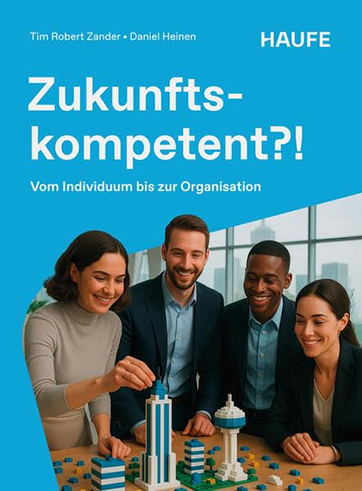
Tim, what is your book about?
Tim: In ‘Zukunftskompetent?! – Vom Individuum bis zur Organisation’, we explore the question of what people and organisations need in order to remain capable of taking action, healthy and competitive in a world full of change.
We deliberately take a broader view of future-readiness than simply a list of supposed ‘future skills’, because it is only possible to predict to a limited extent today what skills we will need tomorrow. Being future-ready therefore also means recognising change, questioning one’s own assumptions, further developing one’s personal and organisational skills portfolio, and actively helping to shape possible futures.
In the book, we combine academic analysis with practical experience, personal insights and discussions with experts. We examine topics such as resilience, self-management, communication, storytelling, agility, artificial intelligence, data literacy, leadership and organisational development across three levels: the individual, the team and the organisation.
Why did you write the book?
Tim: The idea arose from our own work and from many conversations on the podcast ‘BRANDgefaehrlich innovativ’. There, we repeatedly encountered the same fundamental question: how can we shape the future when, at the same time, we have less and less certainty about what that future will look like?
It was important to us to bring together two perspectives that are often considered separately within organisations: the well-being and capacity for action of individuals, and the long-term competitiveness of organisations. In our view, the two are closely interlinked.
That is why we did not want to write yet another book presenting a ready-made catalogue of the most important future-ready skills. We wanted to bring together different perspectives, provide guidance and encourage readers to develop their own answer to the question of what future-ready skills mean for them personally, for their team and for their organisation.
And who should read the book?
Tim: The book is aimed at people who take responsibility for the future – for themselves, for others or for an organisation. This includes managers, entrepreneurs and the self-employed, as well as coaches, consultants, HR and organisational developers, or people who are shaping change within their teams and organisations.
You don’t need to be a futurologist or a transformation expert to benefit from it. Anyone wondering which skills will become truly relevant in an age of AI, increasing complexity and constant change – and how people and organisations can prepare for this – will find scientific foundations, diverse perspectives and practical insights for their own work in the book.
→ Here you’ll find more information about the book ‘Zukunftskompetent?!’.
The End of the Innovation Blockade | Das Ende der Innovationsblockade
Successful products through effective structures and processes | Mit wirksamen Strukturen und Prozessen zu erfolgreichen Produkten
Christoph Schmiedinger

Christoph, what is your book about?
Christoph: Europe doesn’t have a problem with ideas. What’s missing is speed in implementation. Good ideas get stifled in meetings, approvals pile up, and projects run alongside one another for years without having any impact. My book breaks down this innovation bottleneck and shows how organisations can overcome it. This requires structures that are geared towards value streams rather than departmental boundaries, and processes that create flow rather than bureaucracy. And it requires leadership that places responsibility where the knowledge lies. It is not a collection of methods, but a concise practical guide with numerous examples from a wide range of industries.
Why did you write the book?
Christoph: When I last changed jobs, I had a bit more breathing space than usual and used it to look back – on over ten years of consultancy and on the time before that, when I worked in product development myself. One observation kept niggling at me: we’ve known for a long time how product development works better. And yet so many companies are structured in such a way that I’m not surprised when projects fail to make progress. So I asked myself: how successful could we be if we actually put into practice what we’ve known for so long? This book is my answer to that question. Everything I’ve learnt over the years, finally put down on paper.
And who should read the book?
Christoph: Anyone who holds a position of responsibility within an organisation and feels that product development can be more than just a laborious, drawn-out process. This ranges from the board and senior management, through divisional, R&D and IT managers, to product owners, project managers and Agile coaches.
We’re also specifically referring to those who are often overlooked: PMOs, HR, procurement, quality management, finance and legal. After all, they play a key role in determining whether a company acts swiftly or gets bogged down in the maze of approvals and processes. Product development isn’t a specialised field, but a cross-functional task and, for many companies, the very heart of the business. Anyone who has already been through their third reorganisation and is wondering why things still aren’t moving any faster will find concrete starting points here.
→ Here you will find more information about the book ‘Das Ende der Innovationsblockade’.
Value-adding Offboarding | Wertschöpfendes Offboarding
Why the way you say goodbye determines a company’s future | Warum der Abschied über die Zukunft eines Unternehmens entscheidet
Natalia Hoffmann‑Demsing and Nicole Richter
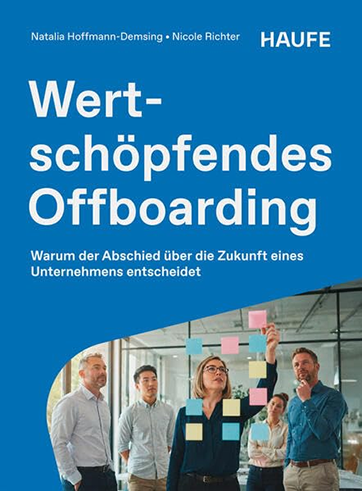
Natalia: Our book is about how organisations can consciously shape the process of saying goodbye to employees and use it as an opportunity. When someone resigns, it is not just an employment relationship that ends. Relationships within the team also change, knowledge may be lost, and an opportunity arises to learn from the collaboration.
The book shows how managers, teams and HR professionals can structure the offboarding process so that the departure is clear and respectful for everyone involved. It combines academic insights with practical experience and offers concrete suggestions, including for resignation and handover meetings, as well as for joint reviews and learning processes.
Why did you write the book?
Natalia: In our work with managers and teams, we have seen how much attention is paid to recruiting new staff and how little is given to saying goodbye. Yet it is precisely this moment that shapes how people look back on their time together and what a team takes away from it.
We were preoccupied with the question: what might be possible if a resignation were treated not only as a loss or an organisational task, but also as an opportunity to pause and learn from one another? With this book, we aim to raise awareness of this and show that a well-managed farewell can benefit both the individual and the organisation.
And who should read the book?
Natalia: The book is aimed at managers, HR professionals and anyone involved in shaping collaboration and change within organisations. It is particularly helpful for people who conduct redundancy discussions, support teams through staff changes or wish to further develop offboarding processes within their organisation.
Anyone wondering how a farewell can yield insights for leadership, collaboration and the organisation will also find inspiration and practical approaches in it.
→ Here you can find more information about the book ‘Wertschoepfendes Offboarding’.
Reality Strikes Back!
The downsides of self-organisation | Schattenseiten der Selbstorganisation
Daniel Dubbel and Kai-Marian Pukall
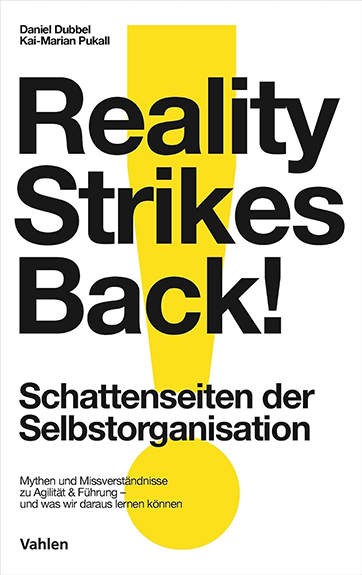
Daniel, what is your book about?
Daniel: For a long time, we thought self-organisation, New Work, agility and modern leadership were the answer – and then we came face to face with reality. The book explains what happens when hierarchies are dismantled and responsibility is meant to be shared. People run into invisible electric fences because nobody has told them what the rules are. Meetings go round in circles instead of making decisions. Power often ends up in the same place as before; it’s just harder to see. We debunk persistent myths – such as the idea that failure is a good thing, or that a new mindset can replace missing structures – and explain, in an easy-to-read and accessible way based on systems theory, why this is the case. Ultimately, we offer a sober assessment of what self-organisation costs and when it’s worth it, without any promises of a miracle cure.
Why did you write the book?
Daniel: Because for years we ourselves were part of that promise. We did away with structures that served a purpose, and only realised the gap they left much later. We sat in meetings where everyone had their say, and afterwards nothing happened. We’ve seen how managers and even clients, with high expectations, demanded agility from teams that never materialised. At some point, we were no longer satisfied with explanations that change is simply difficult and organisations are, by their very nature, slow to adapt. This book is our response to that.
And who should read the book?
Daniel: Anyone who works in an organisation and has ever wondered why, despite the best of intentions, things keep dragging on. Anyone who has sat in a meeting that led to nothing, who was expected to take responsibility for something without being allowed to make decisions about it, or who has waited for a manager who no longer existed in that form, will recognise themselves in this. The same goes for anyone who wants to delegate responsibility, supports teams, or realises in their first job that collaboration is more exhausting than it is in the textbooks. And anyone who has experienced a transformation that was officially deemed a success but changed hardly anything in day-to-day life. You don’t need any specialist knowledge to read this book, just a willingness to examine assumptions you’ve come to cherish – or perhaps have come to hate – and to be open to a new perspective.
→ Here you’ll find more information about the book ‘Reality Strikes Back!’.
The Chronically Ill Woman and the Organisation | Die chronisch Kranke und die Organisation
A (potential) love story | Eine (potenzielle) Liebesgeschichte
Monia Ben Larbi and Julia Hoffmann
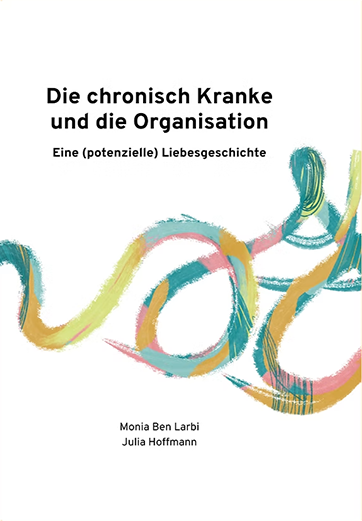
Monia, what is your book about?
Monia: It’s a sort of picture book for adults, with lovely illustrations by Julia Hoffmann. In it, you see how an organisation tries to cope with its challenging day-to-day routine, whilst a ‘chronically ill’ person – who has been given a quiet spot somewhere on the sidelines where she won’t get in the way – keeps making herself heard. She insists that she is capable of more. The organisation wavers between irritation and interesting experiments as it listens to what the chronically ill person needs in order to be able to work effectively. Bit by bit, the organisation becomes a better place to work for everyone.
Why did you write the book?
Monia: I’m always trying out new ways to get the message across: people with chronic illnesses in the workplace are fantastic indicators of unhealthy working environments. Where they collapse, everyone loses strength. In a healthy organisation, everyone is better off. But nobody reads long, tedious texts on this subject. So I thought I’d tell them a fairy tale. The fact that Julia then came on board and turned it into a picture book was a huge gift for me.
And who should read the book?
Monia: I wrote it primarily for people who have influence over organisational structures: business owners, managers, organisational developers. But what makes me happiest is receiving so much feedback from people with chronic illnesses who say: “That’s exactly how it is. Exactly.” It has turned out to be a book that’s also short enough to spark discussion in teams and training sessions. I’m proud of that.
→ Here you’ll find more information about the book ‘Die chronisch Kranke und die Organisation’.
Effective Change Management | Wirksames Change-Management
Successful Change in Dynamic Times | Erfolgreiche Veränderung in dynamischen Zeiten
Olaf Hinz and Jens Eschenbaecher
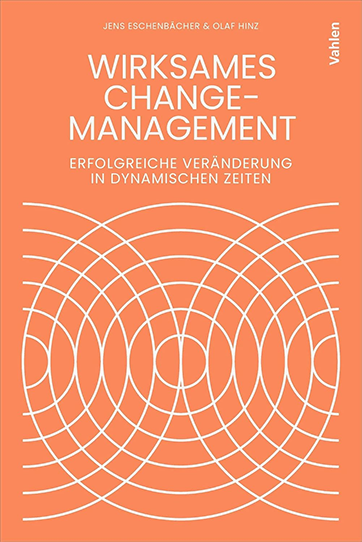
Olaf, what is your book about?
Olaf: At its core, it’s about an uncomfortable observation drawn from over twenty years of practical experience. Most change initiatives fail not because of a lack of will on the part of those involved, nor because of a lack of motivation, but because they are tackled in the wrong place. There is communication, facilitation and engagement, whilst the actual levers – namely decision-making processes, areas of responsibility and structures – remain untouched.
This leads to the central thesis that runs through the entire book: structure comes before psychology. We are not downplaying the psychological aspect; on the contrary, change happens through and with people. But culture and attitudes are shaped by the conditions under which people actually work. Whoever changes these conditions brings about more sustainable change in the organisation than any communication programme ever could.
The book deliberately approaches the subject from multiple perspectives, ranging from organisational theory through business management and decision-oriented views to a systemic approach. It distinguishes between when planned change is effective under stable conditions and when, in dynamic environments, an iterative approach is required. And it remains closely rooted in practice, featuring eight case studies from the energy sector, industry, logistics and the public sector. The outcome is not a new method, but a closer look at why well-intentioned interventions in organisations so often have a different effect than planned.
Why did you write the book?
Olaf: To be honest, we were rather sceptical at the start. A great deal has been written about change management; the shelves are full, and one rightly wonders whether yet another book is needed.
It was the collaboration itself that changed our minds. Together, we developed a postgraduate course on the subject – Jens from an academic perspective, and I from a consultancy background. As we alternated between theory and reality, many questions we thought had been answered suddenly took on a different light.
The real trigger was a gap in practical experience. Much of the discussion around change revolves around attitude, communication and the famous concept of ‘getting people on board’. What was missing was a sober view of organisations for what they are: decision-making systems with their own logic and forces of inertia. It was precisely this gap that we wanted to fill.
And who should read the book?
Olaf: We wrote it for the people responsible for driving change. In other words, for managing directors, executives and project managers who are faced with the question of how to actually make a project work.
It’s also for consultants and those working in organisational development who sense that the familiar formulas are reaching their limits. That is precisely why we devote parts of the book to the current climate of uncertainty and dynamism, and present ‘Change 4.0’ – an approach that no longer relies on the ‘perfect plan’, but instead proceeds iteratively and through learning. Because the book clearly explains the theory and links it to practice, it is also suitable as an introduction for anyone who wants to gain a serious understanding of the field, for example as part of their studies.
It’s worth noting what the book is not: it is not a toolkit for quick application. Anyone looking for a step-by-step guide will be disappointed. However, anyone who wants to understand why interventions work – or fail to work – will find answers.
→ Here you can find further information about the book ‘Wirksames Change-Management’.
Setting Leadership on a Firm Foundation | Leadership vom Kopf auf die Fuesse stellen
Focusing leadership clearly on what really matters | Fuehrung klar und fokussiert aufs Wesentliche ausrichten
Dr. Frank Edelkraut
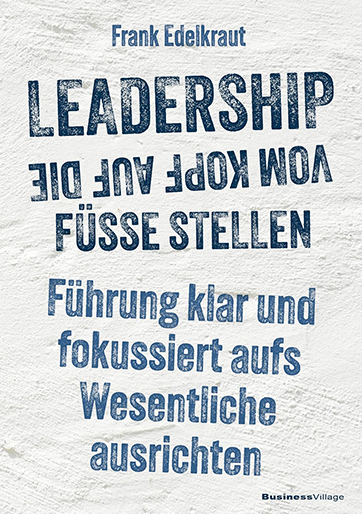
Frank, what is your book about?
Frank: To put it simply: it’s about excellent leadership. At its heart, it addresses the question of what really matters in leadership when it is intended to provide direction, enable performance and achieve impact. To this end, I bring together seven themes that have particularly occupied me during more than 25 years of leadership practice – from leading under pressure and resilience, through transformation and change, to integrity and the fundamental question of what constitutes excellent leadership.
Competitive sport offers many important insights. Leadership and sport have much in common: performance, collaboration, pressure, responsibility and consistent execution. In sport, these mechanisms are often particularly easy to observe. That is why I use numerous examples and supplementary videos. They make leadership more tangible and encourage readers to view their own practice from a different angle.
Why did you write the book?
Frank: Because leadership in practice is becoming increasingly demanding, whilst the discussion surrounding it often becomes ever more simplistic. Managers work in highly dynamic environments characterised by uncertainty and conflicting demands. At the same time, individual aspects of leadership are often viewed in isolation and presented as simple solutions. To me, that falls far short of the mark. I therefore didn’t want to develop a new leadership model, but rather to combine experience, research and practice in such a way as to generate concrete insights for day-to-day leadership. The title ‘Turning Leadership on Its Head’ captures precisely this aim: to think about leadership once again in terms of its actual role and impact.
And who should read the book?
Frank: The book is aimed at leaders who wish to reflect on and further develop their own practice – regardless of whether they are new to leadership or already have a great deal of experience. The seven chapters can be read independently of one another. It is less about a cohesive management model and more about different perspectives, concrete examples and food for thought. The book is ideal for readers who ask themselves: What is truly essential in my leadership situation? What impact am I having? And what specific things can I do better?
→ Here you’ll find further information about the book ‘Leadership vom Kopf auf die Fuesse stellen’.
What remains of a good book?
Not every book leaves the same impression. Some captivate us right from the very first pages, whilst others only reveal their full impact with the benefit of hindsight. And occasionally, it is a single thought that continues to occupy our minds long afterwards, even though we have long since forgotten the rest of the book.
I find it particularly interesting how differently people bring their experiences and knowledge to bear in books. Every author sets their own priorities, asks different questions and examines supposedly familiar subjects from a personal perspective. It is precisely this diversity that makes it appealing to explore topics one has scarcely considered before.
Perhaps you’ll discover a book amongst those featured here that piques your curiosity. Or one that challenges your existing beliefs. In any case, you’ll only really know what impression it leaves once you’ve read it.
Notes:
Would you like to support the authors and their brilliant books? Then share this post or individual interviews within your network or at your workplace.
Here you’ll find more posts with book recommendations:

Oh, interesting books

Oh, books with impact

Oh, books worth reading
Michael Schenkel
Head of Marketing, t2informatik GmbH
On the t2informatik Blog, we share knowledge and experience with people in organisations. We have been developing and modernising software for them since 2012. Pragmatically. ✔️ Personal. ✔️ Professional. ✔️ Get to know t2informatik as your development partner.