
Learner safety between appeal and everyday life
What it really takes for teams to learn
“Rebecca, I really appreciate that you use gender-neutral language and include both male and female examples. But I’ve noticed that all the names in your case studies are German. I think it would be important to have more diversity here.”
This feedback struck a chord with me – in the best possible way. Because that is precisely my aim: for everyone to feel seen. And yet, I had a blind spot in this very area. Without the comment from one of my workshop participants, I probably wouldn’t have recognised it. This moment was very valuable, and it didn’t diminish me; rather, it made me clearer-sighted and therefore better.
This is precisely wherelearner safety comes into play – in the opportunity to address something that is jarring, missing or in need of improvement. To point out a blind spot. To share an observation without fearing that the other person will become defensive, shut down or feel the need to justify themselves. Learning begins where such things are allowed to be spoken.
Such moments are, however, rarer in organisations than many mission statements suggest. Not because learning is unimportant, but because in day-to-day life, something else often takes precedence: operational demands, time pressure, the next task on the to-do list. Many teams are familiar with the result: “We need an open feedback culture”, yet critical feedback is postponed until the annual review. “We must learn from our mistakes,” but please do so in a way that nobody notices. “Retros are important,” except today, because today we have to deliver.
The figures behind this are sobering: 87% of employees want to develop further. [1] But only 26% receive feedback that genuinely helps them do so. [2] And only 3 in 10 feel that their opinion actually counts in the workplace. [3]
Teams do not learn through appeals in the mission statement. They learn in environments where questions, uncertainty, feedback and mistakes are understood not as disruptions, but as a necessary part of development. Learner Safety is a prerequisite for learning to take place at all in everyday working life.
What is learner safety?
In my last post on the t2informatik blog, I outlined the four levels of psychological safety according to Timothy R. Clark:
- inclusion safety,
- learner safety,
- contributor safety and
- challenger safety.
They form the basis for creating a psychologically safer environment. This article focuses specifically on the second level and thus on a question that is crucial for teams: Am I allowed to learn here without paying a price for it?
That is precisely what Learner Safety means at its core. I am allowed to ask questions, even critical ones. I am allowed to try things out, even if they might fail. I am allowed to make mistakes without being punished for them. I am allowed to give and receive feedback. Timothy Clark describes two key levers for this: firstly, the feeling that it is bad to be wrong must diminish. And secondly, the perception that feedback primarily means punishment must change. [4]
It is important to note that Learner Safety is not a free pass for ill-considered behaviour or persistent mistakes. It means that it is okay to learn. However, it does not simply fall from the sky through appeals. It builds on Inclusion Safety. Without a sense of belonging and without a minimum level of trust, hardly anyone will have the courage to admit they do not know something, to ask for help or to voice an uncomfortable observation.
In practice, Learner Safety manifests itself primarily in three areas:
1. Asking questions and admitting what you do not know. Team members often don’t dare to ask for clarification for fear of standing out in an awkward way or appearing incompetent. It is precisely this reluctance that hinders teams’ development. For it is often these very questions that reveal blind spots and disrupt routines.
2. Feedback, and in all directions. Not just from managers to employees, but also the other way round and between colleagues. This is precisely where many organisations fall short. Although feedback is considered important, it often flows in only one direction – from top to bottom.
3. Reflection as a team. Learner Safety is also evident where teams consciously take time to reflect on collaboration, projects, tensions and mistakes. Retrospectives are therefore not just a nice add-on for good times. They are part of the work, and anyone who values learning must also make space for it.
Why do we still choose to say nothing?
Insecurity. A lack of courage. Fear of reactions. A desire for harmony. Time pressure.
These are just some of the answers I hear time and again in workshops – and these obstacles are very real.
In many organisations, feedback is still treated as an add-on rather than a leadership and collaboration task. When there is a lack of fixed times, clear formats and unambiguous responsibilities, feedback disappears from day-to-day business and the question of how we are then supposed to learn remains unanswered.
Added to this are competence barriers. Very few of us have learnt to address feedback and tensions honestly, clearly and, at the same time, respectfully. The result: feedback is either avoided altogether or worded in such a watered-down way that nobody can really make sense of it anymore.
The interpersonal barriers are often the strongest. In many teams, harmony counts for more than clarity. Criticism is avoided because it could be perceived as an attack on the relationship. Some have experienced feedback being used in a hurtful way. Others are familiar with the infamous ‘shit sandwiches’. And many are familiar with the unstructured venting of feedback and tensions when pent-up frustration eventually bursts out unfiltered.
For all these reasons, speaking up often feels riskier than remaining silent.
Radical candor – a guide to effective feedback
If learner safety so often fails in everyday practice due to a lack of clarity or a fear of causing offence, the next question arises: what does feedback that actually supports learning look like?
Here, Kim Scott’s ‘Radical Candor’ model offers helpful guidance. It describes two dimensions that must be effective simultaneously:
- personal care (“Care personally”) and
- direct challenge (“Challenge directly”).
Only when both come together does what Kim Scott describes as Radical Candor emerge: clear feedback without losing sight of the person. [5]
Without care, feedback becomes harsh and hurtful. Without directness, it remains watered down and ineffective. And when both are missing, a system emerges in which people conform, play it safe and hold back.
My experience is this: most teams fail not because of too much directness, but because of too little clarity. They mean well, go easy on one another, downplay problems or only address them once frustration has long since become too great. From the outside, this often appears harmonious. In reality, it is frequently nothing more than conflict-avoiding ambiguity.
How can learner safety be actively promoted in everyday life?
Learner safety does not arise from a mission statement, but through repeated experiences in everyday life: in meetings, when seeking clarification, in reactions to mistakes, and in the way managers handle feedback.
1. As a manager, encourage feedback and normalise not knowing
Many managers expect openness, but unintentionally send a different message. Anyone wishing to strengthen learner safety should therefore not just say: “You can be honest at any time”, but ask specifically: What am I overlooking? Where am I making it difficult for you to speak openly? It is just as important to set an example yourself by saying things like: I don’t know that right now. I’ve changed my mind. I need another perspective on this. This makes it clear that competence does not mean always having an answer straight away.
2. Make mistakes discussable rather than shameful
Many organisations say that mistakes are okay. But what is often meant is: as long as they don’t bother anyone and disappear quickly. Learner Safety requires something else: a practice in which mistakes are not swept under the carpet, but are also not met with shame. The central question is not first: ‘Who was to blame?’ but rather: ‘What can we learn from this?’
3. Make feedback and reflection routine
As long as feedback depends on the courage of individuals, Learner Safety remains fragile. That is why we need small, recurring formats: a brief check-in after meetings, “Was today’s meeting helpful and productive for us?” or “What could we have done better?”. Honest questions in one-to-one sessions, such as “Where do you currently lack support?”, or regular retrospectives. What matters is not the perfect format, but repetition.
Anyone who values learning must make space for it. And those who confuse harmony with safety often overlook precisely the tensions that actually need to be addressed.
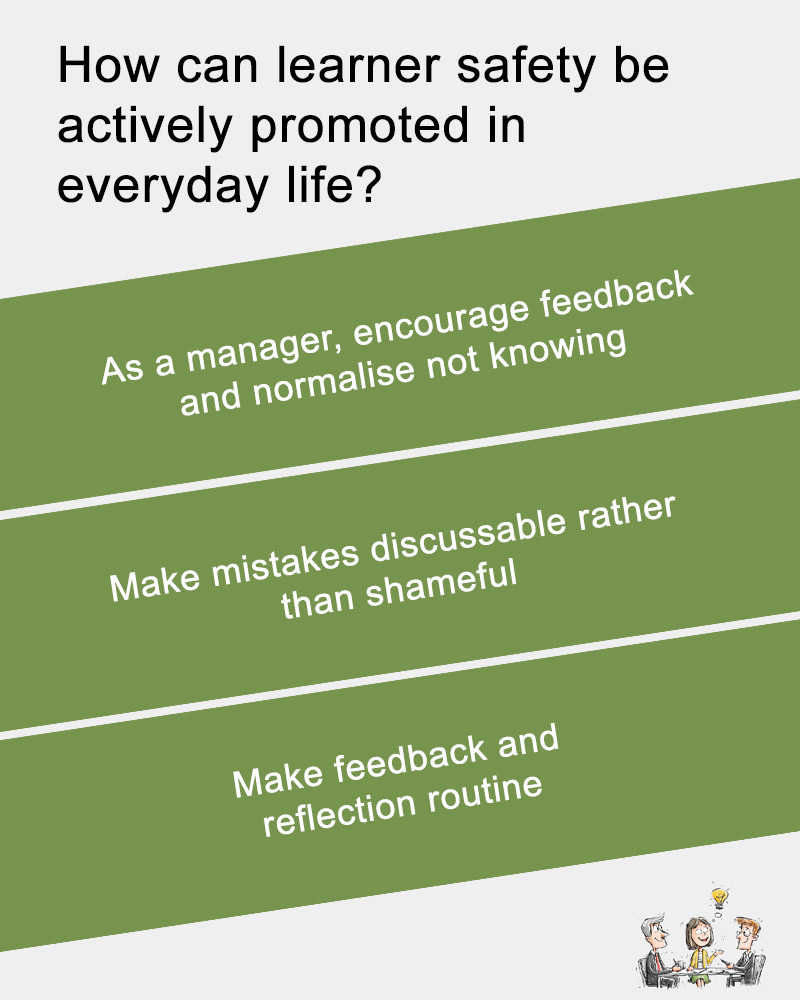
Figure: How can learner safety be actively promoted in everyday life?
Conclusion
Learner safety determines whether people ask questions, highlight mistakes, give feedback and collectively learn from experience. This is precisely why it is not merely an addition to day-to-day operations, but a prerequisite for development, quality and collaboration.
The gap between what organisations say about learning and what they actually facilitate in day-to-day life remains wide. It costs not only development and productivity, but also trust, commitment and, in the worst case, the people who have long since spotted something important but no longer speak up.
The good news is: Learner Safety does not arise from large-scale programmes. It arises from small, consistent experiences in everyday life. Through a manager who visibly asks for feedback. Through mistakes that are not hidden away but reflected upon together. Through routines in which learning has a fixed place.
It is not appeals that create a learning culture, but the experience of not being belittled for uncertainty, mistakes and observations.
Notes (some in German):
Are you interested in teamwork and the development of psychological safety? Then it’s worth taking a look at the excellent website by Rebecca Hartmann. Please feel free to get in touch if you’re interested in team workshops, one-to-one coaching, training sessions or keynote talks.
[1] Gallup Workplace: Millennials Want Jobs to Be Development Opportunities
[2] Gallup Workplace: How Effective Feedback Fuels Performance
[3] Gallup LinkedIn: At work, my opinions seem to count
[4] Timothy R. Clark: Die vier Stufen der psychologischen Sicherheit – Auf dem Weg zu mehr Vielfalt und Innovation am Arbeitsplatz
[5] Kim Scott: Radical Candor – Be a Kick-Ass Boss Without Losing Your Humanity
Here you will find an article on effective leadership and better decision-making through psychological safety.
Would you like to discusslearner safety within your network as an influencer or thought leader? Then please share this post on your social media channels.
Rebecca Hartmann has published three more posts on the t2informatik Blog:

Do you talk about needs in the team?
Role-based work in non-self-organised teams

Psychological safety – the invisible booster for successful teams

Rebecca Hartmann
Rebecca Hartmann is a business psychologist, systemic team developer and coach. She believes that good cooperation does not just happen, but is consciously shaped. She supports managers and teams in enabling truly effective cooperation: with psychological security as a foundation, clear roles as a structure and formats that really work in everyday life. In doing so, she draws on her many years of organisational experience and combines her psychological knowledge with her systemic expertise.
In the t2informatik Blog, we publish articles for people in organisations. For these people, we develop and modernise software. Pragmatic. ✔️ Personal. ✔️ Professional. ✔️ Click here to find out more.