
Leadership in hybrid product teams
Expand the table of contents
Why junior product managers feel isolated more quickly when working from home
Psychological safety as the foundation of hybrid collaboration
The unique role of the product manager in hybrid teams
Typical situations in hybrid product teams and possible interventions
Three levers for leadership in hybrid product teams
Conclusion: Leadership means building connections
Practical tip
Why hybrid collaboration is often challenging for junior product managers
It’s Monday morning and sprint planning is getting underway in the development teams. Some team members are in the office, while others are joining via video conference. As two experienced developers discuss the technical requirements with the product owner, the first questions start appearing in the chat. A younger colleague is working from home and waiting for the right moment to contribute her perspective.
The discussion develops quickly. Some points are clarified directly between those present, whilst others remain unresolved in the virtual space. After the meeting, further messages appear in the chat. A developer still had questions about a user story but didn’t want to interrupt the conversation. The younger colleague was unsure whether her perspective would have been relevant at all during the discussion.
Situations like this are typical for hybrid product teams. They highlight where collaboration reaches its limits. Particularly in software and IT organisations, where complex products are developed iteratively, hybrid working exacerbates existing communication and coordination problems.
Hybrid working models have fundamentally changed collaboration. Whilst part of the team works together in the office, another part is physically remote. This creates an additional challenge for product managers. In addition to product strategy, prioritisation and communication, they must ensure that collaboration works even across physical distances.
In this context, leadership is demonstrated not primarily through decision-making, but through the ability to consciously shape collaboration. A look at current research into hybrid working models helps to understand why this task has become so relevant today.
Hybrid collaboration is changing team dynamics in product management
In many organisations, hybrid working has become established as a permanent model following the COVID-19 pandemic. Teams combine on-site and remote working to balance flexibility and productivity, whilst also positioning themselves as attractive employers.
In day-to-day practice, this model often works surprisingly well. At the same time, tensions arise that are not immediately apparent. Employees working from home report more frequently that they feel less visible or perceive they have less influence on decisions. [1]
A key reason lies in the uneven distribution of communication. Some coordination continues to take place informally. Conversations in the office, spontaneous clarifications or brief discussions between two meetings remain invisible to remote team members.
Research describes this phenomenon as social distance in distributed teams. [2] Physical distance not only reduces spontaneous communication but also influences trust, conflict behaviour and decision-making processes.
This has direct consequences for product managers. They must not only manage content but also create the conditions under which collaboration can function despite these differences.
Why junior product managers feel isolated more quickly when working from home
These structural tensions do not affect all team members equally. They are particularly evident among less experienced staff.
Studies show that employees in virtual work environments are more frequently affected by professional isolation than colleagues in the office. [3]
Isolation rarely arises from a lack of meetings or insufficient coordination. Often, something else is missing: the informal interactions that take place naturally in the office. Brief conversations between tasks, spontaneous queries, or reflecting together on a decision after a meeting.
For junior product managers, this has tangible implications in their day-to-day work. Decisions feel less certain because the team’s reactions are harder to gauge. Approval often goes unspoken, whilst scepticism is not always voiced openly.
The dynamics in meetings are changing too. Virtual formats reduce spontaneous contributions, and less experienced team members in particular are less likely to participate in discussions. Perspectives remain unspoken, even though they would be relevant to the decision. At the same time, there is a sense of reduced visibility. Those working from home are sometimes included later in discussions or decision-making processes, or are less naturally taken into account.
Psychological safety as the foundation of hybrid collaboration
A crucial factor for effective collaboration in hybrid teams is psychological safety. Organisational psychologist Amy Edmondson describes it as a team environment in which people can ask questions, admit mistakes or contribute ideas without fear of negative consequences. [4]
This form of safety becomes particularly important in work environments where team members are physically separated. Digital communication reduces non-verbal cues. This makes uncertainties arise more easily and often persist for longer.
For product managers, this presents a specific task. They shape the conditions under which participation becomes possible. This includes structuring discussions, consciously involving quiet voices, highlighting unresolved issues and explaining decision-making processes in a clear and transparent manner.
In day-to-day practice, this often manifests itself in small interventions. Questions such as “What unresolved issues are currently preventing you from supporting this decision?” or “What perspective have we not yet heard?” help to make the invisible visible and enable participation.
Research findings show that teams with high psychological safety are more likely to share knowledge, address risks and make better decisions. [5] However, this quality does not arise by chance, but through consciously designed collaboration.
The unique role of the product manager in hybrid teams
In hybrid teams, leadership often emerges where there is no formal leadership role.
In most organisations, product managers do not have disciplinary authority. Their influence stems from communication, facilitation and the shaping of decision-making processes.
With hybrid collaboration, this role gains even greater significance. Product managers bridge different perspectives within the team: technical requirements from development, user perspectives from research or design, and strategic goals from the business. Particularly in established organisations with distributed development teams, this is not an abstract leadership principle, but a key factor in productivity.
Organisational research describes this task as ‘boundary spanning’. The term, coined by Deborah Ancona among others, refers to individuals who mediate between different areas of expertise and coordinate information across team boundaries. [6]
For junior product managers, this presents a concrete opportunity to develop influence. Impact is not created through formal authority, but through the ability to bring perspectives together and provide direction.
Typical situations in hybrid product teams and possible interventions
Leadership in hybrid teams is particularly evident in day-to-day work. It is especially in recurring situations that it becomes clear whether collaboration is actively shaped or left to chance.
When remote team members remain silent in meetings
Virtual meetings tend to be dominated by a few people, whilst other participants remain passive, even though they could contribute relevant perspectives. Product managers can consciously counteract this by opening up discussions and actively involving others.
A question such as “Before we decide: are there any further perspectives from design or development that we should take into account?” can help to increase participation and bring different viewpoints to light. It is equally important to make it clear at the start of a meeting which decisions are on the agenda and whose input is particularly relevant. The targeted inclusion of remote participants or a brief follow-up after the meeting can also help ensure that important perspectives are not lost.
When decisions are made outside of meetings
Some collaboration still takes place informally. Conversations in the office mean that decisions are sometimes already made before the whole team has been involved.
Transparency becomes a crucial tool here. Brief summaries in the team channel, which highlight the decision, reasoning and implications, help to bridge information gaps and strengthen trust. Product managers can establish simple yet reliable structures for this, such as a common standard for documenting decisions or a dedicated channel where this information is consolidated.
When junior product managers themselves are unsure
Virtual collaboration reduces immediate feedback. Without brief check-ins between meetings, it is harder to gauge how decisions are perceived within the team.
Open communication can be an effective strategy here. A comment such as “I’d like to quickly check whether we have the same expectations for this story” creates space for clarification. In addition, regular check-ins with key team members and brief written summaries following important meetings help to ensure everyone is on the same page and to clear up misunderstandings early on.
Three levers for leadership in hybrid product teams
From the observations described, three key levers can be identified that stabilise and effectively support collaboration in hybrid product teams.
1. Establishing structure
Hybrid collaboration increases the complexity of coordination. Clear decision-making processes, transparent documentation and carefully designed meetings help to reduce this complexity. Structure creates reliability. It ensures that decisions are traceable, responsibilities remain clear and discussions do not end in ambiguity. This provides guidance, particularly for less experienced team members, which is often lacking when working from home.
2. Ensuring visibility
In hybrid teams, not everything is visible to everyone. Informal conversations, spontaneous coordination or implicit assumptions are often limited to part of the team. Leadership here means actively creating visibility. Important discussions, decision-making processes and open questions should be transparent to everyone, regardless of where they work. This not only strengthens transparency, but also trust and engagement within the team.
3. Nurturing relationships
Even in highly structured work environments, relationships remain a key factor for successful collaboration. Trust rarely develops in formal meetings, but often in direct conversations. Regular check-ins, brief one-to-one chats or targeted follow-ups help to develop a shared understanding and identify tensions at an early stage. Particularly when working from home, these formats replace the informal encounters that are taken for granted in the office.
At first glance, these levers may seem unspectacular. In practice, however, they often determine whether hybrid teams work together effectively or whether uncertainties, misunderstandings and a lack of coordination dominate day-to-day work.
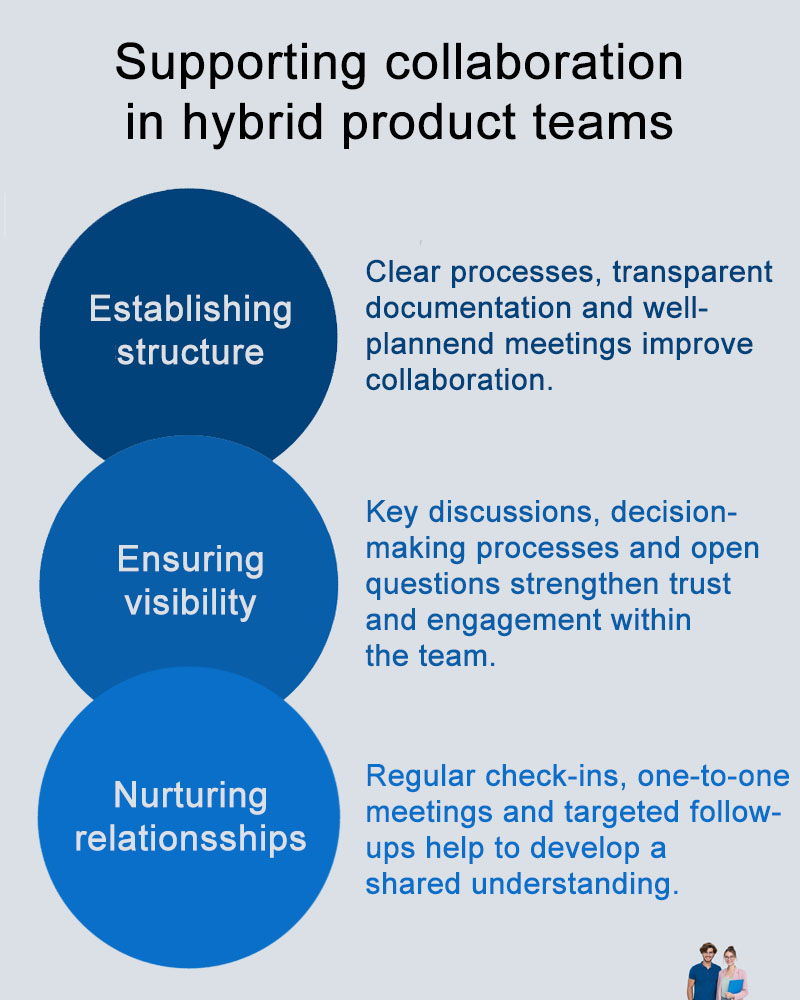
Figure: Supporting collaboration in hybrid product teams
Conclusion: Leadership means building connections
Hybrid working models are bringing about lasting changes to collaboration within product teams. Physical distance affects communication, trust and decision-making processes, and brings to light many dynamics that were previously barely noticeable in day-to-day work.
For junior product managers, this situation can be challenging at first. At the same time, it offers an opportunity to develop leadership skills early on. For it is precisely in hybrid contexts that it becomes clear that influence is not tied to formal authority.
What matters is the ability to forge connections. Between people, between perspectives and between information that would otherwise remain separate. Structured communication, transparent decision-making and deliberately designed interactions are not additional tasks, but central elements of effective collaboration.
Those who actively embrace this role help ensure that physical distance does not lead to separation. Leadership is then not demonstrated through individual decisions, but through the quality of collaboration that a team achieves together.
Practical tip: Strengthening product leadership in a targeted manner
If you want to deepen your leadership skills, Fabian Puls invites you to attend the German-language Impulse Session: Product Leadership. IThere, you’ll learn how to take on responsibility, act strategically and gain visible influence within the company. Ideal for junior product managers and career changers.
Notes:
Are you interested in getting in touch with Fabian Puls? If so, simply send him a message on LinkedIn or visit his informative website.
[1] Kniffin, K. et al. 2021. COVID-19 and the Workplace: Implications, Issues, and Insights for Future Research and Action
[2] Hinds, P. & Bailey, D. 2003. Out of Sight, Out of Sync: Understanding Conflict in Distributed Teams
[3] Golden, T., Veiga, J., & Dino, R. 2008. The Impact of Professional Isolation on Teleworker Job Performance and Turnover Intentions
[4] Edmondson, A. 1999. Psychological Safety and Learning Behavior in Work Teams
[5] Edmondson, A. & Lei, Z. 2014. Psychological Safety: The History, Renaissance, and Future of an Interpersonal Construct. Annual Review of Organizational Psychology and Organizational Behavior
[6] Ancona, D. & Caldwell, D. 1992. Bridging the Boundary: External Activity and Performance in Organizational Teams
Would you like to discuss leadership in hybrid product teams as an influencer or thought leader? If so, please share this post within your network.
Fabian Puls has published three more posts on the t2informatik Blog:

A successful start in product management

Leading as a junior product manager

Better product decisions through UX

Fabian Puls
Fabian Puls is the founder and managing director of Product Impulse. He offers product managers and product owners interactive live online training courses using innovative learning methods that actively engage participants and facilitate practical learning. His courses focus on key areas of product management such as product strategy, leadership and agile methodologies.
As a Certified Product Manager (FH) and Professional Scrum Product Owner™, Fabian Puls combines in-depth methodological knowledge with many years’ experience in national and international product teams.
On the t2informatik blog, we share knowledge and experience with people in organisations. And it is for precisely these people that we have been developing and modernising software since 2012. Pragmatically. ✔️ Personal. ✔️ Professional. ✔️ Get to know t2informatik as your development partner.