
When leaders don’t take responsibility
How managing directors hold themselves and their companies back
You pay your managers to take on responsibility. So why is it that so many problems still end up on your desk? Instead of strategically developing your company, you find yourself resolving conflicts, making operational decisions and dealing with matters that others should have sorted out long ago. Your diary is full, your to-do list is getting longer, and even after work, you can’t seem to switch off from day-to-day business. Many managing directors increasingly feel they have to take on their managers’ work as well.
Yet you probably want exactly the opposite: people you can rely on, who think for themselves, make decisions independently and take the pressure off you. In one of my recent workshops, I met a managing director who said quite openly that he wouldn’t be putting up with this for much longer. He was the first to arrive and the last to leave, and he could no longer sleep properly because of all the tasks on his list. In a survey published in 2024 by *Spiegel* and Civey, almost 62 per cent of the managers surveyed stated that they were exhausted. [1] But why don’t managers take on the responsibility expected of them? And to what extent are managing directors themselves to blame for the fact that so many decisions end up on their desks?
Leadership can be learnt
The managing director I met at the workshop was clearly under a lot of pressure. He spoke of how deeply he would engage with the questions and concerns of his managers and staff, and how he would think through solutions to their problems. He said his door was always open and that his specialist expertise was extensive enough to resolve matters quickly and efficiently.
This already provided a starting point that I frequently encounter in leadership development: managers have a strong focus on taking action. A problem is brought to their attention and is resolved. Why? Because that’s just how it’s done. This fills up their diary and takes an enormous toll on their energy. Employees learn from this that it is easier to ask their boss for help than to try to find a solution themselves. It doesn’t help that some bosses like to present their own solution. Why? Who else is going to realise that you’ve still got what it takes?
As a managing director, it goes without saying that it is your job to ensure the business runs smoothly. Equally important, however, is the question of where your company should be in the long term. When it comes to workforce planning, as well as staff requirements and filling vacancies, there is also the question: how well do my managers lead? If all decisions end up with the managing director, this is not necessarily down to managers who do not want to take responsibility. Perhaps they have never learnt to take responsibility, or the organisation does not allow it.
Leadership can be learnt. And this is a process that you, as managing director, must facilitate and support over the long term. It begins with you clarifying the expectations you have of your management team. This can take place in a one-to-one meeting or in a joint workshop where you discuss leadership guidelines for everyone. Another important step is equipping them with the right management tools. Your managers should be able to give and receive feedback, for example during staff appraisals or performance reviews. They must also be allowed to take disciplinary action in cases of poor performance. Your role as managing director is also that of a coach who regularly discusses difficult cases with your managers, reflects on them and encourages them to develop their own solutions.
Control is not the same as leadership
Some managing directors have built up their businesses successfully over many years through personal decisions, professional expertise and a high level of commitment. As the company grows, however, it is precisely this recipe for success that becomes a problem. As the company expands, its internal structures, processes and leadership culture must keep pace. It is not uncommon for the first mental stumbling block to arise at this stage: the notion that leadership simply has to continue in exactly the same way as one has led the business up to now.
The problem is that this approach no longer works. Whilst, as a lone operator, you were required to manage yourself effectively, the focus is now on leading other people. Instead of delivering the best work yourself, you must define tasks, delegate, empower staff and increasingly achieve success through their performance. You suddenly find yourself in a situation of greater dependence, which affects your need for control. You are now forced to cut back on the very activities that made you successful.
It is essential for you and your managers to define the requirements for each management level and select the right staff. Avoid the mistake of simply promoting the best specialist to a managerial role. Managers must develop people, motivate them and explain the rationale – or lack thereof – behind measures. This involves respectful communication and, for example, the conviction that a good team is needed, in which everyone can contribute their strengths. As a managing director, you oversee both recruitment and staff development, through which managers can address their shortcomings.
Anyone who does not trust their managers to take on responsibility may well end up with precisely the sort of managers whom they cannot trust to take on responsibility.
Of course, it also depends on the experiences you have had with your staff. McGregor’s Theory X and Theory Y describe two opposing ways of thinking about people and their motivation. [2] Whilst one assumes that people tend to shun responsibility (X), the other assumes that, under the right conditions, people will take on responsibility and even actively seek it out (Y).
As a managing director, you should examine how you view the people who work with you. If you lean more towards the X side, there is a clear risk that this is already reinforcing your need for control. Even more concerning is that the behaviour of your managers may reinforce your conviction, leading you to exercise even more control and thus fuelling the downward spiral.
Deci and Ryan’s self-determination theory, however, offers insights into how we can develop strong leaders. [3] Self-determination theory describes three fundamental psychological needs, the fulfilment of which supports autonomous motivation:
- Autonomy: I can shape my own actions within meaningful limits.
- Competence: I experience myself as effective and capable.
- Social connection: I feel recognised and that I belong.
As a managing director, your role increasingly involves ensuring that others are able to make good decisions. The problem here is not necessarily that you are unable to delegate. Sometimes you find it difficult to change your own perception of what actually constitutes good leadership.
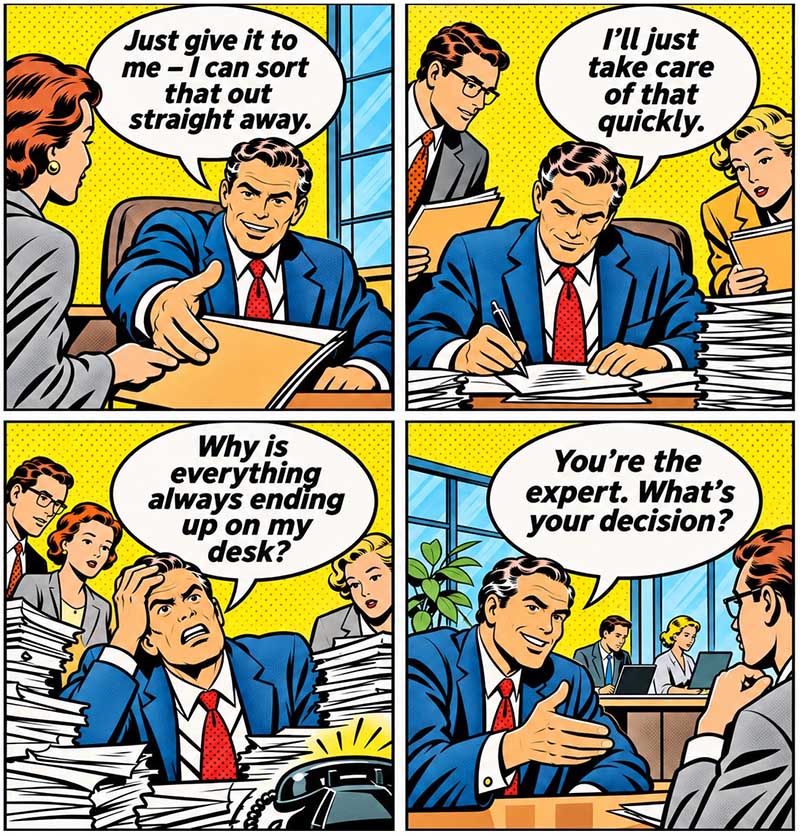
Figure: Making decisions yourself saves time in the short term, but …
Targeted leadership development
No leader has ever been born ready-made. However, it is not enough simply to send every leader on a training course and hope that this will solve all the problems. Take a strategic, long-term approach to leadership development. Start by defining a role profile that meets your needs as a managing director as well as those of your managers and staff. Such a role profile creates a framework within which self-management and development become possible. You can give your managers specific feedback – both positive and negative – and support them in doing an even better job.
As a second step, I would deliberately look for areas of responsibility that you can delegate to your managers. Delegating tasks is about more than simply getting rid of tedious to-dos. It distributes responsibility and, ideally, success as well. When employees see themselves as experts rather than mere extensions of your workbench, success spurs them on to repeat that behaviour. You should therefore consider not only the tasks to be delegated but also the associated powers. In this way, your managers will develop decision-making skills and learn to make independent and transparent decisions, even in the face of uncertainty.
Of course, the actual management of staff is also a key component of leadership development. Train them in communication and conducting discussions. This could start by you initiating regular one-to-one meetings with your managers. Make giving and receiving feedback part of everyday life, so that both critical and positive feedback become second nature. Feedback must not become a ‘Sunday best’ that we only put on for specific purposes. Feedback requires trust and a good relationship.
At the same time, everyone involved must understand that people have different personalities. It is therefore not a good idea to simply lead others in the same way that you yourself have been led.
- What are my managers’ motivations?
- How much experience do they have?
- What are their strengths?
- Who is sensitive and who can certainly cope with some frank advice?
Training courses can lay a solid foundation for dealing with these issues. Furthermore, your managers need support in their day-to-day work, for example from a supportive senior management team that stands by them when the going gets tough.
A management team you can rely on
If, as a managing director, all decisions end up on your desk, it is worth taking a look at your own management culture. This is not just about who decides what, but also about reducing your personal workload and ensuring you enjoy your work. If you are constantly solving your managers’ problems, you will have less and less time to develop your own business strategically.
However, a failure to take responsibility is not necessarily a sign of a lack of motivation or competence. Clear roles, genuine decision-making authority, trust and targeted leadership development are essential for your managers to be able to act independently. As a managing director, you remain responsible for building a management team you can rely on.
Notes:
Do you want to improve collaboration within your team or your communication skills as a manager? Then visit the Michael Zocholl’s website and arrange a meeting. It’s definitely worth it!
[1] Authority: Erschoepfung bei Führungskraeften
[2] Douglas McGregor: The Human Side of Enterprise
[3] Deci, Edward L.; Olafsen, Anja H.; Ryan, Richard M. (2017): Self-Determination Theory in Work Organisations: The State of a Science. Annual Review of Organisational Psychology and Organisational Behaviour, Volume 4, pp. 19–43.
Would you like to support Michael Zocholl and discuss leader development? Then please share this post on social media or within your organisation.
Michael Zocholl has published more posts on the t2informatik Blog, including:

Feedback as an active leadership tool

From colleague to manager

Why staff development must finally count

Michael Zocholl
Michael Zocholl is a business psychologist who supports managers and teams in strengthening communication, cooperation and trust in the long term – through workshops, coaching and training. In his podcast Zuhören, Fragen, Führen (Listen, Ask, Lead), he addresses the challenges and opportunities surrounding employee appraisals once a week.
On the t2informatik Blog, we share knowledge and experience with people in organisations. We have been developing and modernising software for them since 2012. Pragmatically. ✔️ Personal. ✔️ Professional. ✔️ Get to know t2informatik as your development partner.