
What is the Business Model Canvas?
Table of Contents: Definition – Building blocks – Applications – Prerequisites – Approach – Variants – Advantages and disadvantages – Questions – Notes
Smartpedia: The Business Model Canvas describes a business model in nine fields on a single page so that teams can develop it together and test its assumptions.
Business Model Canvas: a shared picture of the business
The business idea sounds good, the presentation goes down well, and then someone in the room asks: who exactly is going to pay for this, and why from us of all people? Within a few minutes it becomes clear that every department has a different picture in mind. Sales is thinking of existing customers, engineering of a new platform, and nobody has said a word about costs so far.
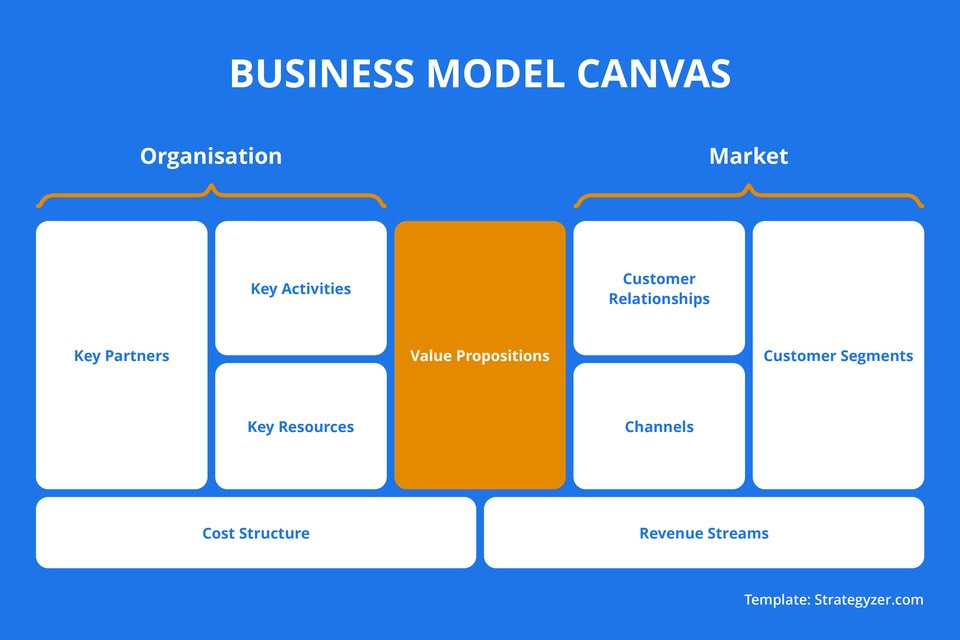
This is exactly the situation the Business Model Canvas (BMC for short) is designed for. It is a business development tool that allows a team to make the logic of a business visible. The canvas shows whom an offering benefits and how, how this benefit reaches customers, how money is earned and what the company needs to make it all work. The term “canvas” refers to a painter’s canvas: a large poster with nine fields on which participants collect, organise and weigh up their ideas. The format forces brevity: anything that does not fit on a sticky note has usually not been thought through yet.
The foundations were laid by the Swiss business theorist Alexander Osterwalder in his doctoral thesis “The Business Model Ontology”, which he completed in 2004 at the University of Lausanne under Yves Pigneur. [1] In 2005 he described the nine building blocks for the first time in a blog post. The model became widely known in 2010 with the book “Business Model Generation”, which Osterwalder and Pigneur developed together with 470 practitioners from 45 countries. [2] Strategyzer, the company co-founded by Osterwalder, provides the template free of charge under a Creative Commons licence. Anyone who uses or adapts it must visibly credit Strategyzer.com as the source [3].
The Business Model Canvas has since become the model for many other templates that condense a management topic onto a single poster, for example for projects, products or roles. In short: once you have understood the principle, you will quickly find your way around its offshoots as well.
Key points at a glance
- A typical reason for using a Business Model Canvas is a new product idea or a business that needs to be rethought.
- The right half of the canvas describes the market with customers, channels and revenue, the left half the organisation with activities, resources, partners and costs.
- Every note on the canvas starts out as an assumption, which is why testing the most important assumptions is an integral part of the method.
- A first draft can often be created in a few hours, using sticky notes on a large wall or a digital whiteboard.
- Alexander Osterwalder developed the model from his doctoral thesis of 2004 and made it widely known in 2010 with the book “Business Model Generation”.
The nine building blocks of the Business Model Canvas
The arrangement of the fields follows a logic that is worth keeping in mind when reading the canvas. At the centre is the value proposition, i.e. the benefit an offering creates. To the right of it lies everything to do with the market: the customers, the ways of reaching them and the type of relationship. To the left lies what the company has to do and buy in to keep its promise. In the bottom row, both sides meet in money: on the left are the costs arising from activities, resources and partners, on the right the revenue the market yields.
The following table shows the building blocks in the order in which teams usually work on them, and gives a guiding question for each as well as the characteristics that Osterwalder and Pigneur distinguish. The characteristics are meant as prompts: they help to fill an empty field and show options a team may not yet have considered.
| Building block | Guiding question | Typical characteristics |
|---|---|---|
| Customer Segments | For whom are we creating value, and which group matters most to us? | Mass market, niche market, segmented market, diversified offering, multi-sided platform |
| Value Propositions | Which problem do we solve, and why does the customer choose us over an alternative? | Newness, performance, customisation, getting the job done, design, brand and status, price, cost reduction, risk reduction, accessibility, convenience |
| Channels | Through which channels do customers hear about, buy and receive our offering? | Phases: awareness, evaluation, purchase, delivery, after-sales; own or partner channels |
| Customer Relationships | What type of relationship does each segment expect from us? | Personal assistance, dedicated contact person, self-service, automated services, communities, co-creation |
| Revenue Streams | What does the customer pay for, how much and how? | Asset sale, usage fee, subscription, renting and leasing, licensing, brokerage fees, advertising; fixed or dynamic pricing |
| Key Resources | What must we own or have access to for the model to work? | Physical, intellectual, human, financial |
| Key Activities | What must we be particularly good at and do regularly? | Production, problem solving, operating a platform or network |
| Key Partners | Who supplies us or takes on tasks we do not want to do ourselves? | Suppliers, joint venture, cooperation with competitors, strategic alliance |
| Cost Structure | What costs does the model incur, and which of them are the largest? | Cost-driven or value-driven; fixed and variable costs, economies of scale, economies of scope |
Two pairs belong particularly closely together: customer segments and value propositions depend on each other, because what is a strong argument for one customer group may be completely irrelevant to another. Channels and customer relationships both describe the connection to the customer, once as a route and once as a way of interacting. Working on these pairs together avoids a canvas whose fields sound plausible individually but do not fit together.
What is the Business Model Canvas suitable for?
The Business Model Canvas is most often used when something new is to be created: a product, a service or an entire line of business. The canvas then helps to think an idea through completely at an early stage, before money flows into development or marketing. It is equally suitable for taking stock of an existing business. Writing down today’s model often quickly reveals where it depends on a few customers, a single sales channel or an irreplaceable supplier.
A third area of application is the targeted search for growth. Here, a team deliberately goes through individual fields and asks which customer segments, channels or partners the company has overlooked so far. Finally, at management level, several business models can be placed side by side. This makes it easier to compare the portfolio and decide where budget and attention should go. The principle can even be used for planning one’s own career.
At the end of a workshop there is more than a colourful poster covered in notes. The participants share a picture of how the business is supposed to work and know where the open questions and risks lie. In addition, there are ideas for new customer groups, channels or partners, as well as a short list of assumptions to be tested next. For many teams, this very list is the most valuable result, because it turns an idea into a work plan.
What does a Business Model Canvas workshop require?
The time required depends on the task. Revising individual fields often takes no more than an hour, a new business model needs half a day or a full day, and large initiatives with guests, keynote talks and first customer conversations can take several days. Small to medium-sized groups put together specifically for the task have proven effective.
More important than the duration are certain conditions within the company: management must be willing to have the existing business questioned and to actually invest in the new one. The culture should tolerate mistakes and unusual ideas, otherwise the sticky notes remain cautious and predictable. And the group should be mixed: people from sales, engineering, service, purchasing and finance each see different fields of the canvas most clearly.
Whoever facilitates needs more preparation than the other participants. This person should know the method well, ideally from the original book, and have experience with creative workshops. A facilitator from outside, for example from another department or an external agency, has one advantage: they ask questions that nobody inside asks any more. At the same time, they put the brakes on so-called groupthink, in which a group agrees on an opinion too quickly. For the other participants, a short introduction in advance is sufficient, such as an explainer video or a text like this one.
A canvas is only as good as the knowledge brought into the room. If the most important facts are on the table at the start, the group does not have to guess and can invest its time in new ideas. The following information has proven useful:
- current customer groups, offerings, sales channels and forms of customer support
- the company’s most important activities, resources and partners
- market data such as competitor overviews or the results of comparisons with other providers
- the scope for how far the team may depart from the existing business
- examples of business models from other industries as inspiration
The figures on current customers are usually the most valuable, because value propositions and segments come first. If something is missing, that is no obstacle: the gap then becomes the first assumption on the canvas.
Very little equipment is needed. For group work, a large writable surface such as a pin board or whiteboard divided into the nine fields is sufficient, plus sticky notes and pens. If there is not enough space, the canvas can be spread across several walls. In virtual workshops, digital whiteboards take on this role; many offer ready-made templates, and there are specialised tools just for canvas models. Anyone working alone can manage with a large printout of the original template, which Strategyzer offers free of charge as a PDF.
Approach: creating the Business Model Canvas in three phases
The book by Osterwalder and Pigneur does not prescribe a fixed order for the nine fields. In practice, a three-phase approach has proven effective: prepare, fill in the canvas and test the most important assumptions. When filling it in, the team starts on the market side and then works its way over to the company side. What a company has to do and spend only becomes clear from what it promises its customers.
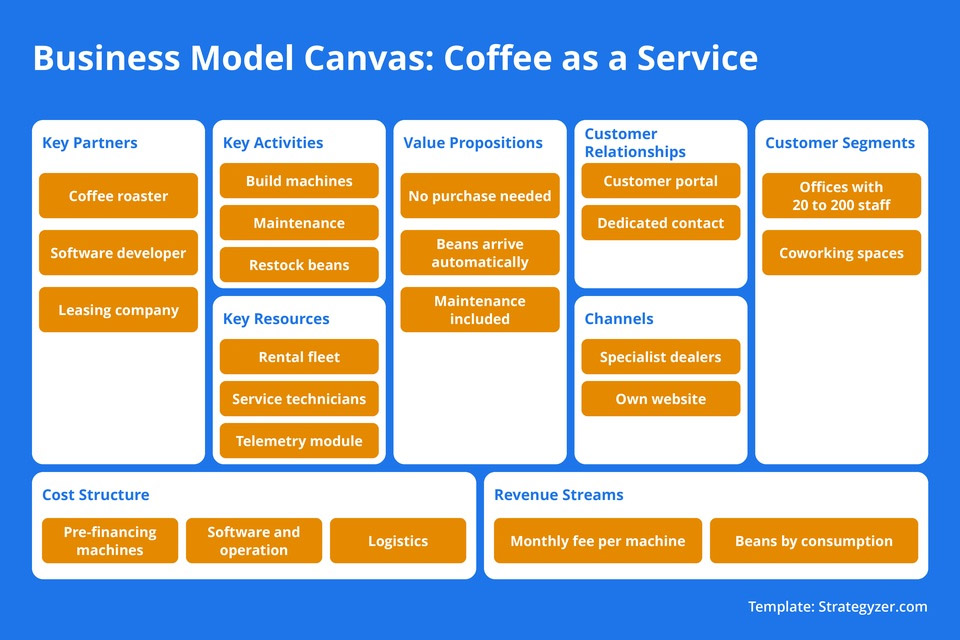
A running example shows what this looks like in practice: a family business with around 140 employees manufactures bean-to-cup coffee machines for offices and has been selling them through specialist dealers for decades. The dealers report that more and more companies are reluctant to spend several thousand euros on a purchase. The managing director therefore wants to explore a model known internally as “coffee as a service”. The machine is rented out, maintenance is included in a monthly flat fee, and a connected machine reports by itself when new beans are due.
Phase 1: Clarify the goal and the scope
Before the first sticky note goes up, everyone needs to know what it is all about. The facilitator explains the task, the reason for it and the approach, and if necessary briefly the nine fields. The canvas often does not stand alone: it may be part of a design thinking process, or a strategic analysis may have set a direction for which a business model is now needed. The clearer the assignment and the context are to the group, the more focused its work can be.
The scope also includes an explicit statement about how freely people may think. Teams that do not know whether unusual ideas are welcome almost always stay close to the existing business.
In the example, the managing director invites participants to a half-day workshop. Those invited are the head of sales, a service technician, the head of electronics development, the financial controller, a buyer and an external facilitator. At the start, she explains why the purchase model is reaching its limits and makes it clear that ideas affecting the dealer network are also welcome. Everyone knows the nine fields from a short video they watched beforehand.
Phase 2: Fill in the canvas, market side first
The two most important fields, customer segments and value propositions, come first. Customers can be divided into segments in various ways, for example by their requirements for the product or by demographic characteristics such as age, place of residence and income. There are also psychographic characteristics, i.e. people’s activities, interests and attitudes. Anyone already working with personas, i.e. sample profiles of typical customers, can use them directly here. For each segment, the team then collects the benefits the offering provides. The characteristics from the table above work well as a list of guiding questions that the facilitator can put up on a wall.
Channels and customer relationships follow. It helps to walk through a customer’s journey from first contact to use and to ask at each stage which channel it runs through. This also shows which sales channels the company operates itself and which are operated by a partner. Own channels take more effort to build up but deliver direct feedback and data on customer behaviour. Partner channels reduce the risk in the early phase but cost commission and therefore margin.
Revenue streams complete the market side. This is about how much and how: does the customer pay once, regularly or according to use? Is there a fixed list price or a negotiated, demand-based price? If there are several revenue streams, a first estimate of how much each should contribute to turnover is worthwhile. [4]
In the example, participants collect ideas on sticky notes in silent individual work and then put them up. For customer segments, two groups prevail: offices with 20 to 200 employees and coworking spaces. The service technician contributes the strongest value proposition, one she knows from many call-outs: nobody in the office wants to deal with empty bean containers and descaling. The head of sales insists on keeping the specialist dealers as a channel, supplemented by the company’s own website and a customer portal. Larger customers are also to have a dedicated contact person. On revenue, the group agrees on a monthly flat fee per machine, with beans billed according to consumption.
Once the market side is complete, the team switches to the left half. It starts there with the key activities. It looks at the prioritised value propositions and asks what the company has to do to deliver them, including operating the channels and maintaining customer relationships. It is important to note down only what is essential. The key resources are derived from the activities, i.e. what has to be available for them: machines and buildings, knowledge and patents, people with specific skills, and capital.
In the first round, there are almost always too many resources on the canvas. Because a new model is based on many unproven assumptions, it is worth checking each resource against three questions:
- Is it needed for a first market test, or is a Minimum Viable Product sufficient for now, i.e. the smallest version with which genuine feedback can be gathered?
- Can a partner take on the associated task?
- Can the resource be rented or leased if it is to stay in-house for reasons of confidentiality or for lack of a partner?
Whatever survives this check really belongs on the canvas. Everything else moves to key partners or is dropped for the time being.
Key partners follow on from this check. Companies bring in partners for three reasons: to reduce costs and benefit from economies of scale, to share risks, and to acquire resources or activities they do not have themselves. The forms range from the classic supplier to a joint venture and cooperation with competitors, for example when two providers jointly develop an expensive technology.
Finally, the team collects the costs arising from activities, resources and partners. One fundamental question helps with classification: is the model cost-driven, like a discount supermarket, or is value for the customer to the fore, like a delicatessen? Most models lie somewhere in between. As long as a model has not been validated, fixed costs should be kept as low as possible. Economies of scale in purchasing and shared activities, such as one logistics partner for several product lines, reduce costs further.
In the example, the facilitator splits the group into two halves for the left side. One half derives activities and resources, the other partners and costs. It quickly becomes clear that the connected machine needs a new component, a telemetry module that reports fill levels and faults, plus software that evaluates these reports and triggers deliveries. The company does not want to develop this software itself, so a software service provider is added to the canvas as a partner, alongside the roastery that supplies the beans. After the check, the rental fleet, the service technicians and the telemetry module remain as key resources. The financial controller adds the largest cost block, which the team had overlooked until then: with a rental model, the company has to pre-finance every machine. The group therefore adds a leasing company as a partner.
Phase 3: Test assumptions and adapt the canvas
A full canvas looks like a result, but at first it is a collection of guesses. Every note starts out as an assumption that may or may not be true. The most important one is almost always that the value proposition solves a real problem for a customer segment. The task of the third phase is to filter out, from all the assumptions, those that would cause the model to fail if they turned out to be wrong. In project jargon, such assumptions are also called showstoppers.
Dot voting has proven its worth: each team member receives a fixed number of sticky dots and marks the notes they consider most critical. For the notes with the most dots, the team decides how to test them, who will do it and how it will recognise that the assumption holds. In the simplest case, the result is a list of clear tasks; for large and risky initiatives, a feasibility study may also be necessary.
In the example, each team member receives four dots. After the vote, five assumptions remain, for which the team draws up a test plan.
| Assumption | Field | Test | Considered confirmed if |
|---|---|---|---|
| Offices prefer renting to buying a machine | Revenue Streams | Interviews with 12 office managers from the dealers’ customer base | at least 8 out of 12 prefer the rental model |
| Automatic restocking is a genuine reason to switch | Value Propositions | A page on the company’s own website that describes the offer and counts pre-registrations | 40 companies pre-register within six weeks |
| The specialist dealers will also sell the rental model | Channels | Talks with the five dealers with the highest turnover | at least 3 out of 5 agree to a pilot |
| The telemetry module costs no more than €60 per machine | Cost Structure | Quotes from two electronics suppliers and one software service provider | one quote is below this limit |
| 200 rental machines can be financed in the first year | Key Partners | Talks with the company’s bank and a leasing company | a commitment on acceptable terms is obtained |
The column on the far right is the most important. Without a criterion set in advance, teams tend to read every result as confirmation after the fact.
After five weeks, the group meets again. Nine out of twelve respondents prefer renting but want to commit for no more than 24 months instead of the planned 36. Two of the five dealers fear losing margin and will only take part if they receive a commission for each contract they broker. The cheapest quote for the telemetry module is €75. The team adapts the canvas in three places: a shorter contract term in the revenue streams, commission for dealers in the cost structure and a monthly flat fee that is €3 higher. Then the next round begins.
How often this cycle is repeated depends on the initiative. For a new line of business, it usually takes several rounds over a few months, and the order of the fields may change in the process. Even a validated model remains a living document: if the market changes or a new partner comes on board, new assumptions find their way onto the canvas.
Variants and related methods
Numerous adaptations have emerged from the Business Model Canvas, and it combines well with other methods. The most important variants each set a different focus.
The Value Proposition Canvas also comes from Osterwalder and his team. In a sense, it zooms in on the two fields customer segment and value proposition. On one side are the jobs, pains and gains of a customer group; on the other are the products and the way they relieve pains and create gains. It is worthwhile when the team gets stuck on the value proposition or needs to justify it in more detail.
The Lean Canvas by the entrepreneur Ash Maurya is an adaptation for start-ups. It replaces the fields key partners, key activities, key resources and customer relationships with problem, solution, key metrics and an advantage that is hard to copy [5]. It fits when it is still unclear whether the customers’ problem exists at all, and is less suitable when an established company is building a new line of business.
Business Model You applies the principle to individuals. The canvas then describes one’s own professional situation: whom do I help, what do I bring, who supports me? It is suitable for career planning or before a change of job. There are also variants with a focus on sustainability that add fields for the environmental and social impact of the business. Optimising an existing model can also be seen as a variant in its own right: here, the team first describes the current state and then marks what should change.
The canvas differs from a business plan or a business case in its level of detail. The canvas outlines on a single page how a business is supposed to work. A business case calculates a specific investment with its costs, benefits and risks and serves as the basis for approval. In practice, the business case often follows the canvas once the most important assumptions have been confirmed.
There are suitable partner methods for the work before and after the canvas. Input can come from personas, a SWOT analysis of strengths, weaknesses, opportunities and threats, an environmental analysis or a value stream analysis that maps processes from order to delivery. For facilitation, Liberating Structures formats such as 1-2-4-All are a good fit, in which ideas are developed first alone, then in pairs, in fours and finally in the whole group. Strategically, the canvas can be combined with the Ansoff Matrix, the Blue Ocean Strategy, design thinking or the Balanced Scorecard. For follow-up work, the business case and an Obeya are useful, the latter being a room in which all the important information about an initiative hangs on the walls.
Advantages and disadvantages of the Business Model Canvas
The Business Model Canvas is so widespread because it creates a great deal of clarity with little effort. Its strengths show above all where people from different areas need a shared picture:
- Focus on the essentials: The limited space forces people to agree on the most important points. Lengthy concept papers, by contrast, are easily filled with secondary matters.
- Common language: Sales, engineering and finance see the same picture and talk about the same fields. Misunderstandings therefore become visible early on.
- Uncomfortable questions early on: Questions about willingness to pay, customer service or financing are put on the table before a lot of money has been spent.
- Lower costs: Consistently checking resources for possible partners often reveals ways of starting with less capital of one’s own.
- Comparability: Because all models have the same format, management can place several lines of business side by side and prioritise them.
These advantages assume that the team sees the canvas as a working tool and actually tests the assumptions later on. Where this is lacking, the weaknesses of the method become apparent:
- Not a form: Simply filling in the fields does not produce a new business model. The value lies in the discussion and the subsequent testing.
- Difficult start: Faced with an empty canvas, some teams struggle to come up with the first notes. A simple practice example helps here.
- Risk of excessive detail: If the team goes into too much detail, it gets lost in debates about trivialities and never reaches the critical assumptions.
- Blind spots: Competitors, legal frameworks and market developments have no field of their own on the canvas. They have to come from other analyses.
- Snapshot: The canvas shows the situation at one point in time. If it is not maintained, the team soon works with a picture that is out of date.
Most of the disadvantages can be offset by good facilitation and complementary methods. Those who see the canvas as a starting point for conversations and tests will get the most out of it.
Questions from practice
Here you will find some questions and answers from practice:
What tips help when working with the Business Model Canvas?
Whether a canvas workshop produces new insights or merely sorts what is already known rarely depends on the template. It depends on the preparation, the facilitation and how the team handles the result after the workshop. The following lessons from experience help:
- Start with an unrelated example: A snack stall or a drinks shop can be put on a canvas together in ten minutes. The team gets to understand the fields without the example shaping the actual task.
- Don’t force every field: There is no obligation to fill in all nine fields equally thoroughly. Where the business is clear, two keywords are enough. The time belongs to the fields with open questions.
- One idea per note: Short keywords can be moved, grouped and evaluated. Whole sentences on a sticky note prevent this.
- Use colours deliberately: One colour per customer segment shows at a glance which notes in the other fields belong to which segment. In the same way, the four types of resources, or existing and new ideas, can be distinguished by colour.
- Overcome mental blocks with creativity techniques: Methods such as SCAMPER, working with stimulus images or asking how a competitor would push your own company out of the market get the group out of familiar ruts.
- Keep the canvas visible: A poster in the project room or a permanently linked digital whiteboard reminds everyone involved of the shared model. Each version is dated so that changes remain traceable.
In our experience, the first two tips make the biggest difference because they overcome the typical block when facing an empty poster. The last tip determines whether the canvas lives on after the workshop or disappears into a drawer.
How many Business Model Canvases does a company with several products need?
A canvas describes one business model, and a company can have several. If two offerings differ significantly in terms of customers, revenue and partners, each gets its own canvas; otherwise the poster becomes unreadable. If, on the other hand, they share resources and channels and differ only in the value proposition, a joint canvas with colour-coded segments is often sufficient. An overall picture for the whole company makes sense when management wants to see where models support each other or where resources are being built up twice.
Where does a note belong that fits into two fields?
This happens frequently, for example with an online portal that can be a channel, a customer relationship and a resource at the same time. The note belongs in the field whose question it is currently answering. The portal as a route to the customer is a channel, the software behind it a resource and running it an activity. It is often clearer to write two notes with different statements than to place one note between two fields. If a discussion about where a note belongs lasts longer than a few minutes, this is a sign that the term is too vague.
Can a competitor’s business model be mapped on the canvas?
Yes, and it is a good exercise for understanding your own model better. The market side can usually be reconstructed well from publicly available information such as the website, price lists, job advertisements and press releases. The company side, on the other hand, remains largely guesswork, because cost structures, partner contracts and internal processes are rarely visible from the outside. Nevertheless, the comparison shows where the competitor positions itself differently and where your own model is vulnerable.
What can you do if the group cannot agree on the most important customer segments?
Forcing an agreement rarely achieves much, because each side may have good reasons. It is better to sketch a separate canvas for each of the two disputed segments. This often shows that one segment entails completely different channels, partners and costs. The question of which segment to tackle first thus becomes a testable assumption that a test can settle.
How is AI changing the Business Model Canvas?
AI can also support the third phase. It drafts interview guides for customer conversations, evaluates open answers from many interviews and calculates variants of prices and costs. In the example, the team could have the notes from twelve conversations with office managers summarised in order to see more quickly which objections keep recurring.
The limits are just as clear. A canvas generated by AI quickly looks complete and plausible, but it is based on general patterns. It does not know your own customers. Market figures from a language model may be invented and must be checked, and internal figures or strategy papers should not be entered unchecked into public tools. The real work remains with the team: deciding which assumptions are critical, talking to real customers and partners, and taking responsibility for the result.
Impulse to discuss:
Who in your organisation decides when an assumption on the canvas counts as confirmed, and what happens if management does not like the result?
Notes:
If you like this post or would like to discuss it, please feel free to share it within your network.
[1] Osterwalder, Alexander: The Business Model Ontology. A Proposition in a Design Science Approach. Doctoral thesis, HEC, University of Lausanne 2004
[2] Osterwalder, Alexander; Pigneur, Yves: Business Model Generation. A Handbook for Visionaries, Game Changers, and Challengers. Wiley, Hoboken 2010
[3] Strategyzer AG: Usage of our tools (terms of use); The Business Model Canvas (template as PDF)
[4] Ideas can be found in: Gassmann, Oliver; Frankenberger, Karolin; Choudury, Michaela: Der St. Galler Business Model Navigator. 55+ Karten zur Entwicklung von Geschäftsmodellen (in German). 2nd edition, Carl Hanser Verlag, Munich 2021
[5] Maurya, Ash: What is Lean Canvas? LEANSTACK
Here you will find an interesting article explaining why change projects work.
And here you’ll find more information from our Smartpedia section:

What are Personas?

What is a Minimum Viable Product?

What is the Blue Ocean Strategy?
‘Smartpedia’ is our glossary for people in organisations involved in software development, project management and product management. It is for precisely these people and their organisations that we have been developing and modernising software since 2012. Pragmatic. ✔️ Personal. ✔️ Professional. ✔️
Get to know t2informatik from Berlin as your development partner.