
What is FOBO?
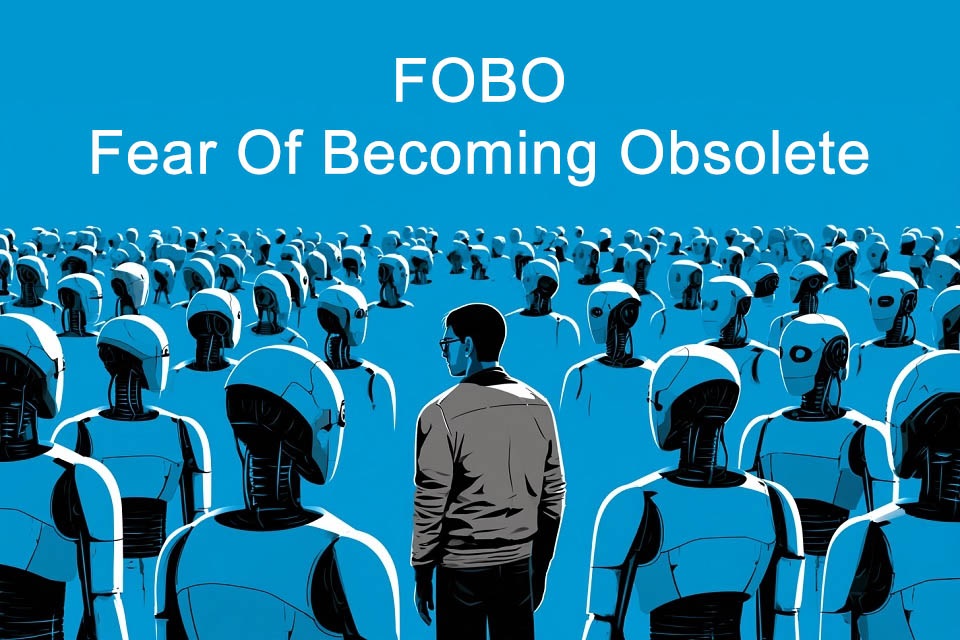
Smartpedia: FOBO stands for ‘Fear of Becoming Obsolete’ and describes the worry that one’s own professional role will become less important as a result of technology.
FOBO – When one’s professional relevance is called into question
An AI can summarise a report in a matter of seconds; it can draft texts, analyse data, create presentations or assist with programming. Tasks that previously required experience and time can now, for the most part, be automated and carried out more quickly.
Such developments can raise an obvious question: will the skills I have today still be needed at all in a few years’ time?
It is precisely this concern, in the context of AI and automation, that is increasingly referred to as FOBO, ‘Fear Of Becoming Obsolete’. It represents the fear that AI or automation could jeopardise one’s professional role. [1] However, it is neither a medical diagnosis nor a clearly defined psychological disorder. Rather, the term serves as a catchy label for concerns that are studied in research under terms such as ‘technology-induced job insecurity’. [2]
Where does the term FOBO come from?
The acronym FOBO predates the current debate on artificial intelligence. Patrick J. McGinnis used it as early as 2004 to mean ‘Fear of a Better Option’ . This refers to the difficulty of deciding on a particular option because a potentially better one might still emerge. [3]
‘Fear of Becoming Obsolete’ is a more recent use of the same abbreviation. In the context of AI and the world of work, FOBO now stands for the concern of becoming professionally redundant or less relevant. Anyone researching FOBO may therefore come across two different meanings. The specific context determines which of these is meant.
What lies behind FOBO?
FOBO can relate to different aspects of one’s work: in this context, a distinction is made between quantitative and qualitative job insecurity. Quantitative job insecurity concerns the potential loss of one’s job. Qualitative job insecurity, on the other hand, refers to the concern that important aspects of one’s work may be lost or lose value. [4]
- The most obvious concern relates to the job itself: could my role eventually be fully automated?
- There is also a second form of insecurity. Even if a job remains, tasks, responsibilities and requirements may change. Employees may therefore fear that, whilst their role remains, important aspects of their work will lose significance or deteriorate.
FOBO can therefore manifest itself in questions such as: Such questions highlight the uncertainties that technological change can trigger.
- What will happen to my role if more and more tasks are automated?
- Will my skills remain relevant in the future?
- Which tasks will continue to be carried out by humans?
- What new skills will be expected of me?
What factors can contribute to FOBO?
FOBO does not necessarily arise wherever new technology is introduced. Rather, the decisive factor is how people perceive this change and the organisational context in which it takes place.
One important factor is the perception that one’s own work could be replaced or significantly altered by technology. The more strongly employees perceive automating technologies as a threat to their work, the greater their perceived job insecurity is likely to be. [5]
Corporate culture also plays a role. If changes are predominantly imposed from above and employees feel they have little influence or guidance, insecurity can increase further.
Conversely, social support and learning opportunities can help people make better sense of technological changes. Dialogue, guidance and the opportunity to develop new skills in a targeted manner can help to reduce feelings of threat.
FOBO is therefore not exclusively an individual reaction. Leadership, communication and organisational culture also influence how technological changes are experienced.
What consequences can technology-driven job insecurity have?
Not everyone reacts to job insecurity in the same way. Some become curious, others cautious, whilst others experience the change as a burden.
Technology-driven job insecurity can affect well-being, motivation and commitment to one’s work. Stress, withdrawal or declining job satisfaction may also play a part.
One’s own career prospects may also be affected. If employees fear that key aspects of their work are losing value, this can undermine their confidence in their own role and their commitment to their current career path.
At the same time, it would be too simplistic to automatically view every technological change as a threat. People can also regard new technologies as a challenge and use them to develop motivation or a willingness to learn. What matters, therefore, is not only what is changing, but also how this change is perceived.
How can FOBO be managed?
There is as yet no generally accepted method for dealing with FOBO. However, some starting points can be derived from research into technology-induced job insecurity:
Make changes concrete: A vague concern is easier to come to terms with once it becomes clear which tasks are actually changing and which new requirements may arise.
Create learning opportunities: Research into AI-induced qualitative job insecurity suggests that the ability to adapt through learning can influence how people cope with technological change.
Strengthen social support: Support from colleagues and the organisation can mitigate the perception of threat. The introduction of technology should therefore not be viewed solely as a technical project.
Consider organisational culture: Research suggests that the cultural context influences the extent to which automation technologies are perceived as a threat to one’s own job. An authoritarian organisational culture can reinforce this perception.
Taking a nuanced view of one’s own work: Not every task within a role is equally amenable to automation. It may therefore be more helpful to consider individual tasks rather than questioning the entire profession in general terms.
FOBO as a challenge for organisations
Incidentally, treating FOBO solely as a personal concern of individual employees falls short of the mark.
Research shows that organisational culture, social support and learning opportunities can influence how technological changes and the associated job insecurity are experienced. Organisations can therefore provide guidance by explaining transparently why AI is being used, which tasks are set to change and what development opportunities this creates.
This does not mean that every concern can be allayed. Technological change can have real-world implications for jobs and roles. This makes it all the more important not only to discuss potential efficiency gains, but also to address what these changes mean for the people affected.
Impulse to discuss
Which aspects of your work could be affected by AI, and which of your skills would become more important rather than less important as a result?
Notes:
If you like the article or would like to discuss it, please feel free to share it in your network. And if you have any comments, please do not hesitate to send us a message.
[1] the stepstone group: “Fear of Becoming Obsolete”: More than one in three employees worry that AI could make their jobs obsolete
[2] MDPI: Navigating the Digital Storm: A Systematic Review and Meta-Analysis of Technology-Induced Job Insecurity, Its Outcomes and Moderators
[3] Patrick McGinnis: Fear of a Better Option
[4] ScienceDirect: The impact of AI adoption in the workplace on knowledge workers’ career commitment: A job insecurity perspective
[5] Vjije Universiteit Amsterdam: The contingent effect of job automating technology awareness on perceived job insecurity: Exploring the moderating role of organizational culture
What does t2informatik do?

And here you will find additional information from our Smartpedia section:

What is the FOMO Effect?

The best was to a decision