
Why AI causes uncertainty for many people
Expand the table of contents
Perhaps you roll your eyes inwardly whenever someone starts talking about artificial intelligence again. Perhaps you’re irritated by the enthusiasm with which people on LinkedIn talk about new models, digital assistants and impressive productivity gains. Or maybe you change the subject as soon as AI comes up in a conversation, because it makes you feel doubtful, uneasy or uncertain.
Perhaps you simply nod and say nothing. That’s fine. You’re not alone in this.
This series of articles isn’t aimed at people who rave about their seven digital assistants, which supposedly save them loads of time. Nor is it for those who try out every new trend straight away. And it’s certainly not for those who celebrate every new model and every upgrade. It’s aimed at people who ask themselves: Where do I actually stand on this whole issue? What does this development mean for my career? Which of my skills will still be needed in future? And how much control will I ultimately retain?
That’s exactly where this first part comes in. It’s about fear, hesitation and silence. Not as a shortcoming, but as a starting point. Before we can answer the question of what a confident approach to AI might look like, it’s worth taking a closer look at our own unease. And this unease has a name.
Your fear has a name
Researchers all over the world are looking closely at exactly what you might feel in the pit of your stomach when you hear about AI. Two terms from this research describe it particularly well.
The first term is FOBO, ‘Fear Of Becoming Obsolete’. It refers to the fear of becoming redundant in one’s job. The underlying question is: will I even be needed in a few years’ time? [1]
This concern is not unfounded. Companies are changing tasks, processes and roles through the use of AI. Tasks are being automated, requirements are shifting, and some tasks that used to take considerably longer can now be completed in a matter of minutes.
Imagine you have been working for ten or more years in a profession you know well and which gives you a sense of security. You have gained experience, know how things work, are reliable and bring a personal and human touch to your work. And suddenly you hear that a computer can carry out many of these tasks in a short space of time. The feeling this creates has a name: FOBO. It is the worry that the skills you possess may soon be less in demand.
The second term is FOLA, ‘Fear Of Losing Agency’. It refers to the fear of losing control and autonomy. The question behind it is: who actually makes the decisions here – me or the machine? [2]
This concern is also understandable. AI systems are becoming more powerful, taking on more tasks and playing an ever-greater role in workflows and decision-making. This also raises the question of how much control remains with humans and how consciously we shape that control.
So if you feel uneasy about AI, you are reacting to real changes in your working world. Your feeling is not a sign of being behind the times. Rather, it shows that you are paying close attention to what is happening and what the consequences might be. The crucial question, therefore, is not whether this unease is justified. What matters is what you make of it.
Alongside FOBO and FOLA, a third term is appearing with increasing frequency: DOBO, “Desire Of Becoming Outstanding”. This refers to the desire, in the age of AI, not simply to go with the flow, but to consciously shape one’s own place and future.
People with this perspective do not merely ask themselves whether they might be replaced. They also ask themselves how they can combine their own strengths with AI in such a way that they work more visibly, more effectively and perhaps even with greater satisfaction. Perhaps you are already sensing a faint trace of this desire. The path to achieving it, however, does not begin with great determination. It often begins much more unspectacularly: with observation, waiting and silence.
Why keeping a low profile is so tempting
Our brains love the familiar. When something seems new, big or overwhelming, they send a fairly clear signal: hold off, stay cautious, observe first, gather impressions and information before committing yourself.
This is not a failure. It is a defence mechanism that has been with us humans for a very long time.
Being quiet, biding one’s time and not exposing oneself straight away can therefore be a perfectly sensible strategy. When it comes to AI in particular, there are even strong arguments in its favour. Development is rapid, the possibilities are hard to grasp, and the public debate often swings between enthusiasm and doomsday scenarios. Anyone who doesn’t join the conversation straight away isn’t automatically in the wrong.
When it comes to AI, however, this caution has a catch: progress doesn’t wait. Whilst you’re observing, the world of work around you is changing. Colleagues are trying out new tools. Companies are altering processes and requirements. Roles are shifting. And at some point, that deliberate wait-and-see approach can lead to a gap that becomes increasingly difficult to bridge.
It is certainly not about having to understand everything straight away or joining in enthusiastically. Nor is it about trying out every new application or allowing yourself to be pressured into adopting a particular stance. Another question is more important: does your silence help you get to where you want to be? Or to put it more pointedly: how will you look back in five or ten years’ time on having remained quiet and cautious about AI today?
Perhaps your answer will be: ‘That was exactly the right thing to do.’ But perhaps you’ll also realise that you’re already far more curious than you’d care to admit. At this point, reserve turns into action. And this is precisely where a simple model can help: the values square.
The value square as a bridge
In change processes, I have been working for many years with a model that helps us to look at apparent contradictions in a new light: the value square.
The idea behind it is simple. Two values that appear to be opposites at first glance can complement one another.
Let’s take thrift and generosity. Thrift is, in principle, a positive thing. It helps us to use resources wisely. If taken to extremes, however, it can turn into stinginess. Generosity is also a positive value. Yet if taken to extremes, it can tip over into wastefulness. So both sides belong together. They keep each other in balance.
In this model, development does not mean doing away with thrift and replacing it with generosity. Development means adding the appropriate counterpart and finding a good balance depending on the situation.
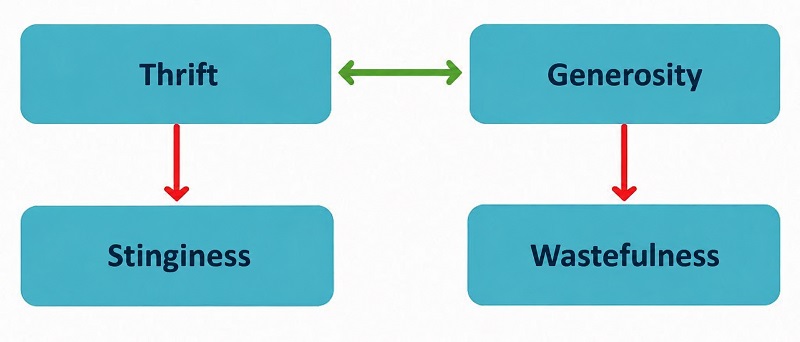
Figure 1: Value square on thrift and generosity
It is precisely this principle that can also be applied to how you deal with AI.
There is merit in keeping a low profile. It protects you from feeling overwhelmed, from making hasty judgements and from the feeling that you must jump on board with every new development straight away. Speaking up also has its merits. It enables you to ask questions, take a stand and exert influence. If you remain silent at all times, you may miss out on opportunities to shape things. If, on the other hand, you always speak out straight away, you run the risk of making hasty judgements or overlooking important nuances.
Your path in dealing with AI therefore does not lead from wrong to right. It leads from a sensible starting point to a complementary approach that opens up more possibilities for you.
For practical application, however, the Values Square can sometimes be a little abstract. That’s why I like to think of development in even simpler terms: as a bridge.
On one side, you stand where you are today. Perhaps anxious, quiet, uncertain or sceptical. On the other side is a state you’d like to reach. Perhaps courageous, audible, confident or curious. The direct leap from one side to the other can quickly seem too great.
From anxious to courageous. From insecure to confident. From overwhelmed to focused. That sounds like a massive change, one that’s more likely to paralyse than to motivate. That’s precisely why the bridge needs pillars in the middle. You don’t have to jump; you can take it step by step.
Below, you’ll find five such bridges. They show how, step by step, a new mindset can emerge from a stressful starting point.
1. From fearful to courageous
Fear can have many causes. Perhaps you’ve experienced setbacks in the past. Perhaps you feel that your opinion carries little weight within the team. Or you have the impression that others have long since been much more confident than you are.
The first step across this bridge is called caution. You begin by looking at the issue from a certain distance, without having to expose yourself straight away.
The second step is called curiosity. You open yourself up to the possibility that AI might also have something to offer you and that you can develop your own perspective on it.
Over time, courage can grow out of caution and curiosity.
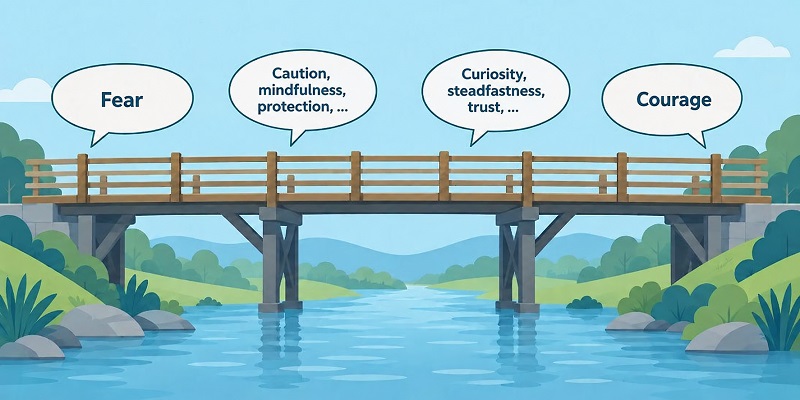
Figure 2: The value square as a bridge – moving step by step from fear towards courage
There are probably good reasons why you tend to keep a low profile when it comes to AI. Perhaps you don’t want to commit yourself too hastily. Perhaps you don’t feel confident enough yet. Or perhaps you’d rather observe first before getting involved yourself.
The first step is careful observation. Listen closely to what others are doing and saying. Pay attention to how AI is discussed within your team or in meetings. The second step is to ask probing questions. You don’t need to have a fully formed opinion just yet. It’s enough simply to ask questions, gain a better understanding of the context and gradually refine your own perspective. In this way, quiet observation gradually gives rise to your own voice.
3. From uncertainty to conviction
Uncertainty often arises when experience is lacking or when previous contributions haven’t been taken seriously. Perhaps you recognise the feeling of having an idea dismissed too hastily or your assessment being laughed at.
The first step is to give it a go. Take a look at a single tool or a straightforward use case, without expecting to master everything perfectly straight away. The second step is to understand. You’ll learn how this tool works, where it can help you and where its limitations lie. Genuine conviction can grow from this understanding.
4. From sceptical to curious
Scepticism isn’t wrong. It shows that you’re weighing things up, asking questions and not blindly following every trend.
The first step across this bridge is to ask about the specific benefits: what can AI actually do for you in your day-to-day work? The second step is to have a bit of a play with it in an area that is personally relevant and manageable for you. In this way, justified scepticism can turn into curiosity based on your own experience.
5. From overwhelmed to focused
The sheer volume of new terms, tools and possibilities can feel like a room full of noise.
The first step out of this sense of being overwhelmed is to sort things out. Ask yourself: Which of these actually affect my day-to-day life? You can consciously set everything else aside for the moment. The second step is to select. Choose exactly one topic or one tool that is truly relevant to you right now. This focus brings clarity. And clarity brings the ability to take action.
These five bridges illustrate the principle. There are many more: from powerless to creative, from hesitant to determined, from passive to proactive, or from being controlled by others to being in control. What matters is not which terms suit others. What matters is your own starting point. And that is exactly where your next step begins.
Your first small step begins now
Now it’s your turn. No technology, no signing up for a programme or a course. Just a few minutes and an honest look at your own approach to AI.
Grab a sheet of paper or your smartphone and write down the word that best describes your current state of mind when it comes to AI. Perhaps ‘anxious’, ‘cautious’, ‘overwhelmed’ or ‘sceptical’. Or perhaps a completely different word fits better.
Next to it, jot down how you’d like to see yourself when dealing with AI in future. Perhaps ‘courageous’, ‘clear-headed’, ‘curious’ or ‘confident’.
Your personal bridge lies between these two terms.
Now ask yourself: what could be a first small step that leads you in this direction? Not a complete transformation. Not the perfect plan. Just a step so small that it seems achievable.
Perhaps take a closer look at a specific AI tool. Perhaps ask a question in a conversation that you’ve kept to yourself until now. Perhaps start by observing how your colleagues use AI. Or try out a single use case that’s truly relevant to your day-to-day work.
If you prefer to speak your thoughts rather than write them down, use the dictation function on your smartphone. Start by stating your starting point, then your desired goal, and finally the one or two intermediate steps that could form the bridge between them. A walk is often better for this than sitting at your desk. Movement creates some distance, and sometimes a simple thought can give rise to a surprisingly clear inner monologue.
The aim here is not yet to put anything into practice straight away. Simply formulating your thoughts consciously changes your perspective on your own situation. A vague feeling becomes a concrete starting point. A distant goal gives rise to a possible path. AI need not be either an adversary or a promise of salvation. It is, first and foremost, a tool. What matters is how you handle it, what you use it for, and what role you yourself play in the process.
Notes:
The second part of the series ‘AI scares me’ explores which human strengths are particularly valuable in the age of AI, and why experience, social skills and responsible decision-making are becoming increasingly important.
Dierk Soellner supports specialists and managers in tackling current challenges through professional coaching and offers useful training courses on AI.
[1] What factors can contribute to FOBO?
[2] What can contribute to FOLA?
Would you like to support Dierk Soellner and discuss fears and concerns regarding the use of AI? Then please share this post on social media or within your organisation.
Dierk Söllner has published more articles on the t2informatik Blog, including:
Ai and education: Why we’re testing the wrong things

Working learning gap – good intentions are not enough

The future of human autonomy

Dierk Soellner
His clients range from DAX corporations to medium-sized companies to smaller IT service providers. He likes to tweet and regularly publishes expert articles in print and online media. Together with other experts, he founded the Value Stream initiative.
On the t2informatik blog, we share knowledge and experience with people in organisations. And it is for precisely these people that we have been developing and modernising software since 2012. Pragmatically. ✔️ Personal. ✔️ Professional. ✔️ Get to know t2informatik as your development partner.