
Oh, interesting books
‘A good book contains more truths than the author himself knew how to put into it.’ – Marie von Ebner-Eschenbach
‘Reading is like any other pleasure: the more wholeheartedly and lovingly we devote ourselves to it, the deeper and more lasting it will be.’ – Hermann Hesse
‘Of all the worlds that man has created, that of books is the most powerful.’ – Heinrich Heine
Some books open doors. They invite us to engage with different ideas, experiences and perspectives, and that is precisely what makes them interesting. This time, I’m presenting a few such books: by and featuring Andrea Grundmann, Jessica Schwarzer, Katharina Schleeberger and Dr Andrea Herrmann, as well as Bernadette von Wittern and Herbert Lippmann.
Digitale Charisma
(Digitales Charisma)
How to make an impression with your personality and attitude in the digital world
(So überzeugst du mit Persönlichkeit und Haltung in der digitalen Welt)
Andrea Grundmann

Andrea, what is your book about?
Andrea: My book is about how people can showcase their personality, attitude and impact in the digital world. I explain why digital communication operates by its own rules, how perception and trust are built, and how to develop an authentic personal brand. In doing so, I combine the themes of communication, leadership, impact and visibility with very practical guidance on building your own digital presence, including on LinkedIn.
The aim is to make just as much of an impact online as you do in the real world – authentically and consistently conveying your own personality, positioning and message.
Why did you write the book?
Andrea: I wrote the book because, in my work, I’ve repeatedly seen how difficult it is – particularly for successful, competent and charismatic people – to communicate authentically online. It’s not that they lack the courage; rather, they lack clarity about what makes them unique and how they can authentically convey that.
At the same time, I believe it’s incredibly important that more strong personalities with conviction become publicly visible and engage in social debates. All too often, the intelligent and substantive voices are too quiet, whilst volume and quantity shape public perception. With this book, I want to help people find their own voice and use it effectively.
And who should read the book?
Andrea: The book is aimed at entrepreneurs, executives, experts and anyone who wants to strengthen their visibility, impact and positioning in the digital space. It is written for those who have something to say, want to present their personality authentically and wish to understand how digital communication works today. It doesn’t matter whether someone is already visible and wants to optimise their online presence, or is consciously engaging with their own digital presence for the first time.
→ Here you can find more information about the book ‘Digitales Charisma’.
On the Psychology of the Stock Market
(Über die Psychologie der Börse)
20 Timeless Lessons on Stock Market Psychology – How to Become a Better (and More Relaxed) Investor
(20 zeitlose Lektionen über Börsenpsychologie – So wirst Du ein besserer (und entspannterer) Anleger)
Jessica Schwarzer
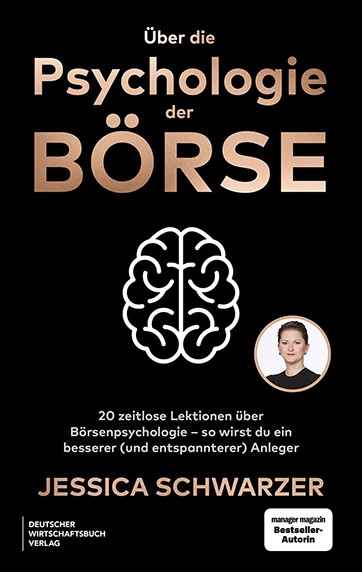
Jessica, what is your book about?
Jessica: It’s all about strong emotions! Although we actually want to – and should – act calmly and thoughtfully when it comes to our finances, we are, unfortunately, anything but rational. On the stock market in particular, this can quickly cost us a lot of money.
“The investor’s greatest enemy stares back at him from the mirror every morning,” Benjamin Graham, professor of economics and mentor to super-investor Warren Buffett, once said. There’s hardly a better way to sum up the dilemma on the stock market: fear, greed, selective perception and self-deception lead us to be guided by emotions rather than reason – often with costly consequences.
My latest book, ‘Über die Psychologie der Börse’, explores how we, as investors, can recognise, avoid and even turn these psychological traps to our advantage. It’s about developing a strong money mindset, getting a handle on emotional decisions and investing in a more relaxed – and, above all, more successful – way in the long term.
Why did you write the book?
Jessica: The subject of stock market psychology has fascinated me for years. We all stumble across emotional pitfalls from time to time, often the same ones over and over again. I’m convinced that it’s important to engage with stock market psychology. When do we lose our nerve? When do we become greedy? When do we ignore losses or sugar-coat negative news? Why do we sell too early and fail to let profits run? Why do we hold on to duds instead of pulling the ripcord? All of this can be explained very well from a psychological perspective. The more we know about it, the better!
And then there’s another reason: I’m a passionate stock market investor and I absolutely love writing books about the stock market. This latest one is actually my eighth. The ninth will follow.
And who should read the book?
Jessica: Beginners, advanced investors, perhaps even the odd professional or two. We’re all flesh-and-blood human beings. We’re not robots. We have emotions, and sometimes they lead us astray. Recognising them (we can’t switch them off) and controlling them makes everyone a better investor.
Fun fact: women, supposedly the more emotional sex, have a better handle on their emotions when it comes to the stock market!
→ Here you can find more information about the book ‘Über die Psychologie der Börse’.
Networkbook®
Learn through networking. Make a difference in your career.
(Netzwerk lernen. Beruflich was bewegen.)
Katharina Schleeberger
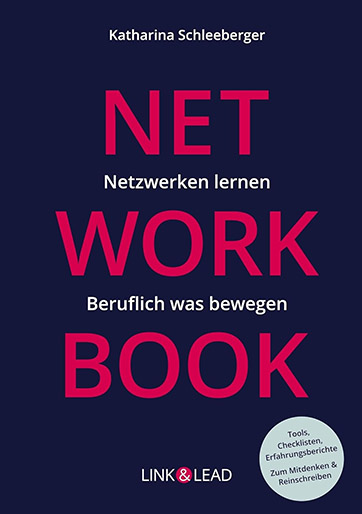
Katharina, what is your book about?
Katharina: The Networkbook® is a practical guide. It helps readers develop their personal networking skills. It combines psychological research with first-hand accounts from networkers.
Tests, methods and reflective questions encourage readers to get involved and record their own thoughts directly in the book. At its heart is the scientifically grounded LINK system of networking: Learn, Identify, Network and Keep. A separate chapter is devoted to each phase.
Why did you write the book?
Katharina: As a psychologist in HR, I have supported several thousand careers – from vocational training right through to a professorship. One pattern kept recurring: many competent people were unable to make the most of their opportunities because they lacked a network.
As there was no existing approach to solving this problem, I used the isolation of the 2020 COVID-19 lockdown to develop the LINK system. Since then, I’ve been applying it in organisations that use networks strategically.
My first client was Coca-Cola, followed by the Deutsche Bundesbank and many others. With the Networkbook®, I am now making this knowledge accessible to everyone.
And who should read the book?
Katharina: People who don’t want to leave their networking to chance. Those who sense that professional achievement alone isn’t enough to be noticed and supported. Those who know: it’s time to take action.
But it’s also aimed at executives who want to embed networking skills strategically within their organisation. Because one thing is clear: we can only succeed together! Many leading organisations have already recognised this.
→ Here you can find more information about the ‘Networkbook®’.
Creativity in IT and Technology for Dummies
(Kreativität in IT und Technik für Dummies)
Dr Andrea Herrmann
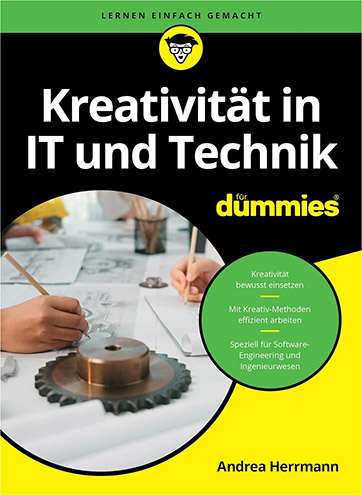
Andrea, what is your book about?
Andrea: It’s about how to effectively integrate creativity into the development process when designing and developing technical products. To this end, I have developed a process model that combines the V-model, iterative approaches, the Double Diamond, Twin Peaks and Design Thinking into a single framework.
In the main section of the book, I use a comprehensive example to demonstrate how creativity methods can be applied in the technical field.
But it’s also about soft skills, such as overcoming creative blocks, preparing and facilitating creativity workshops, and achieving a sense of flow. Throughout the book, I also discuss the use of artificial intelligence, the benefits of which I see primarily in creative activities.
Why did you write the book?
Andrea: The topic of creativity has fascinated me for a long time and is part of my daily toolkit. In practice, creativity is often desired but rarely managed in a results-oriented way. Furthermore, there is as yet no German-language book that not only explains creativity methods for engineers but also demonstrates how they can be practically integrated into the engineering process – as part of the day-to-day workflow rather than as a separate workshop. I hope that my book will not only inspire the German engineering community but also bring more joy back into professional life.
And who should read the book?
Software engineers, female engineers, programmers, electrical engineers, civil engineers and also managers working in the engineering sector who wish to design their products more creatively.
→ Here you can find more information about the book ‘Kreativität in IT und Technik für Dummies’.
Seizing Market Opportunities through Product Management
(Mit Produktmanagement Marktchancen nutzen)
A practical guide to technical products and services that require explanation
(Ein Praxisbuch für technische und erklärungsbedürftige Produkte und Dienstleistungen)
Herbert Lippmann / Bernadette von Wittern

Bernadette: Product management is a demanding role, particularly in B2B companies with technical products that require explanation. This is where complex technologies, differing interests and lengthy decision-making processes converge. Product managers are expected to provide direction, set priorities and ensure market success, often without formal authority.
Our book offers a practical guide to how product management can be effectively organised under precisely these conditions. It provides a clear understanding of roles and responsibilities and describes the interplay between market analysis, product strategy, development and go-to-market. Practical tools and checklists make it a useful companion for day-to-day work. A separate chapter is devoted to the soft skills that are crucial for cross-functional collaboration and leadership within a matrix organisation. After all, technical expertise alone is not enough in product management.
Why did you write the book?
Bernadette: Product management will celebrate its 100th anniversary in 2028. Developed in the consumer goods industry, it only later established itself as an effective, market-oriented organisational model in technical sectors as well. Today, it is the best solution for companies of all sizes in the face of ever-expanding product ranges, individual customer requirements, shorter innovation cycles and increasingly fierce competition.
The problem is that training opportunities for product managers have not kept pace with this growth. Companies with technical products therefore still tend to favour specialists with a technical background, knowing full well that they lack market and marketing knowledge. This must be supplemented through training or self-study.
Our motivation as a team of authors, ever since the first edition, has been to provide product managers with precisely this knowledge, in addition to their product technology expertise. What is lacking are up-to-date, practical resources that companies can use to successfully establish or optimise their product management. We aim to bridge this gap with this book. Now in its 11th, revised edition, we have modernised, updated and expanded this classic.
And who should read the book?
Bernadette: The book is aimed at three groups:
1. Product managers who are new to the role, whether they’re career changers, have moved internally or are just starting out in their careers. Particularly in the first few months, they often lack the necessary confidence in dealing with methods, processes and their own role.
2. Experienced product managers who wish to reflect critically on their role, gain fresh insights and expand their methodological toolkit, against the backdrop of current changes in the world of work that place greater emphasis on agility, autonomy and purpose.
3. Managers who are introducing product management for the first time, setting up or expanding their team, or seeking to boost the performance of their product management organisation.
In short: anyone who wants to do more than just administer products – but actually manage them successfully – will find practical knowledge, applicable tools and plenty of inspiration drawn from real-world projects here.
→ Here you can find more information about the book ‘Mit Produktmanagement Marktchancen nutzen’.
When are books interesting?
Sometimes what makes a book interesting is immediately apparent: a thought takes you by surprise, an idea sticks with you, a sentence opens up a new perspective. And sometimes it reveals itself subtly: curiosity arises between the lines; a theme accompanies us unnoticed and resurfaces later in a decision, a conversation or an attitude.
What makes a book interesting is as individual as the people who read it. For some, it is a new perspective; for others, an impetus to think further or a familiar thought at just the right time. Some books raise questions; others give shape to what we have long suspected.
I am fascinated by how differently books can spark interest. The very same text can inspire today and challenge us tomorrow. That is precisely where its strength lies: interest arises through dialogue with the reader and continues into everyday life. Perhaps one of the recommended books will spark your interest too?
Notes:
Would you, as an influencer or opinion leader, like to discuss these book recommendations? Then please share this post within your network.
Here you’ll find more posts with book recommendations:

Oh, books with impact

Oh, books worth reading

Oh, precious books

Michael Schenkel
Head of Marketing, t2informatik GmbH
Michael Schenkel has a heart for marketing - so it is fitting that he is responsible for marketing at t2informatik. He likes to blog, likes a change of perspective and tries to offer useful information - e.g. here in the blog - at a time when there is a lot of talk about people's decreasing attention span. If you feel like it, arrange to meet him for a coffee and a piece of cake; he will certainly look forward to it!
On the t2informatik blog, we share knowledge and experience with people in organisations. And it is for precisely these people that we have been developing and modernising software since 2012. Pragmatically. ✔️ Personal. ✔️ Professional. ✔️ Get to know t2informatik as your development partner.