
Sunk cost fallacy in legacy systems
Expand the table of contents
Why we keep falling prey to the sunk cost fallacy
The true costs of legacy software often remain hidden
The eye-opener: Calculate the slowdown
How to tell if your company is falling into the sunk cost fallacy
How to act sensibly without reacting rashly
Conclusion: The past must not stand in the way of the future
Why companies cling to old software for too long
Many companies today use software solutions that have been in use for years or even decades. At first glance, this is neither unusual nor fundamentally problematic. Tried-and-tested systems can provide stability, support processes and serve their purpose well over a long period.
However, problems arise when it is no longer the actual benefits that determine continued use, but rather the past. This is precisely where the sunk cost fallacy comes into play. This refers to the cognitive bias of placing too much weight on past investments when making current decisions, even though these costs are long since sunk and cannot be recovered.
This is particularly risky with legacy systems. Whilst the costs of modernisation are immediately apparent, the costs of sticking with the old system often remain hidden: inefficient processes, increasing dependencies, stifled innovation and wasted time.
When past investments dictate today’s decisions
In short, the sunk cost fallacy describes the tendency to stick to a chosen course of action because a significant amount has already been invested. It is precisely this pattern that is frequently observed with legacy systems.
A typical example: An ERP system has been in use for many years. It has been customised, expanded on multiple occasions and deeply integrated into the company’s processes. Numerous processes rely on it; employees are familiar with the system’s specific features; external service providers have been supporting it for years.
At the same time, the limitations are increasing. Customisations take a long time, interfaces are missing, reports are time-consuming to generate, and new requirements can only be implemented at considerable expense. Nevertheless, modernisation is often postponed. Previous investments create the feeling that one must continue along the chosen path. Previous investments unconsciously become an argument for tying up further funds in the present.
The only economically relevant factor is which option creates the greatest benefit from today onwards. This includes continuing to operate the system as is, targeted modernisation, or the introduction of a new solution. The longer this assessment is delayed, the greater the risk that past decisions, rather than future opportunities, will determine the course of action.
Why we keep falling prey to the sunk cost fallacy
The sunk cost fallacy rarely stems from a lack of rationality. It is often the result of psychological mechanisms and organisational conditions working in tandem. This is precisely why this pattern occurs so frequently in companies.
Familiarity conveys a sense of security
An existing system is familiar. Processes are well-established, responsibilities are clear, and typical problems can be anticipated. This familiarity is often perceived as stability, even when significant weaknesses exist.
Past decisions are expected to pay off
Anyone who has invested budget, time and human resources in a solution over the years wants to see a corresponding return. This makes it difficult to take a dispassionate look at alternatives.
Disadvantages grow insidiously
The situation rarely changes overnight. Often, additional manual work, technical limitations and process detours increase slowly over the years. Without a clear turning point, the impetus to act is often lacking.
Day-to-day business takes priority
In many companies, operational issues take up a large part of the attention. Strategic modernisation projects are consequently pushed to the back burner, even though they are highly important.
Responsibility breeds caution
Technological changes affect processes, staff and budgets. Decisions of this magnitude are, understandably, weighed up carefully. However, caution can sometimes lead to prolonged hesitation.
These factors are understandable and are found in many companies. This makes it all the more important to take a conscious look at one’s own decision-making situation. Only in this way can one recognise whether factual arguments still carry weight or whether past investments are gaining too much influence unnoticed.
The true costs of legacy software often remain hidden
Many decisions regarding legacy systems are made on the basis of visible costs. Quotes for new software, project budgets, external consultancy or migration costs are clearly laid out. The ongoing costs of the existing system, however, are much harder to quantify.
It is precisely these hidden costs that often have a greater impact on cost-effectiveness and competitiveness than expected.
Productivity losses in day-to-day operations
Slow processes, duplicate data entry, manual corrections or media breaks cost time every day. Individual delays may seem minor, but over months and years they add up to significant costs.
Increasing internal complexity
Over time, additional solutions, special processes and individual workarounds emerge. This increases the need for coordination, the likelihood of errors and dependencies between teams.
Locked-in expertise
If only a few employees understand the system in detail, this creates a personnel risk. Absences, staff changes or retirement can noticeably disrupt processes.
Slowed-down development
New requirements from sales, customer service, production or controlling can often only be implemented at great expense. Opportunities are missed because technical hurdles slow down decision-making.
Higher operational and security risks
Outdated technologies, limited manufacturer support or a lack of updates increase the long-term risk of disruptions and security issues.
These costs rarely appear grouped together in a single item. This is precisely why they are easily underestimated. A seemingly inexpensive legacy system can be significantly more expensive in economic terms than it appears at first glance.
The eye-opener: Calculate the slowdown
The economic consequences of a legacy system often only become tangible when they are translated into concrete figures. As long as inefficiencies are perceived merely as isolated problems, their true scale remains easily obscured.
A simple approach is to record recurring time losses in day-to-day operations:
Suppose 15 employees each lose 20 minutes a day due to unnecessary detours, duplicate entries, slow processes or manual rework. Over 220 working days, this amounts to around 1,100 working hours per year. Multiply this figure by the average cost of an hour’s work in your company.
The scale of this figure surprises many managers.
Even with conservatively estimated internal costs, this quickly adds up to a mid-five-figure sum. Additional effects such as error corrections, delayed decisions, team frustration or missed business opportunities are not even taken into account here. Even in smaller teams, this can result in significant sums. Several small inefficiencies often have a greater impact than a single major problem.
Such an analysis often shifts the perspective. The focus is then no longer solely on the capital costs of modernisation, but on the ongoing costs of downtime. Those who are aware of these figures can make more informed decisions regarding continued operation, modernisation or new development.
How to tell if your company is falling into the sunk cost fallacy
The sunk cost fallacy rarely stems from a single bad decision. It often develops gradually in day-to-day operations and goes unnoticed for a long time. This makes it all the more important to recognise typical warning signs at an early stage.
Statements that should raise a red flag
Certain phrases crop up time and again in companies when decisions are overly influenced by the past:
- We’ve already invested too much in this.
- A change is out of the question now.
- We’ll postpone this issue until later.
- The system is still running, after all.
- There’s no time for that right now
Such statements are not necessarily wrong. However, they deserve closer scrutiny.
Operational indicators in day-to-day business
Clear signals also frequently emerge during day-to-day operations:
- Some processes run outside the system in Excel, email or ad-hoc solutions.
- Adjustments take a disproportionately long time.
- New requirements are regularly put on hold.
- Support and coordination efforts are increasing.
- Employees are circumventing the system with their own workarounds.
- There are personnel risks, for example, employees who are absent for long periods due to illness or who are retiring.
In many cases, critical knowledge rests with just a few people. When individual employees are virtually the only ones who know the system inside out, a growing dependency arises.
The most important control question
A particularly helpful way to assess the situation is to ask: Given the current circumstances, would you choose this system again today?
If the answer is hesitant or remains open, a structured reassessment is worthwhile.
The sooner these signals are recognised, the greater the scope for action remains to make an economically sound decision.
How to act sensibly without reacting rashly
If you recognise signs of the sunk cost fallacy, you do not need to immediately initiate a complete system overhaul. In many cases, a sober assessment of the current situation is the most sensible first step. The aim is to reach an economically viable decision, not to take action for the sake of it.
Create transparency regarding the status quo
Identify where time is lost in day-to-day operations, which processes are unnecessarily complex, and where media breaks or additional manual work arise. Only with a clear view of the current situation can the actual need for action be assessed.
Assess risks realistically
Examine dependencies on individual employees, technical service providers or outdated components. Issues such as IT security, supportability and scalability should also be included in this assessment.
Define requirements for the coming years
What are your company’s objectives for the next three to five years? Growth, new business models, automation, improved data availability or more efficient processes place different demands on systems than those currently in place.
Compare options for action
Not every situation requires a complete redevelopment. Depending on the starting point, several approaches are possible:
- Continued operation with a clearly defined planning horizon,
- targeted modernisation of individual areas,
- gradual migration,
- introduction of a new standard solution, or
- custom development
A robust comparison of benefits, risks, costs and future viability is crucial.
Aligning decisions with the future
Past investments cannot be changed. You do, however, have influence over the resources deployed from today onwards. This is precisely where the economic leverage lies.
A structured approach brings clarity and lays the foundation for sound decisions with long-term benefits.
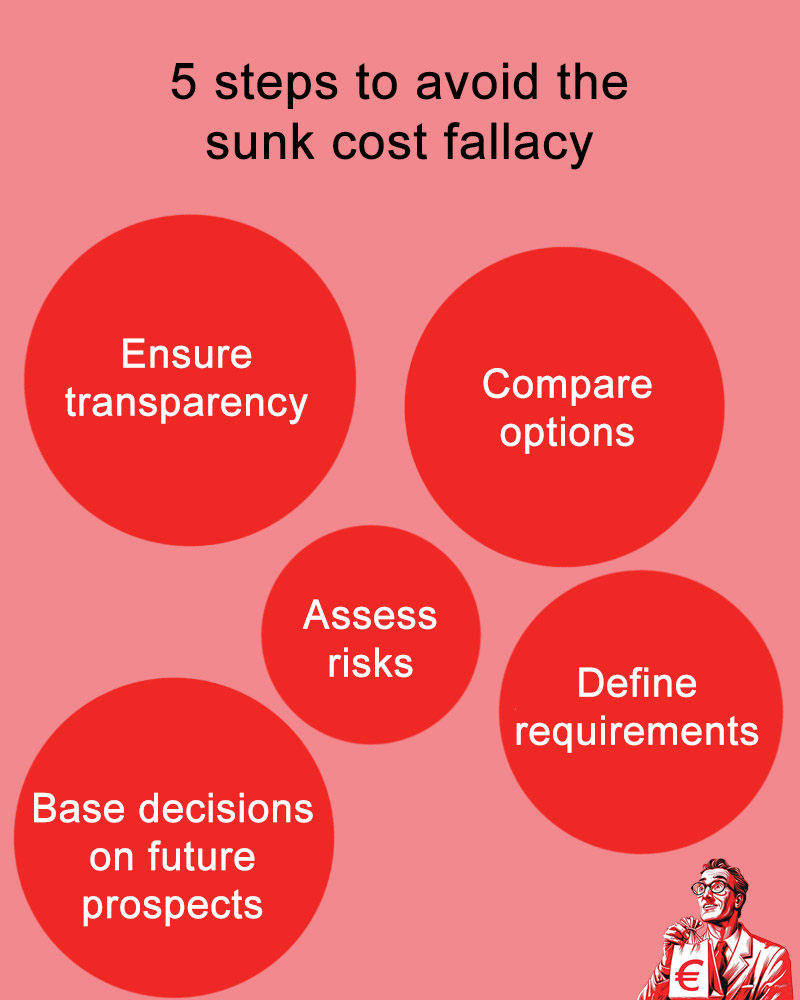
Figure: 5 steps to avoid the sunk cost fallacy
Conclusion: The past must not stand in the way of the future
The sunk cost fallacy is a common reason why companies cling to legacy systems for too long. Not because of a lack of foresight, but because past investments carry greater psychological weight than is economically sensible.
Particularly with legacy software, it is easy to get the impression that sticking with it is the safer or cheaper option. In day-to-day operations, however, many follow-on costs remain hidden: slowed-down processes, increasing complexity, reliance on specific personnel, frustrated staff and missed development opportunities.
Those who continue to base decisions on past expenditure often tie up additional resources without noticeably improving future viability.
A sober assessment of the available options brings clarity. Whether to continue operating the system, modernise it or develop a new solution should be evaluated based on the benefits they deliver from today onwards and how well they support the objectives for the coming years.
Companies that make this shift in perspective at an early stage secure greater room for manoeuvre, better decision-making and a more sustainable technological foundation for future growth.
Notes:
Are you unsure whether your legacy system is still viable? Let’s examine together which option makes the most economic sense. Tell us about your situation.
Would you like to discuss the sunk cost fallacy in relation to legacy systems as an influencer or thought leader? Then share this post on your networks.
Michael Schenkel has published more posts on the t2informatik Blog, including:

Almost done!

Code ownership in the age of LLM

5 excellent service providers for software development

Michael Schenkel
Head of Marketing, t2informatik GmbH
Michael Schenkel has a heart for marketing - so it is fitting that he is responsible for marketing at t2informatik. He likes to blog, likes a change of perspective and tries to offer useful information - e.g. here in the blog - at a time when there is a lot of talk about people's decreasing attention span. If you feel like it, arrange to meet him for a coffee and a piece of cake; he will certainly look forward to it!
On the t2informatik Blog, we share knowledge and experience with people in organisations. We have been developing and modernising software for them since 2012. Pragmatically. ✔️ Personal. ✔️ Professional. ✔️ Get to know t2informatik as your development partner.