
Protest consumption is no substitute for a strategy
Expand the table of contents
What makes more sense in the medium term than a protest?
Tesla is losing 28% of its market share in Europe. X is losing eleven million European users. European companies are ditching US software. That sounds like a statement. But who really benefits?
Everywhere, people are protesting, boycotting and making a stand. The impulse is understandable. When a tech billionaire is openly causing political harm, it feels wrong to continue using his product. Every purchase fills a coffers, and nobody wants to fill coffers whose contents flow in directions they consider harmful.
I understand that. I even share the moral assessment in many cases. But I believe the conclusion is wrong.
Translated with DeepL.com (free version)
The numbers behind the shift in sentiment
To understand what we’re talking about, it’s worth taking a look at what’s actually happening right now. In 2025, Tesla sold around 28% fewer vehicles in Europe than in the previous year. In Germany, once Tesla’s growth engine on the continent, registrations plummeted by 48%. In France, by 38%. In Sweden, they fell by almost 67%. And this, whilst the overall market for electric cars in Europe grew by over 17%. The slump is therefore brand-specific, not market-driven. The trend is continuing into early 2026: in January, Tesla registered just 8,075 vehicles in Europe, a 17% drop compared to an already weak January the previous year. It is the thirteenth consecutive month of declining sales figures.
Things are no better on the X platform: between August 2024 and March 2025, the platform lost around eleven million users in Europe. In France alone 2.7 million, in Poland 1.8 million, in Germany 1.3 million. X’s European market share now stands at under 3%. Institutional accounts, media outlets and public authorities have migrated away in many countries, leaving behind a concentrated pool of political polarisation and algorithmic echo chambers.
And in the cloud market, European governments are formulating as a strategy what is already a reality in the automotive industry and on social media: in November 2025, France and Germany convened a “Summit on European Digital Sovereignty”. The EU is working on a Cloud and AI Development Act designed to give European providers preference in public tenders. The concept of “EuroStack” is doing the rounds, a sort of European counterstrategy to digital dependence on Silicon Valley.
All of this is real. All of this is measurable. And all of this is based on an assumption that I consider dangerous.
The problem with the right feeling
What actually happens when we turn moral outrage into a procurement strategy? Let’s take a concrete example. A medium-sized company in Baden-Württemberg has been using Microsoft Azure DevOps for its software development for years. The tool is deeply integrated, the teams work productively with it, and the processes are well-established. Then the discussion arises: can we, in good conscience, stay with a US corporation? So an evaluation is carried out – perhaps GitLab Self-Hosted, perhaps a European cloud solution. The switch involves six months of migration, lost productivity and training costs. And in the end, you’re left with a setup that works, but in many respects doesn’t run quite as smoothly as before.
Why did they switch? Not because the alternative was better. But because it was less tainted.
And this is precisely where the fallacy lies. The decision sets a quality standard that nobody wants to voice, but which nevertheless has an effect: the competition doesn’t have to be better. It just has to be less tainted than the original.
A benchmark that rewards mediocrity
This is not merely a theoretical problem; it is evident in real-world market dynamics. When European companies began to view US cloud providers more critically in the wake of the Snowden affair, a wave of European alternatives emerged. Many of these were successful not because they were technically superior, but because they were European. Storing data in Frankfurt rather than Virginia became a selling point. This is understandable, but it has a side effect: it signals to European providers that the location of the data centre is more important than the quality of the product.
The same pattern is currently repeating itself on a larger scale. Companies are not replacing Salesforce with a better CRM, but with a European CRM. People are not switching to Bluesky because Bluesky is a better product, but because Elon Musk owns X. Between October 2024 and November 2025, Bluesky grew from 13 to 40 million users, driven not by a superior feature set, but by the exodus of a dissatisfied X user base. Growth has since slowed significantly, suggesting that the peak of the protest wave has been reached and the product alone does not generate enough appeal to grow under its own steam.
Fleet managers are not replacing Tesla with the better car, but with the less controversial one. The manufacturer does not need to be superior; it just needs to be above suspicion. The Tesla case, however, holds a particular irony: those who leave Tesla often find BYD, of all companies, to be their strongest competitor. The Chinese manufacturer overtook Tesla for the first time in European new electric vehicle registrations in May 2025 and tripled its sales in the EU year-on-year. The moral turning away from Musk thus leads in many cases straight into the arms of a state-owned enterprise whose government pursues its own, no less problematic geopolitical agenda. Conscience becomes selective.
Each of these decisions sends two signals at once. One to the provider you are leaving: we are dissatisfied. And one to the provider you are switching to: you are good enough. This second signal is the dangerous one. It rewards not excellence, but inconspicuousness. It says: you don’t need to build features that surpass the market leader. You just need to fly a morally clean flag.
The reality of the market divide
I often hear this objection: “But the alternatives have long since become just as good.” In individual cases, that’s true. BYD does indeed build good electric cars, Proton Mail is a strong product, and OVHcloud broke the billion-euro mark in annual turnover for the first time in 2025. But it’s not true across the board, and anyone who’s honest knows that.
The figures speak for themselves: US providers control 85% of the European cloud market. Amazon, Microsoft and Google alone account for 70%. The largest European provider, SAP, has a 2% market share. Deutsche Telekom also has 2%. The share of European providers in their own market has fallen from 29% in 2017 to 15% and has stagnated at this level ever since. And this lag is no coincidence; it is the result of a decades-long investment gap. The US hyperscalers alone invest around ten billion euros in European infrastructure every quarter. John Dinsdale, chief analyst at Synergy Research Group, sums it up: it is virtually impossible for European cloud providers to seriously reverse the market share trend. It is a game of economies of scale.
Anyone replacing Jira with a European alternative in a B2B context pays for the switch not only in migration costs. They pay for it in a leaner plugin ecosystem, less community support, and fewer integrations with adjacent tools. This is not snobbery towards European providers. It is the reality of a market in which network effects have been built up over decades.
Recognising this is not defeatism. It is the prerequisite for European providers to know which gap they actually need to close.
The question of sovereignty deserves an honest answer
There is an argument that is often conflated with the moral argument in this debate, but is actually a completely different one: strategic sovereignty. And this argument has gained weight over the past year. The Trump administration has openly threatened European tech companies such as SAP, Spotify and Siemens with retaliatory measures should the EU fail to scale back its regulation of US tech firms. In December 2025, US Trade Representative Jamieson Greer spoke of “fees or restrictions” for European service providers. Visa sanctions were imposed on former EU commissioners involved in digital regulation.
Against this backdrop, dependence on US technology is no longer discussed merely as a source of unease, but as a concrete geopolitical risk. The European Council on Foreign Relations recently outlined a scenario in which a future US administration restricts access to American cloud services for foreign users via an executive order. What sounded like science fiction a few years ago now seems like a plausible scenario.
Anyone building European alternatives to reduce this dependency is not acting out of outrage. They are acting out of strategic calculation. And I support this calculation.
But then we must be honest and look at what it costs. Risk management does not mean swapping one risk for another. It means building alternatives that are at least equivalent in the long term. Anyone who replaces US software to avoid dependence on a volatile US administration, but in doing so purchases a product that slows their teams down, has not eliminated any risk. They have swapped political dependence for technological backwardness. The risk profile has changed, not improved.
And there is another uncomfortable truth in the figures: despite all the rhetoric about sovereignty, the market share of European cloud providers has not improved since 2022. It remains stagnant at 15%. The debate is growing louder, investment is rising, and political commitments are becoming clearer. But the actual market is not moving. That should give us pause for thought.
What Tesla teaches us about protest consumption
The Tesla case is particularly instructive because the results are already visible. European buyers have turned their backs on Tesla in large numbers. Sales have fallen for three years running, and its market share has shrunk from a dominant position to less than 1%. The protest was effective.
But what has it achieved? The European car industry has not filled the gap. It was BYD. The Chinese manufacturer has tripled its European sales in 2025, overtaken Tesla in several key markets and is currently building a factory in Hungary with an annual capacity of 800,000 vehicles. SAIC Motor, the parent company of MG, has also recorded strong growth in Europe.
The result of Europe’s rejection of Tesla is therefore not a strengthening of European manufacturers, but an acceleration of Chinese market entry. Volkswagen, BMW and Mercedes do have their EV programmes, but they are lagging behind in terms of price and delivery speed. The morally motivated protest against a US billionaire has primarily paved the way for a Chinese state-owned enterprise.
This is not an argument for approving of Musk. It is an argument that moral outrage alone cannot replace an industrial policy strategy.
What would be the alternative?
At this point, the usual objection is raised: sticking with the best provider and ‘sending a signal’ doesn’t actually send a signal in practice. It’s passivity. No CEO takes note of the fact that you’re buying their product whilst feeling dissatisfied on the inside. Everyone takes note when you take your business elsewhere. The objection is valid. That’s why I’m not suggesting passivity, but a dual strategy.- Use the best tool available. Without shame, without moral contortions. Your competitiveness is non-negotiable. An engineering firm in Stuttgart that switches its CAD software on principle and designs more slowly as a result loses contracts to competitors in Shenzhen who cannot afford such scruples. A start-up in Berlin that relies on European AI models, even though they are not yet on a par, is giving away speed in a market where speed is everything.
- Invest the energy you would otherwise put into migration projects into building genuine European alternatives. Get involved in open-source projects. Fund European start-ups. Set requirements that go beyond simply being ‘not American’. Not as a consolation customer who switches because Musk is a pain, but as a client who says: if you’re better, you get my money. Not before.
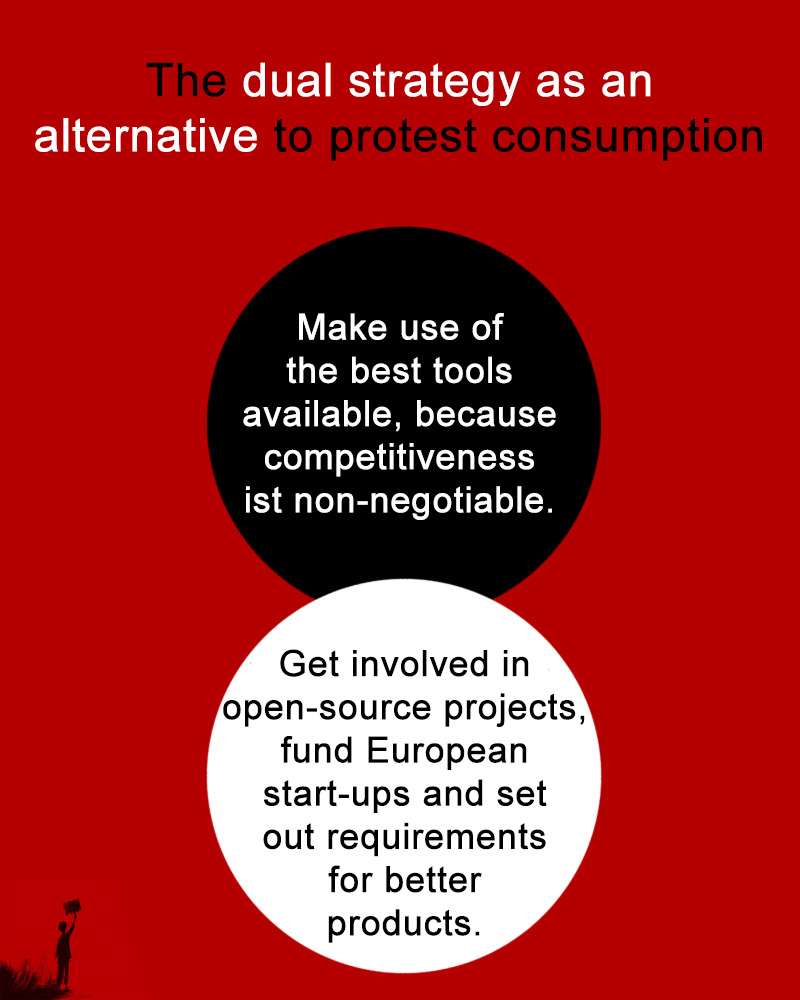
Figure: The dual strategy as an alternative to protest consumption
The Draghi Report on European Competitiveness proposed precisely this approach in 2024: using European public procurement as a lever to help domestic suppliers scale up, not to protect them. Minimum quotas for local production, not as a protectionist measure, but as a catalyst to force companies to reach a level of quality that can compete globally. That is a subtle but crucial difference.
The gap in industrial policy
What has been missing from the European debate so far is precisely this distinction. The drive to break away from US tech stems from two very different sources: morality and strategy. The moral argument goes: Musk is intolerable, so we won’t buy anything from him anymore. The strategic argument goes: our dependence is a risk, so we’ll build alternatives.
The problem arises when we mix the two. For the moral argument creates a sense of urgency without any commitment to quality. It pushes for rapid changes, for products that are ‘good enough’ because the alternative seems morally unacceptable. The strategic argument, by contrast, requires patience, investment and an honest assessment of our own capabilities.
The EuroStack initiative, public procurement quotas, cloud sovereignty programmes: all of these can work, but only if they are designed as an investment in excellence, not as an escape from the uncomfortable. France has migrated over 15,000 public sector bodies to European providers through its ‘Cloud de Confiance’ programme. That is remarkable. But the decisive test will be whether, in five years’ time, these providers are not only “sovereign” but also “better”. If not, Europe will not have won its cloud market. It will have left it behind.
Protest consumption is a luxury problem
I know this text is uncomfortable. It sounds as though I’m belittling moral action. I’m not. I believe that the outrage over the behaviour of certain tech billionaires is justified. I also believe that purchasing decisions are never morally neutral.
But I equally believe that we in Europe are currently deluding ourselves. We are confusing moral relief with strategic action. We feel better because we have switched, and overlook the fact that in doing so we have weakened ourselves. The Tesla figures show this all too clearly: three years of a European buying boycott have not led to a strengthening of the European car industry, but to an accelerated market entry by Chinese manufacturers.
In a global competition where the US and China do not buy according to conscience but according to the best value for money, protest consumption is not a sign of principle. It is a luxury that is becoming increasingly expensive.
The truly strong European response would not be to boycott US products. It would be to build European products that are so good that the switch is no longer a moral decision, but a rational one.
Notes:
Do you want to develop your company in a way that truly inspires users, customers and developers? Then simply connect with Benjamin Igna on LinkedIn and find an approach that suits you and your context perfectly. Alternatively, you can also visit Stellar Work.
Would you like to discuss protest as a strategy or a luxury problem as an opinion leader or catalyst? Then please feel free to share this post within your network.
Benjamin Igna has published more posts on the t2informatik Blog, including:

Germany, land of ad managers

The hidden story of agility

What an old Honda says about innovation

Benjamin Igna
Benjamin Igna is a founder and consultant at Stellar Work GmbH. He has successfully led transformation projects and managed complex projects in the automotive and technology sectors, always with a focus on measurable results and operational efficiency. His expertise lies in aligning strategy and execution to drive sustainable organisational growth.
He also hosts the Stellar Work podcast, in which he profiles remarkable individuals who are redefining the boundaries of the product development process.
In the t2informatik Blog, we publish articles for people in organisations. For these people, we develop and modernise software. Pragmatic. ✔️ Personal. ✔️ Professional. ✔️ Click here to find out more.