
Leading as a junior product manager
Expand the table of contents
The five forms of power and their significance for junior product managers
Where power works in organisations and why junior product managers lead laterally
Specific everyday situations for leadership without a leaderhsip role
Ten core competencies that you can train immediately as a junior product manager
Conclusion: Impact is created in everyday life
Practical tip
How can you gain influence as a junior product manager without a leadership role?
You sit down with your team to discuss the next product expansion. A complex user story is the focus, but key decisions are still pending. Two senior developers are discussing architectural issues. Your UX colleagues have prepared initial drafts. Both are important, but neither gets to the heart of the problem. Your idea of consistently looking at the issue from the user’s perspective is obvious. Nevertheless, you hesitate and wonder whether now is the right moment, whether your perspective really matters and whether you, as a junior, can exert any influence at all.
I encounter situations like this regularly in my work with young product managers. Starting out in product management is characterised by a particular tension. You are expected to take responsibility, prepare decisions and set priorities without having a formal leadership role. Many juniors find this contradictory. They want to deliver and be taken seriously, but don’t yet feel fully settled in their role.
It is precisely in these moments that leadership begins. Not as a title and not through hierarchy, but through behaviour. Leadership shows itself when you create clarity, explain priorities, ask the right questions and make connections visible. This is how influence is created. Even without formal power.
The five forms of power and their significance for junior product managers
Leadership is not an official title. It develops through daily collaboration with cross-functional teams, stakeholders, users and management. As a junior product manager, you generally have no disciplinary power. Your influence stems primarily from two levers: your personal impact and your technical expertise.
These mechanisms have been the subject of research for many decades. French and Raven describe five sources of power that operate in organisations and explain why people follow each other and how influence is strengthened or weakened. [1] These insights are particularly valuable for young product managers because they show where influence can arise, even without a formal leadership role.
1. Legitimate power
Legitimate power arises from a formal position. Junior product managers naturally have little of this. Nevertheless, this form of power can grow if roles are clearly defined and the team understands what you are responsible for. If you act as a moderator of decisions and prepare information in a structured manner, your role will increasingly be perceived as legitimate.
2. Reward power
Reward power is based on rewards. Product managers are generally unable to grant salary increases or promotions. However, they can make recognition visible, share responsibility and consciously highlight the contributions of others. This form of appreciation strengthens relationships and promotes motivation within the team.
3. Coercive power
Coercive power is based on punishment. It is hardly suitable for product managers and is not effective in cross-functional teams. Studies show that this form of power undermines trust and creates resistance in the long term. It is therefore not a sensible option for junior product managers.
4. Expert power
Expert power is one of the most effective sources of influence for young product managers. Explaining user behaviour, classifying data, identifying market trends or clearly naming risks has an impact. Technical expertise builds trust and increases the willingness of others to follow your assessment.
5. Referent power
Referent power comes from personality, integrity and reliable cooperation. People orient themselves towards individuals they trust and enjoy working with. This form of power is particularly valuable because it is not tied to a role, but grows through consistent behaviour.
These five forms of power form the foundation of modern leadership at Juniors. They enable impact without formal authority and help to build trust and influence in a targeted manner. In the situation described at the beginning, the junior product manager is not yet using his expert power. Reliable data, well-founded customer discussions and a clear understanding of user behaviour could have helped to solve the problem from a new perspective and move the discussion forward.
Where power works in organisations and why junior product managers lead laterally
Organisational research describes four directions of influence: upwards, downwards, laterally and outwards. Product managers mainly operate laterally. They work in an environment in which they coordinate experts, stakeholders and different departments. At the same time, they also have an external influence, for example in their exchanges with users or external partners.
This special position leads to typical situations in everyday work:
- They explain priorities, even though others have more experience.
- They identify risks, even though they do not have all the information.
- You moderate decisions that are formally made by someone else.
Such situations can be unsettling. At the same time, they highlight the importance of soft power in product management.
Soft power describes a form of influence that arises from conviction rather than control. It strengthens relationships, reduces conflicts and supports sound decisions. Soft power is particularly valuable for junior product managers because it provides guidance without being dominant.
Soft power arises when you
- take other people’s perspectives seriously,
- listen actively,
- communicate clearly and precisely,
- present information in a structured way,
- explain contexts in an understandable way and
- make decisions comprehensible.
In cross-functional teams, this type of influence is often more effective than any formal power. Applied to the example described at the beginning, this means that after the senior developers and the UX team have presented their views and you have listened attentively, you bundle the information and make connections visible. By clearly identifying open questions, you create a common starting point. The subsequent shift in perspective to the user’s point of view thus appears logical and comprehensible to everyone.
Specific everyday situations for leadership without a leadership role
To develop influence without a formal leadership role, it is worth taking a look at typical situations from the everyday life of junior product managers. This is where leadership emerges on a small scale.
When your idea is not heard
You suggest a solution, but the discussion continues without addressing it. Later, a senior developer makes the same suggestion and receives approval. Such moments are frustrating and familiar to many juniors. The key here is technical clarity and good anchoring. If you link your idea to user data and explain it with a concrete example, the chance that your contribution will be noticed and taken up increases significantly.
When decisions are made over your head
Management changes the roadmap without involving you. You feel overlooked. Leadership in this situation is demonstrated not through resistance, but through classification. If you understand the context, explain the implications and guide the team through the change, you create orientation. You don’t have to approve of the decision, but you can help to classify it and make it manageable.
When everyone wants something from you
External stakeholders report short-term requirements. Marketing needs data. Sales has urgent requests. The developers need clarification. In such phases, prioritisation, clear communication and setting boundaries are crucial. A well-founded ‘no’ is not a sign of weakness, but of responsibility.
When you are new to the team
At the beginning, you want to make a good impression and build trust. At the same time, uncertainty is perfectly normal, because you are not yet familiar with the dynamics within the team, and vice versa. In this phase, trust is built primarily through clarity and an authentic demeanour. By openly stating what you already understand, what is still unclear and what next steps you are planning, you provide guidance to those around you. Clear expectations regarding roles, collaboration and responsibilities also help to avoid misunderstandings early on.
These everyday situations make it clear that leadership in product management is not a title or a formal role. It arises in daily actions. Every exchange, every decision and every moment in which you create structure or bring perspectives together strengthens your leadership impact. Leadership is less a single step than a continuous practice of attitude, clarity and responsibility. Day after day.
Ten core competencies that you can train immediately as a junior product manager
In personal conversations, I am often asked whether a calm, observant demeanour is perceived as a weakness. My answer is: it depends on how this behaviour is expressed. Observational behaviour is an advantage if you recognise patterns, structure discussions and choose the right moment to make a constructive contribution. Attitude is not expressed in volume, but in calm clarity. It arises when you justify your point of view objectively, allow other perspectives and still clearly state what you think is right.
The following skills are particularly crucial for effective leadership:
- Clear communication
- Structured decision-making
- Empathy and relationship building
- Conflict management
- Self-management and prioritisation
- Reliability
- Reflective thinking
- Stakeholder management
- Ability to argue
- Situational behaviour
These skills can be trained at any time. You don’t need a title or a formal leadership role to get started.
Conclusion: Impact is created in everyday life
Leadership in product management does not begin on the day you first lead a team. It arises in precisely the situations we described at the beginning: when the team is deeply immersed in technical and design details, key questions are still unanswered, and you, as a junior product manager, are considering whether your perspective is relevant enough to contribute.
It is precisely in these moments that leadership without a title comes into play. When you pick up on the discussion, organise information, highlight connections and reframe the problem from the user’s perspective, you exert influence. Not because you are obliged to, but because you create clarity. Not through authority, but through attitude.
The effect is evident in meetings where you ask the right questions. In decisions that you prepare carefully. And in situations where you communicate uncertainty openly and professionally. It grows when you understand how soft power, expert power and referent power interact to build trust and provide guidance.
When junior product managers consciously use these levers, they create lasting influence. Even without a formal leadership role.
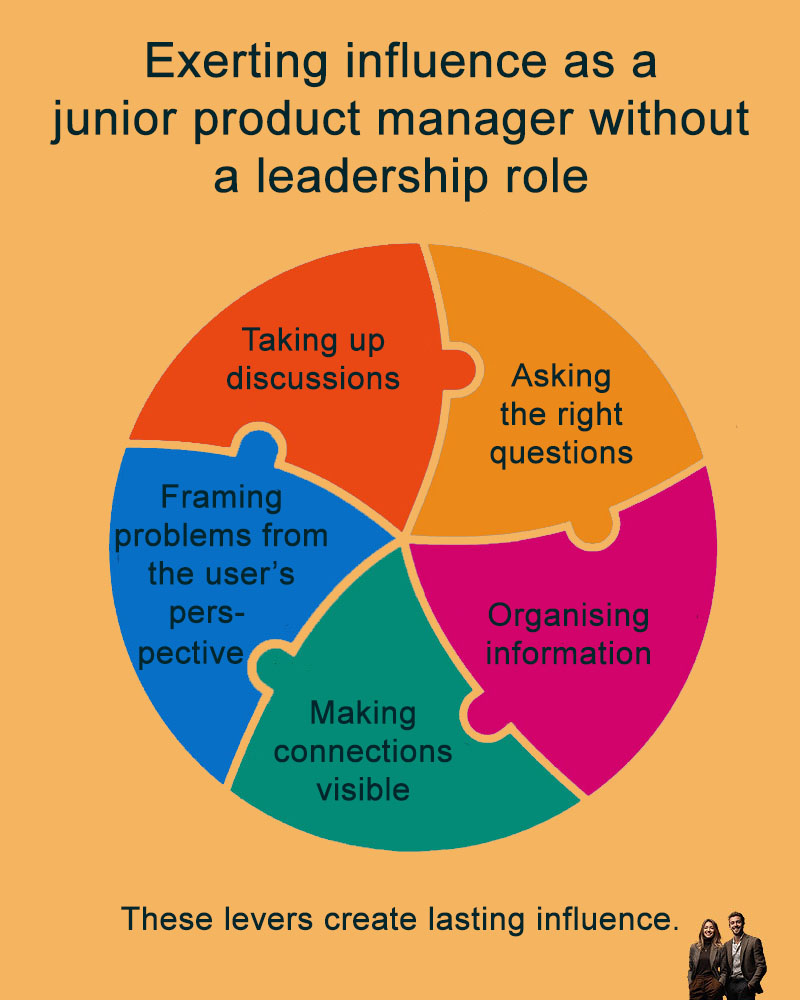
Figure: Exerting influence as a junior product manager without a leadership role
Practical tip: Strengthen leadership with product impulses
If you want to deepen your leadership skills, Fabian Puls invites you to attend the German-language Impulse Session: Product Leadership. In this three-hour Impulse Session, followed by individual coaching, you will learn how to take responsibility, act strategically and gain visible influence within the company – especially for junior product managers and career changers.
Notes and sources:
Are you interested in talking to Fabian Puls? Then simply send him a message on LinkedIn or visit his informative website.
[1] Luneberg, F.C. 2012. Power and leadership: an influence process. International Journal of Management, Business, and Administration. 15(1): 1-9.
Bal, V., Campbell, M., Steed, J. & Meddings, K. 2008. The role of power in effective leadership. Center for Creative Leadership. Available:
French, J.R.P., Jr. & Raven, B. 1959. The bases of social power. In Studies in social power. D. Cartwright, Ed. Ann Arbor, Michigan: Institute for Social Research, University of Michigan. 150-167.
Would you like to discuss leadership as a junior product manager as a multiplier or opinion leader? Then share this post in your network.
Here you will find an interesting article on the question: What makes decisions so difficult?
Fabian Puls has published another post on the t2informatik Blog:

A successful start in product management

Fabian Puls
Fabian Puls is the founder and managing director of Product Impulse UG. He offers interactive live online courses with innovative learning methods that actively involve participants and enable practical learning. His courses focus on key product management topics such as product strategy, market analysis and agile methods, and are held in small groups to promote individual and sustainable learning success.
As a Certified Product Manager (FH) and Professional Scrum Product Owner™, Fabian Puls combines in-depth methodological knowledge with many years of experience in national and international projects.
He also hosts the Küstenimpuls Meetup, where product managers regularly exchange ideas on current topics.
In the t2informatik Blog, we publish articles for people in organisations. For these people, we develop and modernise software. Pragmatic. ✔️ Personal. ✔️ Professional. ✔️ Click here to find out more.