
Demonstrating leadership impact in 90 days
You have been a managing director or divisional manager for around 100 days. The induction period is over, the first decisions have been made, and someone higher up will soon ask you an uncomfortable question: What has changed as a result of your leadership?
Anyone who responds with a list of activities has failed to understand the question. Leadership impact is not the same as leadership activity. Most managers have a gut feeling about this question and a list of activities. Yet neither of these demonstrates what difference their leadership actually makes.
So how can you make your leadership impact visible and demonstrate initial changes within 90 days? The answer is simpler than you might think.
The scene: A CEO and an awkward question
The CEO of a Swiss industrial company with around 250 employees has been in the post for a good three months. Over lunch, the Chairman of the Board of Directors asks him: ‘What is different now compared to before you took over?’
He replies, well prepared. A new meeting structure, two appointments to fill vacancies, a cost-cutting programme, and site visits to all locations.
The Chairman listens and then says: ‘You’ve done all that. I asked what has changed.’
The CEO confided this story to me two days later, still visibly shaken. He had worked hard and initiated numerous changes, but was unable to demonstrate what his leadership had actually achieved. His list consisted of activities. The Chairman wanted to see results that others could also confirm.
Leadership impact begins with how others perceive you
I have been working with top-level executives for over twenty years and time and again I come across the same fallacy: executives judge themselves on the basis of their intentions and actions, whilst those around them primarily notice how they actually behave and what changes as a result.
In 2004, Marshall Goldsmith and Howard Morgan evaluated leadership development programmes across eight large organisations. The study comprised over 86,000 short surveys of around 11,500 leaders, conducted between three and fifteen months after the programmes began. [1]
A clear correlation emerged: managers who discussed their development goals with those around them and followed up regularly were subsequently perceived by those around them to have improved significantly more often. Those who did not follow up achieved considerably smaller improvements in how they were assessed by others.
The study thus provides a strong case for regularly involving one’s own network. However, it does not prove that these perceived changes automatically lead to better business results. This is precisely why I go one step further in my consultancy work.
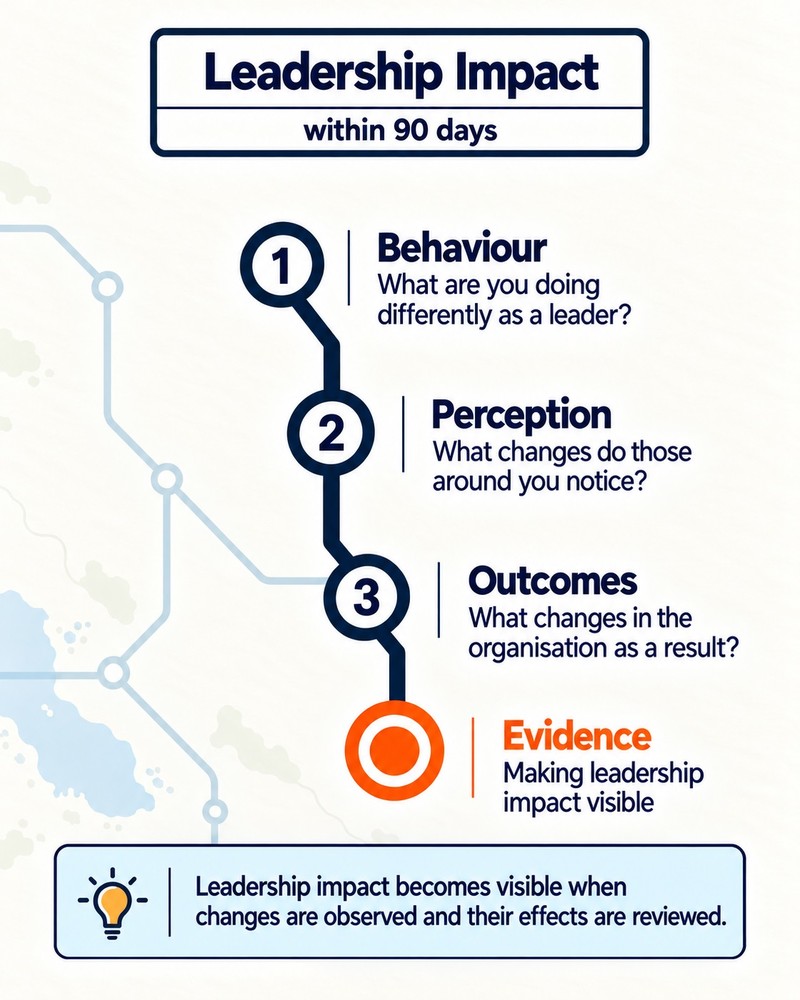
I distinguish between three dimensions of leadership impact:
- Behaviour: What are you, as a leader, actually doing differently?
- Perception: Do other people also perceive this change?
- Impact: How does this change collaboration and the organisation?
What you yourself think about your leadership impact is, initially, merely a hypothesis. Whether your behaviour has actually changed is something others can assess. Additional observations and appropriate key performance indicators reveal the impact of this change.
I take this logic seriously in my own business too. Part of my fee is only payable once my clients’ environment has been confirmed as having improved at the end of a project. Anyone who promises to make an impact should be prepared to be measured against it. This applies just as much to coaches as it does to leaders who are responsible for several hundred people.
Making leadership impact measurable
What I suggested to the CEO fits on a single page. He has put it into practice, and you can start doing the same tomorrow.
1. Focus on a single behaviour
Choose a behaviour that is noticeable to those around you and is also relevant to the challenges facing your organisation. The competency model with its five areas of development can stay on the shelf for now.
If you’re not sure which behaviour you should change, ask five people what you should do more often and what you should do less often in future. Look for common themes and choose a change that’s particularly relevant to your leadership role.
For the CEO, it was the ability to make decisions straight away in meetings, rather than constantly postponing them. His senior management team had already raised this with him during the initial open discussions. However, he had overlooked the feedback because he considered it a matter of personal style.
2. Make your development goal visible
Identify six to eight people who regularly observe your behaviour and can assess it from different perspectives. These might include, for example, managers who report directly to you, colleagues on the executive board and the person to whom you yourself report.
Tell these people what you are working on and ask for an initial assessment of your behaviour to date. This creates a baseline against which future changes can be assessed.
This step takes some effort. Not only are you making your development intention public, but you are also explicitly giving other people permission to observe and critically assess your behaviour. At the same time, this openness increases the likelihood that you will actually engage with your development goal.
3. Ask regularly for specific feedback on changes
Once a month, seek a brief written assessment from the same people. For the CEO, the question might, for example, be: “To what extent has my behaviour when making decisions in meetings changed compared to our starting point?”
Responses are given on a scale from minus three to plus three. Minus three indicates a significant deterioration, zero represents no discernible change, and plus three indicates a significant improvement. In addition, ask an open-ended question: “What specifically should I do differently next month?”
Two minutes per person is sufficient. Three monthly surveys provide three data points, which you can use to identify initial progress. The average score summarises the assessments, whilst the comments provide concrete pointers for your further development.
However, one prerequisite is crucial: those around you must feel confident enough to answer honestly. This is by no means a given, particularly when it comes to a managing director or CEO. You should therefore be transparent about how you handle the feedback and consider whether an independent person should oversee the survey. With such small groups, complete anonymity cannot always be guaranteed.
I am aware of the objections to this method: it is too simplistic, too subjective and not representative. This is partly true, but misses the actual point. You do not want to conduct a scientific study, but rather to find out whether the people who work with you regularly have noticed a change.
You do not necessarily need a large sample size for this. What is more important is having suitable observers, honest feedback and a set of questions that can be compared consistently over the entire period.
One caveat remains: three measurement points indicate an initial trend, not definitive proof of effectiveness. Some changes take longer to materialise, and it is difficult to assess after just one quarter whether an improvement will be sustained. In my consultancy work, therefore, the measurement period usually spans one year.
4. Link the behavioural change to a specific metric
The assessment of your working environment shows you whether your changed behaviour is being noticed. The next step is to check whether this change is also reflected in the relevant work processes.
In the CEO’s case, the metric was obvious: the number of outstanding decisions on the agenda that were carried over from one meeting to the next. Within three months, this figure fell from around a dozen to two.
This is not yet proof of better business decisions. After all, decisions can be made quickly and still be wrong. However, the metric shows that, in parallel with the observed change in behaviour, the decision-making process has also changed. To assess the wider implications, the CEO would also need to examine whether the decisions taken are implemented promptly and achieve the desired results.
For an initial assessment after 90 days, the combination of an external evaluation and a suitable metric nevertheless provides significantly more information than a list of completed activities.
How to provide clear evidence of your leadership impact
Your report to senior management need not be long or complicated. Three points are sufficient to clearly illustrate your progress to date: what changes have you made to your leadership style, how do those around you perceive these changes, and what effects can already be observed using appropriate key performance indicators?
After three months, the CEO was able to summarise his results as follows: “I have resumed making decisions directly in meetings. On average, my senior management team rates the change in my behaviour as a ‘plus two’. At the same time, the number of decisions deferred has fallen from around a dozen to two.”
These three sentences do not yet provide comprehensive evidence of better leadership or greater business success. However, they document a concrete change in behaviour that is noticed by others and is reflected in a relevant process metric. This enables the board of directors to assess what has actually changed, rather than merely being told what the CEO has been focusing on during his first few months.
Where leadership impact is lost in everyday life
There are three mistakes I encounter particularly frequently in my consultancy work:
1. Pursuing too many goals at once
Anyone working on four or five behavioural changes at the same time runs the risk of spreading their attention too thinly. This not only makes it more difficult to consistently change one’s own behaviour, but also makes it harder for those around you to notice and assess individual improvements.
You should therefore focus initially on one behaviour that is of particular importance to your current leadership role. Further development goals can follow later.
2. Seeking feedback only from those in your own circle
Anyone who asks only people who are well-disposed towards them risks receiving mainly confirmatory feedback. You should therefore consciously take different perspectives into account and include people in your circle who assess your behaviour critically.
Some even claim that the opinion of the most critical person is the most important. To a certain extent, I can see the logic in this, although criticism is not automatically more objective than approval. What matters is that your selection allows for different viewpoints and that the people you consult are actually able to assess your behaviour.
3. Asking questions and then remaining silent
This mistake is particularly problematic. Anyone who regularly asks those around them for an assessment but never reveals what they do with the feedback should not be surprised if the willingness to provide honest feedback diminishes over time. In the worst-case scenario, your monthly surveys will turn into a mere formality: The ratings become more favourable without your behaviour actually improving.
That is why every survey should be followed by brief feedback to those involved. Explain what feedback you have received and what you intend to do with it in the coming month. Two sentences are often enough. It is important that those around you recognise that their assessments are taken seriously and influence your future development.
What became of the scene
Six months after that first lunch, the CEO was sitting at the table with the Chairman of the Board once again. This time, he had not only prepared a list of his activities, but was also able to explain his progress in three sentences and two figures.
The Chairman asked a different question to the one he’d asked the first time: “What are you planning to do next?”
This fundamentally changed the nature of the conversation. The CEO no longer had to describe his leadership impact solely from his own perspective, but was able to point to concrete changes that those around him had also noticed. Of course, this did not mean his leadership development was complete. But he had created a clear starting point from which to drive further improvements and assess their impact.
My question to you: If someone in a position of authority were to ask you tomorrow what has changed as a result of your actions, which figure, based on external observation, could you cite?
Notes:
Are you interested in your effectiveness as a leader? Then take a look at Christian Hofmann’s Leadership Empowering Profile or connect with him on LinkedIn.
[1] Goldsmith, Marshall and Morgan, Howard (2004): Leadership Is a Contact Sport: The Follow-up Factor in Management Development, strategy+business.
Would you like to support Cristian Hofmann and discuss leadership impact? Then share this post on social media or within your organisation.

Cristian Hofmann
Cristian Hofmann is an executive coach with a Master of Advanced Studies in Supervision and Coaching in Organisations (MAS/BSO) and has been supporting CEOs, board members and senior management in the DACH region for over twenty years. His focus is on measurable leadership impact: progress is assessed by the leader’s stakeholders, and his fee is linked to this outcome. He is certified in Stakeholder-Centred Coaching according to Marshall Goldsmith and teaches at the ZfU International Business School. He works from Zurich and Schaffhausen.
On the t2informatik Blog, we share knowledge and experience with people in organisations. We have been developing and modernising software for them since 2012. Pragmatically. ✔️ Personal. ✔️ Professional. ✔️ Get to know t2informatik as your development partner.