
Appropriate transparency
Expand the table of contents
Why good leadership requires neither self-exposure nor feigned confidence
If you work your way through the leadership guides, keynote speeches and LinkedIn posts of recent years, you get the impression that the solution to almost every leadership problem has been found: show your vulnerability. Admit to uncertainty. Create psychological safety. The concept sounds good, feels human and spreads quickly. The only problem is: it isn’t true in its simplicity. And the research is quite clear on this point.
Alzahawi and Flynn from Stanford University examined this in five experiments and asked the question: does it help leaders if they openly communicate their own uncertainty? Does this lead to the much-vaunted psychological safety? Or is there a price to pay? The findings leave little room for interpretation. Leaders who publicly admit to their own uncertainty are perceived by their team members as less effective, less competent and less warm. Not a single one of the five experiments could demonstrate any positive effect whatsoever. No ‘sweet spot’. No context in which it helps.
So why do the gurus on social media still preach the opposite? Because it feels good. Because it sounds empathetic. Because it gets shared. The insidious poison here is more subtle than it appears at first glance: anyone who elevates their own insecurity to a leadership tool is essentially absolving themselves of responsibility by offloading their own burden onto those they lead. Leadership, however, is not a social media post. It is a craft, and that requires calibration rather than confession.
This article is not about downplaying the importance of empathy or humanity in leadership. It’s about how leaders can deal with their own insecurity in a way that provides direction. Sorry for the football analogy, but it illustrates the point quite well.
Half-time: 0–2 in the dressing room
Imagine the following scene: your team are 0–2 down at half-time. The manager walks into the dressing room, throws his notes onto the bench and says in a shaky voice: “Lads, to be honest, I’m at a loss right now. I’ve got three ideas, but I’m not really sure about any of them. I’ll give you all three.”
What happens next? Eyes widen. Shoulders slump. The manager’s uncertainty rubs off on the dressing room, and the team heads into the second half without a sense of direction.
This is no fictional exaggeration. We know from research into emotional contagion that the mood of managers directly and demonstrably rubs off on the mood of their staff. Sy, Côté and Saavedra documented this precisely as far back as 2005: a manager’s mood is contagious, regulates the emotional atmosphere of the group and has a lasting influence on cooperation and performance.
Sigal Barsade, who sadly passed away far too young, traced how this so-called ‘ripple effect’ travels through groups, largely unconsciously yet extraordinarily effectively. A manager is not an emotional island. What they send out, others receive.
So anyone who expresses their own insecurity unfiltered during half-time is sending out a signal of disorientation. The interesting question is therefore not whether the manager is allowed to be honest, but how they communicate their insecurity.
What Klopp really did
The new Germany manager, Jürgen Klopp, is regarded by many as a prime example of good leadership. He puts his heart into it on the pitch, shows genuine emotion and doesn’t play a part. And yet: has Klopp ever said in a half-time team talk that he was feeling uncertain at that moment? Did he burden the team with his own doubts ahead of the 2019 Champions League final? Certainly not.
This is because Klopp has intuitively grasped what research shows: emotional connection and clarity are not mutually exclusive. You can show warmth whilst providing direction. You can come across as approachable without making your own insecurity a regular feature.
The reference to Klopp is more than just an anecdote. It highlights a distinction that is often overlooked in the discussion surrounding psychological safety. Amy Edmondson has described the concept of psychological safety as a characteristic of teams: the shared belief that, within a team, one can take interpersonal risks without being penalised for doing so. What she meant by this was the confidence to ask questions, admit mistakes and openly express dissenting opinions. It certainly does not mean the public self-exposure of a leader.
Edmondson and Bransby (2023) confirm this in a comprehensive review of the literature: in 185 articles on psychological safety that were analysed, leadership is the most frequently discussed topic. Psychological safety arises from clear leadership direction, support and trust, not from excessive displays of uncertainty. The path to achieving this lies in a culture where questions, mistakes and differing opinions are structurally welcomed.
Appropriate transparency as a middle ground
What does this mean in practice? In difficult situations, managers tend to want to either say everything or say nothing at all. Neither is a good idea.
One side of this fallacy is the aforementioned overwhelm caused by unfiltered uncertainty. The other side is at least as problematic. Anyone who feigns confidence when the situation is fragile is making the same mistake, only in the opposite direction. People are extremely sensitive to inconsistency. Staff can sense when they are being put on. And mistrust arises not only from perceived weakness, but just as much from perceived dishonesty. A hasty ‘We’ve got everything under control’ in a situation where this is clearly not the case does not have a stabilising effect. Then the mood shifts not towards a sense of direction, but towards withdrawal and a mental check-out.
Leadership does not require a false sense of infallibility, but it does require calibration. Anyone who has doubts should not simply offload the burden, but explain the conscious thought process behind it. This minimises the loss of competence and restores the necessary structure and direction to the team. It is not about less communication, but about better communication. What counts is not the quantity of information, but its manageability – in other words, digestible transparency.
In practical terms, this means, first and foremost, communicating direction rather than mapping out every eventuality. Instead of a thirty-point plan covering every conceivable scenario, simple, clear messages are helpful:
- Where do we stand?
- What has been decided?
- What is deliberately left open?
- What is the next step?
This is not a simplification of reality, but a process of translation – and that is a leadership task.
Added to this is the constructive handling of uncertainty itself. It is not a question of concealing it, but of putting it into context. ‘I don’t know either’ is not a statement befitting a leader. ‘We are currently examining X, Y and Z; I will be in touch as soon as there is more clarity’, on the other hand, is. This signals a capacity to act rather than helplessness, without unnecessarily glossing over the situation.
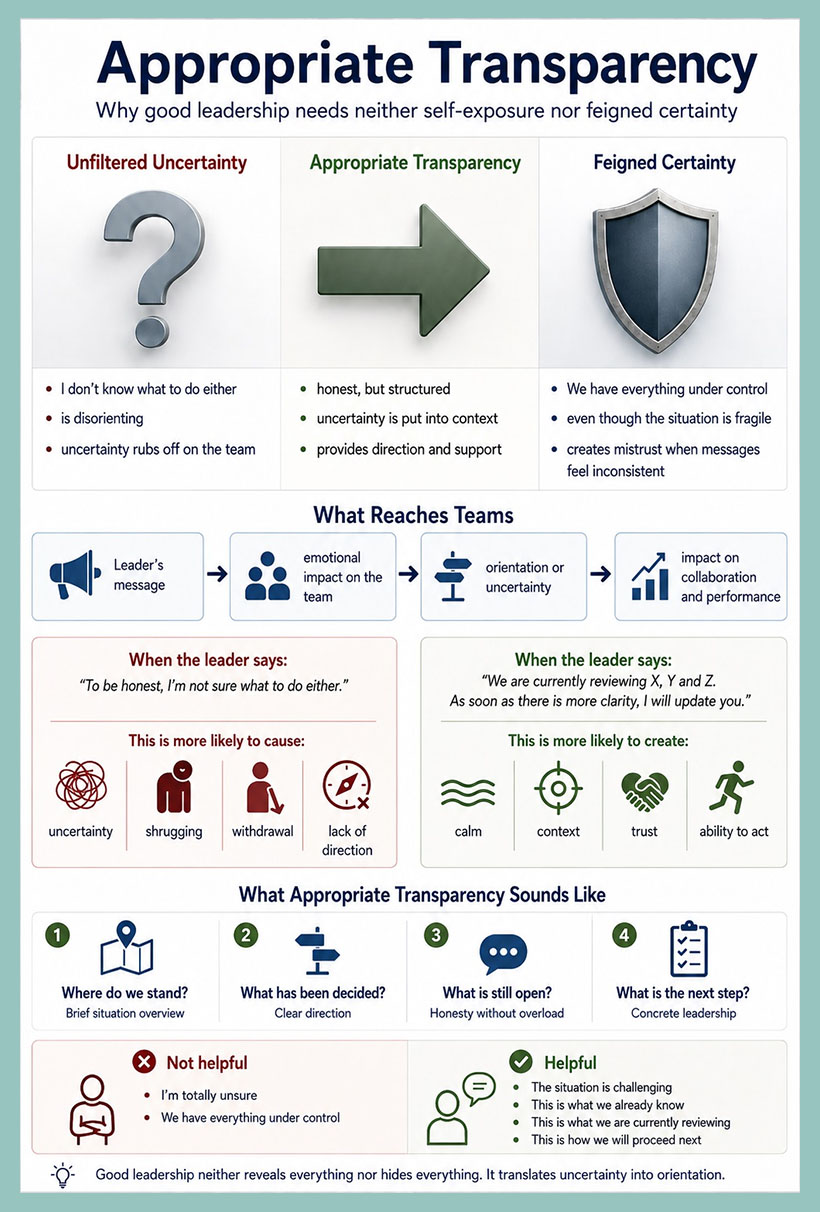
Figure: Appropriate transparency as a middle ground
Conclusion
Allowing oneself to be vulnerable builds trust and plays an important role in leadership. But this role is smaller than self-help books would have us believe. And it depends on the context. In a one-to-one conversation, amongst a close-knit group, and with a clear message, such a signal can strengthen trust. In an all-hands meeting or in a half-time talk in front of the whole team: the wrong tool, the wrong moment.
And anyone who now thinks the solution is simply the opposite – that is, to feign control – is just as wrong. Guidance arises neither from baring one’s soul nor from putting on a façade. It arises from clear messages and appropriate transparency: leaders need neither to hide their uncertainty nor to convey it unfiltered, but rather to frame it in such a way that others can make sense of it and deal with it. Leadership requires less courage to bare one’s soul and more courage to take a clear line. It is not a weakness to refrain from publicly airing one’s uncertainty. Nor is it inauthentic. It is a sign of responsibility and effective leadership.
Notes:
This is a joint article by Prof. Dr Ralf Lanwehr and Elena Grobbel. If you’d like to connect with them, it’s worth taking a look at the C-Lab website and the LinkedIn profiles of Elena Grobbel and Ralf Lanwehr.
Alzahawi, S., & Flynn, F. J. (2025). Does expressing uncertainty help or harm leaders? The Leadership Quarterly, 101880.
Alvesson, M., & Einola, K. (2019). Warning for excessive positivity: authentic leadership and other traps in leadership studies. The Leadership Quarterly,
Barsade, S. G. (2002). The ripple effect: Emotional contagion and its influence on group behavior. Administrative Science Quarterly, 47(4), 644–675.
Edmondson, A. C. (1999). Psychological safety and learning behavior in work teams. Administrative Science Quarterly, 44(2), 350–383.
Edmondson, A. C., & Bransby, D. P. (2023). Psychological safety comes of age: Observed themes in an established literature. Annual Review of Organizational Psychology and Organizational Behavior, 10, 55–78.
Ford, J., & Harding, N. (2011). The impossibility of the “true self” of authentic leadership. Leadership, 7(4), 463–479.
Gardner, W. L., Cogliser, C. C., Davis, K. M., & Dickens, M. P. (2011). Authentic leadership: A review of the literature and research agenda. The Leadership Hoch, J. E., Bommer, W. H., Dulebohn, W. H., & Wu, D. (2018). Do ethical, authentic, and servant leadership explain variance above and beyond transformational leadership? A meta-analysis. Journal of Management, 44(2), 501–529.
Sy, T., Côté, S., & Saavedra, R. (2005). The contagious leader: Impact of the leader’s mood on the mood of group members, group affective tone, and group processes. Journal of Applied Psychology, 90(2), 295–305.
Would you like to support Elena Grobbel and Ralf Lanwehr and discuss digestible transparency and psychological safety? If so, please share this post within your network or at your organisation.
Ralf Lanwehr has published another post on the t2informatik Blog:

Authentic leadership is nonsense!

Ralf Lanwehr
Ralf Lanwehr studied psychology and mathematics, obtained a PhD in business administration and has held a professorship in management since 2008. Alongside his academic work, he has been active as a consultant, trainer and coach for more than 20 years. His work focuses on issues relating to people in the modern workplace: leadership, culture and change. He works at executive board level with companies such as BMW, Google, SAP, Siemens and Lufthansa.

Elena Grobbel
After completing her training in marketing, Elena Grobbel quickly turned her attention to business psychology and, whilst studying, worked on various research projects as part of Ralf Lanwehr’s team. Today, she works as a consultant and marketing manager for the management consultancy C-Lab. Her aim is to help organisations and individuals navigate the challenging conditions of the present and the future, and to work together to provide positive impetus for the working world of tomorrow.
On the t2informatik Blog, we share knowledge and experience with people in organisations. We have been developing and modernising software for them since 2012. Pragmatically. ✔️ Personal. ✔️ Professional. ✔️ Get to know t2informatik as your development partner.