
What are Belbin Team Roles?
Table of Contents: Definition – Nine roles – Applications – Assessment – Prerequisites – Implementation – Example – Differentiation – Advantages and disadvantages – Questions – Notes
Belbin Team Roles at a glance
A team of experienced, highly skilled people embarks on an important project. After a few weeks, there is a lot of discussion, yet decisions are still not being made, and nobody can quite say why progress is so slow. Often, this has to do with the team’s composition: who drives things forward, who checks the work, who holds the group together, and who is missing?
Belbin Team Roles describe nine typical behavioural patterns through which people contribute to the work of a team. The model is used to put together and develop teams in such a way that different strengths complement one another. Managers use it to identify gaps and overlaps within a team and to allocate tasks appropriately. Belbin emphasises that the roles describe observable behaviour. They show what someone does in a team and can therefore change over time [1].
The model was developed by the British management researcher Meredith Belbin. In the 1970s, he and his team spent nine years at Henley Management College observing management teams competing against one another in business simulations [2]. He described one of the surprising findings as the “Apollo Syndrome”: teams made up solely of exceptionally clever people often performed worse than teams with a mixed composition. The most successful teams were those in which different types of behaviour were represented in a balanced way. Belbin published his findings in 1981 in the book “Management Teams. Why They Succeed or Fail” [3]. The model initially comprised eight roles. Belbin added the ninth role, the Specialist, when he applied his findings in organisations.
Strictly speaking, Belbin Team Roles are not a method with a fixed procedure. They give a team a common language for talking about working styles, strengths and weaknesses. They can be used in team development workshops, when planning a project or when a team is reorganising itself.
Key points at a glance
- Belbin Team Roles describe nine typical behavioural patterns in teams, grouped into action-oriented, people-oriented and thought-oriented roles. Each role comes with a strength and an allowable weakness.
- Teams use the model to reveal gaps and overlaps and to allocate tasks according to strengths. As most people have two or three preferred roles, a team of just four people can cover all the roles.
- The roles can be identified using Belbin’s paid questionnaires with observer assessments, using free questionnaires or in a facilitated feedback session. What matters is bringing self-perception and the perception of others together.
- The introduction follows five steps: clarifying the reason and objective, collecting profiles, evaluating the results together, aligning tasks and supporting the collaboration.
- The model creates a common language for collaboration, but its measurement quality is disputed and it carries the risk of pigeonholing people. It is suitable as a starting point for conversations, not as the sole basis for personnel decisions.
The nine Belbin Team Roles and their three groups
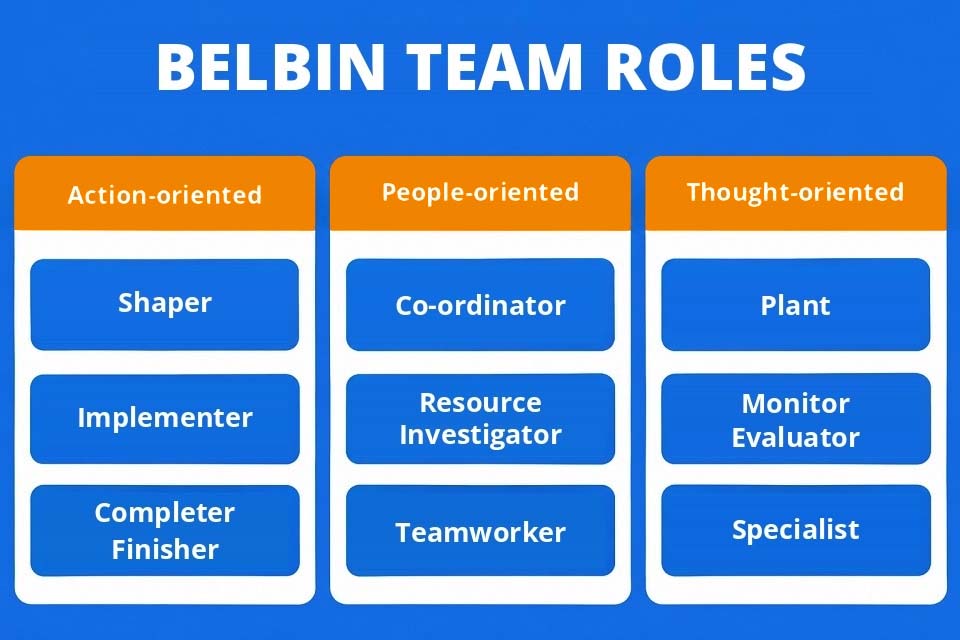
Belbin assigns the nine roles to three groups. The groups describe what the behaviour is primarily directed at: the task, the people within and around the team, or ideas and judgements. This classification is useful when working with the model because it shows at a glance whether a team is one-sided.
- Action-oriented roles drive the work forward and bring it to a proper conclusion. They include the Shaper, the Implementer and the Completer Finisher. Belbin refers to them as “Task Roles”.
- People-oriented roles hold the team together and connect it with its environment. They include the Co-ordinator, the Resource Investigator and the Teamworker. Belbin calls them “Social Roles”.
- Thought-oriented roles provide new ideas, sober evaluations and specialist knowledge. They include the Plant, the Monitor Evaluator and the Specialist. Belbin calls them “Thinking Roles”.
The names of the groups vary depending on the source, and labels such as “communication-oriented” or “knowledge-based” are also common. Belbin’s original terms help you find your bearings when reading literature or test reports.
The following overview shows, for each role, the strength it brings to the team, a typical contribution to a project and the weakness that often goes with it:
| Role | Strength in the team | Typical contribution to the project | Allowable weakness |
|---|---|---|---|
| Shaper | drives things forward, remains able to act under pressure | pushes priorities through and clears obstacles out of the way | can be provocative and offend others |
| Implementer | practical, reliable, well organised | turns decisions into work plans and fixed procedures | sticks to plans and is slow to respond to new things |
| Completer Finisher | conscientious, finds errors | checks results for quality and completeness before handover | worries excessively and is reluctant to delegate work |
| Co-ordinator | clarifies goals, recognises talent | facilitates decisions and allocates tasks | delegates too much, sometimes even their own work |
| Resource Investigator | outgoing, curious | brings knowledge, contacts and opportunities into the team from outside | is overly optimistic and loses interest once the initial enthusiasm has passed |
| Teamworker | cooperative, diplomatic | defuses friction and supports others in their work | is indecisive in a crisis and avoids confrontation |
| Plant | creative, solves difficult problems | develops new approaches when tried-and-tested ones no longer help | overlooks details and is poor at explaining ideas |
| Monitor Evaluator | sober, weighs up options carefully | checks proposals for risks and feasibility | appears uninspiring and at times overly critical |
| Specialist | dedicated, with in-depth expertise | provides expertise that nobody else in the team has | focuses mainly on their own field |
Belbin calls the weaknesses in the right-hand column “allowable”. They belong to the respective strength like the other side of a coin. Anyone who tries to train a Plant out of their erratic nature risks losing their ideas as well. It makes more sense to know the weakness and compensate for it within the team, for example through a Monitor Evaluator who checks the ideas or an Implementer who translates them into plans.
Important in practice: nine roles do not mean that a team needs nine people. Most people feel comfortable in two or three roles, so even a team of four can cover all the roles. Moreover, not all roles need to be active at the same time. Which ones are needed depends on the objectives and the phase of a project.
What are Belbin Team Roles used for?
Belbin Team Roles are used wherever people work together on a result over a longer period of time. For decision-makers, the model is particularly worthwhile when a great deal depends on collaboration. This is the case, for example, with a new project team, under severe time pressure or when a team has to find its feet again after changes in personnel. Typical areas of application can be divided into four groups:
- Putting teams together and filling gaps: Anyone forming a project team or filling a vacancy can check which contributions are already present and which are missing. This also applies to internal teams on the client side that oversee a software project with an external service provider, supplying requirements, testing and making decisions.
- Developing existing teams: When collaboration is not running smoothly, the roles explain some of the friction, for example between an impatient Shaper and a meticulous Completer Finisher. The team can discuss this objectively without anyone feeling personally attacked.
- Allocating tasks and responsibility: Work packages can be tailored to the strengths of those involved. Quality checks are then more likely to go to the Completer Finisher, and coordination with external partners to the Resource Investigator.
- Leadership and self-reflection: Managers recognise their own pattern, for example whether they tend to co-ordinate or to drive things forward, and can delegate in a more targeted way.
Ideally, the end result is a distribution of roles and tasks that has been agreed within the team. The team has also gained a common language for different working styles and an honest view of its gaps. The model itself is quickly explained. Applying it carefully, on the other hand, takes time for preparation, the workshop and follow-up work, regardless of whether the team consists of five or fifty people.
How can team roles be identified?
The official route is via Belbin’s questionnaires. Each person completes the so-called Self-Perception Inventory online, a self-assessment that takes around 20 minutes and is subject to a fee [4]. In addition, colleagues and managers can provide a shorter external assessment, the so-called Observer Assessment. In two lists of positive and negative adjectives, they tick the words that apply to the person. Belbin recommends six such assessments; at least four are required for a report that includes the views of others [5]. A team report brings the individual profiles together. Because behaviour changes with the task, the environment and colleagues, every profile is a snapshot. After major changes in the team or in the task, it is worth updating the profiles.
There are also numerous free questionnaires in circulation. The principle is usually similar: in several sections, you distribute a fixed number of points across statements about your own behaviour in the team, and the totals for each role produce a ranking. The quality of such questionnaires varies considerably, and some are based on early versions with only eight roles. They may be sufficient for a first impression, but they are too shaky a basis for decisions about tasks or staffing.
A third route does not require a questionnaire at all: a facilitated feedback session in which the team jointly assesses who prefers to make which contributions. This requires a facilitator who knows the model well and can confidently guide conversations about strengths and weaknesses.
Whichever route is chosen, self-perception and the perception of others should be brought together. In a study of 65 members of eleven management teams, the observer assessments agreed with one another for only 35 people, and for only seven of these did they match the self-assessment well [6]. In other words, a profile is the starting point for a conversation about roles.
What is needed to use Belbin Team Roles?
Whether working with team roles pays off is largely decided before the first workshop. If there is a lack of trust within the team or a lack of time for a thorough evaluation, the profiles leave behind little more than the memory of a pleasant afternoon. The following prerequisites and resources have proven useful:
- Team culture: Those involved talk openly about their own strengths and weaknesses, listen to one another and can handle criticism. Different ways of working are seen as an asset.
- Time and backing: Management and the organisation support the effort and are willing to accept feedback themselves.
- Facilitation: Whoever leads the process has experience with workshops, group dynamics and conflicts and knows the model, ideally through training. In delicate team situations, an external facilitator can help.
- Information: Objectives and expected results of the project, previous areas of work and responsibilities, schedule and project context, experience from previous collaboration and known tensions within the team. Existing profiles from other methods can add to the picture.
- Resources: Questionnaires or reports, short role descriptions as handouts (Belbin provides such overviews) and facilitation materials. In addition, an undisturbed room or a digital whiteboard and an overview that links roles to tasks or project phases.
A simple table or spreadsheet is sufficient for the overview. More important than the tool is deciding in advance what the analysis is for and who gets to see the results.
Introducing Belbin Team Roles: step by step
In practice, a sequence of five steps has proven effective for the introduction. It runs from the initial reason through to ongoing support in day-to-day work.
1. Clarify the reason and objective
The first question is why the team should work with the roles. Is a new team being formed, should the allocation of tasks be improved, or are there tensions that need to be understood? This determines the desired outcome, for example an agreed distribution of roles. Also define the framework: who will facilitate, which instrument will be used, when will the workshop take place, and who will see the results? Explain the model to the team briefly in advance and emphasise that the profiles serve collaboration. They have no place in performance appraisals.
2. Collect profiles
Everyone involved completes the chosen questionnaire calmly and without time pressure. Honest answers are more important than a profile that looks good. If you work with observer assessments, ask colleagues who know the person from their day-to-day work in good time.
3. Evaluate the results together
In the workshop, each person presents their strongest roles and says what they recognise in them and what they do not. This is followed by a team overview: which roles are represented more than once, and which are missing entirely? Before filling a gap from outside, it is worth looking at the secondary and tertiary roles. Often someone has long been filling a missing role without seeing it as their own [7]. Other options are to bring in a person with a suitable profile, involve external support or adapt the way of working, for example by introducing fixed review steps if there is no Monitor Evaluator.
4. Align tasks and responsibilities
The tasks themselves are created during project planning. First prioritise areas of work by importance and urgency, for example using the Eisenhower Matrix, and then allocate them according to the strengths of those involved. Formal responsibilities can be recorded in a RACI matrix. Also address the allowable weaknesses openly and make agreements, for example a fixed time window for the Completer Finisher’s checks or a clear decision deadline for brainstorming sessions.
5. Support the collaboration and make adjustments
The real test begins in day-to-day work. Short, regular feedback sessions show whether the allocation is working and where things are getting stuck. In retrospectives, the team can ask specifically which roles are working well and where contributions are missing. An anonymous feedback tool is suitable for sensitive topics. Also use the milestones to check whether the team is making progress, and adjust roles and tasks when the project or the team composition changes.
The five steps are repeated whenever the team or the project changes. Teams that see team roles as an integral part of their collaboration can quickly return to a common basis when changes occur.
Example: An internal project team for a new customer portal
A dealer in spare parts for agricultural machinery with around 120 employees is replacing its outdated ordering system. Until now, repair workshops have placed orders by telephone, by fax or via a cumbersome order form. An external software service provider is developing a new customer portal. On the dealer’s side, a five-person project team oversees the project: it supplies requirements, reviews designs and approves them.
After the first coordination meetings, project manager Miriam notices two things: the workshops with the service provider revolve almost exclusively around replicating the old system, and approvals for designs take several weeks. She organises a half-day workshop with an external facilitator. Beforehand, everyone completes Belbin’s online questionnaire and asks four colleagues each for an observer assessment. The evaluation produces the following picture:
| Person | Position in the company | Strongest role | Second-strongest role |
|---|---|---|---|
| Miriam | Head of Inside Sales, project manager | Co-ordinator | Shaper |
| Olaf | Warehouse Manager | Implementer | Completer Finisher |
| Sabine | Accounting | Completer Finisher | Monitor Evaluator |
| Deniz | Customer Service | Teamworker | Implementer |
| Lukas | IT Administration | Specialist | Monitor Evaluator |
Seven of the nine roles are filled at least once. Implementer, Completer Finisher and Monitor Evaluator even appear twice. The team is thorough and reliable, and that is precisely what explains its difficulties: it adopts tried-and-tested processes and checks every design several times. The Resource Investigator and the Plant are missing entirely. Nobody brings in an outside perspective, for example what the repair workshops want or how other portals work, and nobody proposes fundamentally new solutions.
In the workshop, the team decides to close the gaps in a targeted way rather than restructure the team. Jana from the field sales team, who visits repair workshops every day, joins for the concept phase. Her profile shows the Resource Investigator as her strongest role, and she takes on interviews with ten regular customers. The Plant role is partly taken on by the service provider’s UX designer: in two ideation workshops, she is explicitly given room for suggestions that depart from the old system. Only then do Sabine and Lukas evaluate the ideas, so their strength as Monitor Evaluators comes into play at the right point. For approvals, the team agrees on review criteria in advance and a maximum of one round of corrections per design. Miriam, in her role as Shaper, makes sure that the deadlines are met.
Six weeks later, the team takes stock in a retrospective. Approvals now take days instead of weeks, and the concept includes features that did not exist in the old system, such as searching for spare parts by machine number and reordering from the order history. A new pattern also emerges: after the customer interviews, Jana’s commitment noticeably declines, which is typical of a Resource Investigator. The team therefore gives her a clearly defined, time-limited task and asks her to recruit five repair workshops as pilot customers for the testing phase.
The example shows how the model works in practice. All five keep their existing tasks. The model has made visible why the team works the way it does and where a targeted addition makes the biggest difference.
Differentiation from related models and variants
Belbin Team Roles rarely stand alone. Many teams combine them with other models, and there are several ways of applying them. Looking at the differences helps to choose the right tool for the question at hand.
Belbin Team Roles and personality models: Models such as the Riemann-Thomann model or the Myers-Briggs Type Indicator describe fundamental personality traits, such as the need for closeness or distance. Belbin Team Roles, by contrast, describe observable behaviour in a team, which can change with the task. The two perspectives can be combined well when a team wants to understand why someone prefers a particular role.
Belbin Team Roles and the Johari Window: The Johari Window by Joseph Luft and Harry Ingham contrasts self-perception with the perception of others and reveals blind spots. It is well suited to evaluating Belbin profiles when self-assessments and observer assessments diverge.
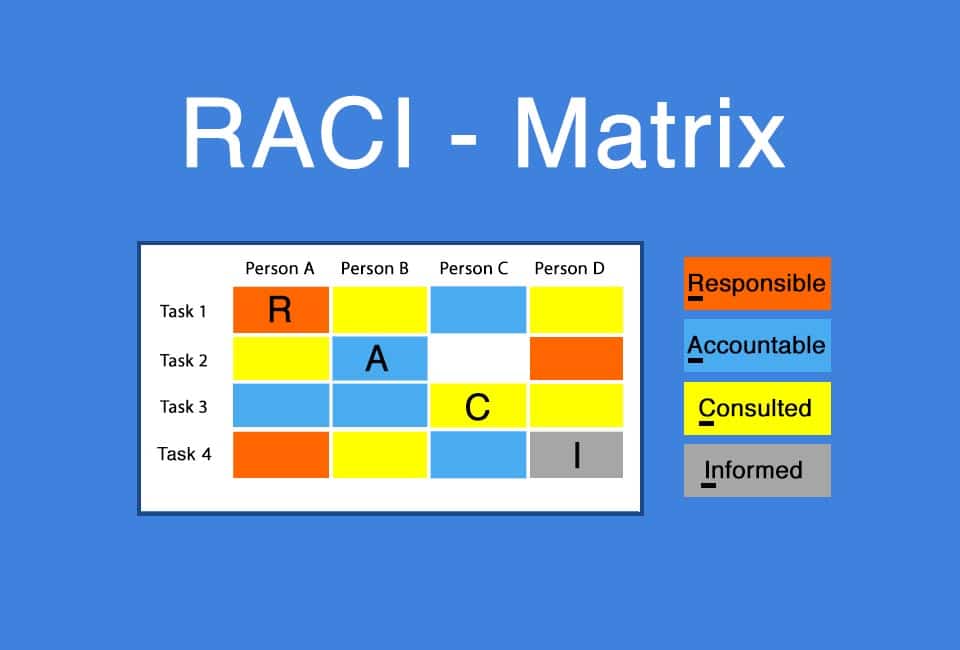
Belbin Team Roles and responsibility matrices: A RACI matrix defines who is responsible for a task, who is accountable, who is consulted and who is informed. It governs formal responsibilities. Team roles describe the way in which someone contributes to the work. The two complement each other, as step 4 shows.
Belbin Team Roles and competence models: Tools such as the competence wheel or the passion-skill matrix capture professional skills and motivation. A team that wants to know whether it is well positioned both professionally and in terms of collaboration uses both perspectives.
There are also variations in how the model itself is applied. They differ in who assesses the roles and which aspect of collaboration the team focuses on. Three variants are common:
- Observer assessment as a 360-degree view: In addition to the self-assessment, colleagues and managers provide an assessment. Belbin regards these Observer Assessments as an integral part of the process.
- Belbin Team Roles in agile teams: Scrum teams have formal accountabilities such as Product Owner or Scrum Master. The team roles cut across these and show whether a self-organising team has someone who drives things forward, checks the work or maintains external contacts.
- Phase-based analysis: The team examines which roles are particularly needed in which project phase. At the start of a project, Plants and Resource Investigators often matter more; towards the end, Implementers and Completer Finishers. An overview of roles and phases shows when each person is in greater demand.
Which combination makes sense depends on the question a team wants to answer. Belbin Team Roles are often sufficient on their own for putting a team together; for the personal development of individuals, an additional look at personality and competences is worthwhile.
Advantages and disadvantages
Belbin Team Roles are among the best-known models in team development. Their strengths lie in communication about collaboration, their weaknesses in measurement and in how the results are handled. On the plus side, the following points stand out:
- Common language: Teams can talk about different working styles without getting personal. A conflict between speed and thoroughness appears as a difference between two roles and is easier to resolve.
- Gaps and overlaps become visible: A team recognises early on whether it lacks outside ideas or critical review, for example, and can take countermeasures before the project stalls.
- Tasks fit people better: People who more often do what suits them usually work more contentedly and faster. However, this only applies as long as the role does not become a one-way street.
- Quiet contributions gain weight: Teamworkers or Completer Finishers often only stand out in everyday work when they are missing. The model explicitly highlights their value.
- Managers delegate in a more targeted way: Those who know their own preferred roles see more clearly which tasks are better placed with others.
These advantages only materialise if a team uses the profiles as an occasion for conversation and invests time in the evaluation. Where profiles are treated as fixed labels or the workshop has no consequences, the following disadvantages take effect.
- Risk of pigeonholing: Pinning people down to one role sacrifices flexibility. Almost everyone shows elements of several roles, and their behaviour changes with the task and the environment.
- Disputed measurement quality: Experts have criticised the questionnaires since the 1990s. A 2007 review reaches a mixed verdict: overall, the roles can be measured adequately, but some are difficult to distinguish from one another [8].
- Distorted self-perception: Relying solely on self-assessments risks a skewed picture. Free questionnaires exacerbate the problem.
- Limits in small teams: With three or four people, members have to take on roles that suit them less well, and some roles remain thinly covered.
- Effort without guarantee: Preparation, the workshop and follow-up support take time. Without follow-up work, little remains of the analysis.
- Lack of acceptance: Anyone who does not recognise themselves in their role will hardly support the agreed allocation. And anyone who overrates the profiles can easily lose sight of what the situation actually requires.
All in all, the model is a conversation tool with limited measurement accuracy. It is too imprecise to serve as the sole basis for personnel decisions. As a starting point for an honest conversation about collaboration, it serves its purpose well.
Questions from the field
Here you will find some questions and answers from practice:
What tips help when working with Belbin Team Roles?
Working with Belbin Team Roles stands or falls with the way a team handles the results. The same profiles can bring a group closer together or put people into boxes. The following experiences help to achieve the first effect and avoid the second.
- Use profiles as an invitation to talk: A profile is a hypothesis that the person concerned confirms, adds to or corrects. Announcing results as a verdict meets with resistance.
- Combine self-perception and the perception of others: Self-assessments often differ significantly from the impression others have. Observer assessments or a facilitated feedback session make the picture more reliable.
- Do not turn roles into job descriptions: A preferred role indicates what comes easily to someone. It does not prevent anyone from taking on other tasks, and in small teams everyone has to fill several roles anyway.
- Cushion allowable weaknesses with agreements: Time limits for brainstorming sessions, a fixed number of correction rounds or an agreed signal when discussions become too heated take the edge off the downsides of the strengths.
- Check in briefly and regularly: Fifteen minutes of review every few weeks achieves more than one big workshop a year. Anonymous feedback helps with sensitive questions.
- Take a fresh look after changes: When someone leaves or joins the team, the balance of roles shifts. A quick review prevents a gap from only becoming apparent at the next bottleneck.
The first two tips carry the most weight. Where profiles serve as an invitation to talk and self-perception and the perception of others come together, the rest usually follows without much effort.
What can be done when two people with the same strong role clash?
Two Shapers or two Co-ordinators in a team often compete for the same position, for example over who sets priorities or facilitates decisions. A clear division of the areas in which each person can play out their role helps, for example by topic or project phase. Sometimes simply naming the overlap openly within the team defuses the situation. If the conflict persists, it is worth looking at the secondary roles: one of the two people can often bring another, equally pronounced role more strongly into play.
Can Belbin profiles be used when selecting new employees?
Belbin also offers reports that match the requirements of a position with team roles. In the application process, however, caution is advised: applicants tend to answer questionnaires in the way they think is expected, and a profile only shows a snapshot. It is therefore not suitable as the sole selection criterion; at best, it is one element alongside interviews and work samples. Whether and how such questionnaires may be used should be clarified in advance with the HR department and, where applicable, the works council.
What should I do if someone disagrees with their profile?
Take the objection seriously, as it is valuable information in itself. Ask about situations in which the person experiences themselves differently, and compare the profile with observer assessments if available. It often turns out that someone behaves differently depending on the environment, for example differently in their own specialist team than in the project. Nobody should be pushed into a role they do not accept; otherwise, the very collaboration the model is meant to improve will suffer.
Impulse to discuss:
Should team role profiles be open to the whole team, or does each result belong solely to the person who completed the questionnaire?
Notes:
If you like this post or would like to discuss it, please feel free to share it within your network.
[1] Belbin Associates: The Nine Belbin Team Roles. Belbin, Cambridge, n.d.
[2] Belbin Associates: Belbin Team Roles in a Nutshell. Belbin, Cambridge 2022.
[3] R. Meredith Belbin: Management Teams. Why They Succeed or Fail. Heinemann, London 1981; 3rd edition Routledge 2010.
[4] Belbin Associates: Belbin Individual Reports. Belbin, Cambridge, n.d.
[5] Belbin Associates: What are Observer Assessments? Belbin, Cambridge, n.d.
[6] Barbara Senior, Stephen Swailes: A Comparison of the Belbin Self Perception Inventory and Observer’s Assessment Sheet as Measures of an Individual’s Team Roles. International Journal of Selection and Assessment, Vol. 6, Issue 1, 1998, pp. 1–8.
[7] Institute for Manufacturing, University of Cambridge: Belbin’s team roles. Cambridge, n.d.
[8] Aitor Aritzeta, Stephen Swailes, Barbara Senior: Belbin’s Team Role Model: Development, Validity and Applications for Team Building. Journal of Management Studies, Vol. 44, Issue 1, 2007, pp. 96–118.
Here you will find two interesting articles on clarifying roles in a team and role-based work in non-self-organised teams.
And here you’ll find more information from our Smartpedia section:

What is the Eisenhower Matrix?
What types of retrospectives are there?
What is the RACI Matrix?
‘Smartpedia’ is our glossary for people in organisations involved in software development, project management and product management. It is for precisely these people and their organisations that we have been developing and modernising software since 2012. Pragmatic. ✔️ Personal. ✔️ Professional. ✔️
Get to know t2informatik from Berlin as your development partner.