
What is the ALPEN method?
Table of Contents: Definition – Areas of application – Prerequisites – Procedure – Example – Distinctions – Advantages and disadvantages – Practical questions – Notes
ALPEN method: Climbing the mountain with a plan
It’s Monday morning: your inbox is full, your diary has three appointments, and there are still eleven outstanding items on the note from Friday. Everything seems equally urgent. If you simply start with the first email, you’ll realise by the evening that the things that actually matter have been left undone.
This can be avoided with the ALPEN method for work and time planning: it takes you through five fixed steps, from a disorganised to-do list to a plan that realistically takes account of the time available.
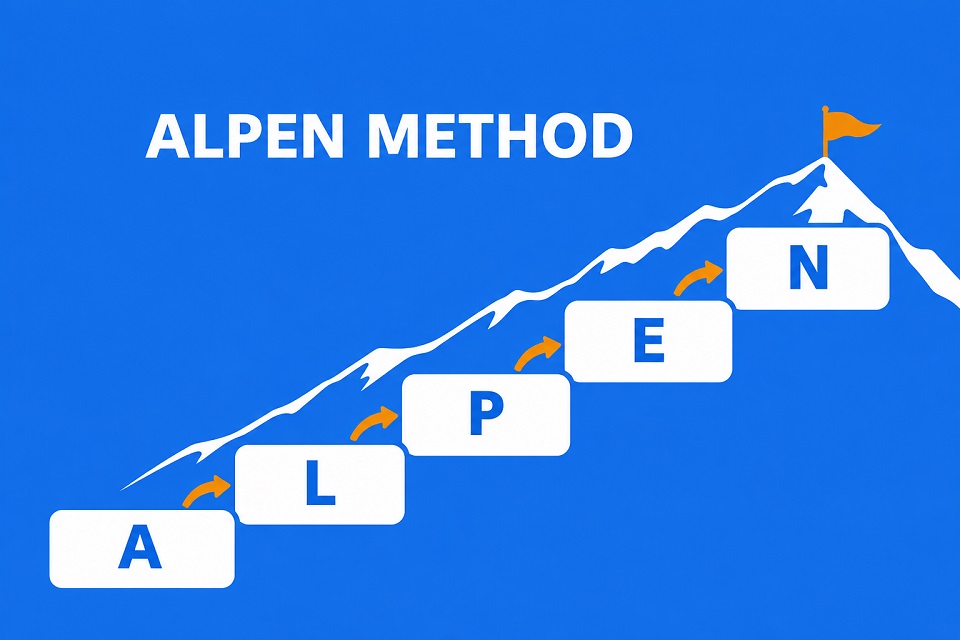
The name is an acronym formed from the first letters of the steps:
- A for Assemble tasks
- L for Length of time estimation
- P for Plan buffer time
- E for Establish priorities
- N for Note progress and review
The method was developed by the economist Lothar J. Seiwert (born 1952), who described it in his 1984 book Mehr Zeit für das Wesentliche [1]. With his best-selling books, Seiwert is one of the best-known German-language authors on time and self-management and has had a major influence on the debate surrounding work-life balance. The ALPEN method also owes its popularity to its name: the acronym sounds a bit clunky, and the literal translation ‘Alps’ ruins the German acronym, but the image behind it sticks in the mind. As you work through your to-do list, you are climbing a mountain step by step. Many trainers have since adapted the method for their own purposes. As you work through your to-do list, you are climbing a mountain step by step. Many trainers have since adapted the method for their own purposes.
Originally, the ALPEN method was intended for a single working day. However, its steps are so general in nature that they are also suitable for planning periods spanning several weeks and for small teams. This article describes the method in this expanded form. In short: the ALPEN method is a framework into which further tools can be integrated, for example for selecting and prioritising upcoming tasks.
Key points at a glance
- The ALPEN method helps you turn a multitude of tasks into a plan that fits within the time available.
- The five letters stand for Assemble tasks, Length of time estimation, Plan buffer time, Establish priorities and Note progress and review.
- Planning using the ALPEN method takes around five to fifteen minutes for a single working day.
- The method is suitable for well-defined tasks and reaches its limits when dealing with interdependencies and scarce resources.
- It was popularised by the time management author Lothar J. Seiwert in the 1980s.
What is the ALPEN method suitable for?
Wherever there are more tasks than there is time, the ALPEN method helps to determine what can realistically be achieved within a given period. In practice, three areas of application can be distinguished.
Planning your own working day: This is the classic scenario. Anyone who spends five to fifteen minutes in the morning or the evening before starts the day with a clear sequence of tasks and an idea of what can be completed by the evening.
Implementing task lists and action plans: Many meeting formats end with a list of tasks, such as a workshop, a strategy retreat following a SWOT analysis, a project structure plan or a sprint planning session in an agile environment. The ALPEN method turns such lists into an implementation plan for the coming days or weeks.
Managing smaller initiatives and project phases: In projects, larger tasks are regularly broken down into subtasks that are to be completed swiftly. Here, the method serves as a framework for what is known as rolling planning: a short period is planned in detail, followed by the next.
In any case, the end result is a work plan that fits the time available. There is also a learning effect: those who regularly review their plans learn to estimate more accurately over time and plan more realistically.
However, the method has a clear upper limit. If the planning itself takes longer than about an hour, the project is usually too large for the ALPEN method, as it does not account for dependencies between tasks or limited resources. As a rule of thumb, the planning period should not exceed four weeks. For longer-term projects, planning using phases and milestones is more suitable.
Prerequisites and tools
The ALPEN method can be used immediately without any training. With each planning cycle, your experience grows, and the approach gradually adapts to your own needs. For it to work, however, a few conditions must be met:
- Freedom to organise: Those doing the planning must be allowed to organise their own work. If another department dictates the order and deadlines, there is little left to plan.
- Independent tasks: The tasks should, for the most part, be able to be carried out independently of one another. If they are interdependent, the order is already predetermined.
- Tasks ready for execution: Each task is described clearly enough that you can get started straight away, estimate how long it will take, and know exactly when it is complete.
- Clear accountability: When a team is planning, each task is already assigned to a person or a group.
The information required includes a list of outstanding tasks, an assessment of effort, importance and urgency, and criteria for when a task is considered complete. In projects, these are often a ‘Definition of Done’ or agreed acceptance criteria.
You don’t need many tools. For your own planning, all you need is a pen and paper, a calendar or a notebook using the bullet journal method, where daily, weekly and monthly plans are laid out side by side. Teams often like to work with cards on a flipchart or a Kanban board – that is, a board with columns for outstanding, in-progress and completed tasks. Any digital task management tool is equally suitable.
The step-by-step procedure of the ALPEN method
The order of the steps is fixed, as each one builds on the outcome of the previous one. There is a rough timeframe for each step, so that the planning itself does not become a time-waster.
1. Assemble tasks
New tasks come from many different sources: from line managers, clients, colleagues, via email, chat, telephone or in casual conversations in the corridor. The first step brings them all together in one place. For individual planning, this should take no longer than five minutes; in a team, no longer than fifteen.
Before you start gathering tasks, you need to decide on the timeframe. The original approach plans for exactly one day, which works well for small tasks taking up to an hour. If a task takes longer – for example, preparing an investment decision that spans several days – it is broken down into sub-tasks and the entire period up to the deadline is planned. You should therefore first determine by when everything needs to be completed.
This is followed by a selection process that often happens subconsciously and is then guided by personal preferences: you do what you enjoy and put off the unpleasant tasks. It is better to make a conscious decision about what actually goes into the plan. The Eisenhower Matrix helps with this; it sorts tasks by importance and urgency and does not include unimportant ones in the plan in the first place. A simple ‘in-out’ framework, also known as an ‘is-is-not analysis’, is quicker: for each task, you decide whether it belongs in this time period or not. Two guiding questions help with this. Is the task even feasible within the chosen time period? And what happens if it remains undone by the deadline? The result is a list of tasks that should or must be completed within this time period.
2. Estimate the length of tasks
For each selected task, estimate how long it will take. This step can often be done whilst gathering the tasks and should under no circumstances take longer than the gathering process itself.
If a single person is working on a task, the duration corresponds to the effort involved. With small teams, the situation is different: not every team member works on the task for its entire duration, so duration and effort do not coincide. Planning is based on duration.
There are two ways to estimate:
- Absolute estimation: For well-known, routine tasks, the duration is written directly next to each task. A standard grid is agreed upon beforehand, for example, in quarters of an hour.
- Relative estimation: If it is difficult to give a direct figure, the tasks are first sorted solely by their duration, with the shortest on the left and the longest on the right. Within the team, this method is also known as the ‘Team Estimation Game’. Only then are specific time values assigned to the tasks.
Finally, the estimated times are added up per person or per team.
3. Plan buffer times
The total of the estimated times is then compared with the actual available working time during the planning period, again broken down by individual or team. If a fixed timetable is already in place, this takes barely a minute. For team planning involving holidays and absences, it should take no more than fifteen minutes.
Every working day also includes unplanned work. Routine tasks, brief enquiries, team coordination and waiting times for input from others take up time that cannot be switched off. That is why only a portion of working time is scheduled. A common rule of thumb is to allocate around 60 per cent of the time to fixed tasks and keep 40 per cent free as a reserve. Those who work with focus and group together interruptions can gradually increase the proportion of time allocated to scheduled tasks. Around 80 per cent is a peak figure that few achieve. Initially, a realistic proportion is closer to half of working hours, and even that is usually a significant improvement on an unplanned day. If the total of the estimated times exceeds the proportion that can be scheduled, tasks are cancelled or postponed.
How can the proportion of time that can be planned be increased? Alternating between focus periods and breaks has proven effective: fixed time slots of 25 to 45 minutes are set aside for undisturbed work – a form of timeboxing. These are interspersed with breaks of five to fifteen minutes, during which brief enquiries and other minor tasks are dealt with. Larger recurring appointments, such as a daily team meeting, are given a fixed slot in the schedule.
4. Establish priorities
The question remains: where to start? This step should be quick; a good rule of thumb is around five seconds per task.
There are complex methods for prioritisation, such as Weighted Shortest Job First (WSJF), which weighs a task’s benefit against its duration. For most planning scenarios, however, a subjective order of importance is sufficient. Those who need support can use dot voting: each team member allocates a limited number of points across the tasks. An alternative is pairwise comparison, in which two tasks are weighed against each other at a time.
To ensure that decisions can still be made in a matter of seconds, it is worth working through such methods thoroughly once and internalising them. Afterwards, you make decisions based on gut instinct, and what you have learnt is incorporated subconsciously. The planning period is then filled with tasks from top to bottom, starting with the most important one. Anything that no longer fits is left out for the time being and dealt with in the final step.
5. Note progress and review
The final step takes place at the end of the planning period. For your own daily planning, five minutes is sufficient: tick off completed tasks and carry over unfinished ones to the next period. For larger projects and during the first few rounds of using the method, a more thorough review is worthwhile.
Check for completion: Is a task really finished, or just almost? A glance at the agreed completion criteria will clarify this. It is simplest if the task has been formulated according to the SMART rule – that is, specific, measurable, attractive, realistic and time-bound – and thus already incorporates the criterion. For larger tasks, a dual-review process may apply, or formal acceptance by the client may be required. If you want to be sure beforehand, you can take on the role of devil’s advocate yourself and deliberately look for reasons why the task is not yet complete. It is more effective to ask someone else to do this.
Learning from the planning: The review focuses on the planning process itself. Questions such as these are helpful: How far off the mark were the estimates, and for which tasks? How much working time was actually left over for the planned tasks in the end? Was the effort spent on planning proportionate to the benefits? What will we change next time? For larger projects and when working in a team, this can develop into a full evaluation following the ‘Lessons Learned’ model.
Example: A garden centre ahead of the start of the season
Jana Brückner runs a garden centre with a farm shop. The spring season begins next week, and for the first time, customers can pre-order plants via a new online shop set up for her by a software service provider. Her to-do list is long. On Monday morning, she plans the week using the ALPEN method.
As she jots things down, twelve items initially end up on her list. She crosses four of them off straight away because they are neither feasible nor necessary this week, including the website redesign. Eight tasks remain. She estimates how long each will take in half-hour increments and arrives at a total of 26 hours.
She then calculates her time budget. The table below shows how much of her 40-hour week is actually available for the planned tasks:
| Time budget | Hours | Proportion |
|---|---|---|
| Working hours Monday to Friday | 40 | 100% |
| Day-to-day tasks (farm shop, telephone, customer enquiries) | 8 | 20% |
| Contingency reserve | 8 | 20% |
| Allocable to the task list | 24 | 60 per cent |
Her eight tasks will take two hours longer than planned. Jana Brückner has therefore postponed comparing quotes for new greenhouse film until next week. She prioritises the remaining seven tasks. At the top of the list are the test orders in the new shop, because any errors there would directly affect customers at the weekend. On Friday, she’ll carry out a follow-up check:
| Priority | Task | Planned in hours | Status on Friday |
|---|---|---|---|
| 1 | Run through test orders in the online shop and report any errors | 4 | Done |
| 2 | Agree the range of plants for pre-orders with the service provider | 3 | Done |
| 3 | Train seasonal staff at the till and collection point | 6 | Done |
| 4 | Create price labels for new products | 5 | Done, took an extra hour |
| 5 | Check supplier invoices | 3 | Done |
| 6 | Approve the spring leaflet | 1 | Done |
| 7 | Plan social media posts for the season opener | 2 | Carry over to the following week |
| Total | 24 |
Six out of seven tasks have been completed, and the most important one is finished before the start of the season. The social media posts have been carried over to next week. Looking back, two things strike Jana Brückner. She had underestimated the cost of the price tags, and the budget reserve was almost entirely used up dealing with enquiries from the service provider regarding the shop. She is therefore planning a fixed time slot for such coordination next week.
How does the ALPEN method differ from other planning methods?
The ALPEN method lies between very simple techniques for daily planning and traditional project planning. A comparison with similar methods shows when it is the right choice.
Ivy Lee method: With this method, the six most important tasks for the following day are noted down the evening before, ranked by importance and worked through one after the other. Duration and buffers are not taken into account. The ALPEN method, on the other hand, estimates processing times and factors in reserves. This makes it possible to say by when a task is likely to be completed, which is particularly important in teamwork.
Eisenhower Matrix: This categorises tasks into four quadrants based on importance and urgency, making it a tool for prioritisation. Within the ALPEN method, it helps in the first step but does not yet provide a timetable.
Phase and milestone planning: For projects spanning several months, involving dependencies or with limited resources, project planning using phases and interim targets is appropriate. The ALPEN method can then handle short-term planning within individual phases.
In addition, there are methods that work well in conjunction with the ALPEN method. For formulating tasks, for example, user stories – which describe a requirement from the user’s perspective – and agreed work packages are suitable. The ‘What I Need From You’ (WINFY) format is also helpful, as it enables teams to clearly state to one another what they need from each other. Entire projects, from which task lists are subsequently derived, can be planned using, for example, a project profile, a roadmap or an A3 report. Other options include the Logical Framework Matrix and the project game plan from Dragon Dreaming.
For short-term projects, the ALPEN method is therefore the ideal tool; for larger projects, it complements project planning.
Advantages and disadvantages
The ALPEN method is easy to use, and this is precisely where its strengths and limitations lie.
The advantages include:
- Quick process: The fixed structure saves you having to think about how to proceed. After a few rounds, planning a day’s work takes barely more than ten minutes.
- Wide range of applications: The steps work just as well for your own working day as they do for a set of actions arising from a workshop.
- Greater motivation: Those who plan realistically experience less overload and more frequently feel they have achieved what they set out to do. This requires that the buffers are estimated honestly.
- Suitable for agile working: Thanks to the minimal planning effort involved, the method combines well with short work cycles, where replanning is often required anyway.
However, these advantages are offset by a number of disadvantages:
- Only for tasks ready for execution: Unclear tasks cannot be estimated or signed off. They must be defined in more detail beforehand.
- No dependencies: The method does not account for whether a task is awaiting the outcome of another task or input from outside sources. In the case of closely interlinked tasks, this leads to unrealistic plans.
- Little benefit when working to instructions: Anyone carrying out tasks according to fixed specifications set by others – for example, on behalf of and under the guidance of a client – has little scope to determine their own order of priority. In such cases, the method is of little help beyond estimating the time required.
For short planning periods and manageable task lists, the advantages clearly outweigh the disadvantages. The larger and more interconnected a project is, the more likely it is to require additional planning tools.
Practical questions
Here you will find some questions and answers from practice:
What tips are there to help when using the ALPEN method?
- Keep planning brief: The method is designed to save time. If planning regularly takes longer than the guideline suggests, either the timeframe chosen is too long or the tasks are described too vaguely.
- Create your own checklist: Note down which points really matter for your planning, such as fixed routine blocks or recurring absences within the team. Leave everything else out.
- Formulate tasks clearly: The more clearly a task is described, the easier it is to estimate the time required and follow up. Formulate tasks with a clear outcome, such as ‘Comparison of quotes sent to management’ rather than ‘Look at quotes’.
- Choose a fixed time for planning: Whether it’s the evening before or first thing in the morning, a consistent time slot turns planning into a habit.
With each round, the estimates become more accurate and the buffer more appropriate. The greatest benefit therefore only becomes apparent after a few weeks.
Does the ALPEN method also work in a team?
Yes, provided the team is small and each task has been assigned to a specific person. Estimates and time budgets are then managed on a per-person basis, so that no one is overloaded whilst others have spare capacity. The main points discussed collectively are the selection of tasks and the priorities. In larger teams with many interdependencies, the method quickly reaches its limits because it does not account for waiting times between individuals.
What should you do if there are regularly a lot of tasks left over at the end?
This is an indication that either estimates were too tight or too little buffer time was built in. A follow-up review will reveal which is the case: if individual estimates were way off the mark, a more granular grid or a comparison with similar tasks that have already been completed can help. If time was lost to interruptions, the proportion of time allocated to planning should be reduced for the time being. If tasks consistently remain undone despite realistic planning, this is more likely to be a capacity issue that cannot be resolved through planning alone.
Does the ALPEN method help when working with a software service provider?
In software projects, there are also many tasks on the client side: clarifying requirements, running through test cases, answering queries, and granting approvals. These tasks usually run alongside day-to-day business and are therefore easily underestimated. Using the ALPEN method, these can be realistically scheduled for the coming days or weeks, including a buffer for coordination. This also helps the service provider, as reliable commitments regarding tests or approvals make the project’s progress more predictable.
How much leeway can a team openly include in its weekly plan before a manager sees it as unused capacity?
Notes:
If you like this post or would like to discuss it, please feel free to share it within your network.
[1] Seiwert, Lothar J.: Mehr Zeit für das Wesentliche. So bestimmen Sie Ihre Erfolge selbst durch konsequente Zeitplanung und effektive Arbeitsmethodik. Verlag Moderne Industrie, Landsberg am Lech 1984.
Here you will find an interesting article on Letting go is the way of planning.
And here you’ll find more information from our Smartpedia section:

What is the Eisenhower Matrix?

What is the Dragon Dreaming Method?

What is the Ivy Lee Method?
‘Smartpedia’ is our glossary for people in organisations involved in software development, project management and product management. It is for precisely these people and their organisations that we have been developing and modernising software since 2012. Pragmatic. ✔️ Personal. ✔️ Professional. ✔️
Get to know t2informatik from Berlin as your development partner.