
What is the Ansoff Matrix?
Table of Contents: Definition – Areas of applications – Growth strategies – Prerequisites – Usage – Example – Differentiation – Advantages and disadvantages – Notes
Smartpedia: The Ansoff Matrix is a strategic planning tool that identifies four growth opportunities based on existing and new products and markets.
Ansoff Matrix: Planning growth strategically
Turnover has been stagnating for two years; regular customers are buying as much as ever, but hardly any more. The management team has a dozen ideas on the table, ranging from a new pricing structure to venturing into a completely new line of business. Which of these represent a small step, and which a leap into the unknown?
The Ansoff Matrix is designed precisely to answer this question. It is a strategic planning tool that enables a company to identify and categorise potential growth paths. The matrix has two axes: one represents products or services, the other markets or customer groups. Both axes distinguish only between ‘existing’ and ‘new’. This creates four quadrants, and each quadrant represents a distinct growth strategy with its own level of risk.
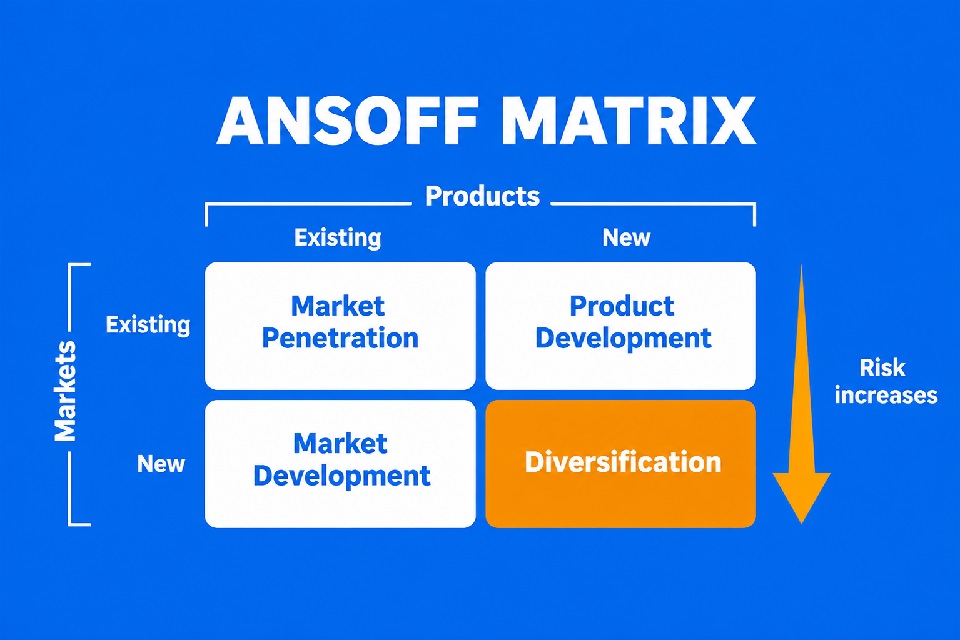
Alongside ‘Ansoff Matrix’, the term ‘product-market matrix’ is commonly used. Its creator was H. Igor Ansoff (1918–2002), a mathematician born in Vladivostok who initially worked for the RAND Corporation in the USA before moving to the aircraft manufacturer Lockheed [1]. There, in the late 1950s, he led a working group tasked with identifying new business areas for the company. This work gave rise to the essay ‘Strategies for Diversification’, published by the Harvard Business Review in 1957, in which the matrix first appeared [2]. By the time his book ‘Corporate Strategy’ was published in 1965, his contemporaries regarded him as the father of strategic management. Consequently, the matrix is almost 70 years old and remains a fundamental tool in any strategic work to this day.
- The Ansoff Matrix categorises growth options according to existing and new products, as well as markets.
- This results in market penetration, product development, market development and diversification.
- New products and markets can bring additional uncertainty. The specific risk must be assessed.
- The matrix does not assess either the profitability or the prospects of success of an idea.
- H. Igor Ansoff published the model in the Harvard Business Review in 1957.
Ares of applications of the Ansoff Matrix
The Ansoff Matrix is suitable when companies are systematically seeking growth options and wish to structure these initially. Typical scenarios include:
- Planning growth: In annual strategy or budget planning, the matrix helps to underpin growth targets with concrete action points. Management can see which options are closely aligned with current business operations and which require more courage.
- Responding to change: When a market changes, a strong competitor emerges or customers have different needs, a company looks for new sources of revenue. In times of crisis, the matrix can help find a way back to profitability.
- Reducing dependencies: Companies that generate the majority of their turnover from a single product, a single season or a single sector can use the matrix to specifically identify sources of revenue that mitigate this concentration risk.
The initial result is a structured list of options. Only a subsequent assessment of demand, profitability, resources and competition enables a well-founded selection to be made.
The four growth strategies of the Ansoff Matrix
The four quadrants answer two questions: Will the company stick to its existing products or services, or will it develop new ones? Is it targeting existing markets or new ones? The overview of risk assessment describes a typical trend, not a fixed ranking for each individual case.
| Strategy | Product/Market | Typical measure | Risk |
| Market penetration | existing/existing | Customer loyalty, upselling, gaining market share | typically rather low |
| Product development | new/existing | Variants, additional services, digital offerings | depending on the project |
| Market development | existing/new | new sectors, new countries, new distribution channels | depending on the project |
| Diversification | new/new | New offerings for new markets, where appropriate through partnerships or acquisitions | typically on the higher side |
Market penetration focuses on existing services and markets. A company can, for example, increase purchase frequency or gain market share from competitors. In product development, it uses its market knowledge to offer new services to existing customer groups. Market development taps into additional target groups or regions with the existing range of products and services. In doing so, requirements relating to sales, regulation or service may be new.
Diversification combines a new offering with a new market. It can be particularly complex, as companies must develop both aspects simultaneously. However, the actual risk depends, amongst other things, on existing capabilities, investment requirements, competition and customer demand. In business administration, a distinction is often made between the following types:
- Horizontal diversification: A company expands its business to include related services at the same stage of the value chain; for example, a bicycle manufacturer that also offers cycling clothing to new customer groups. Whether this constitutes diversification in the sense of the Ansoff matrix depends on whether the market is also new.
- Vertical diversification: A company takes on additional stages of the value chain, such as production or distribution. However, a manufacturer that opens its own shops is only diversifying within the meaning of the Ansoff Matrix if this also involves a new product range and a new market. Otherwise, it may simply be a distribution decision.
- Lateral diversification: The company enters a business that has little connection to its existing product range. This can create new sources of revenue; at the same time, existing capabilities are often less readily utilised.
These three terms describe the relationship to the existing business. They therefore do not replace the classification based on the two axes of the Ansoff Matrix.
Prerequisites and resources
The matrix itself is quick to explain and requires no special training. Whether good ideas emerge depends primarily on the preparation and the people around the table.
Attitude and group: Participants should be prepared to take seriously even ideas that seem far-fetched at first glance. A mixed group comprising sales, technical, service and management staff will identify more opportunities than a panel where everyone shares the same perspective on the business. An eye for detail and the ability to put oneself in the customer’s shoes are helpful. For the subsequent evaluation, however, specialist knowledge is required, for example from market research or financial control.
Clear objectives: Decision-makers must agree in advance on the direction the company wishes to take. A vision or measurable growth targets serve as the yardstick against which the ideas gathered will later be assessed.
Information: An honest assessment of the company’s own resources is required. These include assets, rights, licences, suppliers, partners, the customer base and reputation, as well as the skills of the staff, including their personal expertise. In addition, there are studies, industry reports and trends – including those from other sectors – as well as the participants’ own experience.
Resources: To start with, a sheet of paper and a pen will suffice. In a workshop, noticeboards, facilitation cards and flipcharts – or a digital whiteboard on which even remote teams can collaborate – are helpful.
The step-by-step use of the Ansoff Matrix
The best way to work with the matrix is to alternate between phases in which the group develops ideas and phases in which it observes and reflects. This can take the form of a single workshop or a process spanning several weeks. The sequence remains the same in both cases.
1. Gathering the starting point: The group identifies what the company is capable of, who its customers are and what is happening in the wider environment. It is also important to consider unusual commissions from recent years, customers on the fringes of the product range and topics that have long been of interest to someone in the team. It is important to think beyond official areas of expertise: an employee who restores furniture or programmes apps in their spare time expands the company’s possibilities. As this step does not have a fixed outcome, a set time limit is allocated to it from the outset. Asking participants to carry out their own research in advance saves time here.
2. Filling in the matrix: Only now does the matrix come into play, so that ideas are not pigeonholed too early. It is displayed large and clearly visible to everyone in the room. The group goes through it field by field, noting down each idea where its originator sees fit. Whether an idea fits neatly into its field is of secondary importance; debates over categorisation only waste time. Ideas are neither evaluated nor discarded at this stage. The aim is to end up with plenty of ideas – as a rough guide, 50 or more.
3. Reviewing ideas: Before anyone makes a decision, the group gathers facts. They ask customers, count existing enquiries, read studies and speak to partners. This ensures that the idea that received the most applause in the room does not automatically prevail, and even a suggestion that may have been met with derision is examined objectively. The results are recorded in a pre-agreed format so that a future implementation team can access them. If the research yields new insights, it is worth going through the matrix a second time. In the context of a one-day workshop, there is usually only time for one round.
4. Selection: Now the ideas are assessed against the objectives. Common criteria include the expected impact, the effort required for implementation, the likelihood of success or the risk involved, and the competitive landscape. Many companies have their own procedures for this. Proven methods include a portfolio presentation with the axes ‘impact’ and ‘ease of implementation’, a decision matrix, a SWOT analysis and, for the most promising candidates, a business case. Ideas that narrowly fail are placed in an idea bank and remain available as a reserve.
The matrix on its own rarely yields good results. Its strength lies in the structure it provides for the thought process. That is why it is almost always combined with other methods – for example, brainstorming to gather ideas, and the methods from step 4 for evaluation.
Example: An e-bike hire company is looking to boost its winter business
The following fictional example illustrates how this works: An e-bike hire company in the Mecklenburg Lake District operates four stations with 180 bikes and twelve staff members. Around 85 per cent of annual turnover is generated between April and October. During the winter months, the bikes are in storage; the workshop mainly services its own fleet. The management is looking for additional sources of revenue for the off-season.
As a first step, the team gathers observations: regular customers book repeatedly, holiday let owners enquire about bookings for their guests, and locals ask about repairs to their private e-bikes. Furthermore, other rental companies are interested in the existing booking system. These observations serve as starting points for ideas, but do not yet constitute a reliable demand forecast.
The team then categorises the suggestions in the matrix. The table shows possible guiding questions and ideas. For the categorisation, it is assumed that only bicycles have been hired out to date and that the hire business has so far mainly served holidaymakers.
| Strategy | Key question | Rental company ideas |
| Market penetration | What is stopping our customers from booking with us more often or for longer stays? | Discounts for returning holidaymakers, simplified re-booking |
| Product development | What problem are our customers currently solving themselves – or not solving at all? | Guided half-day tours, luggage transport for previous holiday guests |
| Market development | Who might need our service whom we’ve never considered? | Winter hire of existing e-bikes to commuters, rental in a new region |
| Diversification | What are people asking us about, even though we don’t offer it at all? | Repair service for locals’ private e-bikes, booking software for other rental companies |
The list from the workshop is considerably longer than the table, but even these eight ideas illustrate the range, from small-scale promotional campaigns to the software business.
During the assessment phase, the workshop log shows that 34 repair requests were turned down in October and November alone. The software service provider explains that the booking system would only be usable by several rental companies after a refurbishment lasting several months, plus ongoing support. Of the three companies approached, two are interested in the monthly rental, though the insurance issue remains unresolved.
When it comes to the selection, the repair service comes out on top. The workshop, spare parts and specialists are available in winter anyway, and there is proven demand. It is a diversification that ties in closely with existing expertise. The monthly hire scheme for commuters comes in second place and will go ahead once the insurance has been sorted out. The licence idea is being shelved because the effort and risk involved are too high for a hire business of this size. The hire company will initially trial the repair service at one station, with appointments managed via the existing booking system. [3]
The Ansoff Matrix and related methods
The Ansoff Matrix is used in the same context as other strategic tools. Those who understand the differences can apply each one where it is most effective.
How does the Ansoff Matrix differ from the BCG Matrix? The BCG Matrix, developed by the Boston Consulting Group, categorises existing products into four groups based on market growth and market share, showing which products are profitable and which require investment. It therefore assesses the current portfolio. The Ansoff Matrix looks ahead and asks in which direction the company can grow. The two complement each other well: the BCG matrix shows where the money for growth comes from, whilst the Ansoff matrix shows where it could be channelled.
How does the Ansoff matrix differ from a SWOT analysis? A SWOT analysis compares strengths, weaknesses, opportunities and threats, thereby describing the company’s current situation. It is suitable as preparation for the first step of the Ansoff Matrix and later for evaluating individual ideas.
Workshop version without technical terms: In practice, a variant of the matrix that omits the field names has proved its worth. Terms such as ‘diversification’ or ‘market development’ conjure up fixed ideas among sales or marketing professionals and narrow their thinking. The fields are then simply labelled ‘known service, known customers’ and so on. Instead of markets, the focus is on customers, because people are easier to visualise than abstract segments. It becomes even more tangible with personas – profiles of fictional, typical customers with names and characteristics.
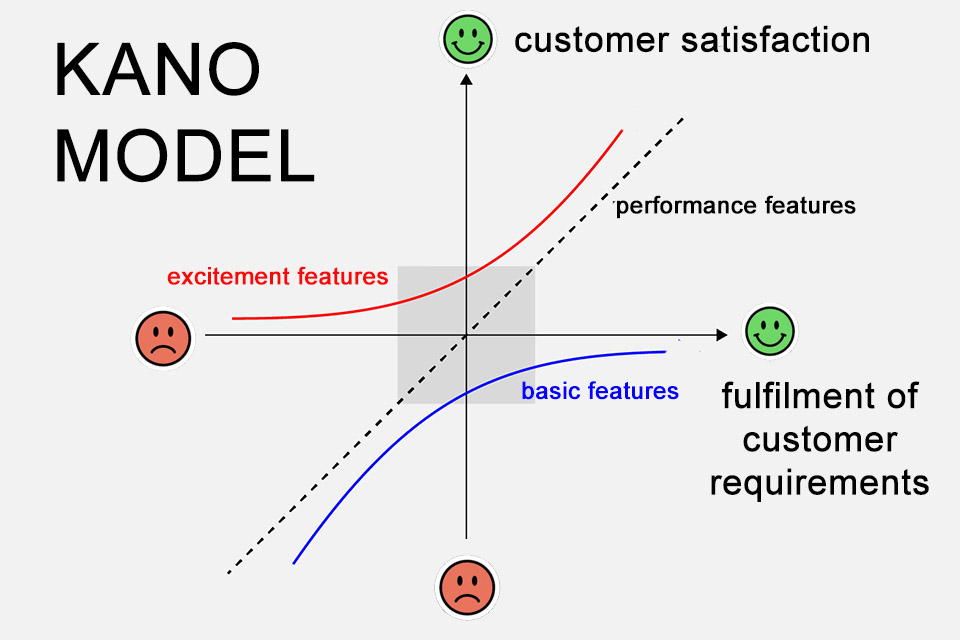
Supplementary methods: Environmental analysis and force field analysis are suitable for examining the wider context. Creative methods such as Design Thinking, the Walt Disney Method or the morphological box help to develop product ideas. The Kano model and customer surveys reveal which features of a new offering actually delight customers.
Viewed in this light, the Ansoff matrix acts as the link between analysis and idea generation: it translates what a company knows about itself and its customers into directions for growth.
Advantages and disadvantages of the Ansoff Matrix
The Ansoff Matrix is one of the simplest strategic tools. This is where its strengths lie:
- Quick to get started: The principle can be explained in a few minutes; no training is required. The matrix works just as well in an executive board meeting as it does in a departmental workshop.
- Minimal effort: Paper, a pen and a well-prepared group are all that’s needed to produce initial results. No expensive tools or data are required to brainstorm ideas.
- Tangible results: After half a day, you’ll have a structured list of potential growth paths that can be examined in detail.
- Common language: The four fields provide management, sales and technical teams with a common framework for discussing the risks and direction of growth.
These advantages apply to the collection and organisation of options. As soon as the question arises as to which option is worthwhile, the matrix reaches its limits:
- No evaluation: The matrix says nothing about prospects of success, costs or profit. Without subsequent review, there is a risk of blind, knee-jerk action.
- Rough categorisation: ‘Existing’ and ‘new’ are rarely clearly distinct in practice. A new product often attracts new customers, and the line between product development and diversification becomes blurred.
- Blind Spot Competition: How competitors react to an initiative and whether the company has sufficient funds and staff to implement it are left out of the equation.
- The danger of routine: Anyone who works through the matrix as if it were a form will end up with obvious ideas and miss out on opportunities beyond their usual patterns of thought.
All in all, the Ansoff Matrix is particularly worthwhile when a company wants to broaden its horizons before channelling money in a particular direction. The decision itself requires additional reliable figures and feedback from customers.
Questions from the field
Here you will find some questions and answers from practice:
What tips are there for using the Ansoff Matrix in a workshop?
- Describe ideas in concrete terms: ‘Repair service for private e-bikes during the winter months’ is easier to assess than ‘expand the service’. Where possible, the proposal should include the target group and the service provided.
- Facilitate neutrally: Someone with no direct interest in a particular option can help ensure that all aspects are given due consideration and that hasty judgements are avoided.
- Highlight connections: Similar ideas can be grouped together and approaches that can be combined can be linked. This helps to identify potential common prerequisites.
- Switch perspectives: Alternating between individual work, small groups and joint discussion enables different perspectives on customer needs and capabilities.
- Further develop ideas initially: Asking follow-up questions helps to clarify vague suggestions. Selection based on agreed criteria takes place only after the ideas have been gathered.
What should you do if almost all your ideas end up in the ‘market penetration’ category?
In which sector does a digital solution such as a customer portal or an app fit?
What matters is the service offered and the target customer group, not the technology used. A digital ordering portal for existing customers can support market penetration. An additional digital service for the same customers forms part of product development. If an existing offering reaches a new customer group online, market development becomes possible. Depending on the business model, a digital solution can also support several strategies.
How often should a company update the Ansoff matrix?
It is worth reviewing the strategy as part of the regular strategic planning process or when market conditions change significantly. Previous ideas can then be assessed in the light of new information. There is no universally correct timeframe for this; it depends on the pace of the market and the need to make decisions.
Why do companies often only start looking at new growth strategies when their existing business comes under pressure? Wouldn’t it make more sense to use the Ansoff Matrix during successful times, when there is sufficient scope to explore new avenues and even make mistakes?
Notes:
If you like this post or would like to discuss it, please feel free to share it within your network.
[1] Ronald W. Puyt, Peter H. Antoniou, Andrea Caputo: The Ansoff archive: Revisiting Ansoff’s legacy and the holistic approach to strategic management. In: Strategic Change, Vol. 33, No. 6, 2024, pp. 513–518.
[2] H. Igor Ansoff: Strategies for Diversification. In: Harvard Business Review, Vol. 35, No. 5, September/October 1957, pp. 113–124.
[3] The Ansoff Matrix can be used to develop and organise options. Only a market test will reveal whether a new offering will be accepted. It is therefore advisable to test specific assumptions before making major investments. Pilot schemes, pre-prototyping, limited test sales or pre-orders can serve this purpose. In the case of digital offerings, for example, a simple initial version can be trialled with a small number of customers. Before undertaking a larger-scale development, factors such as demand, operations, data protection, running costs and technical scalability should be assessed.
Here you will find two related articles on the principle of the affordable loss and the torch into future.
And here you will find further information from our Smartpedia section:

What is a Business Case?

What is Pretotyping?
What is the Kano Model?
‘Smartpedia’ is our glossary for people in organisations involved in software development, project management and product management. It is for precisely these people and their organisations that we have been developing and modernising software since 2012. Pragmatic. ✔️ Personal. ✔️ Professional. ✔️
Get to know t2informatik from Berlin as your development partner.