
Effectiveness needs boundaries
Highly committed staff, managers keen to encourage participation – and yet paralysis is setting in within the product development department of a medium-sized software company. Decisions fizzle out, other departments feel sidelined, and the product developers themselves are caught between high but vague expectations and frequent encroachments on their area of responsibility, the boundaries of which they do not fully understand. Trust has been damaged, both between C-level management and product development, and within the team itself.
How did such committed, constructive people end up in such a mess together? And what is needed for them to become effective again?
My client is a company whose senior management is earnestly striving for participation and a people-centred corporate culture; they are open to criticism and willing to invest a great deal of time, money and passion in this.
The aim of the change process was to develop a new structure that would make product development more effective in the long term – and, by extension, the entire development department, comprising around 50 people. A key requirement set by the head of the development department was that the structure should be developed through a participatory process. The key to success was not the new structure itself, but the team’s willingness to support it and, if necessary, to stand up for it collectively against external interference.
Given the palpable uncertainty, it was important to me to begin the participatory process with the utmost clarity. Every employee should know exactly which decisions are made by whom and how, what influence they themselves have, and what is expected of them in return. Only when people no longer have to fear that boundaries might shift unnoticed at any moment does space for trust and the assumption of responsibility re-emerge. At the same time, due to the pent-up hurt feelings, the process needed to allow space and visibility for the human dimension right from the start.
How clear boundaries build trust
Based on this, I developed, together with the manager, a six-month experiment to collaboratively develop new structures using the consent process. In the Consent Process, a decision is only made if everyone present is prepared to at least support it or to raise an objection, which is then addressed in an integrative manner. ‘Integrative’ here means: what specific change do you need in order to be able to continue moving forward? Knowing and experiencing that every objection is heard and taken seriously builds trust. At the same time, it is an exercise in actively taking responsibility, constantly being faced with the decision: can I and do I want to support this as it stands, or do I take my objection seriously enough to raise it with the group?
I prepared this approach thoroughly with the leader. He did have reservations, but was able to commit to the experiment, including an escalation clause specifying the point at which, in his view, it would be deemed a failure.
A second building block was the joint development of a vision for future collaboration. By working with Lego Serious Play, the group was able to experience first-hand exactly what was at the heart of the process: the constructive development of shared outcomes. Each person began by building their own model. The participants then took turns integrating elements from others’ models into the shared model.
This broadened their perspective: from the previously anxious defence of their own positions to recognising the valuable contributions others made to the common whole. At the same time, differences that no one had previously been aware of became open to discussion.
The most heated debate centred on the question of how open or closed garden fences between different areas should be in the vision. It was precisely where boundaries had long been blurred that the desire for protection through clear fences was greatest.
The vision developed jointly served as an anchor and guide throughout the rest of the process: the tension between openness and the reliability of boundaries, for example, was regularly re-examined using the image of the garden fences.
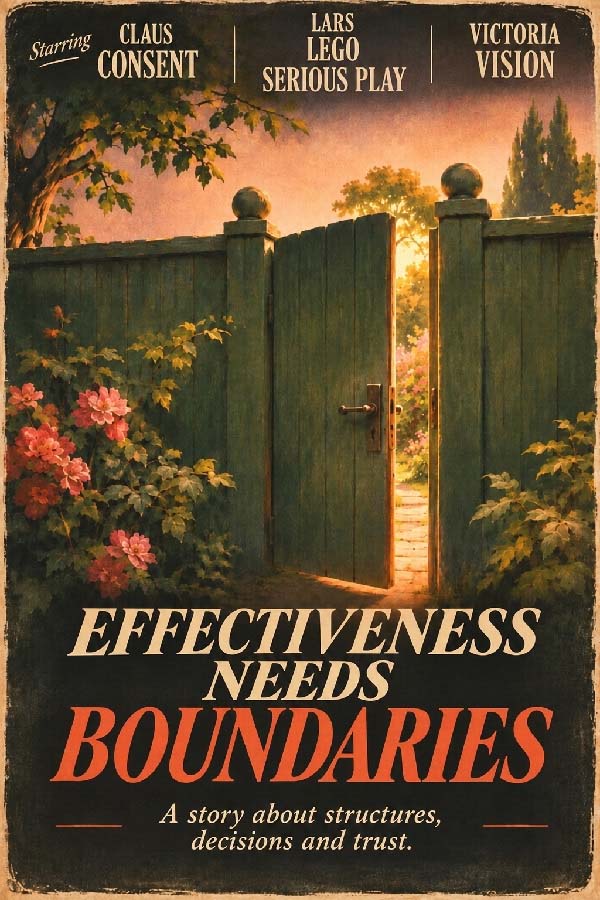
Illustration: Effectiveness Needs Boundaries – a story told by Vivien Mast
The moment of truth: responsibility grows from trust
Yet genuine change is not revealed in neat theory, but in moments of crisis. In the fourth workshop, when the key roles had already been clarified but the specific structure of the teams and the allocation of roles were still to be decided, the tension in the room was immense. It escalated into a conflict between two participants. One of them left the room temporarily.
The real turning point, however, was that the staff themselves turned to the two senior leaders and demanded that a key decision be taken by management, as they felt neither willing nor able to make it themselves. By clearly stating the limits of their own willingness to take responsibility, the staff took responsibility for themselves, for clarifying the roles and for the rest of the process.
This demand opened up space for the next step: working with the two managers, I used systemic constellation work to develop a picture of the specific structure. In the process, a dynamic became apparent that was inherent in the structure of the roles themselves: one role was subject to pressure from many directions, which was almost impossible to avoid within the system. What had been cognitively inaccessible suddenly became immediately palpable and clear in the room. This new clarity regarding the structure untangled the knot that had long blocked the path to a new order.
This moment was made possible because all those involved were prepared to show themselves at a very vulnerable moment: the colleague who left the room and returned; the team that articulated its own limits rather than concealing them; the leaders who had the courage to face up to a difficult decision.
However, this moment was also made possible because the process was designed from the outset to allow trust and the assumption of responsibility to grow step by step: clear, reliable boundaries and space for objections through the consent process; a dedicated space for personal matters in every workshop and the clarity that emotions were permitted during the substantive work without immediately becoming the centre of attention.
Within this framework, the team had learnt over time that even serious conflicts could be resolved together. “It was only in this safe space that enough trust was built to address problems openly and take action,” says the head of the development department, looking back. “In the process, I also learnt personally to tackle difficult issues with greater courage.”
The result: effectiveness at all levels
The new structure clearly distinguishes between what falls under the responsibility of individual product owners and what the product managers decide jointly in accordance with the consent principle. There are clear processes for how the rest of the company is constructively involved. The experiment in participatory development continued for a further two years at a slightly reduced intensity, with the focus shifting towards processes, the involvement of the wider organisation, and the leadership of the individual development teams.
The effects became apparent in many areas: the backlog was cleared, and a backlog of feature requests was sorted, prioritised and decided upon. Within a few months, so many new features had been created that this was viewed positively across the entire organisation.
Today, the product development team actively seeks dialogue, responds to requests and complaints, and at the same time stands united in support of its own process. As a result, other departments see them as constructive partners, the trust of senior management has been restored, and top-down interventions are no longer an issue.
But crucially: by the end of the process, the team itself feels better equipped to handle conflict and take action, and collaboration is based on greater trust. Joint decision-making is now quicker and easier, and there is a prevailing sense of pulling in the same direction, even when things get a bit heated from time to time.
The participants in the process have also developed on an individual level. Several stated that, in difficult conversations, they now more frequently ask: “What specifically do you need from me to make things better for you?”, rather than immediately offering a solution.
We concluded our support when it became apparent that even difficult issues were increasingly being resolved constructively and directly in day-to-day work. The safe space was no longer necessary. The CEO, who observed the process from the outside, later described it as follows: “A crucial blockage has been removed here, and energy has been channelled effectively in the right direction. Where there used to be a standstill, the processes now mesh efficiently.”
The difference: not on the drawing board, but in practice
Looking back, the question that arose at the outset can now be answered: the mess did not arise from ill will, a lack of willingness to take responsibility or a lack of competence, but from the fact that nobody knew exactly where their own boundaries lay and where those of others began. Without this clarity, neither trust could grow nor could responsibility be effectively assumed.
The way out, therefore, did not lie in persuading people to take on more responsibility. The key was to create the conditions in which responsibility could be negotiated more explicitly and boldly: areas of responsibility and boundaries became clearer, objections could be voiced, and there was also scope to address the question of who could not support a particular decision.
The new structure was a building block for this. But the real change did not come about on the drawing board, but step by step through action.
Notes:
If you are interested in how systemic and body-oriented perspectives can provide practical, everyday support in organisations and leadership: Vivien Mast writes regularly on this topic on LinkedIn.
For people in the Leipzig area, she is offering a Supervision Group for Agile Professionals from November 2026 for people in the Leipzig area who want to make a difference in organisations – whilst not losing sight of themselves in the process. With an approach that combines business experience, a systemic perspective and embodiment.
Would you like to support Vivien Mast and discuss greater effectiveness, responsibility and boundaries? Then please share this post on social media or within your organisation.

Dr. Vivien Mast
On the t2informatik Blog, we share knowledge and experience with people in organisations. We have been developing and modernising software for them since 2012. Pragmatically. ✔️ Personal. ✔️ Professional. ✔️ Get to know t2informatik as your development partner.