
What is the 5S Method?
Table of Contents: Definition – Importance – Steps in detail – Implementation – Examples – Differentiation – Advantages and disadvantages – Questions – Notes
5S Method – Creating order that lasts
There are three quotation templates on a shared drive with almost identical names. It is unclear which one contains the current prices and terms. Staff have to open the files and compare them. Such searching and checking tasks are a recurring part of day-to-day work. The 5S method helps to systematically eliminate the root causes of these issues.
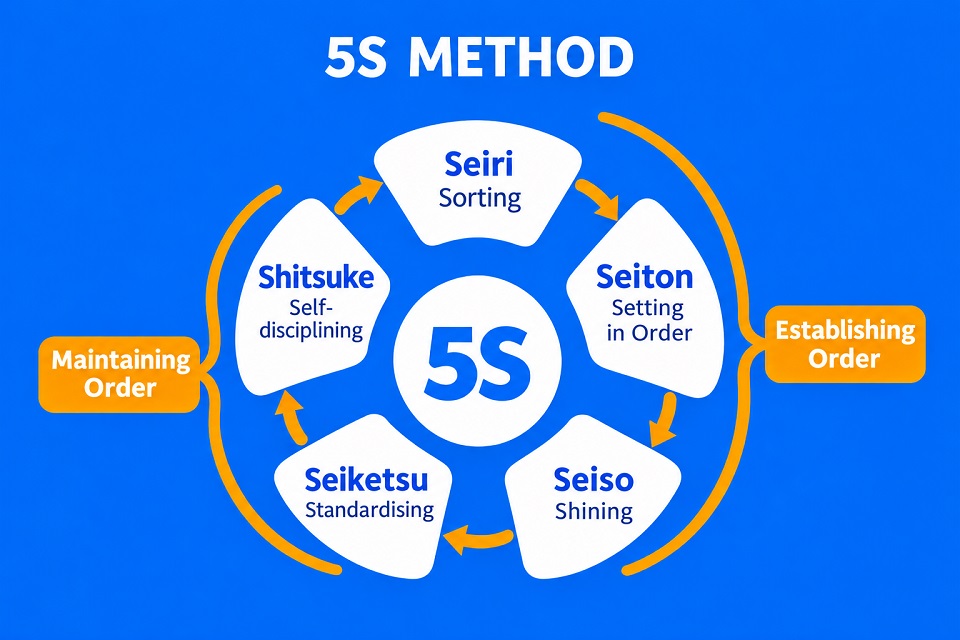
The 5S method is a process for organising and maintaining workspaces within Lean Management. It is also used in quality management. Its aim is to keep necessary work equipment easily accessible, remove unnecessary items and highlight deviations from the agreed state.
The name is derived from five Japanese terms:
- Seiri: Sorting
- Seiton: Setting in order
- Seiso: Shine
- Seiketsu: Standardising
- Shitsuke: Self-disciplining
The method has its roots in Japanese industry and is closely associated with the Toyota Production System. It is not possible to say with certainty who invented it. The first two terms, Seiri and Seiton, had long been familiar in Japanese workplaces as a call to tidy up. The 5S method took its final form thanks to two authors: Takashi Osada described the five steps in 1991 as the key to a quality-oriented working environment [1]. Hiroyuki Hirano published a practical handbook in Japan in 1990, which appeared in English in 1995 and brought the method to international attention [2].
- The name 5S stands for five Japanese terms: Seiri, Seiton, Seiso, Seiketsu and Shitsuke.
- The first three steps create order, whilst the last two ensure that it is maintained in the long term.
- The method originated in Japanese industry and became widely known primarily through books by Takashi Osada and Hiroyuki Hirano.
- The 5S method can be applied to factory floors and offices as well as to digital working environments, such as repositories or ticketing systems.
- The method only becomes effective when those involved actually adhere to the new standards in their day-to-day work.
Why is the 5S method important?
Cluttered work areas lead to time spent searching for items, make it difficult to keep track of equipment and can contribute to errors. The Toyota Production System distinguishes between three types of problems: Muda refers to waste, such as unnecessary searching or rework. Mura refers to inconsistency in processes, and Muri to overloading of people or machines. The 5S method primarily targets avoidable effort and makes disruptions easier to identify.
A lack of designated storage locations prolongs the search for tools or information. If damage or dirt is not detected in good time, this can lead to further errors or interruptions. Such problems are more likely to be identified through clearly defined conditions and regular checks.
5S provides a foundation for this: items and information are assigned fixed locations, work areas are inspected and standards are documented. This can reduce search times and highlight deviations. Whether this leads to improvements in lead times or error rates should be assessed using appropriate key performance indicators.
The principles can also be applied to digital working environments. In repositories, wikis, build environments and ticketing systems, for example, outdated entries, unclear responsibilities or duplicate information can make work more difficult.
The five steps of the 5S method in detail
The steps follow a logical sequence: first, items are sorted out; then they are organised and cleaned. After that, standards are established and practised as part of day-to-day work. As requirements and work areas change, the standards must be reviewed regularly and adjusted where necessary.
1. Seiri: Sorting
First, those involved distinguish between necessary and unnecessary items or information. Anything that is no longer needed is removed or transferred to a designated area. In doing so, retention requirements and company guidelines must be observed. Unclear cases can be marked with red tags and reassessed after an agreed period. Hirano describes this approach as the ‘Red-Tag Strategy’ [2].
2. Seiton: Setting in order
Items that are needed are assigned clear, easily accessible storage locations. Frequently used items are stored as close as possible to where they are used. Labels and visual markings make it easier to find and return items. Where appropriate, measures based on the Poka-Yoke principle can prevent mistakes, such as mechanically interlocked connectors that prevent misalignment. Stock levels should be based on actual requirements.
3. Seiso: Shining
The work area is cleaned and, at the same time, inspected for any abnormalities. This may reveal, for example, wear and tear, loose components or leaks. The team also checks whether the causes of recurring contamination can be eliminated. In sensitive production areas, cleaning also serves to protect against contamination. In a digital context, this step can be applied by analogy to the removal of obsolete test data or dependencies that are no longer required.
4. Seiketsu: Standardising
Seiketsu literally means cleanliness or hygiene. Within the 5S method, this step refers to the standardisation of the achieved state [2]. The team agrees on how the workspace should look, who is responsible for which tasks, and when checks are to take place. Photos of the target state and short checklists make the agreements clear. Standards should be as specific as necessary and as simple as possible.
5. Shitsuke: Self-disciplining
Shitsuke refers to the consistent adherence to and maintenance of the agreed standards. This includes regular routines, training new team members and dealing constructively with deviations. Checks should highlight where rules have become impractical or where support is lacking. This enables the team to adapt standards, rather than simply blaming deviations on individual members.
The first three steps shape the workspace. Standardisation and self-discipline are intended to ensure that the improvements are sustained in day-to-day practice.
Key point: The 5S method only works when a one-off tidy-up becomes a daily habit.
Implementing the 5S method: step by step
For the initial roll-out, it is advisable to select a manageable pilot area with clearly defined responsibilities. The following procedure combines the five steps with the preparatory work and subsequent review:
- Select a pilot area: A manageable area, such as a team or a filing system, delivers quick, visible results and provides valuable experience for other areas.
- Assess the current situation on site: Those responsible go to where the work is taking place and form their own impression. In a Lean context, this visit to the site is known as a Gemba Walk. Photos and notes document the condition before the intervention.
- Define metrics: Search times, lead times or error rates will later show whether improvements have been made. If personal data is collected in the process, data protection considerations and, where applicable, the works council must be taken into account.
- Work through the five steps together: Those involved sort, organise and set standards themselves. A facilitator asks open-ended questions and refrains from offering their own solutions.
- Make standards visible and check them: Short, regular audits using a checklist show whether the agreed standards are being maintained.
- Repeat and improve: Findings from the audits are incorporated into the next cycle. Here, the 5S method ties in with the PDCA cycle, which plans, implements, checks and embeds improvements in four phases.
It is helpful to start on a limited scale. This allows the team to assess which rules actually make the work easier before applying the approach to other areas.
Examples of the 5S method in software development
The following fictional examples illustrate how the principles can be applied to areas of work in software development:
The repository: A development team has accumulated more than 200 branches. The team first checks which branches are still required and only removes unnecessary entries once outstanding work has been clarified and applicable retention rules have been established. It then agrees on a naming convention and, where appropriate, enables the automatic deletion of branches that have already been merged. Regular checks ensure that the agreed state is maintained.
The team wiki: Within a product team, there are four documentation pages for the same interface, containing contradictory information. The team archives outdated pages, establishes a standardised structure and appoints a person responsible for each area. A brief review of the pages becomes part of the Definition of Done, ensuring that the documentation evolves alongside the code.
The test environment: Virtual machines are running on a shared test server without any clear assignment of responsibility. The team documents their purpose and the persons responsible, checks which instances are no longer needed and shuts them down once approval has been given. A script can regularly reset test data to a defined state, provided that the necessary data is retained.
The device lab: An app team tests on around 30 smartphones and tablets, which are scattered in desk drawers. Each device is assigned a labelled slot in a charging station, and a loan list shows who is currently using which device. Once per sprint, one person checks each device in turn to ensure they are all present and have the latest operating system versions.
How does the 5S method differ from related concepts?
The 5S method is often mentioned in the same breath as other approaches that also aim for order, quality and improvement. The differences lie primarily in the focus and scope.
How does the 5S method differ from a one-off tidying exercise? A one-off tidying exercise improves a situation on a one-off basis. With 5S, rules for maintenance and inspection are also agreed. This makes it possible to determine whether order is maintained in day-to-day work.
How does the 5S method differ from Kaizen? Kaizen refers to the ongoing improvement of working methods and processes with the involvement of staff. The continuous improvement process (CIP) builds on this concept. 5S is a specific procedure for organising and maintaining work areas and can be implemented as part of a CIP.
How does the 5S method differ from Clean Code? Clean Code describes values, principles and practices that make code easy to read and maintain. The focus is on the source code itself. 5S focuses on the working environment surrounding development, i.e. storage, tools, surroundings and processes. However, both approaches share the same underlying idea: order is achieved through regular maintenance and shared conventions.
The approaches therefore differ in their scope: Kaizen, or continuous improvement, relates to ongoing improvements in general, whilst 5S focuses on the condition and organisation of workspaces.
Advantages and disadvantages of the 5S method
The steps are easy to follow and can initially be trialled in a small area. The main effort involved lies in coordination, documentation and the ongoing maintenance of the standards.
The advantages include:
- Low barrier to entry: Existing resources are usually sufficient for a pilot area. How quickly results become apparent depends on the initial situation and the scope.
- Less time spent searching: Clear storage locations and labelling can reduce the time spent searching for tools, files and information.
- Shared rules: If the team helps to develop the standards, different requirements can be taken into account and responsibilities clarified.
- Better overview and safety: Unobstructed pathways and regular visual inspections can reduce hazards in the physical workspace. In digital environments, removing components that are no longer needed helps to limit unnecessary complexity; safety implications must be assessed separately.
The disadvantages include:
- A return to old habits: Without clearly defined responsibilities and regular checks, the status quo may be lost.
- Resistance to change: Guidelines drawn up without the involvement of those affected may be perceived as unnecessary control.
- Maintenance effort: Checklists and controls take time. Their scope should be commensurate with the actual benefit.
- Over-regulation: Overly detailed rules can restrict sensible individual working practices.
The introduction should therefore be designed in collaboration with those involved. Managers can set aside time for implementation and help to remove obstacles. Whether the measures are effective is demonstrated by their impact on day-to-day work.
Questions from the field
Here you will find some questions and answers from practice:
What is 6S?
6S adds a sixth point to the five steps: safety. This extension explicitly makes it a priority to identify and eliminate sources of danger in the workplace. In substance, this concept is already embedded in the classic steps, for example when cleaning or keeping walkways clear. However, giving it its own category ensures that safety is not overlooked during audits, which is particularly useful in production and logistics.
Can the 5S method be used on its own?
Yes, the five steps work just as well without a team when it comes to your own desk, personal filing system or email inbox. However, the real strength of the method lies in shared spaces. There, several people contribute different perspectives, and only mutually agreed standards prevent everyone from maintaining their own system of organisation. Anyone applying 5S on their own also misses out on the mutual reminders that help with the fifth step.
How can the success of the 5S method be measured?
Suitable metrics are those collected under comparable conditions both before and after implementation. In production, for example, search times or error rates may be considered. In software development, the number of unexplained branches or the time taken to set up a functional development environment can provide useful insights. The duration of a build, on the other hand, is only a suitable metric if the 5S measures actually affect the build environment. In addition, audits check whether the agreed standards are being adhered to. Photographs alone do not prove lasting improvement.
Impulse to discuss:
How much standardisation can a development team’s working environment tolerate before it hinders rather than supports the individual working styles of its members?
Notes:
If you like this post or would like to discuss it, please feel free to share it within your network.
[1] Takashi Osada: The 5S’s. Five Keys to a Total Quality Environment. Asian Productivity Organisation, Tokyo 1991.
[2] Hiroyuki Hirano: 5 Pillars of the Visual Workplace. The Sourcebook for 5S Implementation. Productivity Press, Portland 1995. The original Japanese edition was published in 1990. Hirano refers to the fourth step as “Standardised Clean-up” and describes the practice of marking items in question with red tags as the “Red-Tag Strategy”.
Here you will find an interesting article on the Delete Strategy: Relief instead of overload.
Here you will find a post well worth reading about Obeya and the visualisation of relevant information.
And here you’ll find more information from our Smartpedia section:

What is the PDCA-Cycle?
What is Kaizen?
What is Clean Code?
‘Smartpedia’ is our glossary for people in organisations involved in software development, project management and product management. It is for precisely these people and their organisations that we have been developing and modernising software since 2012. Pragmatic. ✔️ Personal. ✔️ Professional. ✔️
Get to know t2informatik from Berlin as your development partner.