
How to motivate Generation Z and Alpha long term
Perhaps you’ve experienced situations like this: after what you consider to be a factual feedback meeting, your trainee seems offended for days on end. Your trainee calls in sick at short notice on Monday mornings with striking regularity. Or you walk into the office, the telephone rings shrill, but your three trainees turn a deaf ear with almost masterful skill and simply refuse to pick up the receiver.
For many trainers and managers, situations like these are part of everyday working life. This quickly gives the impression that Generation Z and the emerging Generation Alpha are more difficult to manage, less resilient or need to be motivated differently from previous generations.
It’s not quite that simple. Not every point of friction between trainers and junior staff is a generational conflict. Sometimes it’s simply a clash of differing expectations. At the same time, we can observe that young people today express and demand certain expectations more matter-of-factly. They want to know what is expected of them, why they are doing something, how their work is perceived and what opportunities for development are available to them.
Much of this is, at its core, not a new form of leadership, but good training. Young people may simply be articulating more clearly what is actually helpful for all staff: guidance, responsibility, feedback and development.
It is precisely from this that seven specific levers for day-to-day training can be derived.
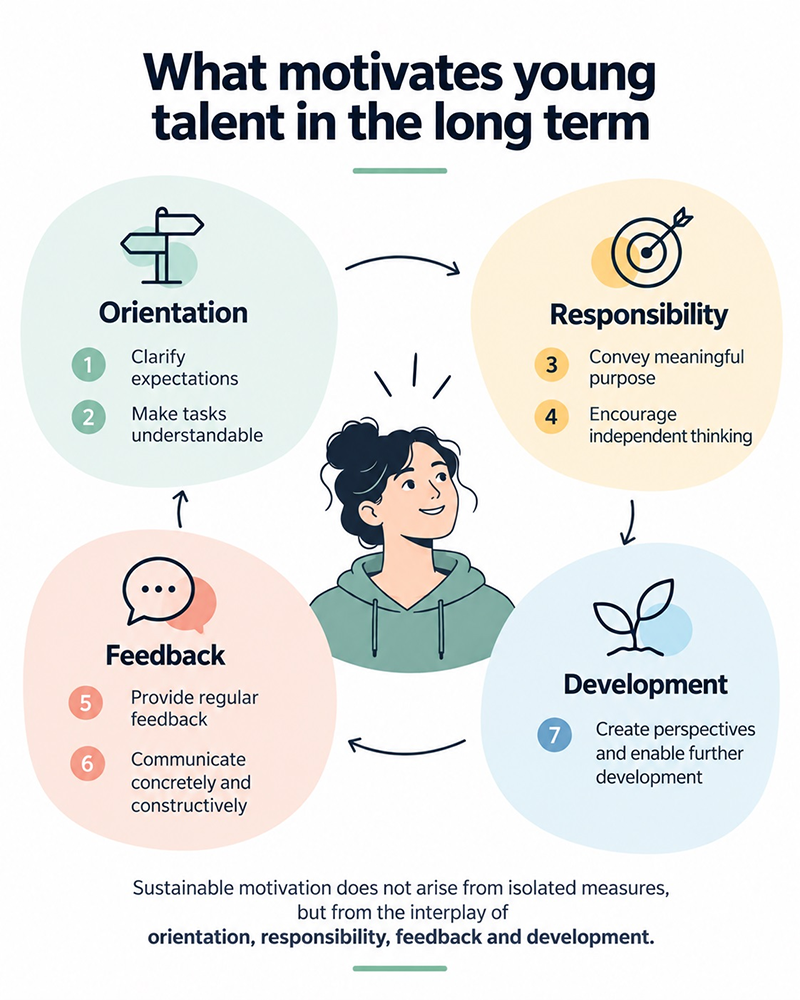
Figure: What motivates young talent in the long term
Providing orientation
If people do not know what is expected of them, they will find it difficult to meet those expectations. Guidance should therefore not only be provided once something has gone wrong; it should be established as early as possible.
1. Ensure clear management of expectations
Ideally, managing expectations should begin in the very first weeks of onboarding. Make a point of setting aside time for a discussion and explain specifically what you mean by punctuality, good communication, reliability and initiative.
Equally important is the other way round: ask your trainees what expectations they have of the training programme, of working together and of you as their trainer. Expectation management only works well when both sides know what is important to the other.
It’s worth explicitly stating things that might be taken for granted. What seems obvious to you after many years in the profession may not be so for someone who is just entering the world of work.
2. Ensure clear objectives and tasks
A task can be delegated quickly. But that doesn’t mean it’s automatically clear.
When assigning a new task, specify four things where possible:
- What needs to be done?
- What is the result needed for?
- By when should it be finished?
- And how will the junior staff member know that the task has been successfully completed?
These four points prevent many follow-up questions, misunderstandings and unnecessary frustration.
Another step is often overlooked when delegating: check whether you are both actually talking about the same thing. Ask, for example: “How did you understand the task?” or “What would be the first step for you now?”.
Young trainees, in particular, do not always have the confidence to ask for clarification when something is unclear to them. They may fear appearing inattentive or incompetent, and therefore prefer to simply nod. A quick question to check their understanding helps to identify misunderstandings before they become apparent in the final result.
Enabling responsibility
Guidance does not mean dictating every single step of the process. Good training establishes a clear framework and, within that framework, enables increasingly independent action.
3. Do not treat junior staff like cheap labour
Making coffee, vacuuming or sitting in the break room for hours because nobody knows what to do at the moment: unfortunately, I hear stories like this time and time again. In the long run, this does little to foster a sense of being needed or of actually learning anything.
Of course, any training programme also includes tasks that may not seem particularly exciting at first glance. Copying, scanning or filing can all be part of it. What matters, however, is the context.
Explain why a task is necessary, what the result is needed for, and how the trainee is contributing through it. Even more importantly, as trainees gain experience, assign them tasks where they can actually make a contribution and take on responsibility.
Meaning doesn’t arise simply because a task is interesting. It also comes from knowing why one’s own work is important.
4. Encourage independent thinking and self-reflection
Those who are always given solutions straight away learn one thing above all else: to wait for the next solution.
You should therefore ask questions more often rather than giving immediate answers. “How would you tackle this problem?”, “What options do you see?” or “What would you do differently next time?” are simple questions that encourage independent thinking.
This takes more time initially. After all, it’s quicker to explain your own solution than to guide someone through developing their own.
In the long run, however, this time pays off. Young professionals learn to structure problems themselves, make decisions and take responsibility for their work. At the same time, they experience being trusted to do the job.
Shaping feedback as a dialogue
Anyone expected to take on responsibility needs feedback. Otherwise, it remains unclear what is already working well and where there is room for improvement.
Two things are crucial here: feedback should be provided regularly and phrased in such a way that the other person can actually make use of it.
5. Give feedback regularly
In day-to-day training, feedback shouldn’t only take place when something goes wrong or the next formal appraisal is due.
Short, regular conversations can be sufficient for this. A fixed debrief at the end of the week, for example, provides an opportunity to ask three simple questions:
- What went well this week?
- Where were there difficulties?
- What are we planning for the coming week?
This isn’t about constant praise. Regular feedback provides guidance and makes progress visible. At the same time, it creates a space where difficulties can be addressed before minor irritations turn into major conflicts.
And feedback shouldn’t be a one-way street. Also ask what your trainees need from you or what you, as a trainer, could do differently.
6. Give feedback that your counterpart can act on
Regular feedback is of little use if it is generalised, personally hurtful or unclear. A simple structure provides help: observation, impact, wish.
First, describe your observation as specifically as possible and stick to observable behaviour. Instead of ‘You’re always late’, you could say, for example: “At the last three team meetings, you arrived about ten minutes after the agreed start time on each occasion.”
Next, describe the impact this behaviour has on you or on teamwork: “Then I’m not sure if we can plan with you, and we end up starting the meeting without you.”
Finally, formulate a specific request: “I’d like you to be there at the agreed time in future. If that’s not possible on occasion, please let me know briefly in advance.”
This turns a general assessment into specific feedback to which the other person can respond.
Incidentally, good feedback does not mean avoiding conflict or wrapping criticism up particularly carefully. It means clearly stating what the issue is without devaluing the person behind the behaviour.
Making development visible
Guidance, responsibility and feedback help in day-to-day working relationships. However, when it comes to long-term retention, there is another question to consider: what prospects does a young talent see within the company?
7. Actively support the development of your apprentices and young talents
One career progression meeting a year is hardly enough if you want to inspire young talent to stay with your company in the long term.
You should therefore discuss development regularly:
- What would they like to learn?
- Which skills would they like to develop further?
- What additional responsibility would be the next sensible step?
- And what prospects are there once their training is complete?
Development does not necessarily have to mean the next major training course. Small additional qualifications, involvement in a new project, mentoring programmes or additional responsibility can equally demonstrate: ‘We recognise your abilities, and we’re investing in your further development.’
Don’t forget the trainers and training coordinators. Anyone tasked with supporting young people needs the right skills and working conditions themselves.
Age-appropriate communication, constructive conflict resolution and supporting different learning paces are all skills that can be developed. Well-qualified trainers therefore not only benefit from further training themselves, but also create better conditions for the development of their young talent.
Sustainable motivation requires more than just individual measures
None of these seven levers will transform your day-to-day training activities overnight. In any case, it is not so much the individual measures that matter as the way they work together.
Young professionals need guidance so that they know what is expected of them. They need responsibility so that they can see that their contribution matters. They need feedback so that they can assess and improve their own actions. And they need opportunities for development so that they can see a future for themselves.
Seen in this light, motivating Generations Z and Alpha is perhaps less about inventing a completely new style of leadership. It is about consistently delivering a good training programme and adapting it where expectations and forms of collaboration are changing.
And perhaps the trainee from the opening example will actually approach you next time if they do not understand your feedback or do not wish to accept it as it stands. The conversation that ensues may initially be more taxing than a silent nod. However, it could prove far more valuable for a good working relationship in the long term.
Notes:
The work of the ROCK YOUR LIFE! Academy also addresses these topics. It supports companies in better guiding, developing and retaining apprentices and young talent in the long term. To this end, ROCK YOUR LIFE! offers online training courses and interactive workshops for those responsible for apprenticeship programmes. The focus includes age-appropriate communication skills, constructive conflict resolution and the question of how young people can be supported individually and in their personal development.
The next 12-week German-language trainer programme starts on 23 October 2026. It requires a time commitment of around two hours per week, which can be organised flexibly.

Melissa Hoellerer
Since 2019, Melissa Hoellerer has been designing effective mentoring and training programmes for apprentices, as well as further training courses for trainers, at the ROCK YOUR LIFE! Academy, and has been embedding these sustainably within SMEs, large corporations and public institutions such as Handtmann, Amazon, Rossmann and Hessischer Rundfunk. Whilst trainees are supported in training and mentoring programmes to take on responsibility, develop their social skills and tackle challenges independently, those responsible for training are provided with practical tools for facilitating discussions, resolving conflicts and offering individual support to young people.
On the t2informatik Blog, we share knowledge and experience with people in organisations. We have been developing and modernising software for them since 2012. Pragmatically. ✔️ Personal. ✔️ Professional. ✔️ Get to know t2informatik as your development partner.