
What is the NABC Method?
Table of Contents: Definition – Elements – Importance – Example – Advantages and limitations – Questions from the field – Notes
Smartpedia: The NABC method outlines a well-thought-out approach to developing and presenting ideas based on Need, Approach, Benefit and Competition.
NABC as a method for developing and communicating ideas
In practice, good ideas rarely fail because of their core concept, but often because of the way they are presented. Anyone presenting a new product, a research project or an internal project often gets bogged down in technical details, whilst key questions remain unanswered: Who is actually affected by the problem? Why is this particular solution the right one? And how does the idea differ from existing alternatives?
Without a clear structure, presentations and proposals often remain incomplete. The benefits for the target audience are not quantified, the chosen approach is not justified, and any comparison with existing solutions is entirely absent. Decision-makers then find it difficult to assess the viability of an idea – regardless of how convincing the idea actually is in terms of content.
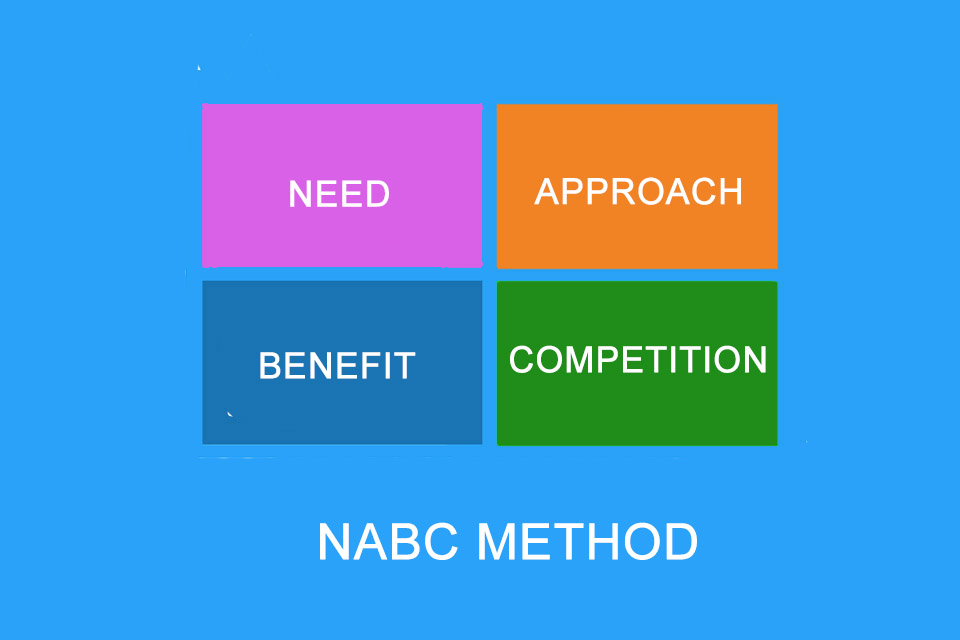
This is precisely where the NABC method comes in. It requires you to think through and present an idea based on four fixed elements: Need, Approach, Benefit and Competition. This results in a clear, comparable and concise presentation that facilitates both the development of the idea and its communication to third parties.
The four elements of the NABC method
NABC was developed in the 1980s at SRI International (Stanford Research Institute), largely under the influence of Curtis Carlson, who originally used the framework to systematically evaluate internal research projects and spin-offs. [1] NABC has since become established far beyond its origins – for example, in innovation workshops, investor pitches and product development.
At its core, the method breaks down every idea into four fixed elements, which together form a complete value proposition:
Need describes the specific need or problem faced by a target group. The aim here is to clearly identify who is affected, how significant and urgent the problem is, and why a solution is needed at all. The more precisely – and, where possible, the more quantitatively – the need is described, the more convincing the overall idea appears.
Approach describes the chosen solution. This element explains how the idea, product or project addresses the need described above. What is important here is not only the technical or substantive implementation, but also the rationale for why this particular approach was chosen.
Benefit describes the benefit that the Approach generates for the target group as well as, where applicable, for the organisation itself. Here, too, the more concrete and measurable the benefits are presented – for example, through figures, time savings or cost-effectiveness – the more convincingly the idea can be communicated.
Competition describes existing alternatives or competitors, such as other products, services or simply the current status quo. This element shows how your own idea stands out and why it has an advantage over existing solutions.
The four elements build on one another: without a clearly defined ‘Need’, the ‘Approach’ appears arbitrary; without a comprehensible ‘Benefit’, the value remains abstract; and without addressing the ‘Competition’, the idea lacks context within its environment. Only when all four points work together does a complete and convincing presentation emerge.
Why is the NABC method important?
Ideas, projects and initiatives are constantly competing for attention, budget and resources within organisations. However, those responsible for deciding which ideas to pursue can only examine a limited number of proposals in detail. Without a common structure, ideas are presented in different ways, justified in varying degrees of detail, and are therefore hardly comparable. NABC provides a standardised format that allows completely different initiatives – from a new technical development to an organisational change – to be assessed on the same basis.
A key reason for the importance of the NABC method lies in the enforced focus on customer benefit. Many ideas arise from technical enthusiasm or internal interest, without it being clear from the outset who they actually benefit. As NABC begins with the ‘Need’, the method compels us to first clarify the target group’s needs before discussing the solution. This prevents the development of solutions that, whilst technically interesting, fail to meet the needs of the market or the target group.
The NABC method also makes it essential to engage with the competition. When viewed in isolation, ideas often seem more convincing than they actually are when compared with existing alternatives. By making a comparison with existing solutions a mandatory part of the process, it becomes clear at an early stage whether an idea really makes a difference or whether it is simply re-addressing a problem that has already been solved.
Last but not least, the NABC method improves the communication of ideas. A presentation structured according to NABC can be grasped quickly, regardless of how complex the underlying topic is. This is particularly important in situations where time is limited – such as during pitches, in decision-making bodies or in brief feedback sessions.
NABC is therefore less a tool for generating ideas in itself, and more a means of making ideas tangible, comparable and ready for decision-making.
Example of the NABC method
A concrete example best illustrates how the four elements of NABC complement one another. Let us assume that a team in a medium-sized company wishes to improve internal project reporting and presents its idea using NABC.
Need
Within the company’s project teams, project managers spend an average of three to four hours a week manually transferring status information from various tools into weekly reports for management. An internal survey of 40 project managers shows that over 70 per cent consider this effort to be unnecessary and prone to errors – in some cases, the information is already out of date by the time the report is produced.
Approach
Instead of compiling reports manually, an internal dashboard will automatically consolidate data from the project and ticketing systems already in use and present it in real time. This will provide managers with an up-to-date overview at all times, without project teams having to undertake any additional manual work.
Benefit
Automation virtually eliminates the weekly reporting workload – with an estimated 50 project managers in the company, this results in a saving of around 175 hours per week. At the same time, data quality improves, as information is no longer transferred manually and is therefore no longer distorted or presented as out of date.
Competition
Although project dashboard solutions available on the market cover similar functions, they are not tailored to the company’s existing system landscape. A trial calculation revealed licence costs of around 18,000 euros per year, plus an estimated migration effort of eight to ten person-weeks. The alternative – sticking with the current manual approach – permanently ties up valuable working time without improving data quality.
This concise example alone illustrates the impact of the method: the idea no longer comes across as a mere pipe dream (“we need a dashboard”), but is concretely justified, backed up by figures and distinguished from existing alternatives. This is precisely what makes it easy for decision-makers to quickly assess the viability of the idea.
Advantages and limitations of the NABC method
NABC can significantly improve the development and communication of ideas, as the method enforces clarity and comparability where arbitrariness would otherwise often prevail.- The fixed structure ensures that none of the four key questions is overlooked. In unstructured presentations, the ‘Need’ and ‘Competition’ aspects in particular are often neglected, even though they are crucial for evaluating an idea.
- The standardised structure makes different ideas and projects comparable. Decision-makers can lay several NABC descriptions side by side and evaluate them on the same basis, regardless of how different the underlying topics may be.
- As NABC is designed to be concise and specific, the method forces users to distil an idea down to its essentials. This not only facilitates external communication but often helps to identify unclear or underdeveloped aspects of an idea even during the development phase.
- The brevity that characterises NABC can also lead to the oversimplification of complex issues. Some ideas cannot be meaningfully reduced to four short statements without losing important nuances.
- NABC provides a structure, but no guarantee of the quality of the answers’ content. A superficially researched competitive analysis or an unsubstantiated benefit remains open to criticism even in NABC form – the method is no substitute for careful research or validation.
- Furthermore, NABC is not a tool for generating ideas in its own right. The method presupposes that an idea already exists which can be described and evaluated. Other methods, such as those drawn from design thinking, are better suited to generating new ideas.
Questions from the field
Here are some practical questions and answers:
Is NABC the same as an elevator pitch?
Not quite. An elevator pitch is, first and foremost, a short, verbal form of presentation. NABC, on the other hand, is a content-based framework that sets out the four aspects an idea must cover. In practice, the two are often combined: the NABC framework provides the content, whilst the elevator pitch provides the short, verbal format in which that content is presented.
How does the NABC method differ from the Business Model Canvas?
The Business Model Canvas maps out an entire business model using nine building blocks, such as channels, cost structure and key partners. The NABC method is significantly more streamlined and focuses exclusively on the four core questions of a value proposition. NABC is therefore particularly suitable for the early stages of an idea, whilst the Business Model Canvas tends to be used when a business model needs to be developed in more concrete terms.
How long should an NABC description be?
There is no fixed requirement, but the basic principle of the NABC method is brevity: a complete NABC description often fits on a single page, and sometimes even consists of just a few sentences per element. What matters is not the length, but that all four elements are answered comprehensively and clearly in terms of content.
Impulse to discuss:
Does the brevity of NABC sometimes prevent complex or long-term ideas from being presented properly, or does it actually force the writer to bring out the very essence of an idea more clearly?
Notes (partly in German):
If you like the article or would like to discuss it, please feel free to share it in your network. And if you have any comments, please do not hesitate to send us a message.
[1] Wikipedia: Curtis Carlson
Here you can find further information about Curtis Carlson and Innovation for Impact.
Here you can find a video on NABC – How to test and present your idea.
And here you can find more information from our Smartpedia section:

What is an Elevator Pitch?

What does a Facilitator do?

What is Ideation?
‘Smartpedia’ is our glossary for people in organisations involved in software development, project management and product management. It is for precisely these people and their organisations that we have been developing and modernising software since 2012. Pragmatic. ✔️ Personal. ✔️ Professional. ✔️
Get to know t2informatik from Berlin as your development partner.