
Welcome to the culture gap
Expand the table of contents
Imagine a senior developer signs an employment contract with you, attracted by promises of ‘maximum agility’ and ‘flat hierarchies’. In their first week, they sit in a three-hour analogue approval meeting for a monitor adapter. Welcome to the culture gap.
What happens when the promise to the outside world is greater than the reality inside? This is where a dangerous zone of incredibility begins. The culture gap describes the difference between the communicated employer brand and the actual corporate culture. It rarely arises from bad intentions. It arises from different speeds.
Marketing and communication often develop at breakneck speed, while internal structures and behaviours take years to change. Career pages are modernised, but processes are not. In the IT world, we would say: you build a shiny front end on top of a back end full of legacy code and unsolved bugs.
Cultural debt: The interest on deception
In software development, we are familiar with the concept of technical debt: you opt for the quick, messy solution instead of the sustainable one. You gain time in the short term, but pay high interest later on. [1] A culture gap is nothing more than ‘cultural debt’.
Today, you buy attention and applications through highly polished claims from an agency, which you later repay with hard currency: cynicism and fluctuation.
The problem is not the vision itself. The problem is the lack of synchronisation. Employer branding is often mistakenly understood as a completed project with a deadline. But culture is a living system. And systems do not change through new claims or colourful creatives. They change through decisions, behaviour and leadership.
In their campaigns, companies talk about trust, transparency and equality. But internally, silo thinking, decision-making bottlenecks and a lack of feedback culture often still dominate. The stronger the external communication, the more obvious this contrast becomes. This is extremely dangerous because expectations create psychological contracts. If these are broken, trust declines rapidly. Recent engagement studies clearly show that the main problem is not a lack of benefits, but inconsistent leadership behaviour. [2] ‘Silent quitting’ does not arise because of a lack of fruit baskets, but because people feel deceived. [3]
Five steps to avoiding the culture gap
A culture gap cannot be closed with another campaign. It requires structure and honest work, which management often underestimates because it comes on top of day-to-day business. But if you want to be more relevant than the competition in 2026, you have to do more than just celebrate New Work rhetorically; you also have to incorporate this part of the work into your day-to-day business.
1. Culture diagnosis before brand work
Before new claims are formulated, a ‘code review’ of your culture is needed. [4] An honest assessment of the current situation is painful but essential:
- How do employees experience leadership in stressful moments?
- How transparent are decisions really?
- Which values are rewarded in everyday life and which are sanctioned?
Without this analysis, any positioning is a high business risk.
2. Determine the maturity of the organisation
Not every company is ready for loud employer branding. Ask yourself critically:
- Are our processes stable?
- Do we have a culture of error that allows for reflection?
- Is our leadership uniformly aligned?
Employer branding should only be as loud as internal maturity allows. Those who promise ‘maximum flexibility’ but enforce a culture of presence internally will produce a steady stream of miscasts.
3. Systematically integrate leadership
Culture is not controlled by HR; it is lived by leadership. If managers are not an integral part of the strategy, a gap automatically arises. According to Gallup, 87% of employees judge their employer primarily on the basis of internal communication and their direct supervisor. [4] In concrete terms, this means:
- Involve managers in the positioning process.
- Define expectations of leadership behaviour in measurable terms.
- Establish feedback loops, including with management.
4. Adjust the speed of communication (synchronisation)
Not every message needs to be published immediately. Sometimes it is wiser to stabilise internal issues first. In IT, you don’t release a feature that hasn’t passed beta testing. If you communicate ‘development’, the budget for it must already have been approved. If you emphasise ‘appreciation’, it must be noticeable in everyday life.
Communication can make reality visible, but it must never replace it. Selling standard things (such as Wi-Fi at work or home office options) as exclusive benefits does not make you attractive to talent, but rather clueless. [5]
5. Use the employee journey as a diagnostic tool
The journey is not an HR buzzword, but your most important control tool. Systematically analyse where the promise breaks down. Use the phases below to examine the journey:
- Job search & application: Do you advertise with ‘innovation’, but your application process is complicated and not optimised for mobile devices? The first impression shapes the entire picture.
- Selection: Do you talk about ‘eye level’, but the interview feels like an interrogation? According to Stepstone, 70% of talent cannot even remember the company name when messages are interchangeable – differentiation comes from genuine experience. [6]
- Feedback: Do you promise transparency but only send standard rejection letters without explanation? This damages the brand before it can even take effect.
- Onboarding: The most critical time window. If the promised ‘high-tech equipment’ is not available on the first day or access is missing, the culture gap is immediately noticeable.
- Offboarding & alumni: The way you part ways is the ‘maturity test’ of your culture. Former employees are your strongest brand ambassadors. If they are ignored, the former branding turns into negative reviews on portals such as Kununu.
Those who consistently follow these five steps close the gap not with words, but with maturity, leadership and lived experience throughout the entire journey.
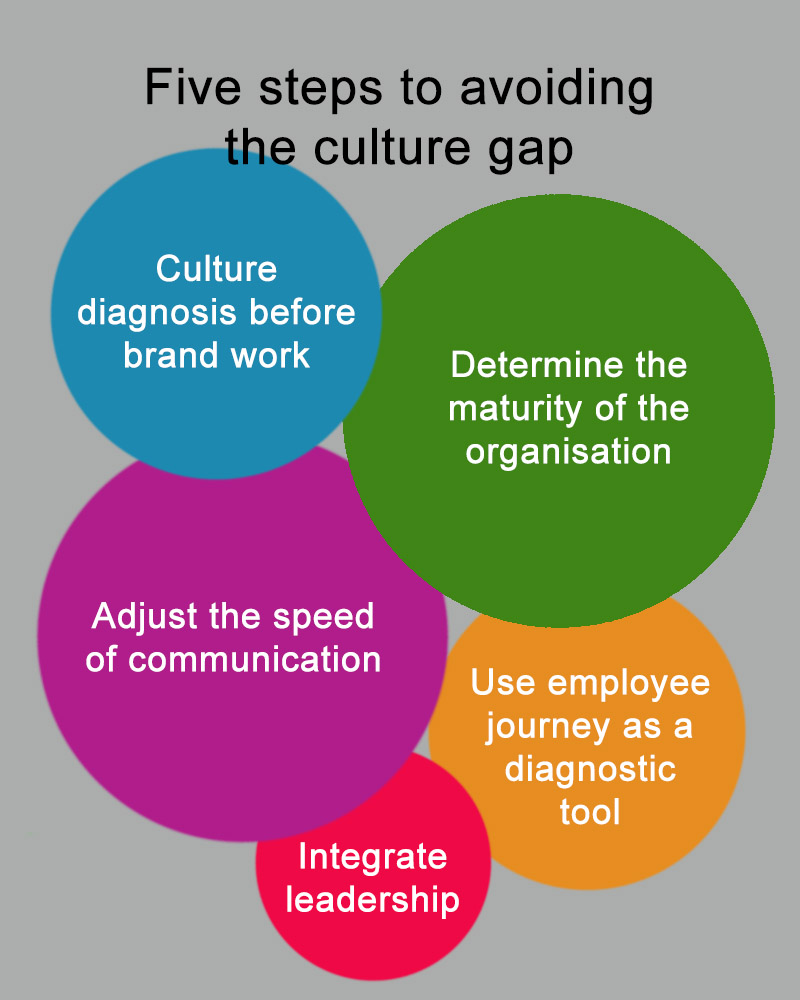
Figure: Five steps to avoiding the culture gap
Conclusion: Consistency beats perfection
The hardest currency of your employer brand is not what you write in your job advertisement or post on LinkedIn. It’s what your employees tell their friends on Friday evening. HR must evolve from being a process manager to a visible culture shaper.
There is no universal best practice, because culture is context-dependent. But successful organisations follow clear principles:
- Honesty before speed
- Integrity before image
- System thinking instead of individual measures
If you do nothing, the culture gap will grow with every claim. At some point, the perception will shift from ‘inspiring’ to ‘untrustworthy’. Regaining trust is much more difficult than protecting it from the outset. Therefore: focus on your current employees. They are the foundation.
If you really want to make an impact, you need more than just a new framework. You need consistency. If you want to build your employer branding strategy on a solid foundation, I can help you align your culture, leadership and journey. So that your brand not only looks good, but also lasts.
Notes (partly in German):
Want to break out of the bubble and make a real impact? Then start with a thorough analysis of your employee journey. Belinda Weibel supports you with an honest outside perspective, sound methodology and practical ideas. So that your employer brand not only looks good, but also makes a difference. Simply contact her on LinkedIn.
[1] ‘Technical debt’ is a metaphor for future, additional expenses as a result of delivering imperfect products in the present. The metaphor comes from Ward Cunningham, one of the 17 authors of the Agile Manifesto and the inventor of the wiki system. Here are some causes of technical debt.
[2] WirtschaftsWoche: Gallup-Studie: Führungskraefte sind der wahre Produktivitaetskiller
[3] Silent or quiet quitting refers to a work behaviour in which employees distance themselves emotionally from their job and only perform the contractually agreed minimum.
[4] A code review is a systematic examination of source code with the aim of finding errors and deficiencies in the code in order to improve the quality of the software. Here are some advantages of code reviews.
[5] Gallup: Global Data Summary – State of the Global Workplace 2025
[6] Universum: Employer Branding NOW 2023: What were the findings?
Would you like to discuss culture gaps and employer branding as a multiplier or opinion leader? Then share this post in your networks.
Belinda Weibel has published another post on the t2informatik Blog:

Forgotten touchpoints in the candidate journey

Belinda Weibel
As an independent consultant, Belinda Weibel brings HR and marketing together – strategically, digitally and with a keen sense of what really drives companies. She supports organisations in building strong employer brands and rethinking the entire employee experience.
Her consulting goes beyond the traditional HR perspective: with her experience in the social media agency world, she combines strategic HR expertise with digital excellence. There’s no buzzword bingo here, just clear language that gets results.
On the t2informatik Blog, we share knowledge and experience with people in organisations. We have been developing and modernising software for them since 2012. Pragmatically. ✔️ Personal. ✔️ Professional. ✔️ Get to know t2informatik as your development partner.