
Peter Drucker meets AI
Fictional conversations about responsibility, meaning and artificial intelligence
Peter Drucker coined the term ‘knowledge work’. Today, systems intervene precisely in this area: they write texts, summarise knowledge and provide suggestions for decisions. What would Drucker say about this? What questions would he ask managers, IT consultants, employees and society? And what answers would he give them?
This is the first part of a series of fictional conversations. In it, Peter Drucker meets well-known figures and people like you and me. People with different roles in organisations, who have fears and worries, desires and hopes. These conversations are less about technical tricks and more about impact: what does AI do with responsibility, meaning and our everyday actions? The series is intended to stimulate and invite reflection and contradiction. And it accommodates both: fascination with new possibilities and concern about consequences.
Why Peter Drucker, who died in 2005 and did not live to see the launch of the iPhone or the breakthrough of generative AI? Precisely because of this, his perspective is worthwhile. Drucker did not think in terms of product cycles, but in terms of questions that have a longer-term impact. As a social ecologist, he did not look first at technology and tools, but at work and collaboration. Despite all the hype, even powerful AI remains a tool in the end.
In this first article, I will show why Drucker’s perspective is really helpful in the age of AI.
Making knowledge work effective
How can we recognise good work when more and more knowledge is being generated automatically?
Drucker drew attention to work in which thinking, questioning and problem solving create value. In doing so, he shifted the focus in management away from the pure efficiency of physical work and towards the effectiveness of intellectual work. It is precisely this area that is currently undergoing radical change. AI generates texts, analyses and even strategy proposals. Drucker would probably have asked less about the technology and more about its impact. What does productivity mean when knowledge becomes a commodity?
His answer remains relevant today: empower people. Knowledge workers need autonomy, responsibility and meaning. When AI takes over routine tasks, it creates space for creativity: for judgement, creativity and meaning. Drucker’s warning sounds more relevant than ever: ‘There is nothing so useless as doing efficiently what should not be done at all.’ Efficiency alone is not enough. AI also requires intelligent and conscious use through conscious leadership.
This brings us to his distinction between efficiency and effectiveness: ‘Efficiency is doing things right; effectiveness is doing the right things.’ This is precisely where the challenge of the present lies.
Generative AI is a machine for extreme efficiency. But those who only work faster without checking whether they are doing the right thing may end up perfecting the wrong thing. Drucker’s statement thus takes on new relevance: AI must not become an accelerator of bureaucratic routines. Instead, it should help to make decisions more creative, more human and more customer-oriented.
True effectiveness arises when efficiency serves a purpose. Progress then means not doing more, but acting more consciously, i.e. with responsibility and orientation. Drucker provides the compass for using technology wisely and humanely.
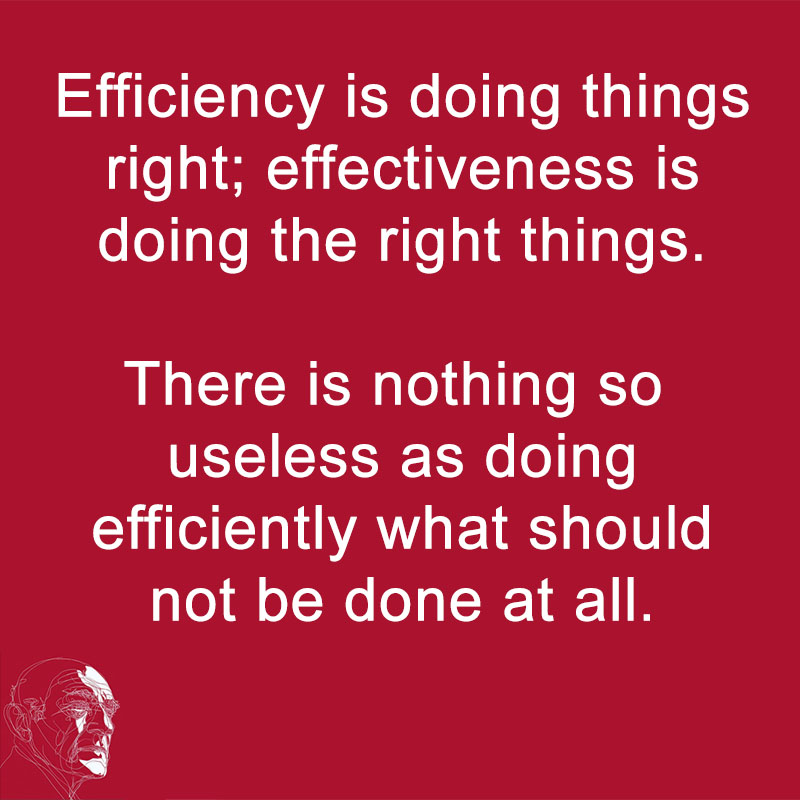
Figure: Efficiency and effectiveness
The computer as an ‘idiot’, humans as meaning makers
Peter Drucker was sceptical about computers, but he was not hostile to technology. He saw them as precise logic machines. In an exaggerated image, he called them ‘mechanical morons’. By this he meant that they are logical, fast and reliable, but have no understanding of meaning and purpose.
His criticism was not directed at computing power, but at the false assumption that logic could replace judgement. For Drucker, data is not yet information. Only when placed in context does it take on meaning. For example, a company may know that it has sold 115,000 units of a product, but only when this is compared with targets, previous years or what customers really need does it become knowledge that supports decision-making.
Back then, it was about computers. Today, the same question arises even more acutely with AI. AI can recognise patterns in huge amounts of data, but interpreting them remains a task for humans.
Let’s take customer support as a simple example: artificial intelligence can produce answers in a matter of seconds. That’s efficient, but is it also good? Do quick answers really help the customer, or do they give up in frustration after a few rounds of going round in circles? And what does that do to trust and satisfaction in the long run? Drucker would say: ‘The decision about what constitutes good help is made by the organisation. And the more AI can do, the more important the question becomes: what do we use it for? Technology creates opportunities, leadership creates direction.’
What matters when algorithms provide answers?
Peter Drucker understood management as a ‘liberal art.’ By this he meant that management has to do with people, values and responsibility, not just numbers and efficiency. It is “liberal” because it combines knowledge, self-awareness and judgement. And it is an ‘art’ because all of this must prove itself in decisions, structures and culture.
In the age of AI, this view takes on new depth. Machines can calculate, control and optimise. But they don’t know what an organisation stands for. Leadership therefore does not mean introducing even more control. Systems are good at control. Leadership means giving meaning, creating orientation and taking responsibility. Where algorithms provide answers, one skill becomes crucial: asking the right questions. Because the biggest mistakes arise not only from wrong answers, but from the absence of crucial questions.
For Drucker, this human side of management leads directly to the social perspective. He saw companies as ‘organs of society.’ They do not exist only for themselves, but fulfil a social function. As a social ecologist, he asked how technical changes shift the balance of a society, for example with regard to work, opportunities for advancement and the stability of the middle class.
Applied to AI, this means that when knowledge work is automated, it is not just a question of efficiency, but of the future of social structures. What happens to skilled workers whose routines are taken over by algorithms? Drucker would have expected companies to take responsibility for retraining and reorientation, not out of altruism, but out of insight. Their own survival depends on a stable, skilled middle class. In this sense, every AI strategy is also a social strategy. Companies should therefore systematically consider how automation affects employment, qualifications, career opportunities and cohesion.
Drucker’s clear view of the future
Peter Drucker was a keen observer and spoke of ‘the future that has already happened’. Behind this lies a simple idea: some developments are already underway, even if their consequences are only gradually becoming apparent. Those who recognise these developments early on can act faster and more effectively.
Demographic change is a good example: birth rates have been falling for decades and the population is ageing. Nevertheless, many organisations plan as if they will always have enough young staff at their disposal.
Applied to AI, Drucker would urge us to speculate less about distant scenarios of superintelligence and instead take the visible realities seriously: skills shortages, shrinking workforces and ageing populations. In this light, AI does not appear to be a job killer, but rather a possible basis for maintaining productivity and prosperity when fewer people are working. It could benefit an ageing knowledge society while strengthening its cohesion.
Conclusion
Hardly anyone has described the connection between management, humanity and responsibility as clearly as Peter Drucker. He understood leadership not as a pure discipline of efficiency, but as a social task. For him, it was always about how organisations create value. Not only economically, but also for the common good.
Especially at a time when data and algorithms set the pace, this seems almost like a counter-concept. Drucker reminds us that progress without values easily becomes arbitrary. This may produce results, but it also leads to a loss of trust, damaged credibility and, ultimately, backlash. At the same time, Drucker was not sceptical about technology. He saw innovation as an opportunity, as long as it served a purpose: to make people more effective and organisations more responsible.
This attitude, curious and pragmatic but never naive, characterises this series of articles. It shows how Drucker often sharpened his thinking through dialogue and by observing strong leaders. And it shows how timeless Drucker’s ideas are when we want to classify artificial intelligence and preserve human standards. Drucker provides something like an operating system for our thinking. AI is the new software. Without principles such as effectiveness, responsibility and human-centredness, we risk using extremely powerful tools for meaningless or even destructive purposes.
Notes (partly in German):
This was the start of a series of articles in which Peter Drucker conducts fictional conversations with people who embody technological optimism, pragmatic application, historical caution and economic reality. The next article is about senior marketing manager Anna, who is concerned that AI will take over her job.
Dierk Söllner supports specialists and managers in meeting current challenges through professional coaching and offers useful training courses on AI.
Here you can find more information about Peter Drucker. And here you can find a book of his that is well worth reading: The Effective Executive.
Would you like to discuss AI from Peter Drucker’s perspective as a multiplier or opinion leader? Then share this article in your network.
Tobias Leisgang has written an interesting article on methods for actively shaping the future.
And Dierk Soellner has published further articles on the t2informatik Blog, including:

Working learning gap – good intentions are not enough
Team topologies in adaptive organisations

Experience Level Agreements (XLAs) – Part 1

Dierk Soellner
His clients range from DAX corporations to medium-sized companies to smaller IT service providers. He likes to tweet and regularly publishes expert articles in print and online media. Together with other experts, he founded the Value Stream initiative.
On the t2informatik blog, we share knowledge and experience with people in organisations. And it is for precisely these people that we have been developing and modernising software since 2012. Pragmatically. ✔️ Personal. ✔️ Professional. ✔️ Get to know t2informatik as your development partner.