
Generational change: turning point in family business
Between farewell and new beginnings
Generational change is one of the most significant and sensitive moments in the life of a family business. It marks the end of an era and the beginning of a new one. It involves much more than the formal transfer of responsibility. The change is an emotional, strategic and cultural turning point that determines the future viability of the company.
In Germany, around 190,000 family businesses are currently facing this transition. [1] For many entrepreneurs, it raises profound questions:
- Who will take over my life’s work?
- Will my company survive into the next generation?
- How can I let go without losing control?
- And what will remain of what has been built up over decades?
These questions show how challenging generational change is in practice. It is not only an organisational step, but also an emotional feat. It affects the identity of the company as well as the identity of the people who have shaped it.
The challenges of generational change
Successful generational change is not a foregone conclusion. It is often characterised by uncertainty, tension and unanswered questions, because several levels are in flux at the same time. The emotional attachment of the outgoing generation is particularly noticeable. Many entrepreneurs have invested decades, shaped the company with personal passion and made countless decisions. Letting go is therefore difficult, because it also means giving up a role that has long been part of their identity.
Added to this is the risk of a creeping loss of knowledge. In many family businesses, much of the crucial know-how is not contained in documentation, but in people’s minds, relationships and experience. If intuition, networks and implicit knowledge are not passed on in time, the company loses valuable orientation.
The successors face a different challenge. The new generation brings fresh ideas and energy, but also questions and uncertainties. What can be changed? What must remain? How much leeway is there really? This dynamic often leads to fear of change, both among those who are taking over and those who are staying.
Added to this is the question of acceptance. Successors have to prove themselves. They have to win the trust of employees, convince customers and often also overcome the scepticism of the outgoing generation. A generational change can therefore quickly become a test that goes far beyond pure professional competence.
After all, the transition often represents a strategic turning point. Markets are changing, business models have to be adapted and the company is at a point where a new course has to be set. The generational change thus becomes a moment when operational routine is replaced by strategic realignment.
All these factors make it clear how challenging the transition actually is. It requires tact, clarity and a conscious approach to emotions and expectations. And what does such a generational change look like in practice?
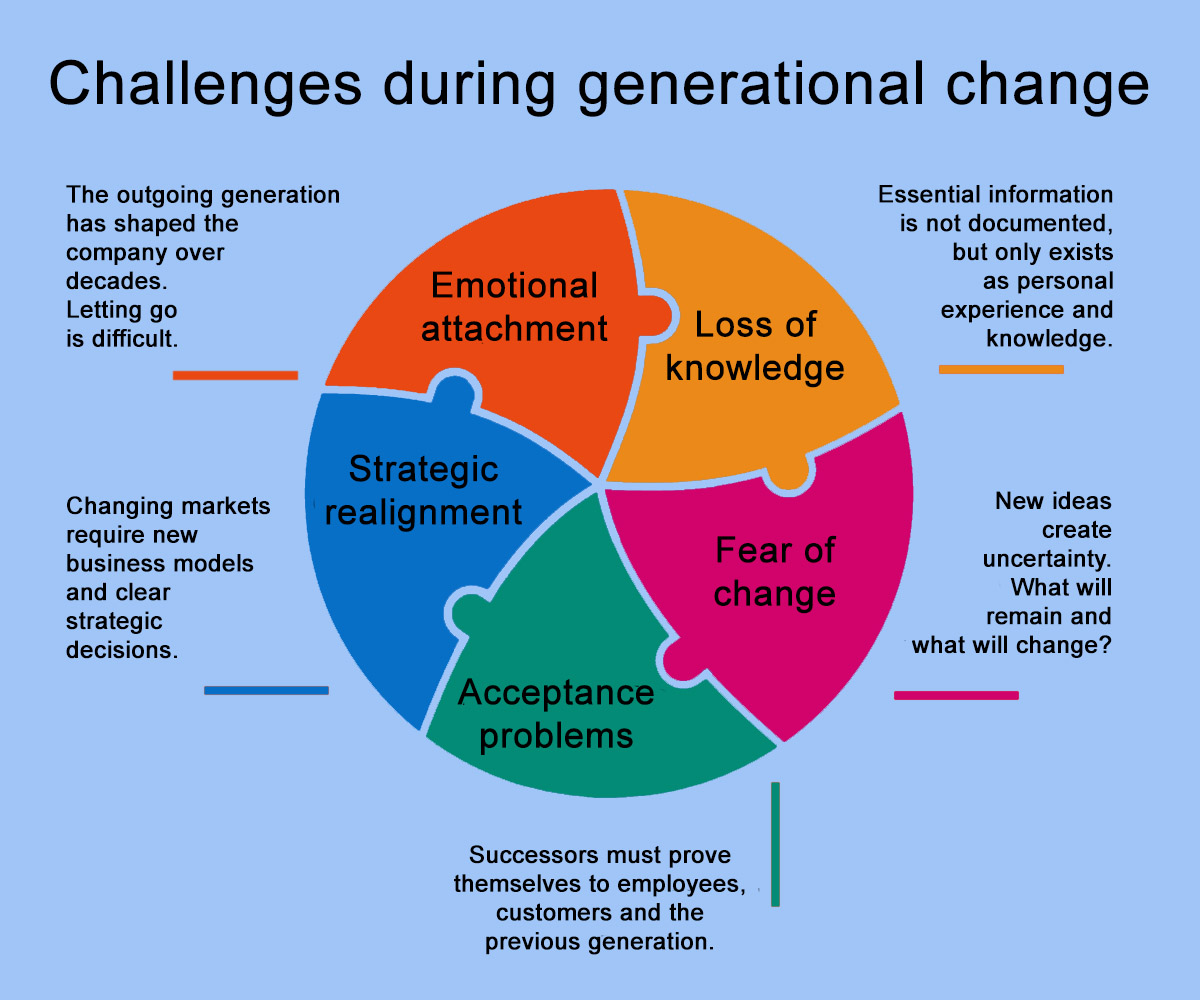
Figure: Challenges during generational change
A look at the practical side: from standstill to realignment
Just how challenging a generational change can be is demonstrated by a medium-sized manufacturing company that was facing precisely this transition. The long-standing owner seemed pensive, almost at a loss. For decades, the business had been stable, but suddenly the orders dried up. When asked why things had gone so well in the past, he said: ‘We had long-standing customers with whom we grew. The orders just came in.’
This statement made it clear that the generational change was not just a question of who would take over, but also of what would be taken over. Was the existing foundation still sufficient to carry the company into the next era?
Together with an experienced consulting team, a systematic analysis was therefore carried out to determine what skills were actually available within the company. Toolmaking, stamping and assembly formed a stable technical foundation, but one that had hardly been used strategically up to that point. During this analysis, not only were resources, processes and market potential examined, but the emotional state of all those involved also became apparent. The owner fluctuated between melancholy and concern, while his successor wavered between respect and a desire to shape the future. This openness made it possible to clearly identify the skills and rethink them.
The key insight was that the company’s strengths were there, but they were not bundled, positioned or used in a market-oriented way. This gave rise to the idea of a competence centre that would bring together technical skills and open up new markets in a targeted manner. It was this bundling that made the strategic realignment possible.
Here is a compact overview of the in-depth analysis:
| Aspect | Core result |
| What was analysed? | Technical expertise, internal resources, processes and market potential of the company. |
| How was the analysis conducted? | Systematic assessment of technical, organisational and cultural factors in close cooperation with a consulting team. |
| Who was involved? | The outgoing generation, successors, advisory team and key employees as knowledge carriers. |
| What was prioritised? | Focus on sustainable strengths, strategically useful skills and realistic market opportunities. |
| What measures have been implemented? | Pooling strengths in a competence centre, targeted development of new markets, strategic realignment, cultural openness and transparent communication. |
This small example shows that generational change rarely succeeds through succession planning alone. It succeeds when existing strengths are consciously made visible, strategically bundled and consistently carried forward into the future.
The emotional core of generational change
Generational change is much more than a strategic or organisational step. It is deeply emotional. For the outgoing generation, it often means letting go of a life’s work that has been built up over decades with passion, courage and perseverance. This farewell affects not only operational responsibility, but also a role that has shaped their identity. Many entrepreneurs report asking themselves: Who am I if I am no longer the boss? This question is not a sign of weakness, but an expression of a deep connection to one’s own company.
At the same time, the step is a great emotional burden for the successors. They have big shoes to fill, want to honour what was, and at the same time go their own way. A tension arises between respect and renewal that can only be overcome with open communication and mutual understanding. Trust becomes a key factor. Trust on the part of the founders in the next generation and their ideas. And trust on the part of the successors in the support of those who have gone before them.
In this sensitive phase, many entrepreneurs are looking not only for technical concepts, but also for a partner who will take responsibility and provide guidance. Good support is based on practical experience, empathy and strategic clarity. It creates space for reflection, for genuine dialogue and for shared visions of the future. In this way, the generational change is not only shaped on paper, but also in the everyday life of the company.
Successful projects show time and again that the transition is particularly successful when it is not viewed as an isolated moment, but as a process. A process that begins early, involves all stakeholders and takes both the emotional and strategic levels into account. Only then can the foundation be laid on which a company can truly sustain the change.
Conclusion: Generational change is not an end, but a beginning
Generational change is much more than a necessary step. It is an opportunity. An opportunity for innovation, growth and cultural renewal that will strengthen the company in the long term. If the transition is consciously designed, a space is created in which experience and future orientation come together. The experience of the founders meets the energy and ideas of their successors. This interaction can give rise to a new course that not only stabilises the company, but also makes it fit for the future.
For this process to succeed, it requires early clarity, open discussions and support that takes both the strategic and emotional levels into account. After all, a generational change is not just about positions, but also about trust, identity and direction. It is not an end, but a moment of new beginnings.
When this transition is successful, the result is an organisation that knows its roots yet is ready to break new ground. An organisation that draws on the combined strength of two generations and boldly looks to the future.
Notes (partly in German):
Would you like to discuss key issues for the future, such as generational change, strategic realignment or market positioning, with Andreas Wagner? Then simply get in touch with him via his website.
[1] Institute for Small Business Research: Business Succession in Germany 2022 to 2026
Demographic change is also bringing knowledge management into sharper focus. Here you will find an article on Knowledge management in transition: concepts for the future.
Would you like to discuss the measurement of corporate culture as a multiplier or opinion leader? Then share this article in your networks.

Andreas Wagner
Andreas Wagner has more than 36 years of management experience in medium-sized family businesses worldwide. His career took him from toolmaker to various management positions and ultimately to the executive board. Along the way, he developed broad expertise in sales, business development and technical innovation.
Today, he supports companies in opening up new markets, developing innovative products and sharpening their strategic focus. He is particularly strong at the interface between technology and sales, as well as in the introduction of modern business processes and AI solutions that significantly increase efficiency and competitiveness.
On the t2informatik blog, we share knowledge and experience with people in organisations. And it is for precisely these people that we have been developing and modernising software since 2012. Pragmatically. ✔️ Personal. ✔️ Professional. ✔️ Get to know t2informatik as your development partner.